December 21, 2021
Mohenjo
Business, Food For Thought, Human Interest, Science, Technical
amazon, business, Business News, current-events, Future, Hotels, human-rights, medicine, mental-health, research, Science, Science News, technology, Technology News, travel, vacation

Click the link below the picture
.
A few days ago, my 4-year-old lifted up her shirt, pointed to her belly, and said, “Mommy, why is my tummy so big?” My heart skipped a beat, and I thought, This can’t be happening already. A moment later it occurred to me that she was probably (hopefully?) asking an innocent question about why the size of her stomach changes throughout the day, but I was nevertheless mortified. Recently my daughter has been asking me more and more whether she’s pretty and if she looks like a princess. She’s clearly getting the message from our society that looks and body size matter—even at the age of 4.
She’s not alone. Research suggests that preschool- and elementary-age children are more dissatisfied with their bodies now than ever before, that girls as young as 3 already perceive heaviness as “bad” and thinness as “good,” and that more than one-third of 5-year-old girls restrict their eating in order to stay thin.
If the pressure to be thin doesn’t seem like a big deal in itself, consider that kids who are dissatisfied with their bodies are more likely than others to become depressed and develop eating disorders or other dangerous habits. We constantly discuss the need to tackle the crisis of childhood obesity, and rightfully so—but we need to remember that more kids today have eating disorders than Type 2 diabetes. Nearly 1 in 3 high school girls, and nearly 1 in 6 high school boys, have disordered eating patterns serious enough to warrant medical help; one study found that 1 in 8 girls have made herself vomit at least once in the past three months.
.
 Illustration by Natalie Matthews-Ramo.
.
.
Click the link below for the article:
.
__________________________________________
December 21, 2021
Mohenjo
Business, Food For Thought, Human Interest, Science, Technical
amazon, business, Business News, current-events, Future, Hotels, human-rights, medicine, mental-health, research, Science, Science News, technology, Technology News, travel, vacation

Click the link below the picture
.
Every day we are expected to make hundreds of decisions and judgements.
These range from small ones, like what to have for breakfast, to big ones like whether to take a new job.
The trouble is that our mental resources are limited – the human mind can only cope with so many things.
Given this huge challenge, we adopt mental shortcuts to function effectively. It is an approach which gets us through life, but which can also limit our growth as people.
Something as simple as thinking about the people we have around us can do a lot to change that and can even help us become more creative.
.
 Getty Images
.
.
Click the link below for the article:
.
__________________________________________
December 21, 2021
Mohenjo
Crime, Food For Thought, Human Interest, Medical, missed News, Political, Science, Technical
amazon, business, Business News, current-events, Future, Hotels, human-rights, medicine, mental-health, research, Science, Science News, technology, Technology News, travel, vacation

.
News You might have missed!
Use your browser or smartphone back arrow (<-) to return to this table for your next selection.
.
__________________________________________
December 20, 2021
Mohenjo
Business, Enthralling, Human Interest, Photographs
amazon, business, Business News, current-events, Future, Hotels, human-rights, medicine, mental-health, research, Science, Science News, technology, Technology News, travel, vacation

Click the link below the picture
.
Djamaa el Djazaïr, also known as the Great Mosque of Algiers, is a mosque in Algiers, Algeria. It houses the world’s tallest minaret and is the third-largest mosque in the world after the Great Mosque of Mecca and Al-Masjid an-Nabawi of Medina in Saudi Arabia.
The construction of the mosque began in August 2012 after the Algerian government’s contract, for 1 billion euros, was won by the China State Construction Engineering Corporation. The design was done by German architects KSP Juergen Engel Architekten and engineers Krebs und Kiefer International and was completed by April 2019. The mosque faced construction delays owing to budgetary concerns due to the falling prices of oil. Around 2,300 workers from China, Algeria, and other African countries were deployed to work on the project. The construction of the mosque was seen by many to serve as a symbol of the reign of long-serving president Abdelaziz Bouteflika.
The mosque sits on a site covering 400,000 m2 (4,300,000 sq ft) and overlooking the Mediterranean Sea. The prayer hall has a capacity of 37,000 worshippers, while the structure including the compound can house up to 120,000 worshippers and has parking space for 7,000 cars. The complex also houses a Quran(قرآن) school, a park, a library, staff housing area, a fire station, a museum of Islamic art, and a research center on the history of Algeria.
The mosque also has a 265 m (869 ft) tall minaret, which makes it the tallest building in Africa. It also houses an observation deck atop the minaret, which has 37 floors. The mosque is designed to withstand an earthquake of magnitude 9.0 and the structure has been specially processed to resist corrosion. The main prayer hall has 618 octagonal columns serving as support pillars and 6 km (3.7 mi) of calligraphic writing engraved with a laser system. The dome of the prayer hall has a diameter of 50 m (160 ft) and rises to a height of 70 m (230 ft). Wikipedia
.
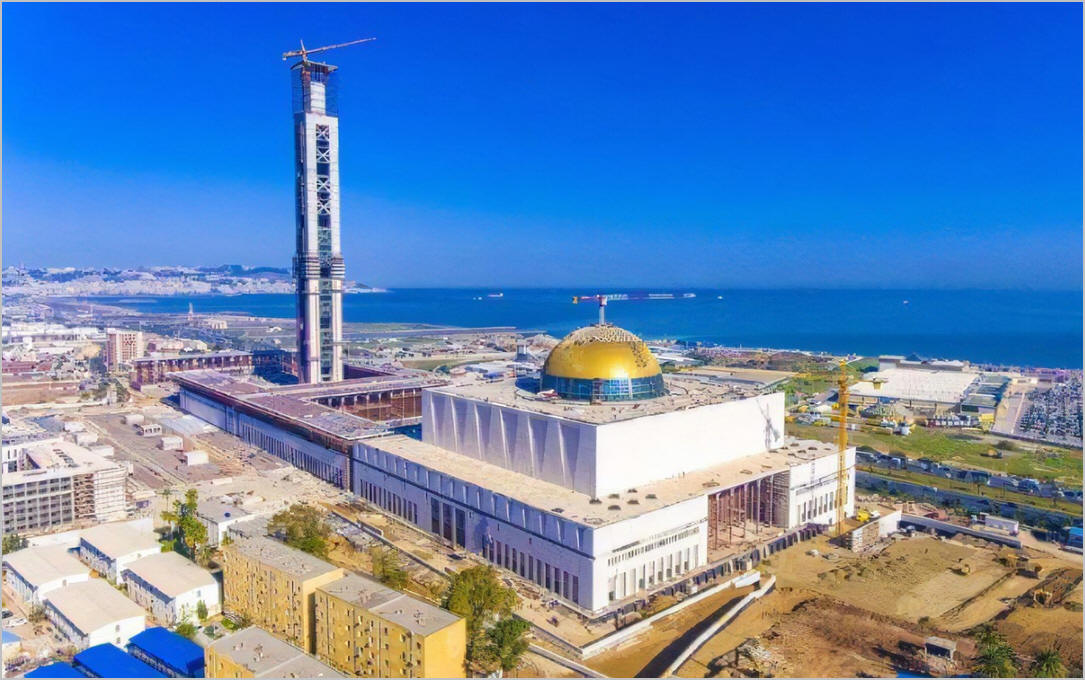 An image of Djamaâ El Djazaïr
.
.
Click the link below for images:
.
__________________________________________
December 20, 2021
Mohenjo
Business, Food For Thought, Human Interest, Science, Technical
amazon, business, Business News, current-events, Future, Hotels, human-rights, medicine, mental-health, research, Science, Science News, technology, Technology News, travel, vacation

Click the link below the picture
.
Astronomers working with the European Southern Observatory’s (ESO) Very Large Telescope say there are two supermassive black holes that are likely to merge into one “monster” black hole—and not far from Earth.
These black holes were observed in NGC 7727, a galaxy just 89 million light-years from the Milky Way. (Remember that the Alpha Centauri system is just four light-years away, so 89 million light-years is only close in a relative sort of way for space.) They’re disparate in size and very huge at 154 million and 6.3 million times the size of the sun.
The ESO is headquartered in Germany and represents dozens of European nations, but its telescopes are in the Southern Hemisphere, all in northern Chile. The Very Large Telescope (yes, that’s its real name) is specifically based in Paranal, Chile. Researchers from all over the world are able to collaborate on data gathered through the Very Large Telescope, but they’re even more excited for the opening of the Extremely Large Telescope by 2030.
For this new research, upcoming in the journal Astronomy & Astrophysics, the Very Large Telescope got an assist from other entities in nearby space. The two black holes are at the center of their galaxy, and because they’re so relatively close to Earth, lead author Karina Voggel (an astronomer at the Strasbourg Observatory in France) and her team were able to measure the black holes’ effects on the surrounding stars. Then, they used that data to extrapolate the existence of the two black holes.
.

draco-zlatGetty Images
.
.
Click the link below for the article:
.
__________________________________________
December 20, 2021
Mohenjo
Business, Food For Thought, Human Interest, Science, Technical
amazon, business, Business News, current-events, Future, Hotels, human-rights, medicine, mental-health, research, Science, Science News, technology, Technology News, travel, vacation

Click the link below the picture
.
Moving about isn’t meant to hurt. If you have normal range of motion, you should be able to stand, squat, walk, bend down, and reach over your head without any real effort or pain—and without having to warm up.
I’ve been working hard on moving better. I’ve gone from having shin splints and sore ankles when I run to bashing out 10Ks happy as anything. It takes a bit of work, but there’s a lot you can do to improve. And it doesn’t matter where you’re starting out, either.
“The body is robust, tolerant, and antifragile,” explains Kelly Starrett, a doctor of physical therapy and co-author of best-selling movement book, Becoming a Supple Leopard. “The resting state of the human being is pain-free.”
Unfortunately, the body has a use-it-or-lose-it policy. If you spend hours sitting at work each day, your hip flexors, hamstrings, and even the joints themselves will stiffen, potentially leading to back or knee pain, and trouble walking. If you don’t ever squat down on your haunches, your body will gradually lose the ability to do so. And too much typing or other computer use can impact your entire upper body.
.
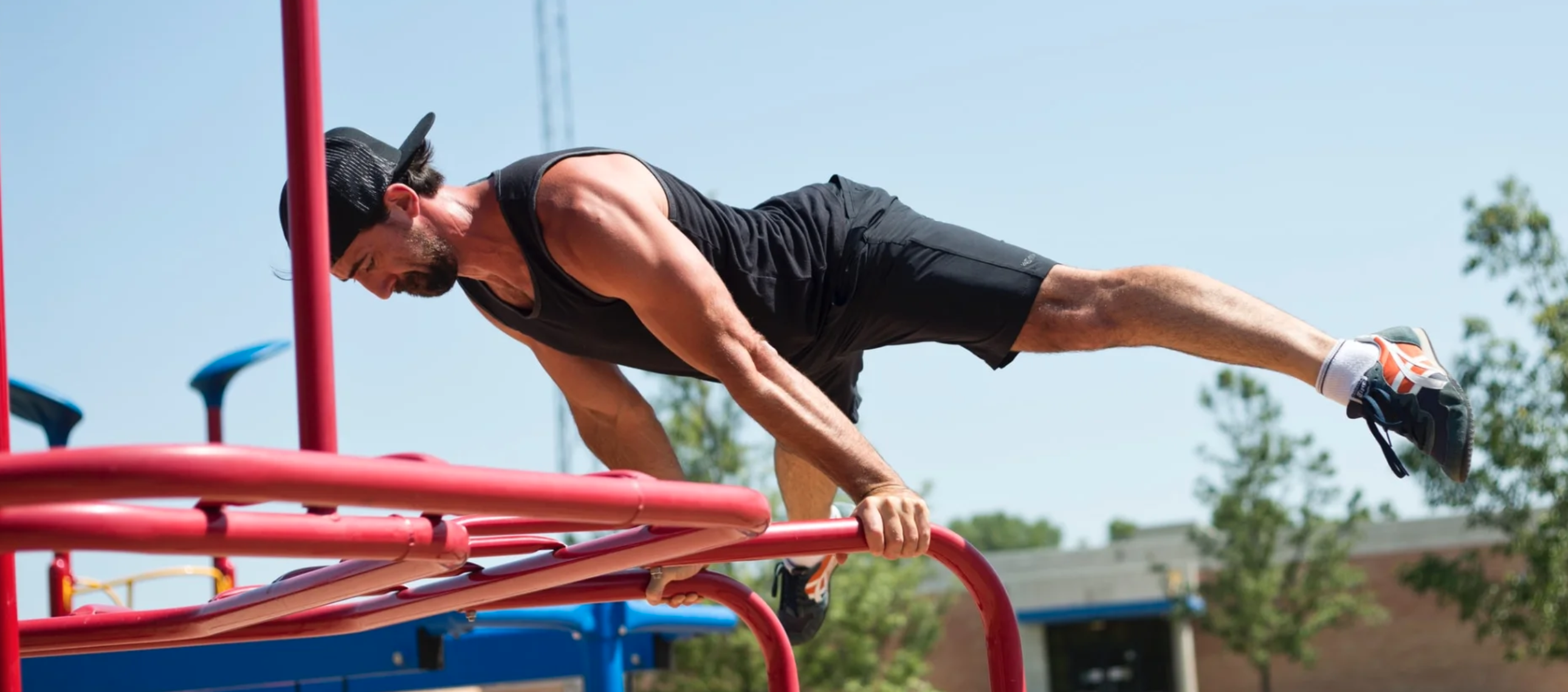 Yeah, being able to do this is cool and all, but walking over to the playground is progress, too. GMB Fitness/Unsplash
.
.
Click the link below for the article:
.
__________________________________________
December 20, 2021
Mohenjo
Crime, Food For Thought, Human Interest, Medical, missed News, Political, Science, Technical
amazon, business, Business News, current-events, Future, Hotels, human-rights, medicine, mental-health, research, Science, Science News, technology, Technology News, travel, vacation
.
News You might have missed!
Use your browser or smartphone back arrow (<-) to return to this table for your next selection.
.
__________________________________________
December 19, 2021
Mohenjo
Business, Food For Thought, Human Interest, Science, Technical
amazon, business, Business News, current-events, Future, Hotels, human-rights, medicine, mental-health, research, Science, Science News, technology, Technology News, travel, vacation

Click the link below the picture
.
Marine ecologist Piper Wallingford was doing fieldwork on the rocky shore of Laguna Beach, California, in 2016 when she noticed a dime-sized creature she’d never seen before. It was a dark unicorn snail, a predator that drills into mussels and injects an enzyme that liquefies their flesh. “Then,” Wallingford explains, “they basically suck it out like soup.”
The animal is native to the Mexican state of Baja California, Wallingford later learned, and it’s been migrating up the coast over the last few decades in search of new habitat, eating into local mussel populations along the way. It’s also one of countless species around the world — from white-tailed deer to lobsters to armadillos to maple trees — that are moving with the climate.
Ecologists expect climate change to create mass alterations in the habitats of these “range-shifting” or “climate-tracking” species, as they’re sometimes called, which will reshuffle ecosystems in ways that are hard to predict. The migrations are critical to species’ ability to survive hotter temperatures.
.
:format(webp)/cdn.vox-cdn.com/uploads/chorus_image/image/70200795/dark_unicorn.0.jpeg) A dark unicorn snail in Dana Point, California, in September 2021.Eric Johnson/iNaturalist
A dark unicorn snail in Dana Point, California, in September 2021.Eric Johnson/iNaturalist
.
.
Click the link below for the article:
.
__________________________________________
December 19, 2021
Mohenjo
Business, Food For Thought, Human Interest, Science, Technical
amazon, business, Business News, current-events, Future, Hotels, human-rights, medicine, mental-health, research, Science, Science News, technology, Technology News, travel, vacation

Click the link below the picture
.
There are seasons in life when a 15-minute walk is the most you can commit to your exercise routine—and, hey, that’s 100 percent okay. Maybe your job is more of a nine to nine than a nine to five right now, or childcare is monopolizing your free moments. Whatever the case, we asked a cardiologist to answer the age-old question is walking enough exercise? And the first thing you need to know is that the simple answer is yes.
.
According to Michael Weinrauch, MD, a New Jersey-based cardiologist, the bottom line is that even the smallest neighborhood loop can have an immense impact on your health and well-being. “The take-home point here is that even 15 minutes a day of walking, without stopping, provides benefit with regards to cardiovascular morbidity and mortality,” he says. Morbidity refers to illness or disease, while mortality refers to death. Research has associated 15 minutes of activity with a 22 percent lower risk of death (mortality), and walking with a 43 percent reduced risk in stroke and reduction the risk factors of heart attack (morbidity), regardless of how fast your heart is beating. “Keep in mind, most of the research that has been done on the benefits of walking have been done without monitoring heart rates during physical activity. Remember, the Fitbit and smartwatch apps are still actually a relatively new phenomenon,” adds Dr. Weinrauch. Long story, short: The morbidity and mortality benefits of walking seem to occur regardless of your heart’s beats per minute (BPMs).
.
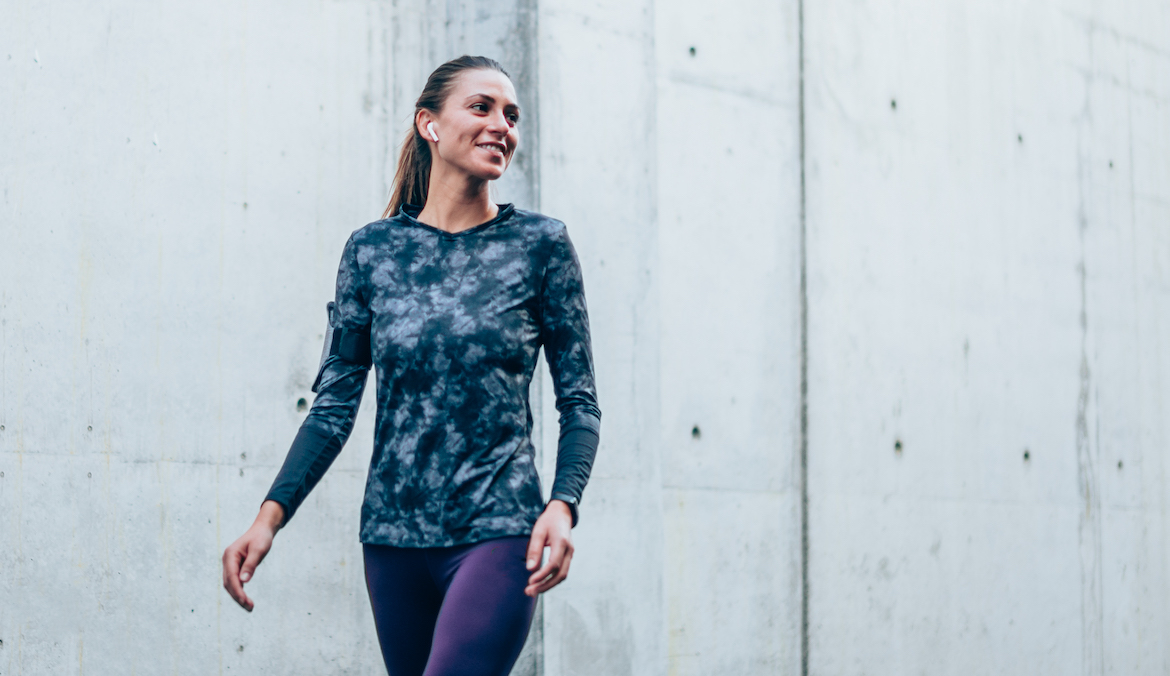 Photo: Getty Images/VioletaStoimenova
.
.
Click the link below for the article:
.
__________________________________________
December 18, 2021
Mohenjo
Business, Enthralling, Human Interest, Photographs
amazon, business, Business News, current-events, Future, Hotels, human-rights, medicine, mental-health, research, Science, Science News, technology, Technology News, travel, vacation
Click the link below the picture
.
The Cabo Blanco Absolute Natural Reserve is a Nature Reserve of Costa Rica, part of the Tempisque Conservation Area in the province of Puntarenas, covering an area of 3,140 acres (12.7 km2) terrestrial and 4,420 acres (17.9 km2) marine on the southern tip of the Nicoya Peninsula near Montezuma-Cabuya and Mal Pais.
The site is home to the San Miguel Biological Station which was developed to promote and support teaching, research, and environmental education and has facilities that include classrooms, laboratories, and a reference library. The reserve was created in 1963 due to a campaign started by Olof Wessberg and was the first major conservation project in the country.
Up to the 1960s the lands that now constitute the Cabo Blanco Nature Reserve were being depleted of their natural forests for use as farm and pasture land. The emphasis in those days was to develop and increase agricultural production and cattle, and little concern was given to conservation of natural habitats.
Olof Wessberg (known as Nicolas) and Karen Mogensen arrived in Costa Rica in the 1960s in the pursuit of Karen’s dream of finding happiness in harmony with nature. They chose to establish themselves in the Nicoya Peninsula.
Soon after establishing themselves in a farm near the Montezuma area, they set up on an expedition to the Cabo Blanco area in search for native tree seeds to reforest their newly acquired farm. Upon arriving to the area, he was amazed at the abundant wildlife and the size of the trees in the area. This was like an oasis in the midst of a desert as all lands around had been devastated to give way to low-yield pasture and agricultural lands. Wikipedia
.
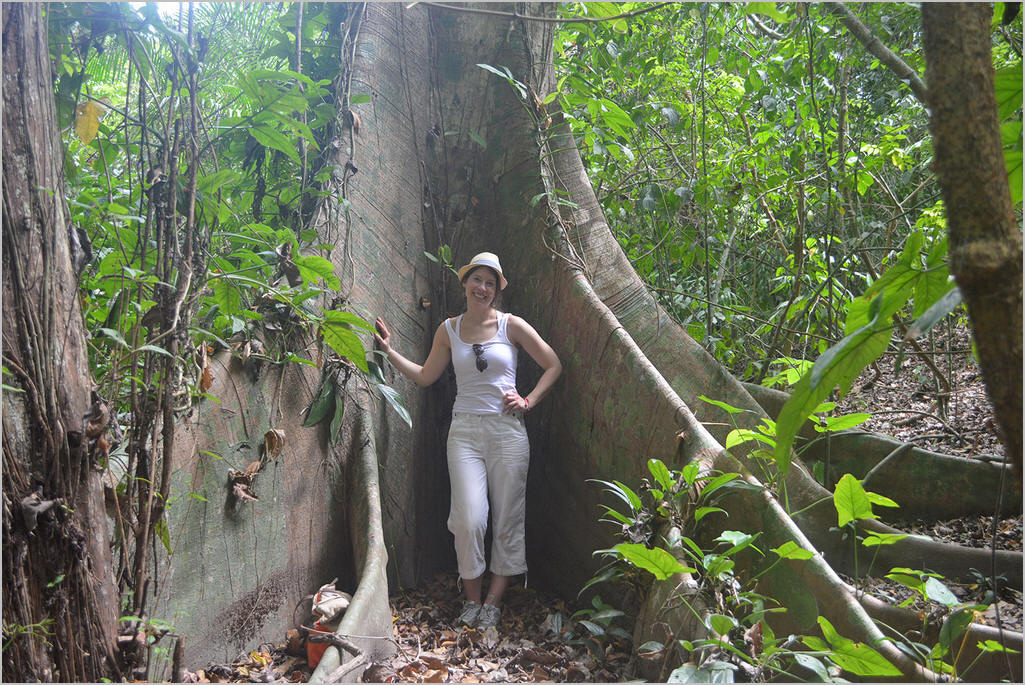 An image from CaboBlanco Absolute Natural Reserve Costa Rica
.
.
Click the link below for images:
.
__________________________________________
Older Entries
Newer Entries

