Woolly mammoths won’t be trouncing through the Arctic tundra anytime soon.
Contrary to recent headlines, which herald the extinct beast’s coming resurrection, scientists are still a long way from figuring out how to revive the elephant ancestor.
Woolly mammoths roamed the planet for hundreds of thousands of years before they vanished about 4,000 years ago. Paleontologists say the culprit for the die-off was possibly overhunting, or changes in mammoth’s food supply after the last Ice Age.
A camp of scientists — known as “revivalists” — are dedicated to bringing mammoths back in the modern era for environmental and biological reasons. Some researchers have made important early progress, although nothing is close to leaving the lab.
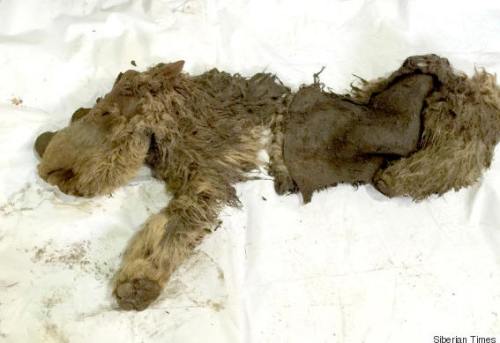
Scientists are going gaga over the recent discovery of a baby woolly rhino.
The pristine specimen of the tiny extinct rhino–the only one of its type ever found–was discovered in permafrost along the bank of a stream in Siberia’s Sakha Republic, The Siberian Times reported.
“At first we thought it was a reindeer’s carcass, but after it thawed and fell down we saw a horn on its upper jaw and realized it must be a rhino,” Alexander ‘Sasha’ Banderov, the hunter who made the discovery, told the Times. “The part of the carcass that stuck out of the ice was eaten by wild animals, but the rest of it was inside the permafrost and preserved well.”
.
(Academy of Sciences Republic of Sakha/Siberian Times)
You never know what’s lying just beneath the surface in your own yard.
Most people find some old coins or a rusty bicycle chain. But two men in Michigan hit the jackpot when they discovered the remains of a massive Ice Age mammal.
Contractor Daniel LaPoint Jr. was working in Eric Witzke’s Bellevue, Mich., yard when he noticed a giant rib sticking out of the ground, according to the Lansing State Journal. Over four days in November, the two worked together to pull 42 bones out of the ground.
.
Mastodon Bones
.
.
Click link below for story, video, photos and slideshow:
A thin disk of dark matter running through the Galaxy might be behind the large meteorite strikes that are thought to be responsible for some of Earth’s mass extinctions, including that of the dinosaurs, two theoretical physicists have proposed.
The model is based on a hypothetical form of dark matter described by the authors and their collaborators last year as a means to solve a separate cosmic conundrum. The existence of such a ‘dark disk’ could be tested soon by astronomical observations.
Mario Livio, an astrophysicist at the Space Telescope Science Institute in Baltimore, Maryland, who was not involved in the research, says that the latest idea, which brings together two speculative and very different theories, is “very interesting”, even if the evidence supporting it is far from compelling.
The earliest, now-extinct human lineages, once thought to be multiple species, may actually have been one species, researchers now controversially suggest.
Modern humans, Homo sapiens, are the only living member of the human lineage, Homo, which is thought to have arisen in Africa about 2 million years ago at the beginning of the ice age, also referred to as the Pleistocene Epoch. Many extinct human species were thought to once roam the Earth, such as Homo habilis, suspected to be among the first stone-tool makers; the relatively larger-brained Homo rudolfensis; the relatively slender Homo ergaster; and Homo erectus, the first to regularly keep tools it made.
To learn more about the roots of the human family tree, scientists investigated a completely intact, approximately 1.8-million-year-old skull excavated from the medieval hilltop town of Dmanisi in the Republic of Georgia. Archaeological excavations there about 30 years ago unexpectedly revealed that Dmanisi is one of the oldest-known sites for ancient human species out of Africa and the most complete collection of Homo erectus skulls and jaws found so far. The world’s largest, extinct cheetah species once lived in the area, and scientists cannot rule out whether it fed on these early humans.
.
An artist’s conception revealing what “Skull 5” may have looked like some 1.8 million years ago when he (the scientists suspect the remains come from a male) lived.
This is one ancient whale of a tale! An international team of scientists from the National Museums Scotland and the Universities of Glasgow and Edinburgh have completed a years-long project to excavate and assemble the most complete fossil of the world’s largest prehistoric fish.
The specimen suggests that Leedsichthys problematicus grew to a full size of around 50 feet long, twice that of previous estimates, according to a written statement from the University of Glasgow.
The massive fish must have cast an impressive shadow as it swam through the seas about 165 million years ago. With a bony physique, Leedsichthys pioneered an important ecological niche: It was the first of the giant plankton-feeders, whose modern-day equivalents today include the behemoth whale shark.
Research team leader Dr. Jeff Liston of the National Museums of Scotland told The Huffington Post in an email that several significant conclusions can be drawn from the Leedsichthys discovery.
Researchers have reconstructed the structure of 4-billion-year-old proteins.
The primeval proteins, described today (Aug. 8) in the journal Structure, could reveal new insights about the origin of life, said study co-author José Manuel Sanchez Ruíz, a physical chemist at the University of Granada in Spain.
Exactly how life emerged on Earth more than 3 billion years ago is a mystery. Some scientists believe that lightning struck the primordial soup in ammonia-rich oceans, producing the complex molecules that formed the precursors to life. Others believe that chemical reactions at deep-sea hydrothermal vents gave rise to cell membranes and simple cellular pumps. And still others believe that space rocks brought the raw ingredients for life — or perhaps even life itself — to Earth.
But it’s difficult to recreate events that happened so far in the distant past.
.
The individual molecules within early Earth’s primordial soup that form the basis of life likely developed in response to natural selection.
Mexican paleontologists say they have uncovered 50 vertebrae believed to be a full dinosaur tail in the northern desert of Coahuila state.
The National Institute of Anthropology and History says the tail is about 15 feet (5 meters) long and resembles that of a hadrosaur or crested duckbill dinosaur.
An institute Monday says it’s not yet possible to confirm the species, but it would be the first full tail of that kind in Mexico.
Paleontologist Felisa Aguilar says they uncovered roughly half of the dinosaur, which was 36 feet (12 meters) long and lived about 72 million years ago.
The excavation took 20 days in the municipality of General Cepeda in the northern state that borders Texas.
.
Paleontologists are working to uncover the tail of a dinosaur at a dig site near the town of General Cepeda in northern Mexico. (AP Photo/INAH-Mauricio Marat)
A new fossilized, cigar-shaped creature that lived about 520 million years ago has been unearthed in Morocco.
The newfound species, Helicocystis moroccoensis, has “characteristics that place it as the most primitive echinoderm that has fivefold symmetry,” said study co-author Andrew Smith, a paleontologist at the Natural History Museum in London, referring to the group of animals that includes starfish and sea urchins. Modern echinoderms typically have five-point symmetry, such as the five arms of the starfish or the sand dollar’s distinctive pattern.
The primitive sea creature, described today (June 25) in the journal Proceedings of the Royal Society B, could even change its body shape from slender to stumpy. Researchers say it is a transitional animal that could help explain how early echinoderms evolved their unique body plans, Smith said.
.
During the Cambrian explosion, the diversity of life exploded and bizarre sea creatures such as the Helcocystis moroccoensis flourished.
.
.Click link below for story, video, and slideshow:
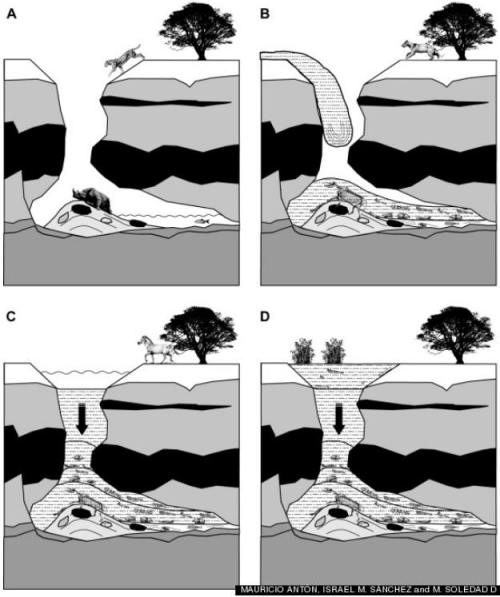
A cavern in Spain may have lured ancient carnivores to their deaths by offering the promise of food and water, new research suggests.
The new study, published May 1 in the journal PLOS ONE, may explain how the carcasses of several carnivore species, including saber-toothed cats and “bear dogs,” wound up in an underground cavern millions of years ago.
“Only the carnivores were daring enough to enter,” said study co-author M. Soledad Domingo, a paleontologist at the University of Michigan. “But they were unable to make their way out.”
.
Hyena skeleton found in Spanish cave. Researchers carefully analyzed the type, age, and orientation of fossils like this one to figure out what happened to ancient carnivores.
The researchers reconstructed the history of the cave. Sediments from the surface fell through fissures in the Earth and formed the cave. Young predators were lured in by the promise of food or water, but became trapped. The smell of their rotting carcasses would then attract other predators. Over time, the cave was filled in by flooding, until it became hidden from view.
.
.Click link below for story, slideshow, and video:
Film and Writing Festival for Comedy. Showcasing best of comedy short films at the FEEDBACK Film Festival. Plus, showcasing best of comedy novels, short stories, poems, screenplays (TV, short, feature) at the festival performed by professional actors.

 (Academy of Sciences Republic of Sakha/Siberian Times)





 James' World 2