Researchers in Florence, Italy, are opening a centuries-old family tomb in hopes of solving one of the art world’s most pressing mysteries. The tomb in question belongs to the family of Lisa Gherardini, the 16th century Florentine woman thought to have been the face of Leonardo da Vinci’s “Mona Lisa.”
According to NBC, a team of specialists have begun a series of DNA tests on three different skeletons found in an Ursuline convent in Florence. The bones were originally discovered in 2012 and are believed to include the remains of Gherardini, the wife of a merchant who at one point lived across the street from da Vinci.
Now, researchers are turning to the Gherardini family tomb, located in Florence’s Basilica della Santissima Annuziata, where they hope to excavate the skeletons of the supposed muse’s sons. The experts plan on comparing DNA evidence from the convent excavation to the bones in the basilica in order to verify that they indeed have access to Mrs. Gherardini’s remains.
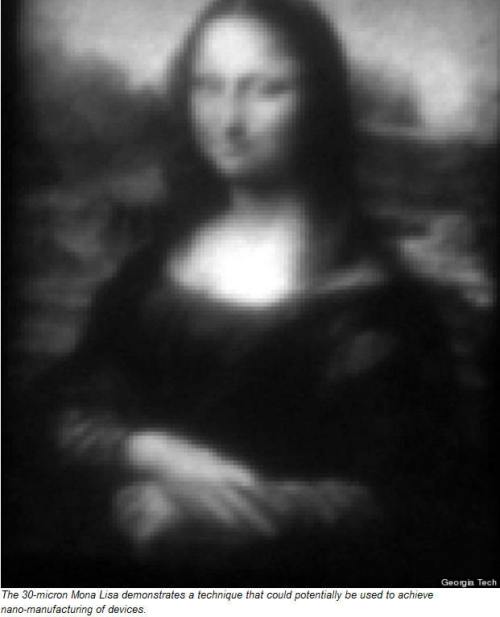
The enigmatic image is perhaps the most reproduced in art history, but it’s never before been painted on such a small canvas.
Using a novel nanotechnique, researchers have made a miniature Mona Lisa that stretches 30 microns across, just a third of the width of a human hair.
A team from Georgia Tech created the molecular masterpiece using an atomic force microscope and a process dubbed ThermoChemical NanoLithography, or TCNL for short.
Each 125-nanometer pixel of the “Mini Lisa” represents a confined set of chemical reactions. The technique allowed the researchers to control the amount of heat applied over each pixel to vary the number of new molecules created in each spot. More heat resulted in more molecules and lighter shades of gray. In this way, the team made the tiny copy of Leonardo da Vinci’s most famous work, pixel by pixel.
The Mona Lisa is arguably the most famous painting in the world. Have you ever wondered why? Leonardo Da Vinci was masterful at manipulating our own visual shortcomings to make us feel something beautiful, complicated, even unsettling. There’s just something about her smile.
Dr. Margaret Livingstone, a visual neurophysiologist at Harvard, knows this all too well. I recently spoke with her about how our visual systems have evolved to process one of the inventions that sets us apart from non-human animals–art.
.
.
.Click link below for story, video, and slideshow:
Film and Writing Festival for Comedy. Showcasing best of comedy short films at the FEEDBACK Film Festival. Plus, showcasing best of comedy novels, short stories, poems, screenplays (TV, short, feature) at the festival performed by professional actors.




 James' World 2