May 29, 2021
Mohenjo
Business, Food For Thought, Human Interest, Science, Technical
amazon, business, Business News, current-events, Future, Hotels, human-rights, medicine, mental-health, research, Science, Science News, technology, Technology News, travel, vacation

Click the link below the picture
.
With the caye split into two and corals smashed into rubble, the underwater world at Laughing Bird Caye National Park off the coast of Belize looked nothing like the vibrant and colorful place that had thrived with life before Hurricane Iris swept across it in 2001. The storm left the water murky and muddy while rotting dead creatures washed ashore.
When Lisa Carne first visited the island in 1994, there were so many large, bright reddish-orange interlocking elkhorn corals that she could hardly swim through or around them. The reef was abundant in fish, corals, lobsters, crabs, sponges, and sea turtles. But after the hurricane, all of this was destroyed. With only a few surviving corals, the scene looked more like a graveyard.
It was not the first time Carne had seen a dead reef. In 1995, she moved full-time to Belize from California and volunteered as a research assistant at Carrie Bow Cay, a Smithsonian field station. She witnessed the effects of the first coral bleaching event in Belize, home to the second-longest barrier reef in the world. Bleaching events leave the structure of corals intact, but strip it of the algae that live in an endosymbiotic relationship with the coral polyps. Some coral recover from such events as the algae returns, although many die.
.

By Veronika Perkova 4th May 2021
.
.
Click the link below for the article:
.
__________________________________________
May 29, 2021
Mohenjo
Business, Crime, Human Interest, Technical
amazon, business, Business News, current-events, Future, Hotels, human-rights, medicine, mental-health, research, Science, Science News, technology, Technology News, travel, vacation

Click the link below the picture
.
Danielle Churchill needed help. She was raising five children in Wollongong, on the Australian coast south of Sydney, and had to cover thousands of dollars in special therapy fees for her 10-year-old son, Lachlan, who has autism. She tried crowdfunding on the site GoFundMe but raised just a tiny fraction of what she had hoped for.
Late last year, she received the message that seemed to solve her financial problems. It was purportedly an email from the billionaire philanthropist MacKenzie Scott, a novelist best known as the ex-wife of Jeff Bezos, the Amazon founder, saying that she was giving away half her fortune and that Ms. Churchill had qualified for a grant.
Ms. Churchill searched Google for Ms. Scott’s name and the word “scam.” Instead of warnings, she found numerous news articles describing how Ms. Scott’s representatives had emailed hundreds of nonprofit groups out of the blue with offers of monetary support.
“People were thinking they were scams, but then they came true,” Ms. Churchill, 34, recalled thinking.
.
 MacKenzie Scott
.
.
Click the link below for the article:
.
__________________________________________
May 29, 2021
Mohenjo
Food For Thought, Human Interest, Medical, missed News, Political, Science, Technical
amazon, business, Business News, current-events, Future, Hotels, human-rights, medicine, mental-health, research, Science, Science News, technology, Technology News, travel, vacation

.
News You might have missed!
Use your browser or smartphone back arrow (<-) to return to this table for your next selection.
.
__________________________________________
May 28, 2021
Mohenjo
Business, Enthralling, Human Interest, Photographs
amazon, business, Business News, current-events, Future, Hotels, human-rights, medicine, mental-health, research, Science, Science News, technology, Technology News, travel, vacation

Click the link below the picture
.
Praia do Castelo is a beach close to the village resort of Sesmarias which is within the Municipality of Albufeira, in the Algarve, Portugal. This beach is located 4.0 miles (6.4 km) by road to the west of Albufeira old town center and is 31.9 miles (51.3 km) west of the regions capital of Faro. This beach is one of the blue flag beaches (2012) in the Algarve.
Praia do Castelo or Castle Beach is in fact made up of one main beach and several small satellite beaches and coves. The main beach is small and made up of gold sand and is 200.00 meters (656.17 ft) long and is sheltered by 30 feet (9.1 m) high jagged cliffs. Spreading in each direction from the main beach are several small coves, interspersed by rocky outcrops. The beach gets its name from the Watchtower which once stood here. The watchtower was built in the mid-16th century to monitor this stretch of the coast for attacks by Barbary pirates coming from North Africa. The remains of this watchtower can be found close to the access point to the beach. Wikipedia
.
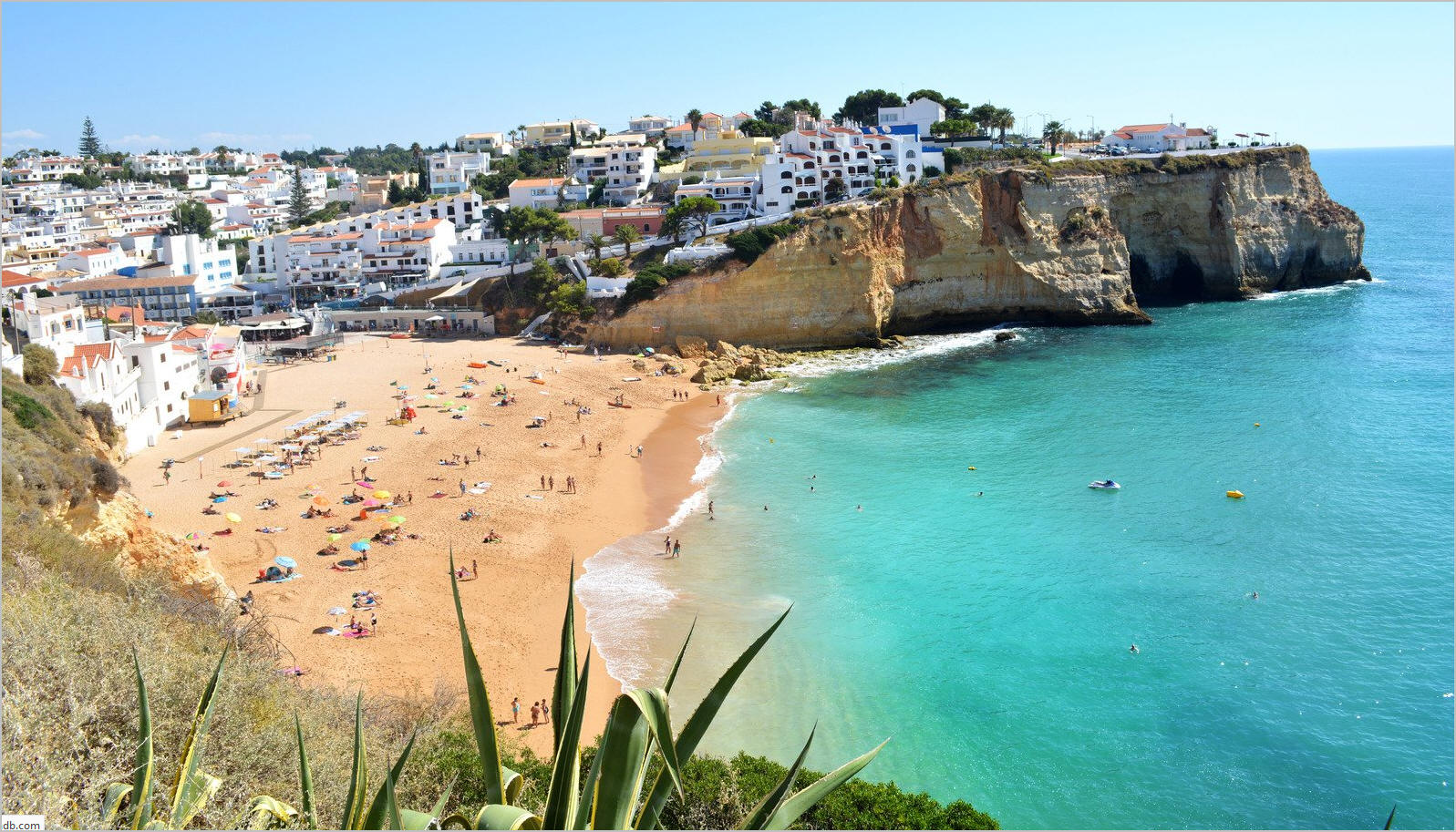 An image from Praia do Castelejo, Portugal
.
.
Click the link below for images:
.
__________________________________________
May 28, 2021
Mohenjo
Business, Human Interest, Science, Technical
amazon, business, Business News, current-events, Future, Hotels, human-rights, medicine, mental-health, research, Science, Science News, technology, Technology News, travel, vacation

Click the link below the picture
.
Shortages of semiconductors are battering automakers and tech giants, raising alarm bells from Washington to Brussels to Beijing. The crunch has raised a fundamental question for policymakers, customers, and investors: Why can’t we just make more chips?
There is both a simple answer and a complicated one. The simple version is that making chips is incredibly difficult—and getting tougher.
“It’s not rocket science—it’s much more difficult,” goes one of the industry’s inside jokes.
The more complicated answer is that it takes years to build semiconductor fabrication facilities and billions of dollars—and even then the economics are so brutal that you can lose out if your manufacturing expertise is a fraction behind the competition. Former Intel Corp. boss Craig Barrett called his company’s microprocessors the most complicated devices ever made by man.
This is why countries face such difficulty in achieving semiconductor self-sufficiency. China has called chip independence a top national priority in its latest five-year plan, while U.S. President Joe Biden has vowed to build a secure American supply chain by reviving domestic manufacturing. Even the European Union is mulling measures to make its own chips. But success is anything but assured.
.
 A robot arm feeds silicon wafers into a chipmaking machine. Video: Adam Glanzman/Bloomberg
.
.
Click the link below for the article:
.
__________________________________________
May 28, 2021
Mohenjo
Business, Food For Thought, Human Interest, Science, Technical
amazon, business, Business News, current-events, Future, Hotels, human-rights, medicine, mental-health, research, Science, Science News, technology, Technology News, travel, vacation

Click the link below the picture
.
How much energy does an industry deserve to consume? Right now, organizations around the world are facing pressure to limit the consumption of non-renewable energy sources and the emission of carbon into the atmosphere. But figuring out how much consumption is too much is a complex question that’s intertwined with debates around our priorities as a society. The calculation of which goods and services are “worth” spending these resources on, after all, is really a question of values. As cryptocurrencies, and Bitcoin, in particular, have grown in prominence, energy use has become the latest flashpoint in the larger conversation about what, and who, digital currencies are really good for.
On the face of it, the question about energy use is a fair one. According to the Cambridge Center for Alternative Finance (CCAF), Bitcoin currently consumes around 110 Terawatt Hours per year — 0.55% of global electricity production, or roughly equivalent to the annual energy draw of small countries like Malaysia or Sweden. This certainly sounds like a lot of energy. But how much energy should a monetary system consume?
.

HBR Staff/Tetiana Lazunova/Getty Images
.
.
Click the link below for the article:
.
__________________________________________
May 28, 2021
Mohenjo
Crime, Food For Thought, Human Interest, Medical, missed News, Political, Science, Technical
amazon, business, Business News, current-events, Future, Hotels, human-rights, medicine, mental-health, research, Science, Science News, technology, Technology News, travel, vacation
.
News You might have missed!
Use your browser or smartphone back arrow (<-) to return to this table for your next selection.
.
__________________________________________
May 27, 2021
Mohenjo
Business, Enthralling, Human Interest, Photographs
amazon, business, Business News, current-events, Future, Hotels, human-rights, medicine, mental-health, research, Science, Science News, technology, Technology News, travel, vacation
Click the link below the picture
.
Querétaro, formally Querétaro de Arteaga, officially the Free and Sovereign State of Querétaro de Arteaga, is one of the 32 federal entities of Mexico. It is divided into 18 municipalities. Its capital city is Santiago de Querétaro. It is located in North-Central Mexico, in a region known as Bajío. It is bordered by the states of San Luis Potosí to the north, Guanajuato to the west, Hidalgo to the east, México to the southeast, and Michoacán to the southwest.
The state is one of the smallest in Mexico, but it is also one of the most heterogeneous geographically, with ecosystems varying from deserts to tropical rainforests, especially in the Sierra Gorda, which is filled with microecosystems. The area of the state was located on the northern edge of Mesoamerica, with both the Purépecha Empire and Aztec Empire having influence in the extreme south, but neither really dominating it. The area, especially the Sierra Gorda, had a number of small city-states, but by the time the Spanish arrived, these had all been abandoned, with only small agricultural villages and seminomadic peoples inhabiting the area. Spanish conquest was focused on the establishment of the Santiago de Querétaro, which still dominates the state culturally, economically, and educationally. Wikipedia
.
 An image from Queretaro, Qro., Mexico
.
.
Click the link below for images:
.
__________________________________________
May 27, 2021
Mohenjo
Business, Food For Thought, Human Interest, Political, Technical
amazon, business, Business News, current-events, Future, Hotels, human-rights, medicine, mental-health, research, Science, Science News, technology, Technology News, travel, vacation

Click the link below the picture
.
Like many Jews on Christmas Eve, Jordan Frazes was bored. She didn’t have the option to meet up with friends or hit up a Chinese restaurant; the pandemic kept her sequestered at home in Chicago with her parents. So when she got a notification about a “Matzo Ball” room on the audio app Clubhouse, she tapped in to join. “It became this hysterical thing where you’re talking to strangers, but it feels really comfortable,” she says; she stuck around for six or seven hours. Since then, Frazes and a growing cohort of Jews—from around the world and from all denominations—have built an unusually focused and education-oriented community on the app, where thousands of listeners and speakers tune in regularly for events like weekly Shabbat, hours-long talks from Holocaust survivors and even a celebrity-studded Passover Seder with guests like Jeff Garlin and Ari Melber.
Frazes considers herself culturally Jewish but not particularly observant. Still, she is aware of the crisis of anti-Semitism spiking around the world: anti-Semitic attacks reached a near all-time high in 2020 according to the Anti-Defamation League, which tracked over 2,000 incidents of anti-Semitism in the U.S. alone. Experts link the rise to a lack of education about Judaism and Jewish history. A 2020 survey showed a troubling decline in Gen Z and Millennial knowledge about the facts of the Holocaust; as many as 63% of U.S. respondents did not know that six million Jews were killed, and 11% believed Jews caused the Holocaust.
.

A Global Jewish Community
.
.
Click the link below for the article:
.
__________________________________________
May 27, 2021
Mohenjo
Business, Human Interest
amazon, business, Business News, current-events, Future, Hotels, human-rights, medicine, mental-health, research, Science, Science News, technology, Technology News, travel, vacation

Click the link below the picture
.
In December 1968, the ecologist and biologist Garrett Hardin had an essay published in the journal Science called ‘The Tragedy of the Commons’. His proposition was simple and unsparing: humans, when left to their own devices, compete with one another for resources until the resources run out. ‘Ruin is the destination toward which all men rush, each pursuing his own best interest,’ he wrote. ‘Freedom in a commons brings ruin to all.’ Hardin’s argument made intuitive sense and provided a temptingly simple explanation for catastrophes of all kinds – traffic jams, dirty public toilets, species extinction. His essay, widely read and accepted, would become one of the most cited scientific papers of all time.
Even before Hardin’s ‘The Tragedy of the Commons’ was published, however, the young political scientist Elinor Ostrom had proven him wrong. While Hardin speculated that the tragedy of the commons could be avoided only through total privatization or total government control, Ostrom had witnessed groundwater users near her native Los Angeles hammer out a system for sharing their coveted resource. Over the next several decades, as a professor at Indiana University Bloomington, she studied collaborative management systems developed by cattle herders in Switzerland, forest dwellers in Japan, and irrigators in the Philippines. These communities had found ways of both preserving a shared resource – pasture, trees, water – and providing their members with a living. Some had been deftly avoiding the tragedy of the commons for centuries; Ostrom was simply one of the first scientists to pay close attention to their traditions and analyze how and why they worked.
.
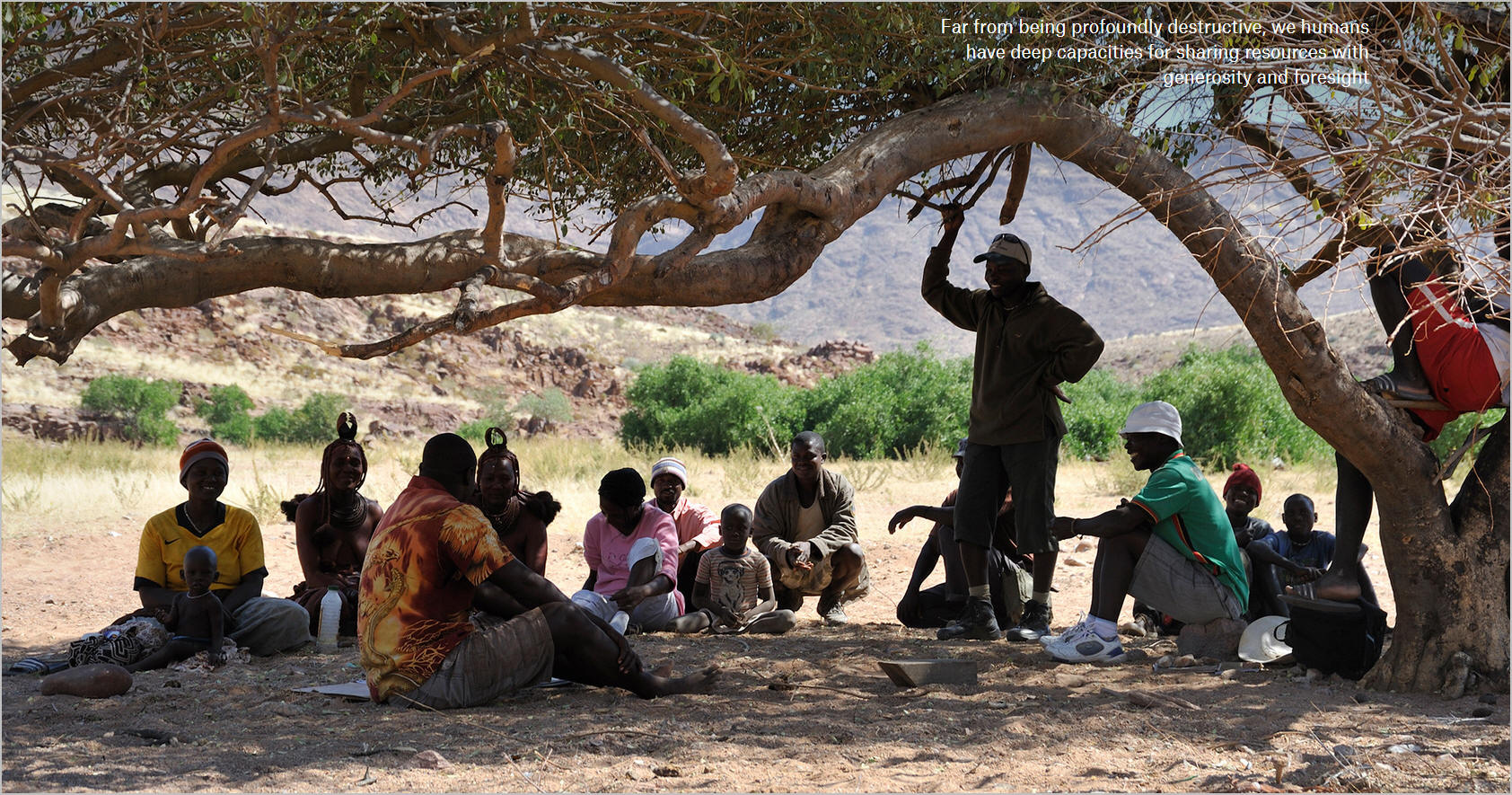 Locals at the Marienfluss Conservancy in Namibia meet to discuss conservation. Photo courtesy of NACSO/WWF Namibia
.
.
Click the link below for the article:
.
__________________________________________
Older Entries
Newer Entries
 James' World 2