Nobody knows what two Navy pilots and their weapons officers saw while training the Nimitz Carrier Strike Group in 2004: It was white and shaped roughly like a Tic Tac. It mirrored their movements, and then it disappeared, a feat neither pilot can explain. Maybe the object was advanced technology, ours or someone else’s. Maybe it was a kind of optical illusion. Maybe — and this is least likely — it was something altogether different, an extraterrestrial visit from an unknown species. Implausible though it is, the possibility excites tremendous interest. 60 Minutes, a venerable media institution, recently dedicated an entire segment to the Nimitz sighting and to other unidentified aerial phenomena. The New Yorker published thousands of words on the subject in April. No longer the province of Ancient Aliens or The X-Files, the UFO has gone mainstream.
Not everyone is pleased by this development. There are real problems to worry about, suggested Emerald Robinson, a correspondent for the far-right Newsmax network. “They want you talking about aliens because they don’t want you talking about Maricopa,” she tweeted, referring to a bizarre recount of presidential ballots there. “They want you talking about UFOs because they don’t want you talking about stagflation, the collapse of the dollar, the crisis on the border, and Biden’s mental health.” The Maricopa recount is “a sham,” as acknowledged by the county’s own board of supervisors. The dollar has not collapsed. Biden’s mental health appears fine. Who knows who “they” might be; the Deep State perhaps, or some other cabal, but whoever they are, they’re unnecessary: Our desire for distraction is organic.
.
Roswell, New Mexico. Photo: Mark Peterson/Corbis via Getty Images
After months of political wrangling, the House late Friday night passed a $1.2 trillion infrastructure bill to modernize highways, rebuild water lines and provide billions for electric vehicle charging stations, the largest transportation spending package in U.S. history.
The passage is a victory for Democrats and President Joe Biden, who had suffered a stinging defeat in Tuesday’s elections.
The bill, passed by the Senate in August, will now be sent to Biden who is expected to sign it into law.
The 228-206 vote followed bitter differences between Democratic progressives and moderates who clashed over the size and scope of Biden’s $1.85 trillion Build Back Better budget bill that would expand social safety net programs and enact sweeping climate programs. The deal Democrats struck allowed passage of the infrastructure bill Friday and a promise that the larger bill would get a vote later this month.
The funeral for Colin L. Powell, former secretary of state, chairman of the Joint Chiefs of Staff and national security adviser, brought out a Washington that barely exists anymore: Republicans and Democrats, including President Biden and two of his predecessors, uniformed military and diplomats, and people on all sides of the Iraq war.
No one would have been more amused by the assemblage than Mr. Powell himself, who often ran a smiling, half-whispered commentary on the city’s temporary loyalties and back-room machinations. Yet on Friday, the Washington National Cathedral was filled with them all — former officials who were at Mr. Powell’s side in the Persian Gulf War and on the seventh floor of the State Department, where he often waged a behind-the-scenes battle for influence in the George W. Bush White House.
Mr. Biden did not speak, nor did the two former presidents who attended, Barack Obama and Mr. Bush, who made Mr. Powell his first secretary of state. Instead, among the eulogists was a Democrat who had often clashed with Mr. Powell over the general’s reluctance to commit American forces to battles when the general, seared by the experience of his service in Vietnam, did not see a clear, successful outcome.
“He said I almost gave him an aneurysm,” the Democrat, Madeleine K. Albright, who served as secretary of state in the Clinton administration, told the mourners, recalling Mr. Powell’s reaction after she famously asked him, “What’s the point of having this superb military you’re always talking about if we can’t use it?”
.
At Washington National Cathedral on Friday, Colin L. Powell was remembered as a “warrior-statesman” whose leadership was valued by officials from both parties. Credit…Jason Andrew for The New York Times
Easton is a city in and the county seat of Northampton County, Pennsylvania, United States. The city’s population was 26,800 as of the 2010 census. Easton is located at the confluence of the Delaware River and the Lehigh River, roughly 55 miles (89 km) north of Philadelphia and 70 miles (110 km) west of New York City.
Easton is the easternmost city in the Lehigh Valley, a region of 731 square miles (1,893 km2) that is home to more than 800,000 people. Together with Allentown and Bethlehem, the Valley embraces the Allentown-Bethlehem-Easton metropolitan area, including Lehigh, Northampton, and Carbon counties within Pennsylvania, and Warren County in the adjacent state of New Jersey. Easton is the smallest of the three Lehigh Valley cities, with approximately one-fourth of the population of the largest Lehigh Valley city, Allentown. In turn, this metropolitan area comprises Pennsylvania’s third-largest metropolitan area.
The greater Easton area consists of the city, three townships (Forks, Palmer, and Williams), and three boroughs (Glendon, West Easton, and Wilson).
Centre Square, the town square of the city’s Downtown neighborhood, is home to the Soldiers’ & Sailors’ Monument, a memorial for Easton area veterans killed during the American Civil War. In the first half of the 20th century, Centre Square was reportedly referred to by locals as the “Circle.” The Peace Candle, a candle-like structure, is assembled and disassembled every year atop the Civil War monument for the Christmas season.[6]
The Norfolk Southern Railway’s Lehigh Line (formerly the mainline of the Lehigh Valley Railroad), runs through Easton on its way to Bethlehem and Allentown heading west and to Phillipsburg, New Jersey just across the Delaware River.
On August 22, 1751, Thomas Penn, the son of William Penn, the colony’s founder and original proprietor married Juliana Fermor. On Sept. 8, 1751, a letter was sent to Colonial Governor James Hamilton by Penn requesting that a new town on the confluence be named Easton and that it be in a new county called Northampton. In 1752, the city was named in honor of Lady Juliana’s family estate, the Easton Neston as requested. The county’s name was also named after the estate’s location, south Northamptonshire, England. Wikipedia
Most folks love learning, regardless of whether or not school is “their thing.” Sometimes it’s just a matter of finding the right teacher for your learning style—or maybe even the right medium.
For auditory learners, podcasts can be excellent vehicles for processing knowledge that’d be less digestible in more visual mediums like video or even the written word. The American education systems tends to fail students in myriad ways, requiring continual education after the fact to learn the truth behind what we were taught in history, art, science, language, literature, and math. Privileged gatekeepers deciding who and what gets taught can result in the denial of diverse voices and perspectives.
Podcasts radically shift the dynamics around who gets to teach, and who gets to learn. A lot of the most beloved and popular shows, like Radiolab and Dan Carlin’s Hardcore History, basically boil down to what you wish your science or history class had been like in the first place. Many others, like 1619 and You’re Wrong About, aim to correct the misinformation in many accepted cultural narratives from both our near and distant pasts.
Now, obviously, podcasts can’t replace a world-class, bonafide, IRL, teacher-to-student relationship. But they can teach us more than a few vital lessons.
.
Listen, and you might learn a things or two.Credit: bob al-greene / mashable
A year ago, as the pandemic ravaged country after country and economies shuddered, consumers were the ones panic-buying. Today, on the rebound, it’s companies furiously trying to stock up.
Mattress producers to car manufacturers to aluminum foil makers are buying more material than they need to survive the breakneck speed at which demand for goods is recovering and assuage that primal fear of running out. The frenzy is pushing supply chains to the brink of seizing up. Shortages, transportation bottlenecks, and price spikes are nearing the highest levels in recent memory, raising concern that a supercharged global economy will stoke inflation.
Copper, iron ore and steel. Corn, coffee, wheat, and soybeans. Lumber, semiconductors, plastic, and cardboard for packaging. The world is seemingly low on all of it. “You name it, and we have a shortage on it,” Tom Linebarger, chairman, and chief executive of engine and generator manufacturer Cummins Inc., said on a call this month. Clients are “trying to get everything they can because they see high demand,” Jennifer Rumsey, the Columbus, Indiana-based company’s president, said. “They think it’s going to extend into next year.”
.
Irrigation lines are set up to water almond tree rootstocks in Tulare, California, on April 21. Photographer: Gary Coronado/Los Angeles Times/Getty Images
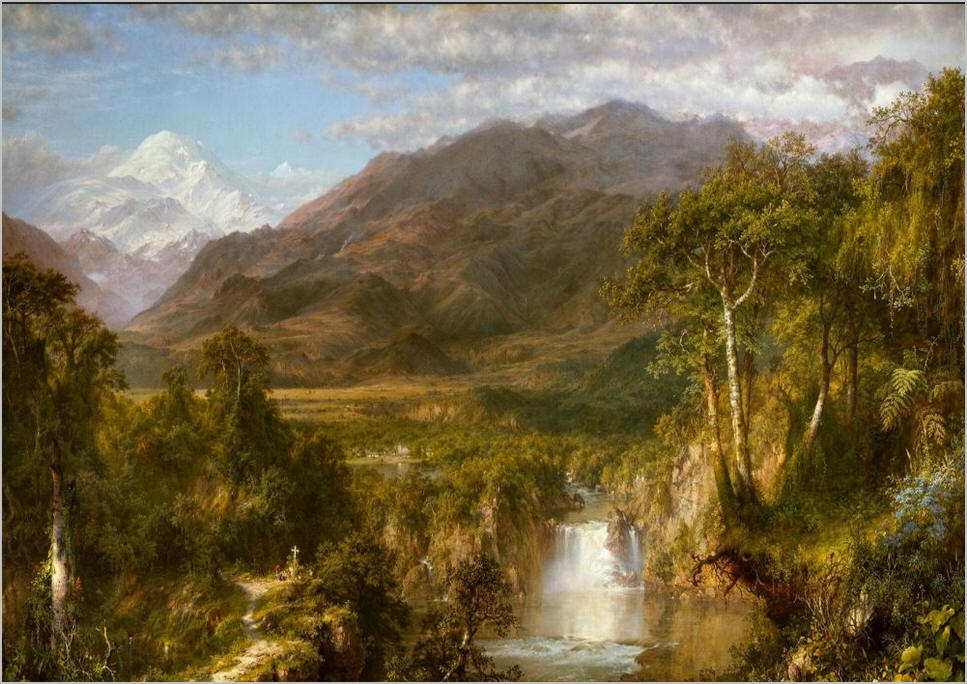
Frederic Edwin Church (May 4, 1826 – April 7, 1900) was an American landscape painter born in Hartford, Connecticut. He was a central figure in the Hudson River School of American landscape painters, best known for painting large landscapes, often depicting mountains, waterfalls, and sunsets. Church’s paintings put an emphasis on realistic detail, dramatic light, and panoramic views. He debuted some of his major works in single-painting exhibitions to a paying and often enthralled audience in New York City. In his prime, he was one of the most famous painters in the United States.
Frederic Edwin Church was a direct descendant of Richard Church, a Puritan pioneer from England who accompanied Thomas Hooker on the original journey through the wilderness from Massachusetts to what would become Hartford, Connecticut. Church was the son of Eliza (1796–1883) and Joseph Church (1793–1876). Frederic had two sisters and no surviving brothers. His father was successful in business as a silversmith and jeweler and was a director at several financial firms. His mother’s brother was Adrian Janes, who owned an iron foundry that constructed the U.S. Capitol Dome. The family’s wealth allowed Frederic to pursue his interest in art from a very early age. In 1844, aged 18, Church became the pupil of landscape artist Thomas Cole in Catskill, New York after Daniel Wadsworth, a family neighbor and founder of the Wadsworth Athenaeum, introduced the two. Church studied with him for two years; by this time his talent was more than evident. Cole wrote that Church had “the finest eye for drawing in the world”. During his time with Cole, he traveled around New England and New York to make sketches, visiting East Hampton, Long Island, Catskill Mountain House, The Berkshires, New Haven, and Vermont. His first recorded sale of a painting was in 1846 to Hartford’s Wadsworth Athenaeum for $130; it was a pastoral depicting Hooker’s journey in 1636. In 1848, he was elected as the youngest Associate of the National Academy of Design and was promoted to full member the following year. He took his own students including Walter Launt Palmer, William James Stillman, and Jervis McEntee. Wikipedia
.
A painting Heart Of The Andes by Frederic Edwin Church
Remember those old and scratchy vinyl records that would skip and play the same thing over and over until you moved the needle? (I know I’m showing my age, play along.)
Well, the Gallup Organization has been playing a tune now for over three decades, one that sure sounds a lot like a scratchy record that won’t move forward. You know it well—roughly 30 percent of employees in the U.S. are actually engaged in their work. But here’s the part of the song that keeps skipping incessantly: People leave managers, not companies.
We’ve known this for a while and yet we can’t seem to solve the leadership crisis that will result in happy, engaged, and motivated workers.
That’s because most people in positions of power don’t have a clear understanding of what it truly takes to influence others. You don’t manage people; you lead people and manage the work.
In the world, human beings are facing various problems. People who are full of greed, anger, and ignorance are seen to be fighting with each other in words and deeds. As the fighting continues, various problems such as civil wars, wars of aggression, and wars of aggression are occurring. As world peace is being destroyed, humans are facing unbearable problems. Innocent children and women are not getting the rights they deserve and deserve. I can't think of one thing every time. What is it? The United Nations. If we look at the responsibilities and duties of the United Nations, I think it is not suitable for solving the problems that are happening in the world today. In fact, the United Nations and the World Security Council, such an organization must rule the world, must be able to give orders, and must have various ways to obey orders. There must be no organization that can influence more than that organization. There should be experts from each country. They can even dominate the superpowers like the US, China, and Britain. Only then will global peace be achieved quickly. Now, if a country with power develops more militarily, economically, or socially than its own country, then powerful countries will jealously seek out enemies and wage war. Or they will attack with fighter jets. In this, innocent people are losing their lives. No one understands the value of a life. You should think about how to achieve global peace by controlling these. If the US continues to be the permanent president of the UN, world peace will never be achieved. If you think carefully, no one sees that they are working for the common good, but for their own benefit, for the benefit of their own country. The permanent president of the UN and the Security Council has rejected this, As a young Rohingya, I have come to realize that only by electing the president and secretary from among the countries in the world through a secret ballot system and governing the world fairly can we achieve global peace. The United Nations and the Security Council are organizations in which any country must govern, give orders, and make them obey their orders. For example, only when a defendant is tried in court can we hold the leaders of the countries in check and control them, can we achieve global peace smoothly. Otherwise, it will not be easy for powerful countries to use various excuses to end this war every year, every year, for the benefit of themselves and their countries. No country's leaders pay any attention to the words of the United Nations and the Security Council. If we look at it in practice, look at the Rohingya issue. Myanmar is a small country. Even that country has been under siege for 8 years. What action can be taken? Why is the UN and the Security Council Powerless? Without such Power, how can the organization bring about global peace? Everyone should think about it. Whether there is a veto or a strong one, all countries in the world can only achieve global peace if they are subject to the UN and the Security Council. Seek peace in the quiet embrace of nature. Peace is an indispensable need of the human race. It is not as if one person can kill another person, and it is as if one country can attack another country, but instead of trying to build peace, we must try to destroy the peace now, and the world is getting hotter and is on the verge of collapse. I especially appeal to all the world experts to urgently try to bring about peace in all parts of the world. Mr, Noor Muhamed Arkhan Rohingya Youth Myanmar
Film and Writing Festival for Comedy. Showcasing best of comedy short films at the FEEDBACK Film Festival. Plus, showcasing best of comedy novels, short stories, poems, screenplays (TV, short, feature) at the festival performed by professional actors.