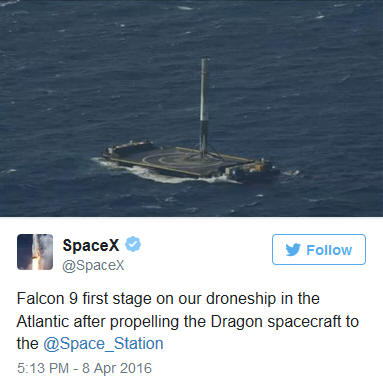
A SpaceX Falcon 9 rocket blasted off from Florida with a cargo ship bound for the International Space Station on Friday, and its reusable main-stage booster landed itself on an ocean platform in a dramatic spaceflight first.
The liftoff at 4:43 p.m. EDT from Cape Canaveral marked the resumption of resupply flights by privately owned Space Exploration Technologies for NASA following a launch accident in June 2015 that destroyed a different cargo payload for the space station.
About 2 and a half minutes after Friday’s launch, the main part of the two-stage SpaceX rocket separated, turned around and headed toward a landing platform floating in the Atlantic about 185 miles of Cape Canaveral.
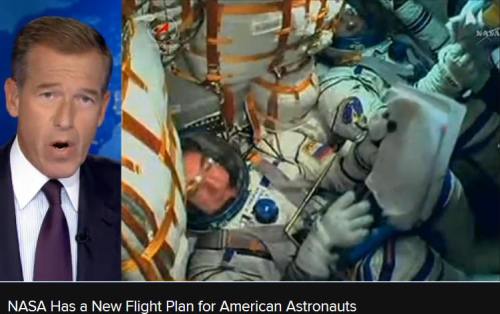
For the first time in 340 days, American astronaut Scott Kelly and Russian cosmonaut Mikhail Kornienko are back on solid ground.
At 11:26 p.m. EST Tuesday, the Soyuz TMA-18M spacecraft safely touched down southeast of Dzhezkazgan, Kazakhstan.
“They did it! They’re home after a year in space and they stuck the landing,” NASA spokesman Rob Navias said during a live webcast.
.
NASA Until a manned Mars mission, Kelly will just have to settle for the simple pleasures of life on Earth, like going for a stroll and eating food that stays put on a plate.
.
.
Click link below for story, video, photos, social media and slideshow:
An hour after sunrise on June 28, Mike Safyan and nine co-workers from Planet Labs gathered in their San Francisco office for a pancake breakfast. It was a Sunday, so business was closed.
But this weekend morning was too momentous for Safyan and crew to stay home. Their 5-year-old start-up, which builds shoebox-sized satellites to orbit Earth and capture images of the planet, had eight “doves,” as they’re known, aboard an unmanned SpaceX capsule that was headed for the International Space Station.
If all went as planned, within about a month those satellites would join a fleet of 36 Planet Labs doves orbiting the Earth.
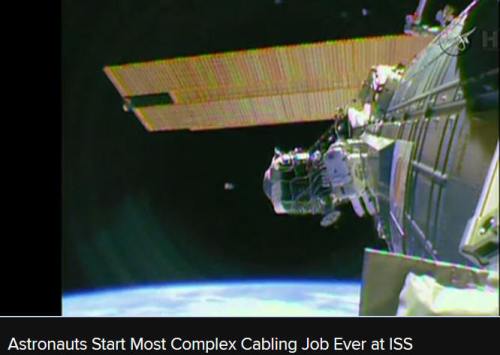
Spacewalking astronauts routed more than 300 feet of cable outside the International Space Station on Saturday to prepare for the arrival of new American-made crew capsules. It was the first of three spacewalks planned for NASA astronauts Butch Wilmore and Terry Virts over the coming week.
Altogether, Wilmore and Virts have 764 feet (233 meters) of cable to run outside the space station. They got off to a strong start Saturday, rigging eight power and data lines, or about 340 feet (105 meters). The longest single stretch was 43 feet (13 meters). “Broadening my resume,” Virts observed.
NASA considers this the most complicated cable-routing job in the 16-year history of the space station. Equally difficult will be running cable on the inside of the complex.
NASA is going back to the future with $6.8 billion in backing for Apollo-style spaceships designed by Boeing and SpaceX. Both companies have been given the go-ahead to build, test and fly their gumdrop-shaped “space taxis,” with the aim of transporting astronauts to and from the International Space Station starting in 2017.
“Today, we’re one giant leap closer to launching our astronauts from the U.S. on American spacecraft,” NASA Administrator Charles Bolden said Tuesday from Kennedy Space Center in Florida.
Since the retirement of the space shuttle fleet in 2011, NASA has had to rely on the Russians for rides to the station, at a cost topping $70 million per seat. Tuesday’s award is the latest phase in a years-long commercial effort aimed at fixing that situation — an effort that already has cost NASA $1 billion.
Political favoritism can quite literally be seen from space, according to a new study that finds the home regions of leaders become brighter at night after the person comes to power.
The findings apply mostly to countries with weak political institutions and limited public education. One prominent example was Zaire (now the Democratic Republic of the Congo) during the reign of Mobuto Sese Seko. Mobuto, who was president between 1971 and 1997, was born near the small town of Gbadolite. While he was in power, the town flourished.
“Mobuto built a huge palace complex costing millions of dollars, luxury guesthouses, an airport capable of handling Concords, and had the country’s best supply of water, electricity and medical services,” study researcher Paul Raschky, an economist at Monash University in Australia, said in a statement. Years of satellite data reveal Gbadolite as initially dark at night, brightening under Mobuto and quickly fading again after the authoritarian ruler’s exile and death.
.
In this image, snapped from the International Space Station on Jan. 30, 2014, while South Korea (lower right) and China (upper left) are aglow in lights, poverty-stricken North Korea is really in the dark. | NASA Earth Observatory
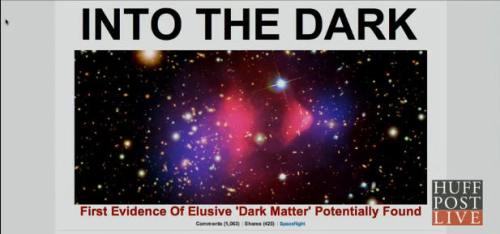
It is one of the cosmos’ most mysterious unsolved cases: dark matter. It is supposedly what holds the universe together. We can’t see it, but scientists are pretty sure it’s out there.
Led by a dogged, Nobel Prize-winning gumshoe who has spent 18 years on the case, scientists put a $2 billion detector aboard the International Space Station to try to track down the stuff. And after two years, the first evidence came in Wednesday: tantalizing cosmic footprints that seem to have been left by dark matter.
But the evidence isn’t enough to declare the case closed. The footprints could have come from another, more conventional suspect: a pulsar, or a rotating, radiation-emitting star.
.
.
.Click link below for story, video, and slideshow:
The interplanetary internet has been used by an astronaut at the International Space Station (ISS) to send commands to a robot on Earth. The experimental technology, called Disruption-Tolerant Networking (DTN) protocol, could be a future way to communicate with astronauts on Mars. Currently, if there is a problem when data is sent between Earth and Mars rovers, information can be lost.
The Internet Newspaper: News, Blogs, Video, Community
Click link below slideshow
.
Wow. A new time-lapse video compiling thousands of photos from the International Space Station beautifully reveals what it’s like to fly by Earth at nearly 18,000 miles per hour–and the view is pretty jaw-dropping.
.
This slideshow requires JavaScript.
.
.Click link below for article videos and slideshow:
Film and Writing Festival for Comedy. Showcasing best of comedy short films at the FEEDBACK Film Festival. Plus, showcasing best of comedy novels, short stories, poems, screenplays (TV, short, feature) at the festival performed by professional actors.




 .
.
 .
.
 .
.




 James' World 2