February 6, 2015
Mohenjo
Technical
3d printing, amazon, business, Business News, camera, cubesat, Goddard Space Flight Center, Hotels, Hubble Space Telescope, human-rights, Jason Budinoff, mashable, medicine, mental-health, NASA, NASA engineer, research, Science, Science News, Space, technology, Technology News, travel, US & World, vacation

Click link below picture
.
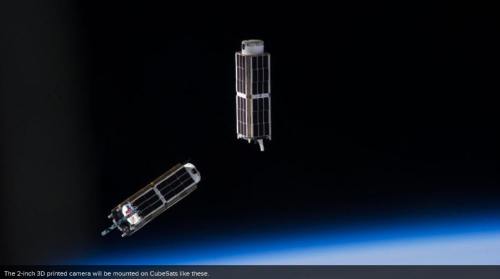
NASA is already using 3D printing to make rocket engine parts, a space pizza maker and even physical photos from the Hubble Space Telescope. But by the end of September, one NASA engineer expects to complete the first space cameras made almost entirely out of 3D-printed stuff.
“As far as I know, we are the first to attempt to build an entire instrument with 3D printing,” Jason Budinoff, an aerospace engineer at NASA’s Goddard Space Flight Center in Maryland, said in a statement.
Budinoff is building a 2-inch (50 millimeters) camera for a CubeSat — a miniature satellite. The camera will have to pass vibration and thermal-vacuum tests next year to prove that it’s capable of space travel. Budinoff is also using 3D printing to build a 14-inch (350 mm) dual-channel telescope.
.
 .
.
.
Click link below for article:
http://mashable.com/2014/08/12/3d-printed-cubesat-camera/?utm_cid=mash-com-Tw-main-link
.
__________________________________________
December 24, 2014
Mohenjo
Science
amazon, business, Business News, Chandra X Ray Observatory Space, Colliding Galaxies, Colliding Galaxies Photo, composite image, Galaxies Light Show, Galaxy Light Show, Hotels, Hubble Space Telescope, Huffpost Science Click, human-rights, IC, medicine, mental-health, Merging Galaxies, NASA, photo showing, research, Science, Science News, Space, Space Photo, space photos, Space Porn, spectacular light show, technology, Technology News, travel, Universe, vacation
FROM
Huffpost Science
Click link below picture
.
Just in time for the holidays, NASA has released a new photo showing a spectacular light show created by a pair of merging galaxies 130 million light-years from Earth.
The photo is a composite image of the spiral galaxies NGC 2207 and IC 2163, located in the constellation Canis Major.
The image is a mash-up of X-rays captured by NASA’s Chandra X-Ray Observatory (shown in pink), visible light data from the Hubble Space Telescope (shown in red, green, and blue), and infrared data from NASA’s Spitzer Space Telescope (shown in red).
.
 Spiral galaxies NGC 2207 and IC 2163.
.
.
Click link below for story and slideshow:
http://www.huffingtonpost.com/2014/12/17/colliding-galaxies-light-show-photo_n_6341298.html
.
__________________________________________
June 6, 2014
Mohenjo
Science
amazon, business, Business News, colorful image, European Space Agency, Hotels, Hubble, Hubble Deep Field, Hubble Space Telescope, Hubble Telescope, Hubble Ultra, human-rights, medicine, mental-health, NASA, research, Science, Science News, Space, space photos, Spaceflight, star formation, Stars, technology, Technology News, travel, vacation
Click link below picture
.
NASA calls it the most colorful image ever captured by the Hubble Space Telescope–and the most comprehensive. It has to be one of the most spectacular.
But the image–the remarkable payoff of a new survey called the Ultraviolet Coverage of the Hubble Ultra Deep Field–is more than merely beautiful. It may also help fill in some gaps in our understanding of how stars form.
.
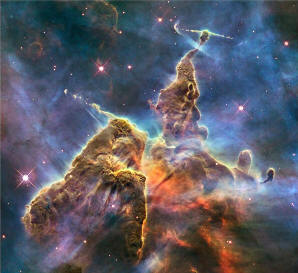 Image From NASA’s Hubble Telescope
.
.
Click link below for story, Amazing Shot, video and slideshow:
.
__________________________________________
January 8, 2014
Mohenjo
Science
Abell 2744, Abell 2744 Galaxies, amazon, American Astronomical Society, Ancient Galaxies, business, Business News, Distant Galaxies, Faraway Galaxies, Galaxies, Hotels, Hubble Galaxies, Hubble Space Telescope, huffingtonpost, human-rights, Jennifer Lotz, medicine, mental-health, NASA, research, Science, Science News, Slideshow, Space, space photos, Space Program, Spaceflight, technology, Technology News, travel, vacation, Youngest Galaxies
Click link below picture
.
The Hubble Space Telescope has peered back to a chaotic time 13. 2 billion years ago when never-before-seen galaxies were tiny, bright blue and full of stars bursting to life all over the place.
Thanks to some complex physics tricks, NASA’s aging telescope is just starting to see the universe at its infancy in living color and detail.
Images released by NASA on Tuesday show galaxies that are 20 times fainter than those pictured before. They are from a new campaign to have the 23-year-old Hubble gaze much earlier and farther away than it was designed to see.
“I like to call it cosmic dawn,” Hubble astronomer Jennifer Lotz said at the American Astronomical Society convention in Washington. “It’s when the lights are coming on.”
.

This long-exposure image from NASA’s Hubble Space Telescope of massive galaxy cluster Abell 2744 is the deepest ever made of any cluster of galaxies. It shows some of the faintest and youngest galaxies ever detected. | ASSOCIATED PRESS
.
.
Click link below for story and slideshow:
.
__________________________________________
December 2, 2012
Mohenjo
Science
Biggest Black Hole, Biggest Black Hole Discovered, Biggest Black Hole Ever, Biggest Black Hole Ngc 1277, Biggest Black Hole Photo, Black Hole, Black Hole Discovered, Black Hole Discovery, Black Hole Found, Black Hole Ngc 1277, business, climate, constellation perseus, Galaxy Ngc 1277, Hubble Space Telescope, huffingtonpost, Largest Black Hole, lenticular galaxy, mcdonald observatory, New Black Hole, New Black Hole Discovered, New Black Hole Discovery, Ngc 1277, ngc1277, Science, Science News, supermassive black hole, Supermassive Black Hole Ngc 1277, Supermassive Black Hole Perseus, Video
FROM

Click link below picture
.
A supermassive black hole discovered by University of Texas researchers ranks among the largest ever observed.
The enormous black hole is located in NGC 1277, a small, lenticular galaxy 250 million light years from Earth in the constellation Perseus, Space.com reports.
The black hole’s event horizon — the “point of no return” within which nothing can escape — has a diameter 11 times greater than Neptune’s orbit around the Sun, according to a written statement issued by the university’s McDonald Observatory in Austin.
.
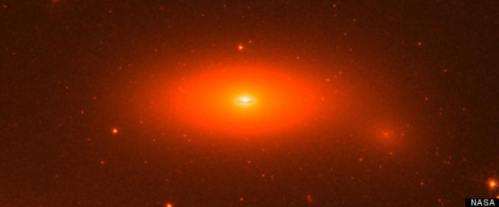
Galaxy NGC 1277, shown here in a Hubble Space Telescope image, may contain the
largest black hole ever discovered.
.
.Click link below for story, slideshow, and video:
http://www.huffingtonpost.com/2012/11/29/supermassive-black-hole-ngc-1277-among-biggest-discovered_n_2205982.html?ref=topbar
.
_______________________________________________________
November 2, 2012
Mohenjo
Science
anniversary photos, business, climate, dark energy, Dr. Edwin Hubble, Environment, first-ever auroras above Uranus, Future, Galaxies, Hubble Anniversary, Hubble Space Telescope, huffingtonpost, infrared wavelengths, Jupiter, low earth orbit, myaol, near-infrared wavelengths, Nebula, photographs in visible light, research, Saturn, Science, Science News, Space, Space Telescope, Stars, Supernovas, Tarantula Nebula, technology, travel, ultraviolet, vacation
FROM
Click link below picture
.
The Hubble Space Telescope launched on April 24, 1990, ushering in a new era in space exploration.
From its low-earth orbit, the telescope can take pictures without interference from the planet’s atmosphere, snapping photographs in visible light, ultraviolet and near-infrared wavelengths.
.

.
.Click link below for story an slideshow:
http://www.huffingtonpost.com/2012/04/27/hubble-space-telescope-anniversary-photos_n_1460494.html?ref=science&icid=maing-grid7|myaol|dl8|sec1_lnk3%26pLid%3D156579
.
____________________________________________________
May 31, 2012
Mohenjo
Science
Chile, climate, helicopter, Historic Events, History, html ref, Hubble Space Telescope, Igor Sikorsky, Inventors. Historic Experiments, John Glenn, London Zoo, Love Canal, maing, Malcolm Scott Carpenter, mercury capsule, Niagara Falls, orbit the Earth, reattachment, Science, science history, Science News, second U.S. astronaut, Slideshow, Space, SS Savannah, The Concorde, This Week In Science History, Video, world's first-ever text
FROM

Click link below slideshow
.
You know John Glenn was the first American to orbit the Earth–his Mercury capsule circled the Earth three times before splashing down in the Atlantic Ocean. But who was the second U.S. astronaut to orbit the Earth? Don’t know? Don’t worry–you’ll find out in HuffPost Science’s debut “This Week In Science History” slideshow.
.
This slideshow requires JavaScript.
.
.Click link below for narrative and slideshow:
http://www.huffingtonpost.com/2012/05/27/week-in-science-history-may-20-27_n_1543085.html?ref=science&icid=maing-grid7%7Cmyaol%7Cdl8%7Csec1_lnk3%26pLid%3D164788
.
_______________________________________________________


 James' World 2