A snowstorm can’t stop it. A blazing fire can’t stop it. And even getting run over by a car is no problem for this squishy little bot.
.
Researchers from Harvard University have developed a soft robot that not only can stand up and walk on its own, but also withstand tough elements all while carrying the equipment it needs on its back — from its microcompressors to control systems to batteries. Just check it out in the video above, which was recently posted to the university’s YouTube account.
.
Even a New England winter storm can’t stop this soft robot, which was recently developed by Harvard researchers.
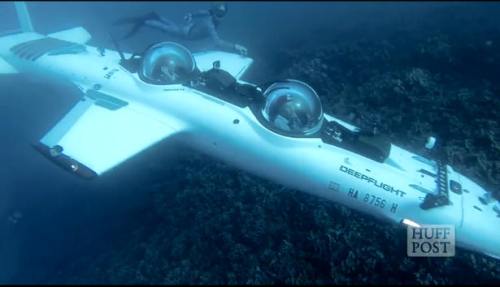
While conducting tests with a conventional submersible that crawled on the bottom of the sea, ocean engineer Graham Hawkes came nose to nose with a little crustacean that was poised to fight the underwater machine.
“I remember stopping and laughing,” Hawkes told The Huffington Post. “But I thought, ‘That crab has got it all wrong. These fish are moving in three dimensions. This guy is scurrying along the bottom. So am I. We’ve both got it wrong.'”
Inspired by the movement of fish, Hawkes designed and built the DeepFlight Super Falcon, a submarine that flies through the water like an airplane, instead of taking on water to sink itself. Similar to how hot-air balloons release weights to fly up, traditional submarines have compartments that fill with water to sink down.
Hawkes started a company out of his garage to create the DeepFlight Super Falcon in 1995. Today, Hawkes’ dream has become a reality. “What we’re doing is really, really obvious,” Hawkes said. “There’s nothing that clever about it. We actually build a thing that has wings, we build up speed, and it just flies underwater.”
The word “drone” tends to conjure up images of planes that kill terrorists or of creepy surveillance tools.
But tiny drone airplanes made of foam may be more useful in rural environments, one researcher says. There, the fliers could revolutionize agriculture, reducing the need for pesticides and improving crop production.
Because drones can fly cheaply at a low altitude, they can get highly detailed images of cropland, said Chris Anderson, the CEO of 3D Robotics and former editor-in-chief of Wired, here on Saturday (May 18) at this year’s Maker Faire Bay Area, a two-day celebration of DIY science, technology and engineering. Drone-captured close-ups of fields could help farmers tailor their pesticide treatment and identify subtle differences in soil productivity. [Rise of the Drones: Photos of Unmanned Aircraft]
A robot as small as a housefly has managed the delicate task of flying and hovering the way the actual insects do.
“This is a major engineering breakthrough, 15 years in the making,” says electrical engineer Ronald Fearing, who works on robotic flies at the University of California, Berkeley. The device uses layers of ultrathin materials that can make its wings flap 120 times a second, which is on a par with a housefly’s flapping rate. This “required tremendous innovation in design and fabrication techniques”, he adds.
The robot’s wings are composed of thin polyester films reinforced with carbon fibre ribs and its ‘muscles’ are made from piezoelectric crystals, which shrink or stretch depending on the voltage applied to them.
.
.
.Click link below for story, videos, and slideshow:
Film and Writing Festival for Comedy. Showcasing best of comedy short films at the FEEDBACK Film Festival. Plus, showcasing best of comedy novels, short stories, poems, screenplays (TV, short, feature) at the festival performed by professional actors.




 James' World 2