An experimental vaccine tested on thousands of people in Guinea exposed to Ebola seems to work and might help shut down the ongoing epidemic in West Africa, according to interim results from a study published Friday.
There is currently no licensed treatment or vaccine for Ebola, which has so far killed more than 11,000 people in West Africa since the world’s biggest outbreak began in the forest region of Guinea last year.
“If proven effective, this is going to be a game-changer,” said Dr. Margaret Chan, Director-General of the World Health Organization, which sponsored the study. “It will change the management of the current outbreak and future outbreaks.”
.
Doctor Francis Kateh, right, from Redemption Hospital volunteering to receive a trial vaccine against Ebola at Redemption Hospital on the outskirts of Monrovia. ZOOM DOSSO / AFP – Getty Images file
When Dr. Ian Crozier was released from Emory University Hospital in October after a long, brutal fight with Ebola that nearly ended his life, his medical team thought he was cured. But less than two months later, he was back at the hospital with fading sight, intense pain and soaring pressure in his left eye.
Test results were chilling: The inside of Dr. Crozier’s eye was teeming with Ebola.
His doctors were amazed. They had considered the possibility that the virus had invaded his eye, but they had not really expected to find it. Months had passed since Dr. Crozier became ill while working in an Ebola treatment ward in Sierra Leone as a volunteer for the World Health Organization. By the time he left Emory, his blood was Ebola-free. Although the virus may persist in semen for months, other body fluids were thought to be clear of it once a patient recovered. Almost nothing was known about the ability of Ebola to lurk inside the eye.
.
Before he contracted Ebola, Dr. Ian Crozier had two blue eyes. After he was told he was cured of the disease, his left eye turned green.Credit Emory Eye Center
An American healthcare worker infected with Ebola in Sierra Leone serious condition at the National Institutes of Health, the NIH said Friday. The unidentified patient is the 11th Ebola case treated in the U.S.
The person was flown back from West Africa in isolation on a chartered flight, the NIH said in a statement Friday. The NIH admitted the patient to its high-level containment facility in Bethesda, Maryland. It’s the same unit that treated nurse Nina Pham and that kept watch over a doctor and a nurse who were eventually found to have escaped infection.
“The unit staff is trained in strict infection control practices optimized to prevent spread of potentially transmissible agents such as Ebola. NIH is taking every precaution to ensure the safety of our patients, NIH staff, and the public,” NIH said in a statement.
New guidelines for the personal protective equipment that wear have on when treating Ebola patients make clear that what you wear counts — but even more important is how you put it on and take it off.
And the guidelines that the World Health Organization updated Friday suggest only highly trained medical professionals should be taking on the dangerous job of caring for Ebola patients, say the country’s leading doctors at the National Institutes of Health.
“Anybody could do this, but the training process is something that takes a lot of time,” Dr. Francis Collins, who heads the National Institutes of Health, told NBC News in an interview.
A New York City doctor who recently returned from treating Ebola patients in Guinea tested positive for the disease on Thursday.
Dr. Craig Spencer, 33, reported a fever of 100.3 degrees and gastrointestinal problems Thursday morning, both symptoms of Ebola. He was then transported to Bellevue Hospital in an ambulance staffed by a “specially trained HAZ TAC unit wearing Personal Protective Equipment,” according to a statement from the New York City Department of Health and Mental Hygiene. Tests conducted at the hospital revealed that he had the virus.
Spencer is the only case of Ebola in the city of more than 8 million. He is now the fourth person to be diagnosed in the U.S. with the viral disease.
Nurses, the frontline care providers in U.S. hospitals, say they are untrained and unprepared to handle patients arriving in their hospital emergency departments infected with Ebola.
Many say they have gone to hospital managers, seeking training on how to best care for patients and protect themselves and their families from contracting the deadly disease, which has so far killed at least 3,338 people in the deadliest outbreak on record.
The U.S. Centers for Disease Control and Prevention has repeatedly said that U.S. hospitals are prepared to handle such patients. Many infectious disease experts agree with that assessment.
.
Experts warn deadly Ebola virus could spread to Britain through MEAT: Scientists fear contaminated ‘bush’ produce illegally smuggled into UK could carry killer bug and may be ‘on a market stall in London’
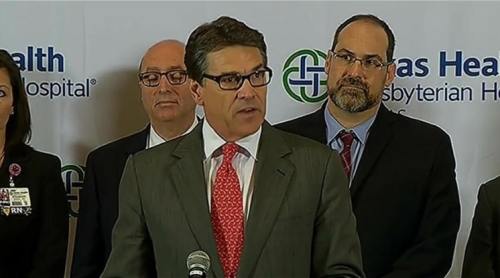
Texas Gov. Rick Perry and other officials told a news conference Wednesday that the man with the first case of Ebola diagnosed in the United States had contact up to 18 people, including “some school-age children.”
“The children have been identified and they are being monitored,” the governor said.
Dr. Christopher Perkins, with the Dallas Dept. of Health and Human Services, said that there were five people in the patient’s immediate household and then about 12-18 other “contacts” — including an ambulance crew — all of whom would be monitored closely for 21 days.
The number of Ebola cases could start doubling every three weeks in West Africa, the World Health Organization said Tuesday, warning that the outbreak will cost nearly $1 billion to contain so it does not turn into a “human catastrophe.”
Even as President Barack Obama is ordering the deployment of 3,000 U.S. military personnel to help provide aid in the region, Doctors Without Borders said the global response to Ebola has been far short of what is needed.
“The response to Ebola continues to fall dangerously behind,” Dr. Joanne Liu, president of the medical charity, told a U.N. special briefing on Ebola in Geneva. “The window of opportunity to contain this outbreak is closing. We need more countries to stand up, we need greater deployment, and we need it now.”
The Ebola virus has now killed more than 1,000 people in West Africa. Although the mortality rate of the most recent outbreak isn’t as high as in previous events, it’s still the case that most people who become infected with Ebola will not survive. (The mortality rate is about 60 percent for the current outbreak, compared with 90 percent in the past, according to the National Institutes of Health.)
But despite this somber prognosis, health experts in the United States aren’t particularly worried about the threat of Ebola in this country or in other developed countries.
The United States’ top disease detective calls Ebola a “painful, dreadful, merciless virus.”
The World Health Organization has declared the outbreak in West Africa an international emergency, killing more than 900 people and spreading.
That’s scary and serious. But it also cries out for context.
.
This undated photo made available by the Antwerp Institute of Tropical Medicine in Antwerp, Belgium, shows the Ebola virus viewed through an electron microscope. The World Health Organization on Friday, Aug. 8, 2014 declared the Ebola outbreak in West Africa to be an international public health emergency that requires an extraordinary response to stop its spread. (AP Photo/Antwerp Institute of Tropical Medicine) | ASSOCIATED PRESS
Film and Writing Festival for Comedy. Showcasing best of comedy short films at the FEEDBACK Film Festival. Plus, showcasing best of comedy novels, short stories, poems, screenplays (TV, short, feature) at the festival performed by professional actors.



 .
.





 James' World 2