In July, three unmanned missions blasted off to Mars – from China (Tianwen-1), the US (Nasa’s Mars 2020 Perseverance Rover), and the United Arab Emirates (Hope). The Chinese and American missions have lander craft that will seek signs of current or past life on Mars. Nasa is also planning to send its Europa Clipper probe to survey Jupiter’s moon Europa and the robotic lander Dragonfly to Saturn’s moon Titan. Both moons are widely thought to be promising hunting grounds for life in our solar system – as are the underground oceans of Saturn’s icy moon Enceladus.
Meanwhile, we can now glimpse the chemical makeup of atmospheres of planets that orbit other stars (exoplanets), of which more than 4,000 are now known. Some hope these studies might disclose possible signatures of life.
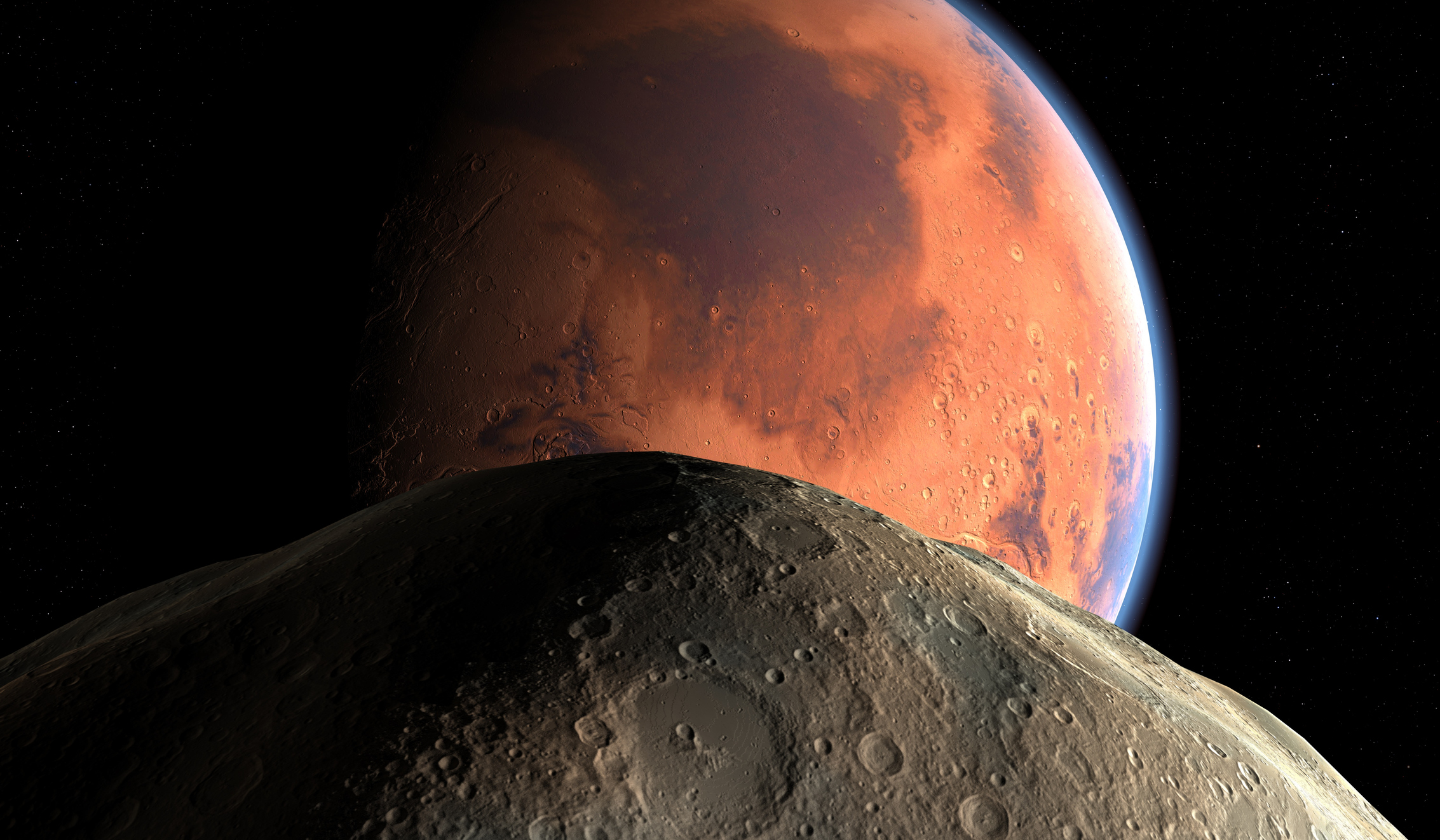
But can any of these searches do their job properly unless we have a clear idea of what “life” is? Nasa’s unofficial working definition is “a self-sustaining chemical system capable of Darwinian evolution”. “Nasa needs a definition of life so it knows how to build detectors and what kinds of instruments to use on its missions,” says zoologist Arik Kershenbaum of the University of Cambridge. But not everyone thinks it is using the right one.
.
‘You can’t hunt for something if you have no idea what it is.’ Credit: Mark Garlick / Science Photo Library / Getty Images.
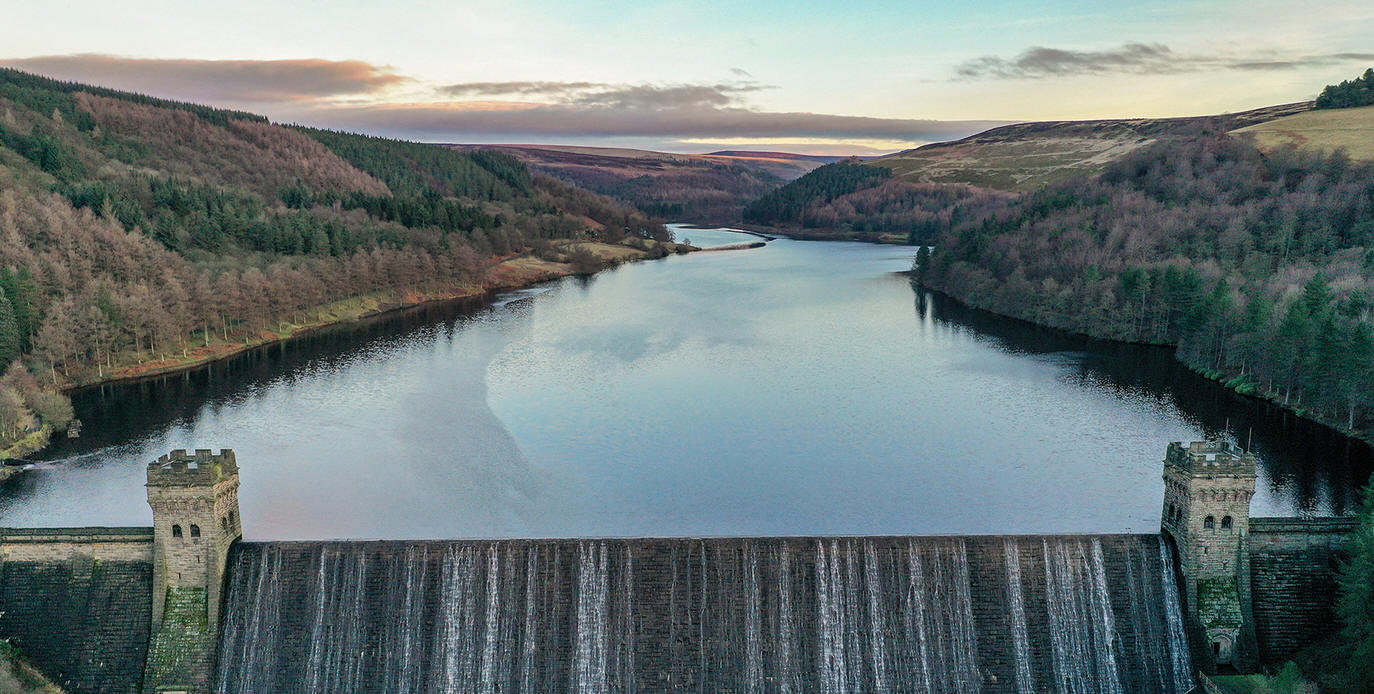
Derwent Reservoir is the middle of three reservoirs in the Upper Derwent Valley in the northeast of Derbyshire, England.It lies approximately 10 miles from Glossop and 10 miles from Sheffield. The River Derwent flows first through Howden Reservoir, then Derwent Reservoir, and finally through Ladybower Reservoir.
Some questions are infinitely more interesting than their answers. One such question started to echo around the internet in the early days of the Covid-19 lockdowns and has become increasingly frantic in the febrile weeks that have followed. The question was this: How shall we stay productive when the world is going to hell?
Productivity, or the lack of it, has become the individual metric of choice for coping with the international econo-pathological clusterfuck of the Corona Crisis. How should we self-optimize when we’re suddenly having to meet our deadlines with our roommates, kids, and inner critics screaming in the background? If we’re lucky enough to be able to shelter in place and we’re not using that time to launch podcasts and personal projects and life-hack our way to some cargo-cult pastiche of normality, are we somehow letting the side down?
.
There has always been something a little obscene about the cult of the hustle, the treadmill of alienated insecurity that tells you that if you stop running for even an instant, you’ll be flung flat on your face. Photograph: Marcelo Santos/Getty Images
Derbyshire is a county in the East Midlands of England.A substantial portion of the Peak District National Park lies within Derbyshire, containing the southern extremity of the Pennine range of hills which extend into the north of the county.
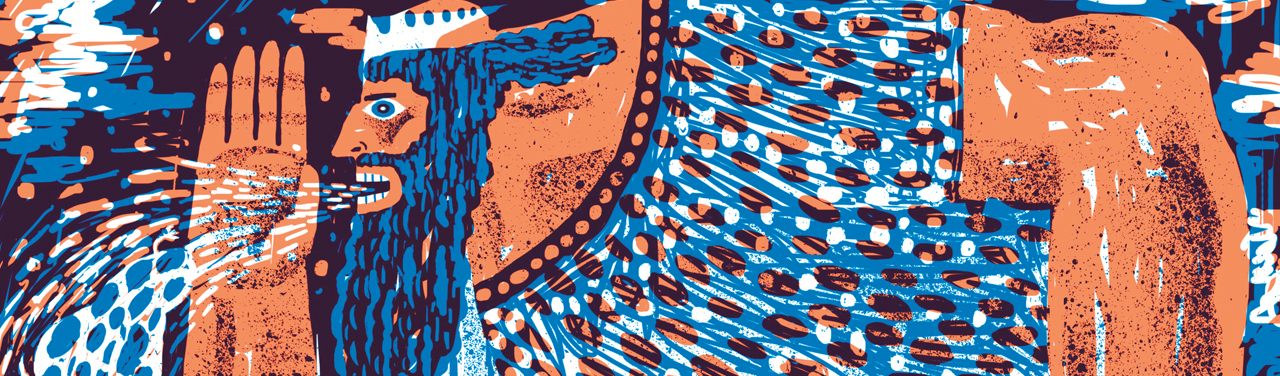
In some ways, the history of science is the history of a philosophical resistance to mythical explanations of reality. In the ancient world, when we asked “Where did the world come from?” we were told creation myths. In the modern world, we are instead told a convincing scientific story: Big Bang theory, first proposed in 1927 by the Belgian Roman Catholic priest Georges Lemaître. It is based on observations that galaxies appear to be flying apart from one another, suggesting that the universe is expanding. We trace this movement back in space and time to nearly the original point of the explosion, the single original atom from which all the universe emerged 14 billion years ago.
While it is based on the empirical measurement and quantitative reasoning, it is also a creation story, and therefore shares some of the traits of the stories that have come before. For one thing, it resonates with the ethos of the modern age—this is the era of big explosions, like those in White Sands and over Nagasaki. Also, like all creation stories, it explains in comprehensible language something which otherwise requires unobtainable categories of thought. After all, we cannot really know what the world was like before its creation. But we do see how things around us change, grow, are born, and die. And, like the ancients, we fashion these observations into the story of our creation.
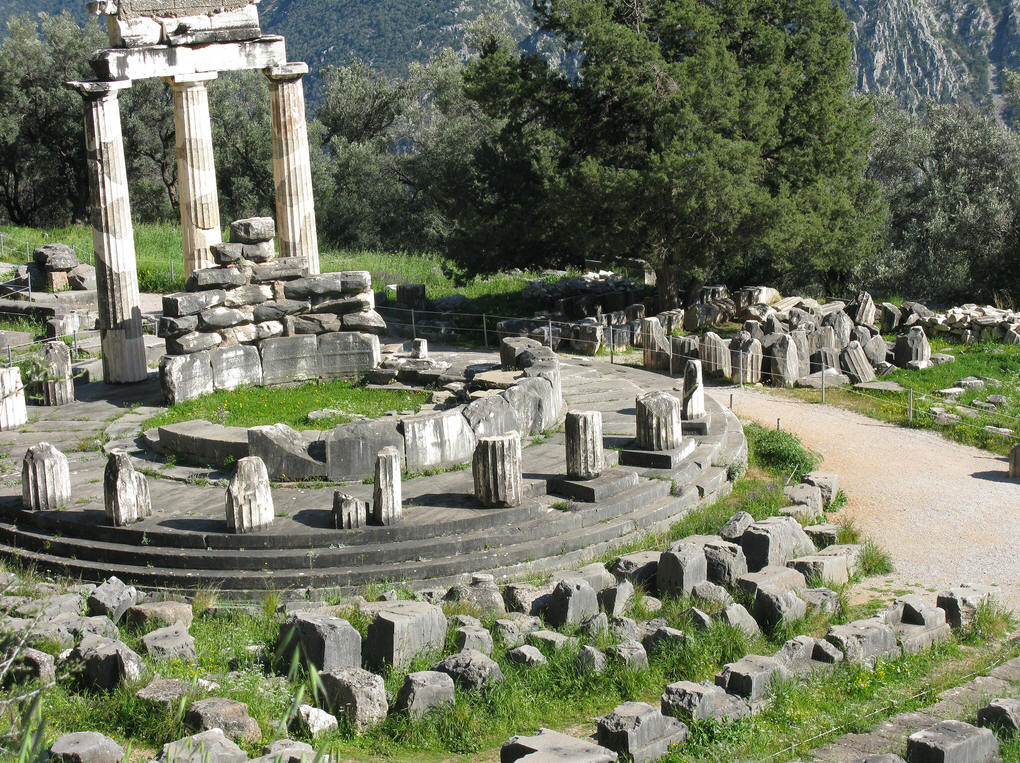
The Temple of Athena Pronaia was a temple at the ancient site of Delphi, in the Sanctuary of Athena Pronaia, a group of buildings comprising temples and treasuries as well as the famous Tholos of Delphi.It was actually built thrice.
.An image of the Temple of Athena Pronaia in Delphi, Greece
The standard story of the birth of the cosmos goes something like this: Nearly 14 billion years ago, a tremendous amount of energy materialized as if from nowhere.
In a brief moment of rapid expansion, that burst of energy inflated the cosmos like a balloon. The expansion straightened out any large-scale curvature, leading to a geometry that we now describe as flat. Matter also thoroughly mixed together, so that now the cosmos appears largely (though not perfectly) featureless. Here and there, clumps of particles have created galaxies and stars, but these are just minuscule specks on an otherwise unblemished cosmic canvas.
That theory, which textbooks call inflation, matches all observations to date and is preferred by most cosmologists. But it has conceptual implications that some find disturbing. In most regions of space-time, the rapid expansion would never stop. As a consequence, inflation can’t help but produce a multiverse — a technicolor existence with an infinite variety of pocket universes, one of which we call home. To critics, inflation predicts everything, which means it ultimately predicts nothing. “Inflation doesn’t work as it was intended to work,” said Paul Steinhardt, an architect of inflation who has become one of its most prominent critics.
.
In a cyclic universe, periods of expansion alternate with periods of contraction. The universe has no beginning and no end.
Film and Writing Festival for Comedy. Showcasing best of comedy short films at the FEEDBACK Film Festival. Plus, showcasing best of comedy novels, short stories, poems, screenplays (TV, short, feature) at the festival performed by professional actors.

 ‘You can’t hunt for something if you have no idea what it is.’ Credit: Mark Garlick / Science Photo Library / Getty Images.