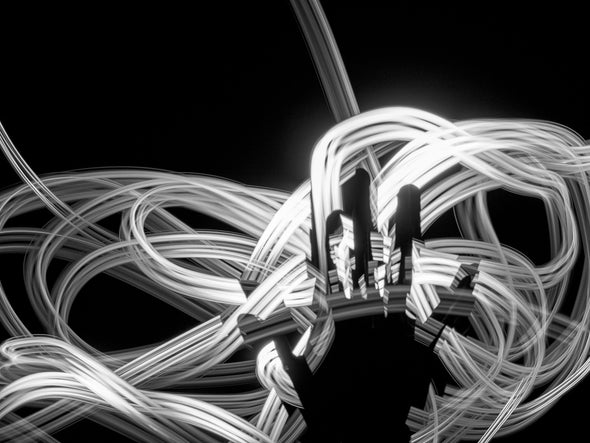
That question irked and inspired Hungarian-American physicist Eugene Wigner in the 1960s. He was frustrated by the paradoxes arising from the vagaries of quantum mechanics—the theory governing the microscopic realm that suggests, among many other counterintuitive things, that until a quantum system is observed, it does not necessarily have definite properties. Take his fellow physicist Erwin Schrödinger’s famous thought experiment in which a cat is trapped in a box with poison that will be released if a radioactive atom decays. Radioactivity is a quantum process, so before the box is opened, the story goes, the atom has both decayed and not decayed, leaving the unfortunate cat in limbo—a so-called superposition between life and death. But does the cat experience being in superposition?
Wigner sharpened the paradox by imagining a (human) friend of his shut in a lab, measuring a quantum system. He argued it was absurd to say his friend exists in a superposition of having seen and not seen a decay unless and until Wigner opens the lab door. “The ‘Wigner’s friend’ thought experiment shows that things can become very weird if the observer is also observed,” says Nora Tischler, a quantum physicist at Griffith University in Brisbane, Australia.
Nago–Torbole is a comune in Trentino in the northern Italian region Trentino-Alto Adige/Südtirol, located about 30 kilometers southwest of Trento on the north shore of Lake Garda.The municipality of Nago–Torbole contains the frazioni Torbole, Nago, and Tempesta.
A team of researchers at the Niels Bohr Institute, University of Copenhagen, have succeeded in entangling two very different quantum objects. The result has several potential applications in ultra-precise sensing and quantum communication and is now published in Nature Physics.
Entanglement is the basis for quantum communication and quantum sensing. It can be understood as a quantum link between two objects which makes them behave as a single quantum object.
Researchers succeeded in making entanglement between a mechanical oscillator—a vibrating dielectric membrane—and a cloud of atoms, each acting as a tiny magnet, or what physicists call “spin.” These very different entities were possible to entangle by connecting them with photons, particles of light. Atoms can be useful in processing quantum information and the membrane—or mechanical quantum systems in general—can be useful for the storage of quantum information.
.
Light propagates through the atomic cloud shown in the center and then falls onto the SiN membrane shown on the left. As a result of interaction with light, the precession of atomic spins and vibration of the membrane become quantum correlated. This is the essence of entanglement between the atoms and the membrane. Credit: Niels Bohr Institute
Lake Garda, in northern Italy, is known for its crystal clear water.At the south end, the town of Sirmione is dominated by the Rocca Scaligera, a fortress with harbor views. The nearby Grotte di Catullo archaeological site includes a Roman villa. On the lake’s western shore, in Gardone Riviera, is Il Vittoriale Degli Italiani, former home of poet D’Annunzio. The Dolomites frame Riva del Garda, a resort in the north.
Laura Leebrick, a manager at Rogue Disposal & Recycling in southern Oregon, is standing on the end of its landfill watching an avalanche of plastic trash pour out of a semitrailer: containers, bags, packaging, strawberry containers, yogurt cups.
None of this plastic will be turned into new plastic things. All of it is buried.
“To me, that felt like it was a betrayal of the public trust,” she said. “I had been lying to people … unwittingly.”
Rogue, like most recycling companies, had been sending plastic trash to China, but when China shut its doors two years ago, Leebrick scoured the U.S. for buyers. She could find only someone who wanted white milk jugs. She sends the soda bottles to the state.
.
Landfill workers bury all plastic except soda bottles and milk jugs at Rogue Disposal & Recycling in southern Oregon.
Rhonda Fleming, the red-haired actress who became a popular sex symbol in Hollywood westerns, film noir, and adventure movies of the 1940s and ’50s, died on Wednesday in Santa Monica, Calif. She was 97.
Her death, in a hospital, was confirmed by Carla Sapon, her longtime assistant.
Ms. Fleming’s roles included those of a beautiful Arthurian princess in the Bing Crosby musical version of Mark Twain’s novel “A Connecticut Yankee in King Arthur’s Court” (1949); a gambler and the love interest of Wyatt Earp (Burt Lancaster) in “Gunfight at the O.K. Corral” (1957); an amorous duchess in Bob Hope’s comedy “The Great Lover” (1949); and the somewhat less bad sister of Arlene Dahl’s bad-girl character in “Slightly Scarlet” (1956), which might be described as a Technicolor noir.
.
Rhonda Fleming in an undated photo. Sometimes referred to as the Queen of Technicolor because of her red hair, green eyes and fair skin, she later looked back on that label as a drawback.Credit…Popperfoto, via Getty Images
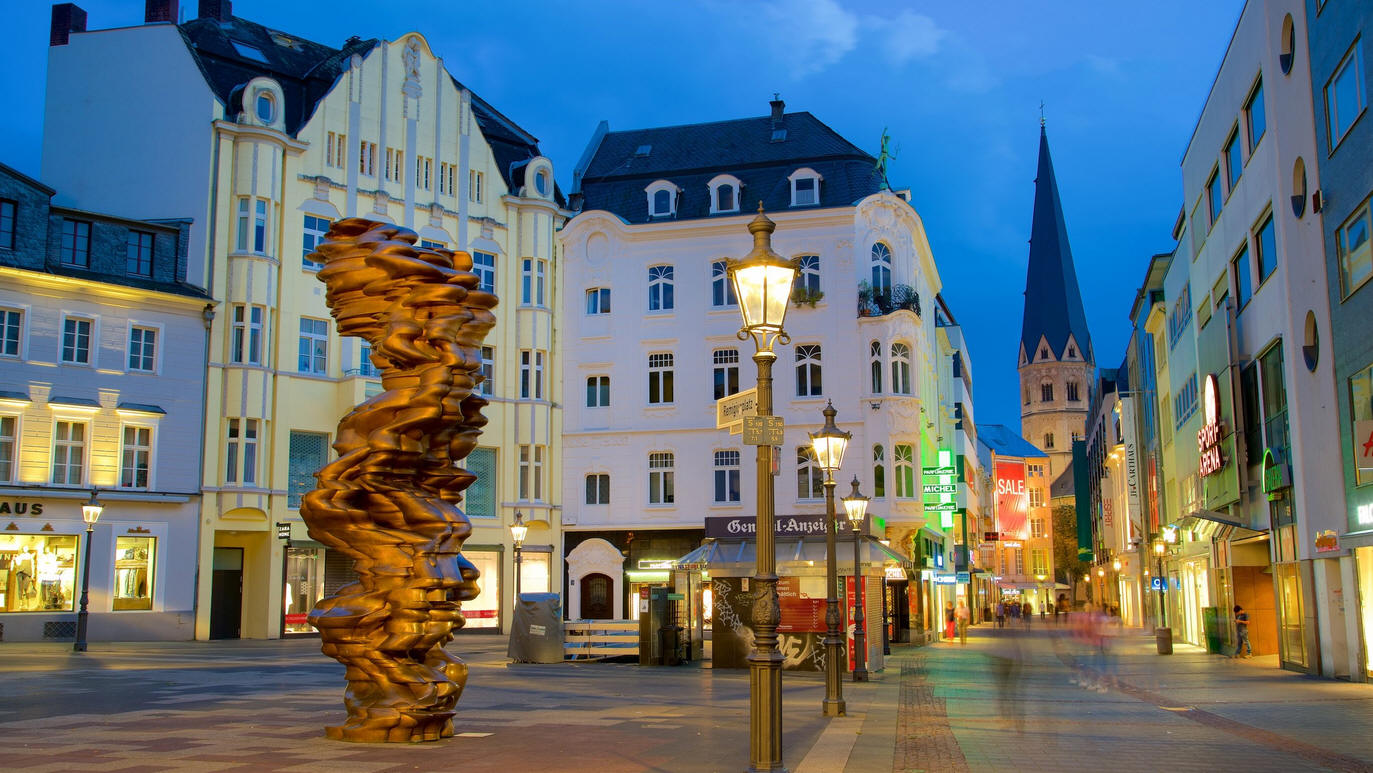
Bonn is a city in western Germany straddling the Rhine river. It’s known for the central Beethoven House, a memorial and museum honoring the composer’s birthplace. Nearby are Bonn Minster, a church with a Romanesque cloister and Gothic elements, the pink-and-gold Altes Rathaus, or old city hall, and Poppelsdorf Palace housing a mineralogical museum. To the south is Haus der Geschichte with post-WWII history exhibits.
.
An image from Bonn, North Rhine Westphalia Germany
Film and Writing Festival for Comedy. Showcasing best of comedy short films at the FEEDBACK Film Festival. Plus, showcasing best of comedy novels, short stories, poems, screenplays (TV, short, feature) at the festival performed by professional actors.

 Credit: Getty Images



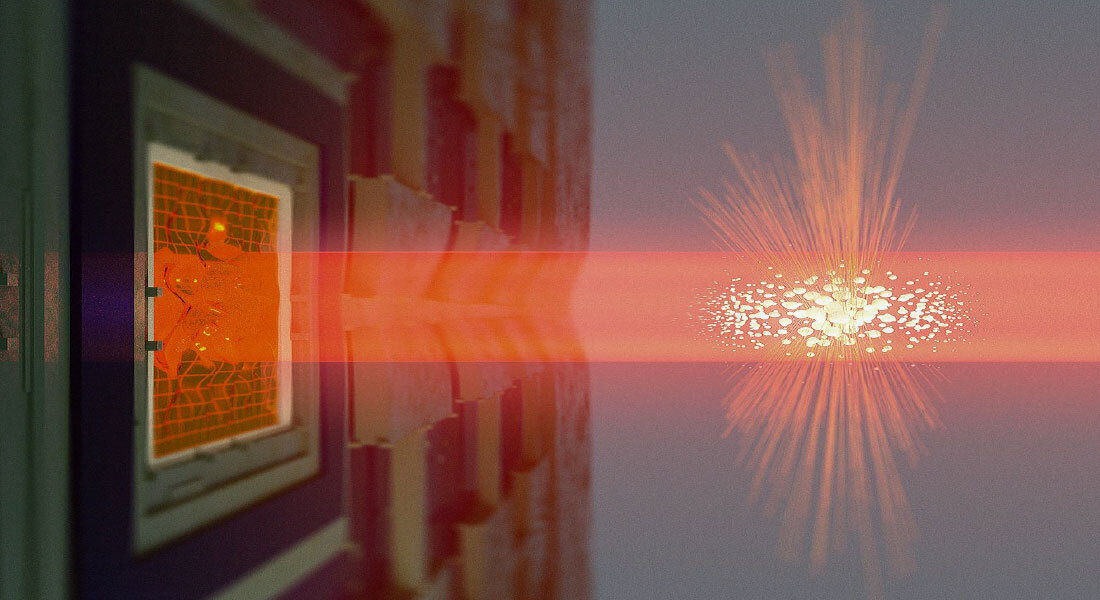 Light propagates through the atomic cloud shown in the center and then falls onto the SiN membrane shown on the left. As a result of interaction with light, the precession of atomic spins and vibration of the membrane become quantum correlated. This is the essence of entanglement between the atoms and the membrane. Credit: Niels Bohr Institute