It’s been almost a year since Donald Trump emerged from an election campaign of threats, lies and vitriol as the future president of the United States of America.
His victory speech on Nov. 9, 2016, sparked cautious optimism that perhaps his presidency would not be quite as hate-filled as his campaign.
“We will deal fairly with everyone, with everyone — all people and all other nations,” Trump vowed. “We will seek common ground, not hostility; partnership, not conflict.”
But within weeks, he had unleashed the first of a seemingly endless stream of Twitter tirades from his new bully pulpit. He lambasted the “failing” New York Times, the “highly overrated” Broadway musical “Hamilton,” the “unwatchable” “Saturday Night Live” and, of course, the “crooked” media, to name a few.
.
John MacDougall/Pool/Reuters
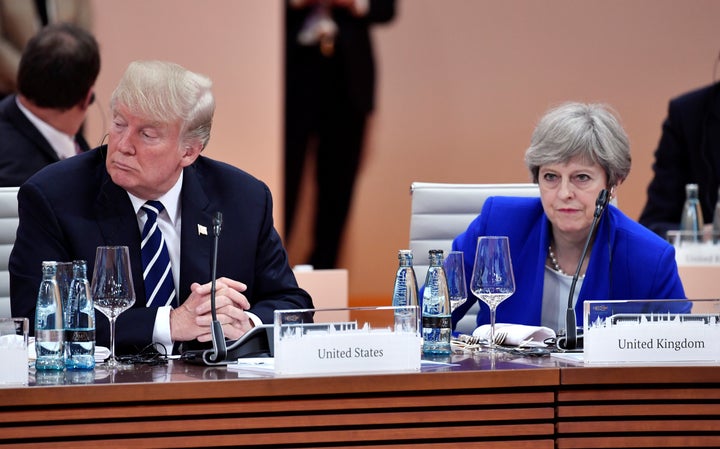
Trump and British Prime Minister Theresa May wait at the start of the first working session of the G-20 meeting in Hamburg, Germany, on July 7.
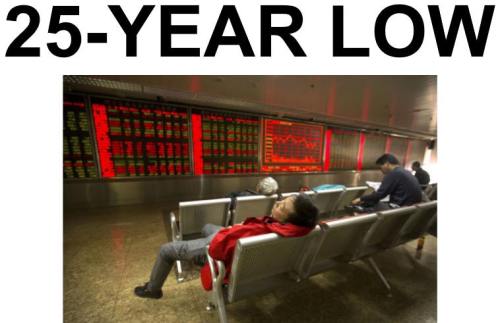
China’s economic growth edged down to 6.8 percent in the final quarter of 2015 as trade and consumer spending weakened, dragging full-year growth to its lowest in 25 years.
Growth has fallen steadily over the past five years as the ruling Communist Party tries to steer away from a worn-out model based on investment and trade toward self-sustaining growth driven by domestic consumption and services. But the unexpectedly sharp decline over the past two years prompted fears of a politically dangerous spike in job losses.
Full-year growth declined to 6.9 percent, government data showed Tuesday. That was the lowest since sanctions imposed on Beijing following its crackdown on the Tiananmen Square pro-democracy movement caused growth to plummet to 3.8 percent in 1990.
.
China’s economic growth edged down to 6.8 percent in the final quarter of 2015
China halted stock trading Thursday, its second daylong trading suspension this week, after prices plunged in the latest spasm of investor panic on its volatile markets.
Chinese markets have lurched up and down as regulators gradually withdraw emergency measures imposed after the main stock index plunged in June following an explosive rise.
A similar price plunge Monday triggered a sell-off on Wall Street and other global markets.
On Thursday, trading was suspended after a market index, the CSI 300, nose-dived 7 percent a half-hour after markets opened, triggering a “circuit breaker” that took effect Jan. 1.
.
Image: Breaking News and Opinion on The Huffington Post
U.S. stocks jumped at the open after China’s central bank cut interest rates to support its economy.
The Dow Jones industrial average rose 296 points, or 1.9 percent, to 16,180.61, as of 9:45 a.m. Eastern time. The Standard & Poor’s 500 index climbed 38 points, or 2 percent, to 1,932. The Nasdaq composite rose 109 points, or 2.4 percent, to 4,635.
Oil prices are up, but U.S. crude is still trading below $40 a barrel.
Massive explosions that rocked the port city of Tianjin were so strong that residents miles away thought they were experiencing an earthquake, witnesses said Thursday as the death toll rose to 50.
Twelve firefighters were among those killed in the twin blasts, which sent massive fireballs into the sky and devastated a warehouse district as well as nearby homes. More than 700 wounded were being treated at hospitals, including 71 in serious condition. No figure was given for those missing.
Chinese authorities did not say what caused the blasts. Local officials said firefighting was suspended on orders of the central government so that a team of chemical experts could assess hazardous materials on site.
.
Death toll rising from massive explosion in Tianjin, China
.
.
Click link below for article, videos and social media:
The global “currency war” entered a new phase on Tuesday as China’s surprise devaluation threatened to unleash competitive devaluations and keep monetary policy around the world looser for longer, perhaps even forcing the U.S. Federal Reserve to delay its expected interest rate rise.
“Currency wars,” a phrase used by Brazil’s former finance minister Guido Mantega in 2010 to describe how competing countries explicitly or implicitly weaken their exchange rates to boost exports, have intensified in recent years.
As interest rates have fallen to zero in some developed economies and money printing has proliferated, exchange rate policy has become one of the few remaining levers to stimulate business activity and in some cases avoid deflation. So investors are now concerned that China may elect to keep pushing the yuan lower.
.
Image: Breaking News and Opinion on The Huffington Post
Chinese authorities have evacuated tens of thousands of people, canceled scores of trains and flights and shuttered seaside resorts as a super-typhoon with wind gusts up to 200 kilometers per hour (125 mph) heads toward the southeastern coast.
China’s national weather service said super Typhoon Chan-hom is expected to make landfall by early Saturday at Fujian or Zhejiang province, and has issued its highest-level alert.
Zhejiang’s Civil Affairs Bureau said nearly 60,000 people were evacuated from coastal areas. The country’s railway service said more than 100 trains between the region’s cities are canceled through Sunday.
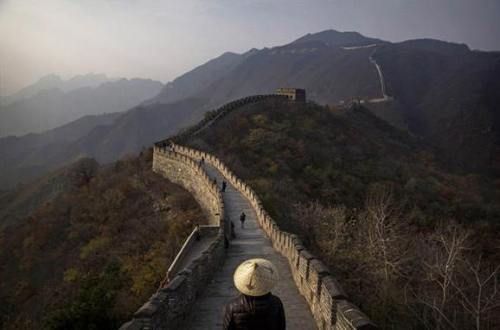
Around one-third of the Great Wall of China has been destroyed by vandalism and exposure to the elements, according to Chinese state-run media.
While human behavior — like the use of the wall’s stones for home-building or sale on the — has contributed to the deterioration, overgrown plants also have endangered the structure, Xinhua reported. As a result, whole sections of the UNESCO World Heritage site have large gaping holes and are crumbling — particularly in rural areas east of Beijing, it added in a report over the weekend.
“The destruction of the Great Wall has natural and human causes,” Dong Yaohui, vice chairman of the nonprofit Great Wall Society, told NBC News on Tuesday, calling for the creation of a systematic conservation plan. “The urgent task is to protect what is left.”
.
Visitors walk on a section of the Great Wall of China in 2014 in Mutianyu, near Beijing, China. Kevin Frayer / Getty Images file
He Quangui spends his days in a bed connected to a battered oxygen machine that pumps air into his lungs. The monotonous sound is punctuated only by his gasping cough. Like many of his fellow villagers in a mountainous area of Shaanxi Province in China, he answered the government’s call to leave his farm and make a better living as a migrant worker in the 1990s.
He went to work in an illegal gold mine, which, while helping fuel China’s growing economy, cost him dearly: He has silicosis, a form of pneumoconiosis, China’s most common occupational disease.
Today, when he leaves his bed, he often collapses, unable to breathe. There are treatments that could prolong his life and ease the suffering, but he has neither money nor benefits after his seven years working in the mines.
.
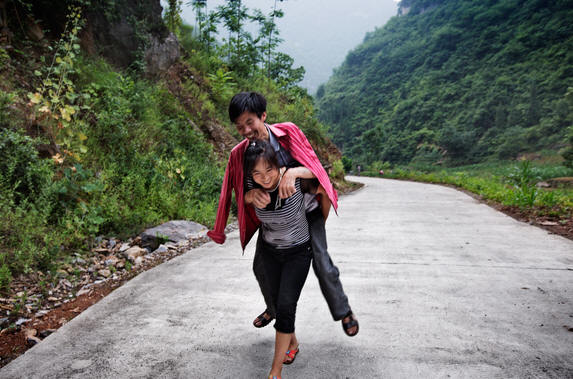
He Quangui, a former gold miner, is slowly dying of silicosis — an irreversible but preventable lung disease he contracted from years of working in small, unregulated mines in Henan Province in central China. Since he became ill 10 years ago, his wife, Mi Shixiu, 36, has had to take care of his every need. When he is too sickly to walk, she carries him, even up flights of stairs.
Film and Writing Festival for Comedy. Showcasing best of comedy short films at the FEEDBACK Film Festival. Plus, showcasing best of comedy novels, short stories, poems, screenplays (TV, short, feature) at the festival performed by professional actors.


 Chinese girl dancer/magician
 China’s economic growth edged down to 6.8 percent in the final quarter of 2015
 Image: Breaking News and Opinion on The Huffington Post
 Bull Market
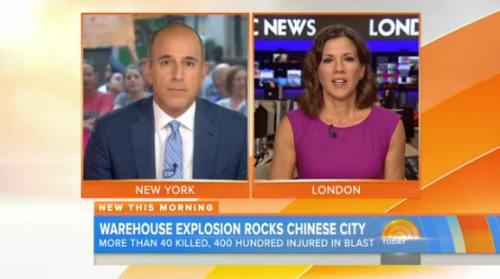

 Image: Breaking News and Opinion on The Huffington Post


 James' World 2