January 3, 2014
Mohenjo
Medical
alzheimers disease, amazon, biology, business, Business News, cognitive decline symptoms, Health, Health Medical Pharma, Hotels, human-rights, Hyperlink, Maurice Dysken, medicine, mental-health, Mild cognitive impairment, nutrition, placebo, red orbit, research, Science, Science News, technology, Technology News, travel, vacation, Vitamin
Click link below picture
.
A new study published in The Journal of the American Medical Association on Wednesday has indicated that taking vitamin E supplements during the early stages of Alzheimer’s can slow the progression of cognitive decline symptoms.
Study researchers said they found the supplement allowed patients’ to maintain their ability to perform basic tasks by an average of about six months.
“It will be very interesting to see to what extent this will change practice,” study author Dr. Maurice Dysken told Reuters. “I think it will, but we’ll have to see how people in the field such as providers view the findings and patients too.”
Previous research had revealed that the vitamin hampered the disease’s progression in people with a moderately severe Alzheimer’s. However, vitamin E had not been shown to be an effective treatment for people with a pre-Alzheimer’s condition called mild cognitive impairment.
For the new study, the researchers recruited over 610 volunteers between August 2007 and March 2012 from 14 Veterans Affairs medical centers. Participants were arbitrarily assigned to one of four groups.
One group took a daily supplement containing 2,000 International Units (IU) of vitamin E. A second group received the Alzheimer’s medication memantine. A third group took both the supplement and the drug and the final group took a placebo.
.

.
.
Click link below for article:
.
__________________________________________
December 21, 2013
Mohenjo
Science
amazon, Better Decisions, biology, business, Business News, Christian List, Daily Discovery, Decision Making, Decision-Making Study, Emotional Intelligence, Hotels, huffingtonpost, human-rights, Insects, Making-Better-Decisions, Mammals, medicine, Meerkats, mental-health, research, Science, Science News, Slideshow, social animals, swarm intelligence, technology, Technology News, travel, vacation
FROM

Click link below picture
.
What can humans learn from meerkats? More than you might imagine.
A provocative new study shows that, among meerkats and other social animals, conflict yields better decisions about shared goals, such as foraging and avoiding predators. And the researchers behind the study — in which existing scientific literature was used to create a complex model of decision-making — think something similar to this so-called “swarm intelligence” may play out in the human realm as well.
“Our results showed that shared decisions, made by animals without conflict, were often surprisingly poor,” study co-author Dr. Christian List, professor of political science and philosophy at the London School of Economics, said in a written statement. “It’s possible that this could be applicable to human collective decision making and would provide a strong argument for not excluding different or minority factions from collective decisions.”
.

Luke Horsten via Getty Images
.
.
Click link below for story and video:
.
__________________________________________
October 24, 2013
Mohenjo
Science
amazon, Ancient Human Skull, anthropology, Archaeology, biology, business, Business News, Daily Discovery, evolution, Health, Homo erectus, Homo ergaster, Homo habilis, Homo sapiens, Hotels, huffingtonpost, Human Ancestors, Human Evolution, human family tree, Human Skull Georgia, human species, human-rights, mental-health, Paleontology, Prehistoric Skull, Prehistory, research, Science, Science News, Skull 5, Skull 5 Humans, Slideshow, Smarter Ideas, technology, Technology News, travel, vacation, Video
FROM
Click link below picture
.
The earliest, now-extinct human lineages, once thought to be multiple species, may actually have been one species, researchers now controversially suggest.
Modern humans, Homo sapiens, are the only living member of the human lineage, Homo, which is thought to have arisen in Africa about 2 million years ago at the beginning of the ice age, also referred to as the Pleistocene Epoch. Many extinct human species were thought to once roam the Earth, such as Homo habilis, suspected to be among the first stone-tool makers; the relatively larger-brained Homo rudolfensis; the relatively slender Homo ergaster; and Homo erectus, the first to regularly keep tools it made.
To learn more about the roots of the human family tree, scientists investigated a completely intact, approximately 1.8-million-year-old skull excavated from the medieval hilltop town of Dmanisi in the Republic of Georgia. Archaeological excavations there about 30 years ago unexpectedly revealed that Dmanisi is one of the oldest-known sites for ancient human species out of Africa and the most complete collection of Homo erectus skulls and jaws found so far. The world’s largest, extinct cheetah species once lived in the area, and scientists cannot rule out whether it fed on these early humans.
.
 An artist’s conception revealing what “Skull 5” may have looked like some 1.8 million years ago when he (the scientists suspect the remains come from a male) lived.
.
.
Click link below for story, video and slideshow:
.
______________________________________________________________________________
September 13, 2013
Mohenjo
Science
amazon, biology, business, Business News, Fossils, Hotels, huffingtonpost, human-rights, largest prehistoric fish, Leedsichthys, Leedsichthys 50 Feet, Leedsichthys World's Largest Prehistoric Fish, museums of scotland, Paleontology, Prehistoric Fish Leedsichthys, research, Science, Science News, shark research, Slideshow, technology, Technology News, travel, university of glasgow, vacation, Video, whale shark, World's Largest Fish
FROM
Click link below picture
.
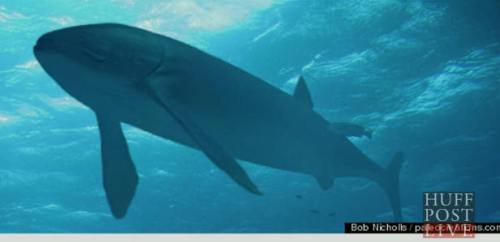
This is one ancient whale of a tale! An international team of scientists from the National Museums Scotland and the Universities of Glasgow and Edinburgh have completed a years-long project to excavate and assemble the most complete fossil of the world’s largest prehistoric fish.
The specimen suggests that Leedsichthys problematicus grew to a full size of around 50 feet long, twice that of previous estimates, according to a written statement from the University of Glasgow.
The massive fish must have cast an impressive shadow as it swam through the seas about 165 million years ago. With a bony physique, Leedsichthys pioneered an important ecological niche: It was the first of the giant plankton-feeders, whose modern-day equivalents today include the behemoth whale shark.
Research team leader Dr. Jeff Liston of the National Museums of Scotland told The Huffington Post in an email that several significant conclusions can be drawn from the Leedsichthys discovery.
.
.
.
Click link below for story, video and slideshow:
.
______________________________________________________________________________
September 7, 2013
Mohenjo
Science
amazon, Animal Behavior, animals, biology, Boa Constrictor, Boa Eating Monkey Video, Boa Eats Monkey, business, Business News, Hotels, howler monkey, Howler Monkeys, huffingtonpost, monkeys, new evidence, paul garber, primates, primatologist, research, Science, Science News, Slideshow, Snake Eating Monkey, technology, Technology News, time scientists, travel, vacation, Video
FROM
Click link below picture
.
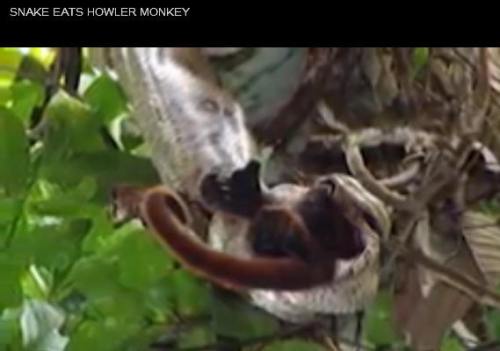
If a snake eats a monkey in the forest and no one sees it, does it make a difference? New evidence suggests that it does.
For the first time, scientists have witnessed a boa constrictor attacking and eating a howler monkey. The finding, and boa-eating-monkey video, is noteworthy since reports of primates being eaten by predators are relatively rare, according to the study, published this month in the journal Primates.
“This may cause us to rethink how vulnerable [these] primates are to predation,” said Paul Garber, a primatologist at the University of Illinois, who wasn’t involved in the study.
.
.
.
Click link below for story, video and slideshow:
.
______________________________________________________________________________
September 1, 2013
Mohenjo
Science
amazon, Ancient Nanotechnology, Ancient Romans, Ancient Romans Lycurgus Cup, Ancient Romans Nanotechnology, ancient technology, anthropology, Archaeology, biology, business, Business News, chemistry, color changes, Daily Discovery, Hotels, huffingtonpost, illinois assistant, Lycurgus Cup Nanotechnology, Nanotechnology, Nanotechnology History, Physics, research, Science, Science News, silver and gold, Slideshow, smithsonian magazine, technology, Technology News, tiny particles, travel, vacation, Video
FROM
Click link below picture
.54294
The ancient Romans were pretty advanced for their time — so advanced that they may even have been pioneers of what we now call nanotechnology.
In fact, an ornately decorated Roman artifact, known as the Lycurgus cup, is inspiring researchers to explore practical applications of the ancient technology.
Created sometime in the Fourth Century, the goblet exhibits a color-changing property that makes its glass take on different hues, depending on the light source — just watch the cup in the video above.
Scientists were long at a loss to explain the cup’s color changes. Then in the 1990s they discovered tiny particles of silver and gold in the cup’s glass. According to Smithsonian Magazine, “When hit with light, electrons belonging to the metal flecks vibrate in ways that alter the color depending on the observer’s position.”
Now, a research team is attempting to build upon the unique technology and apply it in the medical field.
Gang Logan Liu, an University of Illinois assistant professor who has studied the Lycurgus cup for several years, described it as an “icon for inspiration.”
.
.
.
Click link below for story, video and slideshow:
.
______________________________________________________________________________
August 28, 2013
Mohenjo
Science
amazon, Ancient Proteins, biology, business, Business News, chemistry, climate, deep sea hydrothermal vents, early earth, Earth, evolution, Fossil Proteins, Fossils, Hotels, html ref, Paleontology, physical chemist, Prehistory, Protein Fossils, research, Science, Science News, Slideshow, Space, Space Rocks, technology, Technology News, travel, university of granada, vacation
FROM
Click link below picture
.
Researchers have reconstructed the structure of 4-billion-year-old proteins.
The primeval proteins, described today (Aug. 8) in the journal Structure, could reveal new insights about the origin of life, said study co-author José Manuel Sanchez Ruíz, a physical chemist at the University of Granada in Spain.
Exactly how life emerged on Earth more than 3 billion years ago is a mystery. Some scientists believe that lightning struck the primordial soup in ammonia-rich oceans, producing the complex molecules that formed the precursors to life. Others believe that chemical reactions at deep-sea hydrothermal vents gave rise to cell membranes and simple cellular pumps. And still others believe that space rocks brought the raw ingredients for life — or perhaps even life itself — to Earth.
But it’s difficult to recreate events that happened so far in the distant past.
.

The individual molecules within early Earth’s primordial soup that form the basis of life likely developed in response to natural selection.
.
.
Click link below for story and slideshow:
.
______________________________________________________________________________
August 16, 2013
Mohenjo
Science
Adam & Eve, Adam And Eve, amazon, Ancient Humans, anthropology, aviation, biology, business, Business News, celebrities, climate, Earliest Human Ancestor, entertainment, gaming, Genetic Adam And Eve, Genetics, Hotels, huffingtonpost, Human Ancestors, human-origins, human-rights, Religion and Science, research, Science, Science News, Slideshow, technology, Technology News, transportation, travel, vacation, Video
FROM
Click link below picture
.
Almost every man alive can trace his origins to one man who lived about 135,000 years ago, new research suggests. And that ancient man likely shared the planet with the mother of all women.
The findings, detailed today (Aug. 1) in the journal Science, come from the most complete analysis of the male sex chromosome, or the Y chromosome, to date. The results overturn earlier research, which suggested that men’s most recent common ancestor lived just 50,000 to 60,000 years ago.
Despite their overlap in time, ancient “Adam” and ancient “Eve” probably didn’t even live near each other, let alone mate.
“Those two people didn’t know each other,” said Melissa Wilson Sayres, a geneticist at the University of California, Berkeley, who was not involved in the study.
.
.
.
Click link below for story, video and slideshow:
.
______________________________________________________________________________
July 24, 2013
Mohenjo
Science
aix marseille, amazon, biology, business, Business News, climate, Dail Discovery, Dna, electron microscopy image, evolutionary biologists, genes, genome, Genome Largest Viruses, Hotels, huffingtonpost, jean michel claverie, Largest Viruses, Megavirus, Mimivirus, New Life Form, Pandoraviruses, record breakers, research, Science, Science News, Slideshow, technology, Technology News, travel, vacation, Virus Genome, viruses
FROM
Click link below picture
.
The organism was initially called NLF, for “new life form”. Jean-Michel Claverie and Chantal Abergel, evolutionary biologists at Aix-Marseille University in France, found it in a water sample collected off the coast of Chile, where it seemed to be infecting and killing amoebae. Under a microscope, it appeared as a large, dark spot, about the size of a small bacterial cell.
Later, after the researchers discovered a similar organism in a pond in Australia, they realized that both are viruses — the largest yet found. Each is around 1 micrometre long and 0.5 micrometres across, and their respective genomes top out at 1.9 million and 2.5 million bases — making the viruses larger than many bacteria and even some eukaryotic cells.
But these viruses, described today in Science, are more than mere record-breakers — they also hint at unknown parts of the tree of life. Just 7% of their genes match those in existing databases.
“What the hell is going on with the other genes?” asks Claverie. “This opens a Pandora’s box. What kinds of discoveries are going to come from studying the contents?” The researchers call these giants Pandoraviruses.
.

Electron microscopy image of a mimivirus particle.
.
.Click link below for story and slideshow:
http://www.huffingtonpost.com/2013/07/20/virus-genome-fourth-domain-life_n_3624207.html?ref=topbar
.
____________________________________________________
June 19, 2013
Mohenjo
Science
amazon, animals, biology, birds, Birds Penises, business, climate, evolution, external genitalia, gaming, Genital Tubercle, Genitals, Hotels, How Birds Lost Penises, howard hughes medical, Howard Hughes Medical Institute, huffingtonpost, hughes medical institute, molecules, nature, Penises Birds, research, Science, Science News, Slideshow, technology, Technology News, travel, vacation, Weird Science
FROM
Click link below picture
.
How did the chicken lose its penis? By killing off the growing appendage in the egg.
That’s the finding of a new study, which reveals how most birds evolved to lose their external genitalia. Turns out, a particular protein released during the development of chickens, quail and most other birds nips penis development in the bud, according to the new research, published today (June 6) in the journal Current Biology.
The findings have implications for genital development in general, which is important because birth defects in the external genitalia are among the most common congenital defects in humans, said study researcher Martin Cohn, a developmental biologist at the Howard Hughes Medical Institute and the University of Florida.
.

The chicken embryo develops the beginnings of a penis, but the growth of the organ halts and regresses before hatching.
.
.Click link below for story and slideshow:
http://www.huffingtonpost.com/2013/06/06/birds-penises-protein-genitals_n_3397504.html?ref=topbar
.
_____________________________________________________
Older Entries
Newer Entries



 James' World 2