Whoops, we accidentally made the planet move: New research says human-caused climate change has accelerated the rate at which Earth’s rotational axis changes.
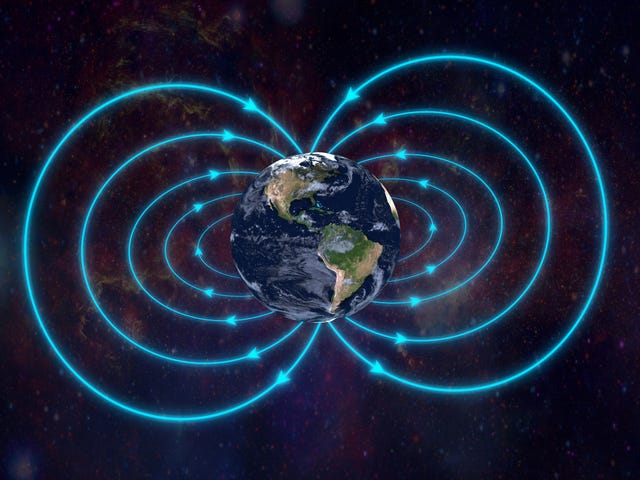
Earth has two kinds of poles. The north and south magnetic poles, which affect things like navigation, drift and even switch places back and forth over time. Earth’s other kind of pole is the axis around which the planet physically spins. This axis has also slightly shifted over time, but scientists haven’t been able to exactly figure out why.
To get to the bottom of it, researchers from the Institute of Geographic Sciences and Natural Resources Research in China and the Technical University of Denmark pulled satellite data from NASA’s Gravity Recovery and Climate Experiment (GRACE) spacecraft and studied this “true polar wander” phenomenon during a specific period of time in the 1990s.
By now, you have probably heard of the huge Facebook data breach, in which upwards of 533 million Facebook users from 106 countries had personal data leaked online, including phone numbers, Facebook IDs, birthdates — you name it.
Your first question will be, of course, how to check whether you are part of that breach. There are a couple of places out there where you can find out whether your data has been compromised.
One well-known site that tracks data breaches is Have I Been Pwned. Just follow the link to the site and put in your email address or phone number. You will find out not only if you’ve been part of the Facebook breach, but also any other breaches in which your data may have been compromised.
Troy Hunt, creator of Have I Been Pwned, was considering whether to include a phone number search (as this comes with certain privacy risks), but ultimately decided to add the feature:
For an academic, Michael Caulfield has an odd request: Stop overthinking what you see online.
Mr. Caulfield, a digital literacy expert at Washington State University Vancouver, knows all too well that at this very moment, more people are fighting for the opportunity to lie to you than at perhaps any other point in human history.
Misinformation rides the greased algorithmic rails of powerful social media platforms and travels at velocities and in volumes that make it nearly impossible to stop. That alone makes information warfare an unfair fight for the average internet user. But Mr. Caulfield argues that the deck is stacked even further against us. That the way we’re taught from a young age to evaluate and think critically about information is fundamentally flawed and out of step with the chaos of the current internet.
“We’re taught that, in order to protect ourselves from bad information, we need to deeply engage with the stuff that washes up in front of us,” Mr. Caulfield told me recently. He suggested that the dominant mode of media literacy (if kids get taught any at all) is that “you’ll get imperfect information and then use reasoning to fix that somehow. But in reality, that strategy can completely backfire.”
.
Our attention economy allows grifters, conspiracy theorists, trolls and savvy attention hijackers to take advantage of us and steal our focus. Credit…Leah Nash for The New York Times
As we inch closer to the heart of winter, many Americans are starting to prepare for the worst. Maybe you’re adjusting your thermostat more often or preparing your garage for cold weather conditions.
Among the terms used to describe wintery weather, the most dreaded might be “polar vortex.” The ominous term sounds like some earthly black hole trying to kill us with Arctic air. So what exactly is a polar vortex, and why do we keep hearing about it year after year?
The term “polar vortex” dates back to at least 1853, but names for the phenomenon shifted when scientists began to study it in earnest in the 20th century. The term was revised in 1950 when it was called a “circumpolar vortex,” then back to “polar vortex” by 1959. The American Meteorological Society glossary revised the definition in 2000, 2014, and then again in 2015.
The reason these changes keep happening is that the term “polar vortex” actually describes two types of cold weather events. One happens in the troposphere, the lowest layer of the earth’s atmosphere, while another happens higher up in the stratosphere. Basically, it’s a frigid cyclone.
For Bob Dylan’s 80th birthday we’ve compiled our list of the 80 greatest covers of his songs — a collective gift back to him to say thank you for everything he’s given us. The list has songs recorded by his folk peers nearly 60 years ago, and others from as recently as last year. Getting down to 80 wasn’t easy. As the greatest songwriter of all time, Dylan has inspired thousands of covers of his songs by artists from every corner of music. Our picks include everyone from Hendrix, Baez, and the Byrds to Cher, Adele, and Roots.
Dylan loved the ides of other people doing his songs, and it’s amazing how many songs here were recorded many times by other artists before the man himself ever released his own versions; often, they lived whole other lives, evolving and changing over the years, with his idea of the song as only a blueprint. And because there are so many kinds of Dylan songs, there’s a vast array of different kinds of Dylan covers: R&B singers love relaxing into the contours of “Lay Lady Lay”; country singers like his rootsy stuff; indie-rockers key into his sad side; heroic rock singers love scaling the peaks of open-ended classics — like “It’s All Over Now, Baby Blue” or “Like a Rolling Stone” — finding their own way to make new meanings amidst the intersecting, and often contradictory, emotions and ideas that can roil around within one Dylan song. Even weird, tossed-off or straight-up bad Dylan songs can make for great covers.
Upon reading this, true fans will immediately think of their own favorite covers that didn’t make the list. And that’s part of the fun. This story leads in a million directions. The road always ends wherever you’re at right now.
.
Photographs in illustration by Bruce Fleming/AP; Yui Mok/PA Wire/AP; H. Thompson/Evening Standard/Hulton Archive/Getty Images; David Corio/Redferns/Getty Images; Jason DeCrow/AP
The routine software update may be one of the most familiar and least understood parts of our digital lives. A pop-up window announces its arrival and all that is required of us is to plug everything in before bed. The next morning, rather like the shoemaker and the elves, our software is magically transformed.
Last spring, a Texas-based company called SolarWinds made one such software update available to its customers. It was supposed to provide the regular fare — bug fixes, performance enhancements — to the company’s popular network management system, a software program called Orion that keeps a watchful eye on all the various components in a company’s network. Customers simply had to log into the company’s software development website, type a password and then wait for the update to land seamlessly onto their servers.
The routine update, it turns out, is no longer so routine.
Hackers believed to be directed by the Russian intelligence service, the SVR, used that routine software update to slip malicious code into Orion’s software and then used it as a vehicle for a massive cyberattack against America.
.
An NPR investigation into the SolarWinds attack reveals a hack unlike any other, launched by a sophisticated adversary intent on exploiting the soft underbelly of our digital lives.
In May 2019, an agent at the Department of Homeland Security received a trove of unsettling images. Found by Yahoo in a Syrian user’s account, the photos seemed to document the sexual abuse of a young girl. One showed a man with his head reclined on a pillow, gazing directly at the camera. The man appeared to be white, with brown hair and a goatee, but it was hard to really make him out; the photo was grainy, the angle a bit oblique. The agent sent the man’s face to child-crime investigators around the country in the hope that someone might recognize him.
When an investigator in New York saw the request, she ran the face through an unusual new facial recognition app she had just started using, called Clearview AI. The team behind it had scraped the public web — social media, employment sites, YouTube, Venmo — to create a database with three billion images of people, along with links to the web pages from which the photos had come. This dwarfed the databases of other such products for law enforcement, which drew only on official photography like mug shots, driver’s licenses, and passport pictures; with Clearview, it was effortless to go from a face to a Facebook account.
Film and Writing Festival for Comedy. Showcasing best of comedy short films at the FEEDBACK Film Festival. Plus, showcasing best of comedy novels, short stories, poems, screenplays (TV, short, feature) at the festival performed by professional actors.


/cdn.vox-cdn.com/uploads/chorus_image/image/69076937/acastro_180806_1777_facebook_0001.0.jpg)









 James' World 2