October 19, 2021
Mohenjo
Business, Food For Thought, Human Interest, Science, Technical
amazon, business, Business News, current-events, Future, Hotels, human-rights, medicine, mental-health, research, Science, Science News, technology, Technology News, travel, vacation
Click the link below the picture
.
Steven Weinberg, who died on July 23, towered over theoretical physics in the second half of the 20th century. He strongly believed that, armed only with the fundamental principles of relativity and quantum mechanics, the theoretical physicist can examine all phenomena in the universe — from the smallest to the largest scales. His work transformed our understanding of every aspect of fundamental physics in startlingly deep and original ways.
Weinberg was a master of quantum field theory, a branch of physics born from applying the rules of quantum mechanics to the electromagnetic field, which sees a particle — the photon —as a “quantized” excitation of the field. He was instrumental in propelling quantum field theory to astonishing new heights in the description of nature.
The themes of unification and symmetry drove all of Weinberg’s work and led to his famous breakthrough on electroweak unification, which revealed a hidden unity between two of the universe’s four fundamental forces. At first sight, the electromagnetic and weak interactions seem utterly different: We see electromagnetic waves as light in everyday life, while the weak force — responsible for radioactivity — operates on subnuclear scales. Weinberg realized that at very high energies, the two forces should be intertwined, described by what’s known as Yang-Mills theory, whose equations have a special property called gauge symmetry. But this essential commonality is hidden by the so-called Higgs mechanism, which generates masses for elementary particles such as the electron and the W and Z particles (which mediate short-range weak interactions), all the while leaving the long-range photon massless. The model he proposed in 1967 for realizing this vision made many detailed predictions and has been triumphantly confirmed by experiments beginning in the 1970s and ’80s, capped off by the 2012 discovery of the Higgs particle. Weinberg shared the 1979 Nobel Prize in Physics with Sheldon Glashow and Abdus Salam for this work, a pillar of the Standard Model of particle physics.
.

Steven Weinberg at the American Physical Society Meeting in 1977. His work in particle physics redefined our understanding of the universe. AIP Emilio Segrè Visual Archives, Weber Collection
.
.
Click the link below for the article:
.
__________________________________________
October 19, 2021
Mohenjo
Business, Food For Thought, Human Interest, Science, Technical
amazon, business, Business News, current-events, Future, Hotels, human-rights, medicine, mental-health, research, Science, Science News, technology, Technology News, travel, vacation

Click the link below the picture
.
No matter where you look in the universe, in any direction, your line of sight will eventually run into some type of matter or radiation. The Earth is embedded in the solar system, with planets, moons, rocky and icy bodies, dust, and plasma particles permeating our environment. Beyond our own backyard are stars, gas, and dust strewn throughout the Milky Way, and at even greater cosmic distances are galaxies, quasars, and the matter in the intergalactic medium. If you somehow manage to pick a line of sight that doesn’t run into any of those, you’ll still encounter something: the cosmic microwave background, which is thought to be the leftover radiation from the early stages of the hot Big Bang.
And yet, no matter what we observe in any direction, two properties will correspond to whatever object we see:
- We are seeing the object not as it is today, but as it was a finite amount of time ago: when it emitted the light that’s now striking our eyes.
- That object is currently a specific distance away from us; if we could somehow “freeze” time and measure the distance between ourselves and that object, we’d get a certain value.
You might think that these two properties — time and distance — would be equal. A star whose light arrives after a journey of 10 years is 10 light-years away; a galaxy whose light arrives after a 100-million-year journey is 100 million light-years away; light from the Big Bang that arrives after a 13.8-billion-year journey has the emitting location 13.8 billion light-years away.
But that isn’t true at all — and the expanding universe is to blame.
.
 Artist’s logarithmic scale conception of the observable universe. Galaxies give way to large-scale structure and the hot, dense plasma of the Big Bang at the outskirts. This ‘edge’ is a boundary only in time. (Credit: Pablo Carlos Budassi; Unmismoobjetivo/Wikimedia Commons)
.
.
Click the link below for the article:
.
__________________________________________
October 19, 2021
Mohenjo
Crime, Finance, Food For Thought, Human Interest, Medical, missed News, Political, Science, Technical
amazon, business, Business News, current-events, Future, Hotels, human-rights, medicine, mental-health, research, Science, Science News, technology, Technology News, travel, vacation

.
News You might have missed!
Use your browser or smartphone back arrow (<-) to return to this table for your next selection.
.
__________________________________________
October 18, 2021
Mohenjo
Business, Food For Thought, Human Interest, Science, Technical
amazon, business, Business News, current-events, Future, Hotels, human-rights, medicine, mental-health, research, Science, Science News, technology, Technology News, travel, vacation
Some content on this page was disabled on April 15, 2025 as a result of a DMCA takedown notice from Guardian Media Group. You can learn more about the DMCA here:
https://wordpress.com/support/copyright-and-the-dmca/
October 18, 2021
Mohenjo
Business, Food For Thought, Human Interest, Science, Technical
amazon, business, Business News, current-events, Future, Hotels, human-rights, medicine, mental-health, research, Science, Science News, technology, Technology News, travel, vacation

Click the link below the picture
.
Where did all this come from? In every direction we care to observe, we find stars, galaxies, clouds of gas and dust, tenuous plasmas, and radiation spanning the gamut of wavelengths: from radio to infrared to visible light to gamma rays. No matter where or how we look at the universe, it’s full of matter and energy absolutely everywhere and at all times. And yet, it’s only natural to assume that it all came from somewhere. If you want to know the answer to the biggest question of all — the question of our cosmic origins — you have to pose the question to the universe itself, and listen to what it tells you.
Today, the universe as we see it is expanding, rarifying (getting less dense), and cooling. Although it’s tempting to simply extrapolate forward in time, when things will be even larger, less dense, and cooler, the laws of physics allow us to extrapolate backward just as easily. Long ago, the universe was smaller, denser, and hotter. How far back can we take this extrapolation? Mathematically, it’s tempting to go as far as possible: all the way back to infinitesimal sizes and infinite densities and temperatures, or what we know as a singularity. This idea, of a singular beginning to space, time, and the universe, was long known as the Big Bang.
But physically, when we looked closely enough, we found that the universe told a different story. Here’s how we know the Big Bang isn’t the beginning of the universe anymore.
.
 The modern cosmic picture of our universe’s history begins not with a singularity that we identify with the Big Bang, but rather with a period of cosmic inflation that stretches the universe to enormous scales, with uniform properties and spatial flatness. The end of inflation signifies the onset of the hot Big Bang. (Credit: Nicole Rager Fuller/National Science Foundation)
.
.
Click the link below for the article:
.
__________________________________________
October 18, 2021
Mohenjo
Business, Finance, Food For Thought, Human Interest, Medical, missed News, Political, Science, Technical
amazon, business, Business News, current-events, Future, Hotels, human-rights, medicine, mental-health, research, Science, Science News, technology, Technology News, travel, vacation
.
News You might have missed!
Use your browser or smartphone back arrow (<-) to return to this table for your next selection.
.
__________________________________________
October 17, 2021
Mohenjo
Business, Food For Thought, Human Interest, Science, Technical
amazon, business, Business News, current-events, Future, Hotels, human-rights, medicine, mental-health, research, Science, Science News, technology, Technology News, travel, vacation

Click the link below the picture
.
Some of the most important decisions you will make in your lifetime will occur while you feel stressed and anxious. From medical decisions to financial and professional ones, we are often required to weigh up information under stressful conditions. Take for example expectant parents who need to make a series of important choices during pregnancy and labor – when many feel stressed. Do we become better or worse at processing and using information under such circumstances?
In 2018, my colleague Neil Garrett, now at the Princeton Neuroscience Institute in New Jersey, and I ventured from the safety of our lab to fire stations in the state of Colorado to investigate how the mind operates under high stress. Firefighters’ workdays vary quite a bit. Some days are pretty relaxed; they’ll spend part of their time washing the truck, cleaning equipment, cooking meals, and reading. Other days can be hectic, with numerous life-threatening incidents to attend to; they’ll enter burning homes to rescue trapped residents, and assist with medical emergencies. These ups and downs presented the perfect setting for an experiment on how people’s ability to use information changes when they feel under pressure.
.
 Bad News
.
.
Click the link below for the article:
https://getpocket.com/explore/item/how-your-mind-gets-better-at-processing-bad-news?utm_source=pocket_discover
.
__________________________________________
October 16, 2021
Mohenjo
Business, Food For Thought, Human Interest, Science, Technical
amazon, business, Business News, current-events, Future, Hotels, human-rights, medicine, mental-health, research, Science, Science News, technology, Technology News, travel, vacation

Click the link below the picture
.
AcrossAcross China and Western Europe in July, the amount of rain that might typically fall over several months to a year came down within a matter of days, triggering floods that swept entire homes off their foundations. In June, the usually mild regions of Southwest Canada and the US’s Pacific Northwest saw temperatures that rivaled highs in California’s Death Valley desert. The severe heat was enough to buckle roads and melt power cables.
Yesterday, a landmark United Nations report helped put those kinds of extreme events into context. By burning fossil fuels and releasing planet-heating greenhouse gases into the atmosphere, humans are fueling more dangerous weather. Researchers have been able to connect the dots between greenhouse gas emissions and climate change for decades. But the new report showcases a big leap forward in climate science: being able to tie the climate crisis directly to extreme weather events like the June heatwave, which would have been “virtually impossible” without climate change according to recent studies.
The Verge spoke with Alex Ruane, one of the authors of the new report and a research physical scientist at the NASA Goddard Institute for Space Studies. He walks us through the phenomena that’s supercharging extreme weather events. And he explains why scientists have gotten so much better at seeing the “human footprint” in each weather disaster.
.
/cdn.vox-cdn.com/uploads/chorus_image/image/69704257/840653818.0.jpg) A view of the Houston skyline after heavy rains broke during the aftermath of Hurricane Harvey August 29, 2017. Harvey, swirling for days off Texas and Louisiana, dumped more than 49 inches (124.5 centimeters) of rain on the region.Photo credit should read BRENDAN SMIALOWSKI/AFP via Getty Images
A view of the Houston skyline after heavy rains broke during the aftermath of Hurricane Harvey August 29, 2017. Harvey, swirling for days off Texas and Louisiana, dumped more than 49 inches (124.5 centimeters) of rain on the region.Photo credit should read BRENDAN SMIALOWSKI/AFP via Getty Images
.
.
Click the link below for the article:
.
__________________________________________
October 16, 2021
Mohenjo
Business, Food For Thought, Human Interest, Science, Technical
amazon, business, Business News, current-events, Future, Hotels, human-rights, medicine, mental-health, research, Science, Science News, technology, Technology News, travel, vacation

Click the link below the picture
.
If you’ve ever gazed at a model of the solar system, you’ve likely noticed that the sun, planets, moons and asteroids sit roughly on the same plane. But why is that?
To answer this question, we have to travel to the very beginning of the solar system, about 4.5 billion years ago.
Back then, the solar system was just a massive, spinning cloud of dust and gas, Nader Haghighipour, an astronomer at the University of Hawaii at Mānoa, told Live Science. That massive cloud measured 12,000 astronomical units (AU) across; 1 AU is the average distance between Earth and the sun, or about 93 million miles (150 million kilometers). That cloud became so big, that even though it was just filled with dust and gas molecules, the cloud itself started to collapse and shrink under its own mass, Haghighipour said.
As the spinning cloud of dust and gas started to collapse, it also flattened. Imagine a pizza maker throwing a spinning slab of dough into the air. As it spins, the dough expands but becomes increasingly thin and flat. That’s what happened to the very early solar system.
.
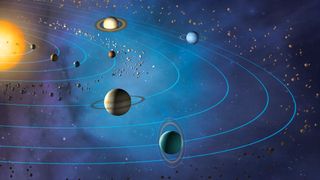 Artwork showing the planets orbiting the sun (from inner to outer): Mercury, Venus, Earth, Mars, Jupiter, Saturn, Uranus, and Neptune. (Image credit: Mark Garlick/Science Photo Library via Getty Images)
.
.
Click the link below for the article:
.
__________________________________________
October 16, 2021
Mohenjo
Finance, Food For Thought, Human Interest, Medical, missed News, Political, Science, Technical
amazon, business, Business News, current-events, Future, Hotels, human-rights, medicine, mental-health, research, Science, Science News, technology, Technology News, travel, vacation
.
News You might have missed!
Use your browser or smartphone back arrow (<-) to return to this table for your next selection.
.
__________________________________________
Older Entries
Newer Entries
 James' World 2