October 22, 2021
Mohenjo
Business, Food For Thought, Human Interest, Science, Technical
amazon, business, Business News, current-events, Future, Hotels, human-rights, medicine, mental-health, research, Science, Science News, technology, Technology News, travel, vacation

Click the link below the picture
.
What is it, at a fundamental level, that makes up the universe? When we ask this question, we typically think about starting with things that we directly observe — things like stars, planets, humans, gas, dust, plasma, and other forms of the matter we know — and dividing them up until you reach something that is indivisible. Although we originally thought that atoms would be these “uncuttable” things, we soon discovered they could be further divided: into electrons and atomic nuclei, which themselves are composed of quarks and gluons.
As we mastered the laws of physics and began to manipulate these subatomic particles, we gained the ability to accelerate and collide them, enabling the creation of a wide slew of particles and antiparticles: everything described by the Standard Model of particle physics. And yet, if we add up the sum total of all of these forms of matter, including photons, neutrinos, and everything that does not compose atoms, we fall far short of what is needed to describe our universe. Two additional components are necessary: dark matter and dark energy. Moreover, although we fully expect there to be a particle responsible for dark matter, that is not the case at all for dark energy.
.
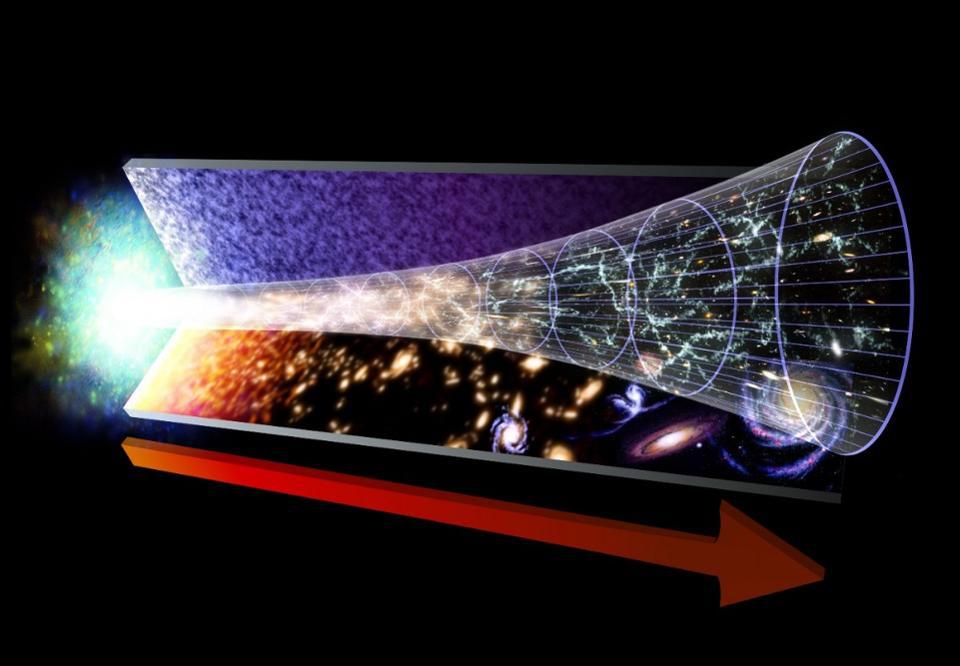 There is a large suite of scientific evidence that supports the picture of the expanding Universe and the Big Bang, complete with dark energy. The late-time accelerated expansion doesn’t strictly conserve energy, but the presence of a new component to the Universe, known as dark energy, is required to explain what we observe. (Credit: NASA / GSFC)
.
.
Click the link below for the article:
.
__________________________________________
October 22, 2021
Mohenjo
Business, Food For Thought, Human Interest, Science, Technical
amazon, business, Business News, current-events, Future, Hotels, human-rights, medicine, mental-health, research, Science, Science News, technology, Technology News, travel, vacation

Click the link below the picture
.
The list of mycologists whose names are known beyond their fungal field is short, and at its apex is Paul Stamets. Educated in, and a longtime resident of, the mossy, moldy, mushy Pacific Northwest region, Stamets has made numerous contributions over the past several decades— perhaps the best summation of which can be found in his 2005 book Mycelium Running: How Mushrooms Can Help Save the World. But now he is looking beyond Earth to discover new ways that mushrooms can help with the exploration of space.
In a new “astromycological” venture launched in conjunction with NASA, Stamets and various research teams are studying how fungi can be leveraged to build extraterrestrial habitats and perhaps someday even terraform planets. This is not the first time Stamets’s career has intersected with speculative space science. He also recently received an honor that many researchers would consider only slightly less hallowed than a Nobel Prize: the distinction of having a Star Trek character named after him.
Scientific American spoke with Stamets about the out-of-this-world implications for the emerging field of astromycology.
.
 Paul Stamets. Credit: Trav Williams Broken Banjo Photography
.
.
Click the link below for the article:
.
__________________________________________
October 22, 2021
Mohenjo
Arts, Crime, Food For Thought, Human Interest, Medical, missed News, Political, Science, Technical
amazon, business, Business News, current-events, Future, Hotels, human-rights, medicine, mental-health, research, Science, Science News, technology, Technology News, travel, vacation

.
News You might have missed!
Use your browser or smartphone back arrow (<-) to return to this table for your next selection.
.
__________________________________________
October 21, 2021
Mohenjo
Business, Food For Thought, Human Interest, Science, Technical
amazon, business, Business News, current-events, Future, Hotels, human-rights, medicine, mental-health, research, Science, Science News, technology, Technology News, travel, vacation

Click the link below the picture
.
As the world’s top climate scientists released a report full of warnings this week, they kept insisting that the world still has a chance to avoid the worst effects of climate change.
“It is still possible to forestall most of the dire impacts, but it really requires unprecedented transformational change,” said Ko Barrett, vice-chair of the Intergovernmental Panel on Climate Change. “The idea that there still is a pathway forward, I think, is a point that should give us some hope.”
That hopeful pathway, in which dangerous changes to the world’s climate eventually stop, is the product of giant computer simulations of the world economy. They’re called integrated assessment models. There are half a dozen major versions of them: four developed in Europe, one in Japan, and one in the U.S., at Pacific Northwest National Laboratory.
“What we mostly are doing, is trying to explore what is needed to meet the Paris goals,” says Detlef van Vuuren, at the Netherlands Environmental Assessment Agency, which developed one of the models.
.

Electrical workers check solar panels at a photovoltaic power station built in a fishpond in Haian in China’s eastern Jiangsu province. STR/AFP via Getty Images
.
.
Click the link below for the article:
.
__________________________________________
October 21, 2021
Mohenjo
Business, Food For Thought, Human Interest, Science, Technical
amazon, business, Business News, current-events, Future, Hotels, human-rights, medicine, mental-health, research, Science, Science News, technology, Technology News, travel, vacation

Click the link below the picture
.
Two intriguing signals spotted in a small gravitational-wave detector could represent all kinds of exotic phenomena — from new physics to dark matter interacting with black holes to vibrations from near the beginning of the universe. But, because of the experiment’s novelty, researchers are being cautious about claiming a discovery of any kind.
Facilities such as the Laser Interferometer Gravitational-Wave Observatory (LIGO) use gigantic laser-driven detectors to look for enormous ripples in the fabric of space-time known as gravitational waves. These come from the collisions of black holes and neutron stars out in the distant universe, which are events so powerful they shake space-time and send out surges with wavelengths measured in hundreds of miles.
Long before these huge observatories were built, scientists suspected that gravitational waves of such sizes existed because they knew that black holes and neutron stars should sometimes crash together, Michael Tobar, a physicist at the University of Western Australia in Perth, told Live Science.
.
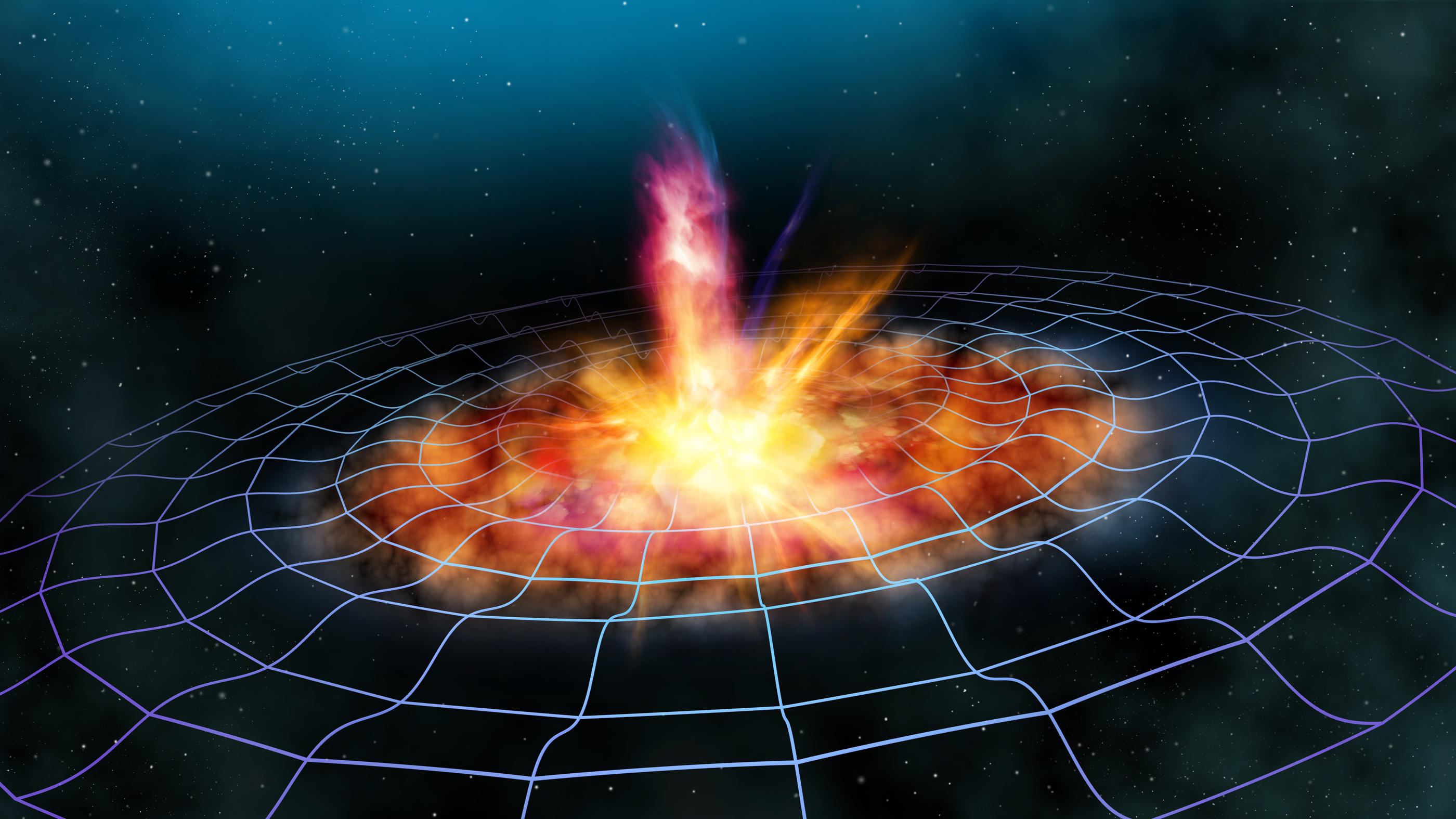 Gravitational waves are giant ripples in the fabric of space-time. (Image credit: Shutterstock)
.
.
Click the link below for the article:
.
__________________________________________
October 21, 2021
Mohenjo
Crime, Finance, Food For Thought, Human Interest, Medical, missed News, Political, Science, Technical
amazon, business, Business News, current-events, Future, Hotels, human-rights, medicine, mental-health, research, Science, Science News, technology, Technology News, travel, vacation
.
News You might have missed!
Use your browser or smartphone back arrow (<-) to return to this table for your next selection.
.
__________________________________________
October 20, 2021
Mohenjo
Business, Food For Thought, Human Interest, Science, Technical
amazon, business, Business News, current-events, Future, Hotels, human-rights, medicine, mental-health, research, Science, Science News, technology, Technology News, travel, vacation

Click the link below the picture
.
In 2017, an evolutionary biologist named R. Alexander Pyron ignited controversy with a Washington Post commentary titled “We don’t need to save endangered species. Extinction is part of evolution.” He wrote: “Conserving a species we have helped to kill off, but on which we are not directly dependent, serves to discharge our own guilt, but little else.”
Pyron’s take challenged the decades-old idea that biodiversity is a good thing — that humans should strive to preserve all forms of life on Earth and their interconnectedness across ecosystems. It prompted scientist and writer Carl Safina to mount a passionate defense of biodiversity, calling Pyron’s stance “conceptually confused” and containing “jarring assertions.” Safina’s most cutting rebuke was that belittling biodiversity derails environmental conversations. “It’s like answering ‘Black lives matter’ with ‘All lives matter,’” he wrote. “It’s a way of intentionally missing the point.”
Nobel Prize winners co-signed more rebuttals. Professors blogged long meditations on why endangered species need to be saved. There were scientists who had previously questioned hyperfocus on saving species, to be sure, though none had done so in such a public and broad-sweeping manner as Pyron. Josh Schimel, an ecologist at UC Santa Barbara, wrote: “Remember, you are a scientist — it is not your job to be right. It is your job to be thoughtful, careful, and analytical.” Pyron declined a request for comment for this story.
.
/cdn.vox-cdn.com/uploads/chorus_image/image/69681997/biodiversity_board_3.0.jpg) Christina Animashaun/Vox
Christina Animashaun/Vox
.
.
Click the link below for the article:
.
__________________________________________
October 20, 2021
Mohenjo
Business, Food For Thought, Human Interest, Science, Technical
amazon, business, Business News, current-events, Future, Hotels, human-rights, medicine, mental-health, research, Science, Science News, technology, Technology News, travel, vacation

Click the link below the picture
.
What will our Sun look like after it dies? Scientists have made predictions about what the end will look like for our Solar System, and when that will happen. And humans won’t be around to see the final act.
Previously, astronomers thought it would turn into a planetary nebula – a luminous bubble of gas and dust – until evidence suggested it would have to be a fair bit more massive.
An international team of astronomers flipped it again in 2018 and found that a planetary nebula is indeed the most likely solar corpse.
The Sun is about 4.6 billion years old – gauged on the age of other objects in the Solar System that formed around the same time. Based on observations of other stars, astronomers predict it will reach the end of its life in about another 10 billion years.
There are other things that will happen along the way, of course. In about 5 billion years, the Sun is due to turn into a red giant. The core of the star will shrink, but its outer layers will expand out to the orbit of Mars, engulfing our planet in the process. If it’s even still there.
One thing is certain: By that time, we won’t be around. In fact, humanity only has about 1 billion years left unless we find a way off this rock. That’s because the Sun is increasing in brightness by about 10 percent every billion years.
.
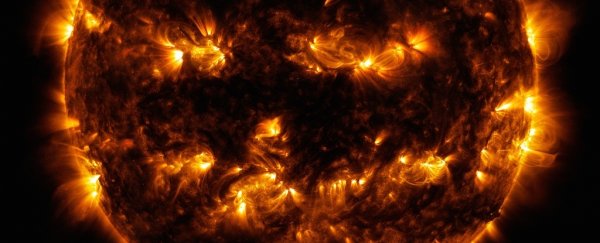 (NASA/SDO)
.
.
Click the link below for the article:
.
__________________________________________
October 20, 2021
Mohenjo
Crime, Food For Thought, Human Interest, Medical, missed News, Political, Science, Technical
amazon, business, Business News, current-events, Future, Hotels, human-rights, medicine, mental-health, research, Science, Science News, technology, Technology News, travel, vacation
.
News You might have missed!
Use your browser or smartphone back arrow (<-) to return to this table for your next selection.
.
__________________________________________
October 19, 2021
Mohenjo
Business, Food For Thought, Human Interest, Science, Technical
amazon, business, Business News, current-events, Future, Hotels, human-rights, medicine, mental-health, research, Science, Science News, technology, Technology News, travel, vacation
Click the link below the picture
.
Steven Weinberg, who died on July 23, towered over theoretical physics in the second half of the 20th century. He strongly believed that, armed only with the fundamental principles of relativity and quantum mechanics, the theoretical physicist can examine all phenomena in the universe — from the smallest to the largest scales. His work transformed our understanding of every aspect of fundamental physics in startlingly deep and original ways.
Weinberg was a master of quantum field theory, a branch of physics born from applying the rules of quantum mechanics to the electromagnetic field, which sees a particle — the photon —as a “quantized” excitation of the field. He was instrumental in propelling quantum field theory to astonishing new heights in the description of nature.
The themes of unification and symmetry drove all of Weinberg’s work and led to his famous breakthrough on electroweak unification, which revealed a hidden unity between two of the universe’s four fundamental forces. At first sight, the electromagnetic and weak interactions seem utterly different: We see electromagnetic waves as light in everyday life, while the weak force — responsible for radioactivity — operates on subnuclear scales. Weinberg realized that at very high energies, the two forces should be intertwined, described by what’s known as Yang-Mills theory, whose equations have a special property called gauge symmetry. But this essential commonality is hidden by the so-called Higgs mechanism, which generates masses for elementary particles such as the electron and the W and Z particles (which mediate short-range weak interactions), all the while leaving the long-range photon massless. The model he proposed in 1967 for realizing this vision made many detailed predictions and has been triumphantly confirmed by experiments beginning in the 1970s and ’80s, capped off by the 2012 discovery of the Higgs particle. Weinberg shared the 1979 Nobel Prize in Physics with Sheldon Glashow and Abdus Salam for this work, a pillar of the Standard Model of particle physics.
.

Steven Weinberg at the American Physical Society Meeting in 1977. His work in particle physics redefined our understanding of the universe. AIP Emilio Segrè Visual Archives, Weber Collection
.
.
Click the link below for the article:
.
__________________________________________
Older Entries
Newer Entries
 James' World 2