At least five deaths and more than a dozen injuries were reported by Sunday morning in the aftermath of Harvey, the hurricane that tore across the Gulf Coast of Texas over the weekend.
• The powerful system, now a tropical storm, pounded the region with torrential rains that were expected to continue for days, causing catastrophic flooding, according to the National Hurricane Center.
• “This event is unprecedented,” the National Weather Service said in a tweet.
• The public hospital for Harris County, which includes Houston, began evacuating patients after flooding disrupted its power supply.
Think virtual reality is just about gaming and the world of make-believe? Get real. From product design to real estate, many industries have adopted VR and related technologies— and nowhere are the benefits of VR greater than in healthcare.
“We are seeing more and more of this incorporated faster than ever before,” said Dr. Ajit Sachdeva, Director of Education with the American College of Surgeons. “VR has reached a tipping point in medicine.”
As NBC News MACH reported previously, psychologists have found VR to be good for treating post-traumatic stress disorder. And stroke doctors, pain specialists, surgeons, and other medical practitioners have found their own uses for VR. In some cases, medical VR involves the familiar headsets; in others, 3D glasses and special video screens give a VR-like experience.
.
Sarah DiGiulio
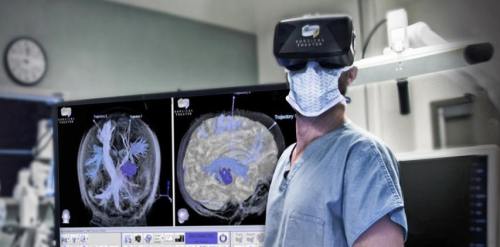
Surgeons can now don VR headsets to virtually fly through their patient’s brain or body.
The National Hurricane Center has upgraded Hurricane Harvey to a stronger-than-expected Category 4 storm.
Residents on the Texas coast who have not yet evacuated should find a safe place and shelter there.
Texas Gov. Greg Abbott has asked President Donald Trump for a presidential disaster declaration ahead of Harvey’s landfall Friday night.
As Hurricane Harvey trundled toward Texas on Friday it strengthened into a Category 4 storm, exceeding previous projections shortly before making landfall.
The National Hurricane Center upgraded the slow-moving, waterlogged storm to a Category 4 hurricane late Friday afternoon as its maximum sustained winds grew to 130 mph. The bulk of the storm is expected to make landfall Friday night.
The National Weather Service warned Category 4 storms can result in “catastrophic damage” to even well-built frame homes, while dwellings like mobile homes will almost certainly be destroyed. Given the intensity of the winds ― Category 4 tops out at 156 mph ― large trees will also likely be snapped or uprooted.
The last Category 4 storm in the U.S. was Hurricane Charley, which caused $13 billion in damages when it made landfall in Florida in 2004.
Harvey intensified into an extremely dangerous Category 3 hurricane as it closed in on the Texas coast Friday afternoon. The storm is set to become the first major hurricane, rated Category 3 or higher (on the 1-5 Saffir-Simpson intensity scale), to strike U.S. soil in 12 years when it comes ashore late Friday night or early Saturday.
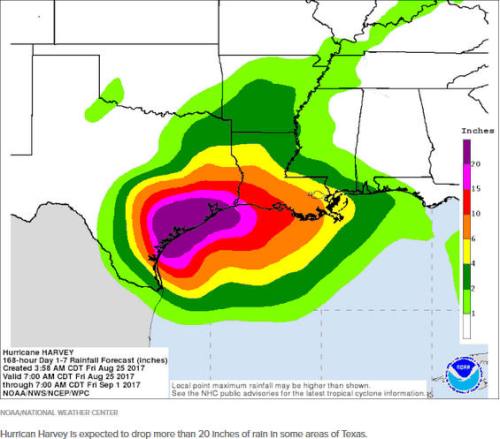
The National Hurricane Center said it expects “catastrophic and life-threatening” flash flooding along the middle and upper Texas coast. An incredible amount of rain, 15 to 25 inches with isolated amounts of up to 35 inches, is predicted because the storm is expected to stall and unload torrents for four to six straight days. In just a few days, the storm may dispense the amount of rain that normally falls over an entire year, shattering records.
“Let’s set the expectations: Texas is about to have a very significant disaster,” said Brock Long, FEMA administrator.
Tiny versions of human organs smaller than a pea are making a big splash around the world — and for a good reason. Though the clusters of cells of brain, kidney, or liver aren’t much to look at, experts say these so-called “organoids” and “organs-on-a-chip” are poised to remake the way new drugs are brought to market.
Right now, drug development is notoriously slow and costly; bringing a new drug to market can take a dozen years and cost upward of $2 billion. Even after all that time and money have been spent, new drug candidates often prove to be ineffective — or to have dangerous side effects.
“A huge percentage of drugs fail even after hundreds of millions or billions of dollars of investment,” says Dr. Donald Ingber, director of Harvard University’s Wyss Institute for Biologically Inspired Engineering and a leader in organ-on-a-chip technology. In fact, only about one in 10 drugs that make it to human tests (after testing in the lab and in animals) wind up getting FDA approval.
Hurricane Harvey intensified to a Category 2 hurricane by early Friday as it moved toward Texas, with meteorologists forecasting that the storm could be a Category 3 “major hurricane” when it makes landfall late Friday or early Saturday.
No storm that strong has hit Texas since 2008.
Harvey is expected to stall after it hits land, dumping torrential rain over the southeast Texas region through Tuesday and causing potentially historic flooding, NBC News meteorologist Bill Karins said.
.
‘Be Nice Harvey’ adorns a boarded-up business Thursday in Port Aransas, Texas. Eric Gay / AP
Ever since the 10-story Home Insurance Building in Chicago was called the first “skyscraper” in 1885, architects have been striving to create ever-taller buildings. Ten stories quickly became 20, 20 became 50, and on and on. In 2009 the Burj Khalifa in Dubai became the world’s tallest building, with its 154 floors towering above ground level.
So why is the mayor of Portland, Oregon, calling a modest 12-story tower set for completion there next year “a true technological and entrepreneurial achievement?” It’s not the affordable housing the building affords, nor its dozens of bike racks or even the roof farm that has Ted Wheeler gushing. It’s that the Framework apartment building will be made almost entirely of wood.
Once completed, Framework will be America’s tallest wooden building and its first “plyscraper” — a high-rise building built with panels made of cross-laminated timber (CLT). These modular sheets are made from cheap, sustainable softwood that are glued or pinned together in layers — a bit like super-strong, super-thick plywood. – Eco-Friendly ‘Plyscrapers’ Are on the Rise.
.
Mark Harris
Framework is slated to become the first mass timber high-rise in the U.S. Artist’s rendering courtesy of LEVER Architecture .
The Arctic is warming about twice as fast as other parts of the planet, and even here in sub-Arctic Alaska the rate of warming is high. Sea ice and wildlife habitat are disappearing; higher sea levels threaten coastal native villages.
But to the scientists from Woods Hole Research Center who have come here to study the effects of climate change, the most urgent is the fate of permafrost, the always-frozen ground that underlies much of the state.
Starting just a few feet below the surface and extending tens or even hundreds of feet down, it contains vast amounts of carbon in organic matter — plants that took carbon dioxide from the atmosphere centuries ago, died and froze before they could decompose. Worldwide, permafrost is thought to contain about twice as much carbon as is currently in the atmosphere.
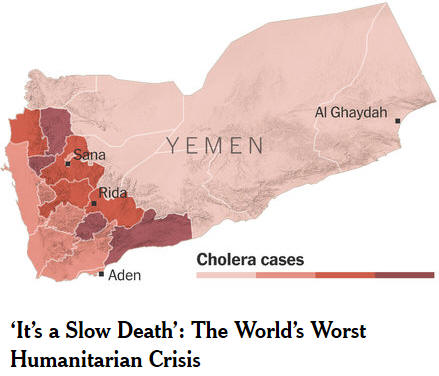
After two and a half years of war, little is functioning in Yemen.
Repeated bombings have crippled bridges, hospitals and factories. Many doctors and civil servants have gone unpaid for more than a year. Malnutrition and poor sanitation have made the Middle Eastern country vulnerable to diseases that most of the world has confined to the history books.
In just three months, cholera has killed nearly 2,000 people and infected more than a half million, one of the world’s largest outbreaks in the past 50 years.
Your circadian rhythm (also known as your sleep/wake cycle or body clock) is a natural, internal system that’s designed to regulate feelings of sleepiness and wakefulness over a 24-hour period. This complex timekeeper is controlled by an area of the brain that responds to light, which is why humans are most alert while the sun is shining and are ready to sleep when it’s dark outside.
Your circadian rhythm causes your level of wakefulness to rise and dip throughout the day. Most people feel the strongest desire to sleep between 1:00pm and 3:00pm (a.k.a. the post-lunch, afternoon crash) and then again between 2:00am and 4:00am, but this can vary from person to person. That’s why some people are “morning people,” while others function best in the evening. Your circadian rhythm can also change as you age. When you were a teenager, for example, your body was programmed (so to speak) to sleep for more total hours, as well as go to bed and wake up later.
Film and Writing Festival for Comedy. Showcasing best of comedy short films at the FEEDBACK Film Festival. Plus, showcasing best of comedy novels, short stories, poems, screenplays (TV, short, feature) at the festival performed by professional actors.

 .
.






 .
.
 .
.
 Good Sleep
 James' World 2