The sCarabane camper is equipped with a wind generator, solar panels, and a parabolic mirror for heating water, making it a great choice for those who want to go camping without sacrificing luxury.
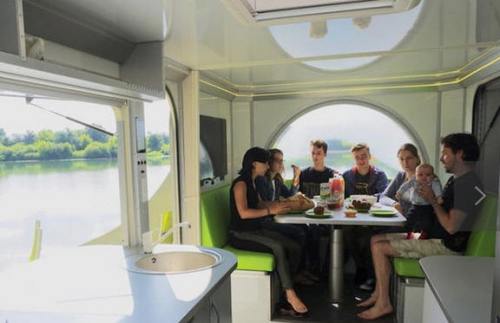
We’ve seen some impressive campers in our day, but nothing quite compares to the sCarabane. Billed as a “self-sufficient rotating caravan,” this concept trailer features a slew of amenities — including the ability to generate its own power — that could make it the ultimate portable home for those living off the grid.
When in its mobile form — it can be pulled by a vehicle — the sCarabane measures 25.5 feet in length, 9.1 feet in height, and 8.2 feet in width. But, upon arrival at the campsite, the trailer transforms into surprisingly large and open space, complete with two bedrooms, a bathroom, kitchen, and dining area. It even comes with a 140 square-foot foldout deck that provides additional outdoor living space. This transformation requires just one person and takes about 30 minutes to complete.
.
Amazing, collapsible, transforming trailer
.
.
Click link below for article, video and 22 image slideshow:
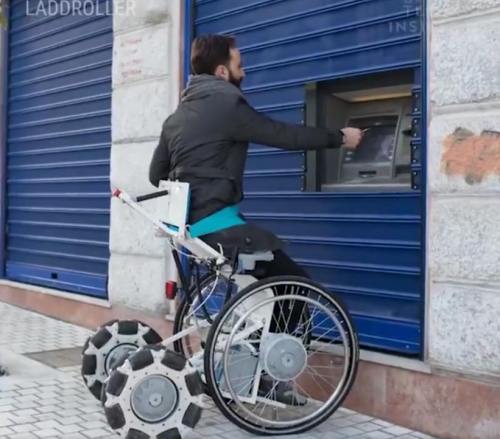
Laddroller wheelchair – This wheelchair design aims to give people with disabilities more freedom, going from seated to standing position in just seconds.
Last summer, a blueberry farm in Oregon was desperate to solve its bird problem. The year before, the farm had lost more blueberries to hungry birds than in any previous growing season, with robins and starlings devouring 25 percent of its crop.
At the start of this year’s growing season, the 168-acre farm installed six Agrilaser Autonomics—which are automated laser guns mounted on a pedestal—and aimed them at its blueberry bushes. The devices shoot a steady green laser beam that sweeps across the bushes from side to side. Birds seem to mistake the sweep of the laser for a predator’s approach, and take flight whenever it comes near.
Bird Control Group, the company that manufactures the lasers, says the devices have reduced the number of birds on the blueberry farm by 99 percent, from an average of 1,500 birds to just a handful. The farm estimates it has saved about 262,500 kilograms (578,713 pounds) of blueberries, worth US $99,733, as a result.
Jonathan Rothberg, a entrepreneur who prides himself on drastically disrupting the biomedical industry every so often, has typically big claims for his new product. The Butterfly iQ, a cheap handheld ultrasound tool with AI smarts tucked inside, will 1) revolutionize medical imaging in hospitals and clinics, 2) change the game in global health, and 3) eventually become a consumer product that will be as ubiquitous as the household thermometer, he says.
Today, Rothberg’s startup Butterfly Network unveiled the tool and announced its FDA clearance for 13 clinical applications, including cardiac scans, fetal and obstetric exams, and musculoskeletal checks. Rather than using a dedicated piece of hardware for the controls and image display, the iQ works with the user’s iPhone. The company says it will start shipping units in 2018 at an initial price of about $2,000.
But that’s just the beginning, Rothberg tells IEEE Spectrum. He expects to bring the price down on the handheld gadget, and is already looking ahead to radically new products. “In the next two years we’ll release a patch that uses ultrasound to monitor patients, and a pill you can swallow to look at cancer from within the body,” he says.
One of the crazier facts about life in America is this: For roughly two decades, nobody had any clue what time it was.
In office buildings, it could be 4 p.m. on one floor and 5 p.m. on another — an important matter for several reasons, including who punched out first to get to happy hour. People would step off airplanes with no idea how to set their watches. Ponder this head-scratcher:
“A short trip from Steubenville, Ohio, to Moundsville, West Virginia became a symbol of the deteriorating situation. A bus ride down this thirty-five-mile stretch of highway took less than an hour. But along that route, the local time changed seven times.”
.
Preparing for daylight saving, a worker adjust hands on a stainless steel tower clock at Electric Time Company in Medfield, Mass., on March 7, 2014. (Elise Amendola/AP)
Directly contradicting much of the Trump administration’s position on climate change, 13 federal agencies unveiled an exhaustive scientific report on Friday that says humans are the dominant cause of the global temperature rise that has created the warmest period in the history of civilization.
Over the past 115 years global average temperatures have increased 1.8 degrees Fahrenheit, leading to record-breaking weather events and temperature extremes, the report says. The global, long-term warming trend is “unambiguous,” it says, and there is “no convincing alternative explanation” that anything other than humans — the cars we drive, the power plants we operate, the forests we destroy — are to blame.
The report was approved for release by the White House, but the findings come as the Trump administration is defending its climate change policies. The United Nations convenes its annual climate change conference next week in Bonn, Germany, and the American delegation is expected to face harsh criticism over President Trump’s decision to walk away from the 195-nation Paris climate accord and top administration officials’ stated doubts about the causes and impacts of a warming planet.
.
Smoke rose from trees burned in a wildfire in Wrightwood, Calif., last year. A report from 13 federal agencies says extreme weather events have cost the United States $1.1 trillion since 1980.CreditJonathan Alcorn/Agence France-Presse — Getty Images
Video Friday is your weekly selection of awesome robotics videos, collected by your Automaton bloggers. We’ll also be posting a weekly calendar of upcoming robotics events for the next two months; here’s what we have so far
20 videos.
.
Image: Caltech via YouTube
.
Click link below to enjoy 20 videos (Caltech’s Cassie is featured in video #8):
Dustin Shillcox fully embraced the vast landscape of his native Wyoming. He loved snowmobiling, waterskiing, and riding four-wheelers near his hometown of Green River. But on 26 August 2010, when he was 26 years old, that active lifestyle was ripped away. While Shillcox was driving a work van back to the family store, a tire blew out, flipping the vehicle over the median and ejecting Shillcox, who wasn’t wearing a seat belt. He broke his back, sternum, elbow, and four ribs, and his lungs collapsed.
Through his five months of hospitalization, Shillcox’s family remained hopeful. His parents lived out of a camper they’d parked outside the Salt Lake City hospital where he was being treated so they could visit him daily. His sister, Ashley Mullaney, implored friends and family on her blog to pray for a miracle. She delighted in one of her first postaccident communications with her brother: He wrote “beer” on a piece of paper. But as Shillcox’s infections cleared and his bones healed, it became obvious that he was paralyzed from the chest down. He had control of his arms, but his legs were useless.
At first, going out in public in his wheelchair was difficult, Shillcox says, and getting together with friends was awkward. There was always a staircase or a restroom or a vehicle to negotiate, which required a friend to carry him. “They were more than happy to help. The problem was my own self-confidence,” he says.
A few months after being discharged from the hospital, in May 2011, Shillcox saw a news report announcing that researchers had for the first time enabled a paralyzed person to stand on his own. Neuroscientist Susan Harkema at the University of Louisville, in Kentucky, used electrical stimulation to “awaken” the man’s lower spinal cord, and on the first day of the experiments he stood up, able to support all of his weight with just some minor assistance to stay balanced. The stimulation also enabled the subject, 23-year-old Rob Summers, to voluntarily move his legs in other ways. Later, he regained some control of his bladder, bowel, and sexual functions, even when the electrodes were turned off.
.
Patient No. 4: Dustin Shillcox volunteered to have electrodes and a pulse generator implanted in his spine. Photo: Greg Ruffing
Climate change is costing taxpayers billions of dollars in disaster relief and the tab will only increase as extreme weather events become more common, according to a new government study.
The federal government has spent an estimated $350 billion over the past decade responding to extreme weather and fire events, which are exacerbated by climate change, according to the Government Accountability Office (GAO) report. It comes as Congress moves to approve billions of dollars in extra funding for hurricane relief.
“Climate change impacts are already costing the federal government money, and these costs will likely increase over time as the climate continues to change,” the report found.
. Kids bike in an area without grid power or running water about two weeks after Hurricane Maria swept through the island on October 5, 2017 in San Isidro, Puerto Rico. Mario Tama / Getty Images
Film and Writing Festival for Comedy. Showcasing best of comedy short films at the FEEDBACK Film Festival. Plus, showcasing best of comedy novels, short stories, poems, screenplays (TV, short, feature) at the festival performed by professional actors.


 Amazing, collapsible, transforming trailer
 Laddroller wheelchair

 Photo: Butterfly Network






 .
.

 James' World 2