Remember when ketchup turned upside down? Or when half gallons of milk grew plastic screw caps on their sides? We are resistant to change in food packaging, attached to our squeezy honey bear, Toblerone’s triangular prism, the resealable paperboard tube that houses Pringles’s neat stack of hyperbolic paraboloid chips.
But what if there’s a better way? (Seriously, try going back to doing the pinchy-pully motion to open the cardboard wings of a milk carton without mauling things.)
Something new is coming and soon you will scarcely remember when it didn’t exist. It’s called the Standcap Inverted Pouch. Daisy brand sour cream led the charge, debuting their Daisy Squeeze in 2015: a soft-sided, inverted wedge shape with a flat, flip-top dispensing closure on which it sits jauntily. It rolls down like a toothpaste tube, uses gravity as an assist and minimizes the introduction of oxygen, thus slowing spoilage.
.
The Standcap Inverted Pouch features a soft-sided, inverted wedge shape with a flat, flip-top dispensing closure. It rolls down like a toothpaste tube for maximum product evacuation, and introduces minimal oxygen to extend shelf life. (Original Uncle Dougie’s/Original Uncle Dougie’s)
Enjoying a transcendent meal is a little like having a wedding or a car accident—time slows to a crawl.
That’s the sensation I had in Kyoto while I negotiated biting into an umeboshi plum sheathed in translucent tempura batter, a dish so lovely that I nearly couldn’t bring myself to eat it. So many others arrived as part of this unforgettable three-hour lunch that I began to lose track: a perfect sphere of seafoam shiso sorbet; a clay teapot filled with a dark broth of shiitake mushrooms, gingko nuts, and custardlike tofu; pearly squares of wheat gluten fragrant with the aroma of yuzu.
More memorable still was a cube with the color and consistency of the freshest buffalo-milk burrata. I pointed at it and the server spoke the words ebi imo. After fumbling with a translation app, I learned that I’d eaten a taro native to the Kansai Plain called a shrimp potato. Count me among its fans.
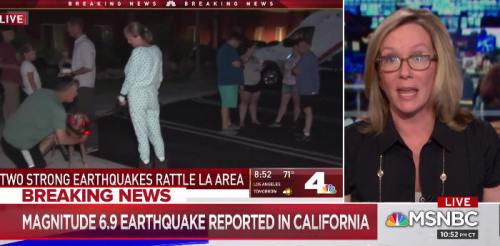
A quake with a magnitude of 7.1 jolted much of California, cracking buildings, setting fires, breaking roads and causing several injuries while seismologists warned that large aftershocks were expected to continue for days, if not weeks.
The Friday night quake — preceded by Thursday’s 6.4-magnitude temblor in the Mojave Desert — was the largest Southern California quake in at least 20 years and was followed by a series of large and small aftershocks, including a few above magnitude 5.0.
There is about a 1-in-10 chance that another 7.0 quake could hit within the next week, said Lucy Jones, a seismologist at the California Institute of Technology and a former science adviser at the U.S. Geological Survey.
The chance of a 5.0-magnitude quake “is approaching certainty,” she added.
Aftershocks from the new main quake could occur for years, Jones said.
However, the quake was unlikely to affect fault lines outside of the area, she said, noting that the gigantic San Andreas Fault was far away.
Alaska hit record-breaking temperatures on Independence Day, shattering the previous heat record by 5 degrees.
At 5 p.m. local time Thursday, Anchorage reached 90 degrees for the first time in the state’s recorded history, topping the previous record set at Anchorage International Airport of 85 degrees on June 14, 1969.
“Breaking an all-time record by this much is pretty unheard of in the climate community,” NBC News meteorologist Bill Karins said. At least three other cities and towns in Alaska also reached new record temperatures, according to Karins.
“A plethora of daily and all-time records were set across southcentral and southwestern Alaska” on Thursday, the National Weather Service said Friday.
A powerful earthquake with a preliminary magnitude of 7.1 struck Southern California Friday night, centered 11 miles from Ridgecrest — the same area where a strong quake hit Thursday.
Authorities reported multiple fires, minor injuries, building collapses and gas leaks in Ridgecrest — about 150 miles northeast of Los Angeles — after Friday’s quake.
California Gov. Gavin Newsom has requested a presidential emergency declaration from Donald Trump for federal assistance “to further support emergency response and recovery in impacted communities,” he said in a statement.
Thousands of residents in Ridgecrest and the nearby Mojave town of Trona were without power, according to Southern California Edison. Rock slides and cracks in the earth closed down at least one highway. The airport in Ontario, California, was evacuated and closed down, a local ABC affiliate reported.
Chernobyl has become a byword for catastrophe. The 1986 nuclear disaster, recently brought back into the public eye by the hugely popular TV show of the same name, caused thousands of cancers, turned a once populous area into a ghost city, and resulted in the setting up of an exclusion zone 2600km² in size.
But Chernobyl’s exclusion zone isn’t devoid of life. Wolves, boars and bears have returned to the lush forests surrounding the old nuclear plant. And when it comes to vegetation, all but the most vulnerable and exposed plant life never died in the first place, and even in the most radioactive areas of the zone, vegetation was recovering within three years.
Humans and other mammals and birds would have been killed many times over by the radiation that plants in the most contaminated areas received. So why is plant life so resilient to radiation and nuclear disaster?
The world just recorded its warmest June ever. A deadly heat wave has been baking much of Europe ― France experiencing its highest temperature on record last week, a blistering 45.9 degrees Celsius (or nearly 115 degrees Fahrenheit). Now, Alaska is enduring what for it is an ongoing heat wave.
In short, it’s hot. And scientists warn this is just a taste of what the climate crisis has in store for the Earth.
World Weather Attribution, an international organization of scientists conducting climate research, said the frequency and intensity of Europe’s heat waves have been exacerbated largely by humans.
Signs are pointing to a coming U.S. recession, according to an economic indicator that has preceded every recession over the past five decades.
It is known among economists and Wall Street traders as a “yield curve inversion,” and it refers to when long-term interest rates are paying out less than short-term rates.
That curve has been flattening out and sloping down for more than a year, raising worries among some analysts that investors’ long-term view of the market is not positive and that an economic downturn is looming.
But on Sunday, an inauspicious milestone was achieved: The yield curve remained inverted for three months, or an entire quarter, which has for half a century been a clear signal that the economy is heading for recession in the next nine to 18 months, according to Campbell Harvey, a Duke University finance professor who spoke to NPR on Sunday. His research in the mid-1980s first linked yield curve inversions to recessions.
.
The floor of the New York Stock Exchange. An economic indicator known as the “yield curve inversion” hit the three-month mark, an occurrence that has preceded the past seven U.S. recessions.
Film and Writing Festival for Comedy. Showcasing best of comedy short films at the FEEDBACK Film Festival. Plus, showcasing best of comedy novels, short stories, poems, screenplays (TV, short, feature) at the festival performed by professional actors.

 The Standcap Inverted Pouch features a soft-sided, inverted wedge shape with a flat, flip-top dispensing closure. It rolls down like a toothpaste tube for maximum product evacuation, and introduces minimal oxygen to extend shelf life. (Original Uncle Dougie’s/Original Uncle Dougie’s)


 .
.
 .
.
 .
.
 Chernobyl
 .
.

 James' World 2