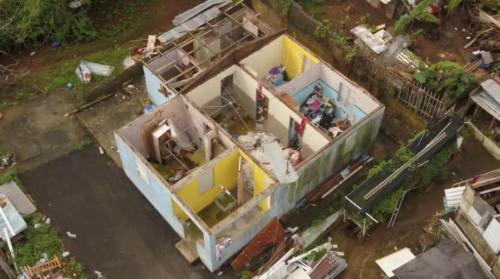
After Hurricane Maria toppled the bridge that connects him to the rest of civilization and ripped the roof and walls off his house here in the central mountains of Puerto Rico, Ramón Sostre raised a weathered American flag above the wreckage.
His message to the world: I’m alive, and I’m American.
.
It worked, if temporarily. Helicopters came. So did a tarp, food and bottled water.
.
Yet little else has changed. His roof is still missing, as are some walls. He and his cat, Tipo, sleep in the kitchen. When the wind blows at night, rain soaks them. The power is out, as it is for roughly 3 million Puerto Ricans, or more than 80% of the island’s residents. More than a third of households in the US territory, including much of Sostre’s community, are without reliable drinking water at home. That’s roughly 1 million American citizens.
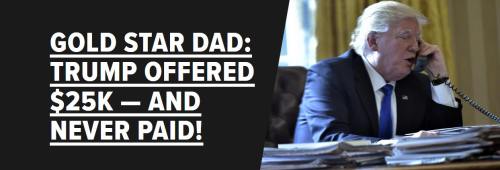
The father of a slain U.S. Army corporal says President Donald Trump offered him $25,000 over the phone earlier this year while calling to offer his condolences and then never followed through, according to The Washington Post.
Chris Baldridge told the publication that a few weeks after his 22-year-old son, Army Cpl. Dillon Baldridge, was gunned down by an Afghan police officer on June 10, he had a 15-minute phone call with the president. Baldridge said he told Trump of “his struggle with the manner in which his son was killed,” according the Post story, and was offered $25,000 after telling the president about his frustration with the military’s survivor benefits program.
Baldridge said he “can barely rub two nickels together,” and that his ex-wife would receive the Pentagon’s $100,000 death gratuity because she was his son’s beneficiary.
On my last week in India, I went to say goodbye to Jahiruddin Mewati, the chief of a small village where I had made a dozen or so reporting trips.
Jahiruddin and I were not precisely friends, but we had spent many hours talking over the years, mostly about local politics. I found him entirely without scruples but candid. He suspected my motives but found me entertaining, in the way that a talking dog might be entertaining, without regard for the particulars of what I said.
Jahiruddin, though uneducated, was an adept politician, fresh from winning a hard-fought local election. During our conversations, he would often break into rousing, patriotic speeches about truth and justice, thumping the plastic table in emphasis and making it jump. The effect was somewhat tarnished by his Tourette’s syndrome, which caused him to interject the word “penis” at regular intervals.
.
Jahiruddin Mewati, the chief of Peepli Khera, a small village in Uttar Pradesh, presided over a particularly Indian form of justice.Credit Andrea Bruce for The New York Times
A federal jury convicted Ahmad Khan Rahimi, a loner from New Jersey drawn to online calls to jihad and instruction manuals for carrying it out, of setting the explosives in the Chelsea neighborhood that blew out windows and sent shrapnel flying into buildings, cars and people during a two-day bombing campaign in and around New York City last year.
Mr. Ramini, 29, a stocky and bearded husband and father born in Afghanistan who lived most of his life in New Jersey, remained mostly expressionless in Federal District Court in Manhattan on Monday as he listened to a single word — “guilty” — called out over and over, eight times, by the jury foreman. He blinked rapidly and at times appeared to nod.
Terror attacks that kill and injure scores of people have become all too common around the world. The Chelsea explosion, which took no lives, was widely seen as a near miss. But its proximity to the site of the Sept. 11 attacks in Manhattan, and its callbacks to that day, sent shudders through the city 15 years later. The police have said there have been some two dozen terror plots against the city since then, the vast majority thwarted, but none that shook and smashed a block as strongly.
.
Ahmad Khan Rahimi in custody last year, after he was accused of setting bombs in Manhattan and New Jersey. He was found guilty on all counts Monday.Credit Mel Evans/Associated Press
George Soros, the billionaire hedge fund manager and a major Democratic donor, has given $18 billion to his Open Society Foundations, one of the largest transfers of wealth ever made by a private donor to a single foundation.
The gift, made quietly over the past several years but disclosed only on Tuesday, has transformed Open Society into the second-biggest philanthropic organization in the United States, behind the Bill and Melinda Gates Foundation. It will also place Mr. Soros, a lightning rod for conservative critics, squarely in the middle of the social and political debates convulsing the country.
Founded by Mr. Soros more than 30 years ago, Open Society promotes democracy and human rights in more than 120 countries. In recent years, the organization has increased its attention on the United States, investing in programs to protect gays and lesbians and reduce abuses by the police.
.
George Soros at the offices of the Open Society Foundations in New York in 2014.Credit Joshua Bright for The New York Times
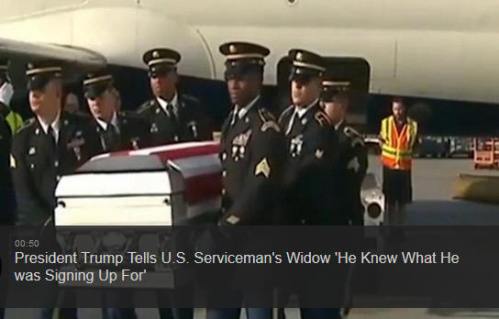
A Florida congresswoman described President Donald Trump’s phone call to the widow of a soldier killed during an ambush in Niger as “insensitive” after the president reportedly said the man “must’ve known what he signed up for.”
Rep. Frederica Wilson (D-Fla.) was in the car with Myeshia Johnson, the pregnant widow of Army Sgt. La David Johnson, when Trump called her Tuesday and spoke for about five minutes, according to South Florida’s NBC affiliate.
“Sarcastically he said: ‘But you know he must have known what he signed up for,’” Wilson recounted to NBC6. “How could you say that to a grieving widow? I couldn’t believe… and he said it more than once. I said this man has no feelings for anyone. This is a young woman with child who is grieved to her soul.”
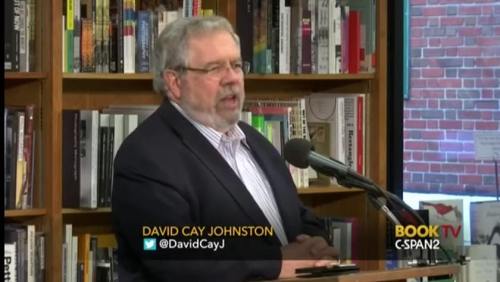
David Cay Boyle Johnston (born December 24, 1948) is an American investigative journalist and author, a specialist in economics and tax issues, and winner of the 2001 Pulitzer Prize for Beat Reporting.
.
From 2009 to 2014 he was a Distinguished Visiting Lecturer who taught the tax, property, and regulatory law of the ancient world at Syracuse University College of Law and the Whitman School of Management. From July 2011 until September 2012 he was a columnist for Reuters, writing, and producing video commentaries, on worldwide issues of tax, accounting, economics, public finance and business. Johnston is the board president of Investigative Reporters and Editors. He has also written for Al Jazeera English and America in recent years.
.
Johnston covered “student radicals, black politics and development” at the San Jose Mercury News from 1968 to 1973.[3] Although he “earned enough credits for at least one master’s degree,” his formal educational credentials are limited to a “night high school diploma” as he “skipped most general education requirements in favor of upper division and graduate study at seven schools,” including San Francisco State University (1972), the University of Chicago (where he studied under a five-month fellowship in 1973) and Michigan State University (1973-1975).[4][3] At Michigan State, he wrote an internal textbook (A Guide to Public Records) for the University’s journalism department.[4] From 1973 to 1976, he was an investigative reporter at the Detroit Free Press in its Lansing bureau. In 1976, he joined the Los Angeles Times, where he remained until 1988. Johnston subsequently worked as a reporter at The Philadelphia Inquirer from 1988 to 1995. He joined The New York Times in February 1995.
.
As a reporter Johnston investigated Los Angeles Police Department (LAPD) political spying and other abuses, the hotelier Barron Hilton, misuse of charitable funds at United Way, news manipulation at WJIM-TV in Lansing, Michigan, and Donald Trump’s financial dealings.
.
Johnston has been critical of news media coverage of the 2008 $700 billion bailout of Wall Street. In a letter to American journalist and blogger Jim Romenesko, Johnston wrote, “In covering the proposed $700 billion bailout of Wall Street don’t repeat the failed lapdog practices that so damaged our reputations in the rush to war in Iraq and the adoption of the Patriot Act. Don’t assume that Congress must act instantly, as so many news stories state as if it was an immutable fact. Don’t assume there is a case just because officials say there is.” Johnston has been cited favorably by Glenn Greenwald as well as other bailout critics.
.
Johnston is the author of best-selling books on tax and economic policy. Free Lunch: How the Wealthiest Americans Enrich Themselves at Government Expense and Stick You With The Bill, is about hidden subsidies, rigged markets, and corporate socialism. It follows his earlier book Perfectly Legal: The Covert Campaign to Rig Our Tax System to Benefit the Super Rich—and Cheat Everybody Else, a New York Times bestseller[16] on the U.S. tax system that won the Investigative Reporters and Editors 2003 Book of the Year award.
.
Johnston’s first book, the 1992 Temples of Chance: How America Inc. Bought Out Murder Inc. to Win Control of the Casino Business is an account of how the junk-bond kings usurped mob control of the casino industry in the 1980s. The book discusses corruption in the industry and the role of the federal and state governments in that corruption.
.
In 2014 Cay Johnston released Divided: The Perils of Our Growing Inequality. Cay Johnston shows most Americans, in inflation-adjusted terms, are now back to the average income of 1966. Post-recession (from 2009 to 2011) the top 1 percent of households took in 121% of the income gains while the bottom 99% saw their income actually fall.
.
In 2016, Johnston released The Making of Donald Trump, a journalistic account of the rise of businessperson-turned-presidential candidate Donald Trump, with Melville House Publishing.[17] At the time he wrote the book, Johnston had known Trump for 28 years. The book soon became a New York Times bestseller.
Maribel Casas was in the middle of a dialysis treatment when she got an unexpected text message from her sister saying she had to be at Isla Grande Airport, a small airfield in San Juan, Puerto Rico, by 2 p.m. Her relatives in Miami had managed to get her a seat on a humanitarian flight off the island.
Casas ended her treatment two hours early. “I told the nurse: ‘I have to go. I’m leaving,'” she said.
Only after she landed in Fort Lauderdale, Florida, did she learn that the private plane she had traveled on belongs to the rapper Pitbull, who lent his jet to evacuate cancer patients and others like Casas, who need constant treatment to live.
. Elderly and ill evacuees from Puerto Rico arrive at Opa Locka Executive Airport in Miami. Their evacuation was coordinated by Fundacion Stefano. Courtesy Fundacion Stefano
President Donald Trump on Monday refused to take any blame for legislative failures and fingered Republican senators for “not getting the job done.”
“Despite what the press writes, I have great relationships with, actually, many senators, but, in particular, with most Republican senators,” Trump told reporters during a meeting with his Cabinet. “But we’re not getting the job done. And I’m not going to blame myself. I’ll be honest, they are not getting the job done.”
The president specifically blamed Senate Republicans for failing to follow through on a years-old GOP pledge to repeal the Affordable Care Act. Senate leaders shelved their repeal bill last month after Sen. John McCain (R-Ariz.) and at least two other Republicans said they’d vote against it.
“We’ve had health care approved, and then you had the surprise vote by John McCain,” said Trump. We’ve had other things happen and they’re not getting the job done.”
.
Image: Breaking News and Opinion on The Huffington Post
A Florida nursing home where a dozen patients died after Hurricane Irma knocked out power has closed and laid off its 245 employees, according to a notice to state officials.
The patients, between the ages of 57 and 99, died last month after The Rehabilitation Center at Hollywood Hills failed to evacuate them from the sweltering facility in the days after the storm, state officials said.
.
The nursing home informed state officials in a letter dated September 27 that the facility had closed seven days earlier and its employees were out of jobs.
.
“A 60-day notice could not be provided due to unforeseen business circumstances that occurred after the impact of hurricane Irma,” the letter said.
.
The 245 workers included occupational, speech and physical therapists, nurses and dietary aids, according to the letter.
Film and Writing Festival for Comedy. Showcasing best of comedy short films at the FEEDBACK Film Festival. Plus, showcasing best of comedy novels, short stories, poems, screenplays (TV, short, feature) at the festival performed by professional actors.

 About 1 million Americans without running water
 .
.




 .
.
 .
.


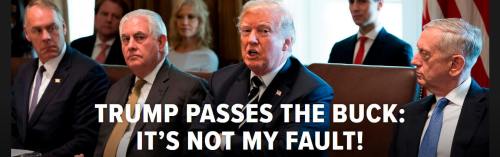 Image: Breaking News and Opinion on The Huffington Post
 .
.
