October 11, 2022
Mohenjo
Business, Food For Thought, Human Interest, Political, Science, Technical
amazon, business, Business News, current-events, Future, Hotels, human-rights, medicine, mental-health, research, Science, Science News, technology, Technology News, travel, vacation

Click the link below the picture
.
When you start a business, the first question that comes to mind is probably where you’ll be located. You might have some ideas about your industry or what type of business you want to start. But where should you set up shop if you’re considering expanding across borders and doing international business? Here are three ideal countries for starting a global business based on their ability to accommodate new businesses, lack of stress on the pocketbook, and friendly atmosphere for foreigners who want to start something new.
.
 .
.
.
Click the link below for the article:
.
__________________________________________
October 11, 2022
Mohenjo
Business, Food For Thought, Human Interest, Political, Science, Technical
amazon, business, Business News, current-events, Future, Hotels, human-rights, medicine, mental-health, research, Science, Science News, technology, Technology News, travel, vacation
Some content on this page was disabled on April 15, 2025 as a result of a DMCA takedown notice from Guardian Media Group. You can learn more about the DMCA here:
https://wordpress.com/support/copyright-and-the-dmca/
October 10, 2022
Mohenjo
Business, Enthralling, Human Interest, Photographs
amazon, business, Business News, current-events, Future, Hotels, human-rights, medicine, mental-health, research, Science, Science News, technology, Technology News, travel, vacation

Click the link below the picture
.
Ilkley Moor is part of Rombalds Moor, the moorland between Ilkley and Keighley in West Yorkshire, England. The moor, which rises to 402 m (1,319 ft) above sea level, is well known as the inspiration for the Yorkshire “county anthem” On Ilkla Moor Baht ‘at (dialect for ‘on Ilkley Moor without a hat’).
During the Carboniferous period (325 million years ago), Ilkley Moor was part of a sea-level swampy area fed by meandering river channels coming from the north. The layers in the eroded bank faces of stream gullies in the area represent sea levels with various tides depositing different sorts of sediment. Over a long period of time, the sediments were cemented and compacted into hard rock layers. Geological forces lifted and tilted the strata a little towards the southeast, producing many small fractures, or faults. Since the end of the Carboniferous period more than a thousand meters of the coal-bearing rocks have been completely removed from the area by erosion. During the last million years, Ice Age glaciers modified the shape of the Wharfe valley, deepening it, smoothing it, and leaving behind glacial debris. The millstone grit not only gives character to the town of Ilkley but gives the area its acid soils, heather moors, soft water, and rocky scars. Wikipedia
.
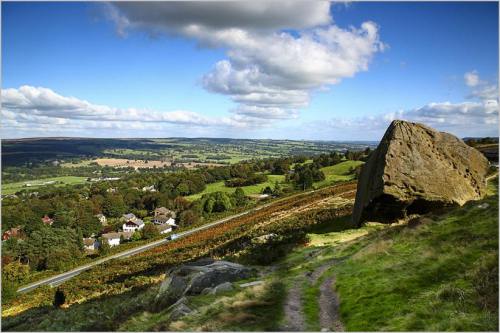 An image from Ilkley Moor Yorkshire
.
.
Click the link below for images:
.
__________________________________________
October 10, 2022
Mohenjo
Business, Food For Thought, Human Interest, Political, Science, Technical
amazon, business, Business News, current-events, Future, Hotels, human-rights, medicine, mental-health, research, Science, Science News, technology, Technology News, travel, vacation

Click the link below the picture
.
On a September morning in Sydney, Melanie Perkins peers through the double doors of Sterling hair salon in the city’s Surry Hills neighborhood. It’s now bustling with customers in highlight foils and black capes, but 10 years ago the space was where Perkins and then-boyfriend, now husband Cliff Obrecht spent nearly every waking moment. It housed the Sydney office of Fusion Books, the yearbook publishing business the couple founded prior to launching Canva, a visual communications company. Today their second business is valued by one estimate at $26 billion, the most of any female-founded and woman-led startup in the world and a sum that has grown the couple’s combined net worth to an estimated $7.8 billion.
.

CEO Melanie Perkins conceived Canva after growing frustrated with existing design tools.
Ben Baker for Fortune
.
.
Click the link below for the article:
.
__________________________________________
October 10, 2022
Mohenjo
Business, Food For Thought, Human Interest, Political, Science, Technical
amazon, business, Business News, current-events, Future, Hotels, human-rights, medicine, mental-health, research, Science, Science News, technology, Technology News, travel, vacation

Click the link below the picture
.
Last month, I decided to get a snack from a convenience store. As I walked to the door, there was another customer ahead of me. And he opened the door for himself without bothering to look back.
How rude, I thought. Who doesn’t hold the door open for someone behind them! I got my snack, returned to my car and stewed about the incident. Didn’t he see me? Did he do that on purpose? The thoughts consumed me as I drove around running errands — and even continued over the next few days.
I knew I was wasting a lot of emotional energy on a seemingly trivial moment. And it got me wondering — why was I taking this incident so personally? And how do I manage my feelings about it?
To help answer these questions, I turned to Ethan Kross, psychologist and author of Chatter: The Voice in Our Head, Why It Matters and How to Harness It; psychotherapist Sana Powell, author of Mental Health Journal for Women: Creative Prompts and Practices to Improve Your Well-Being; and clinical psychologist Adia Gooden. They told me it’s human to get upset when we feel offended by something that someone did or said, because we may feel their actions or words are a personal affront to our character.
.
 Richard Drury/Getty Images
.
.
Click the link below for the article:
.
__________________________________________
October 9, 2022
Mohenjo
Business, Food For Thought, Human Interest, Political, Science, Technical
amazon, business, Business News, current-events, Future, Hotels, human-rights, medicine, mental-health, research, Science, Science News, technology, Technology News, travel, vacation

Click the link below the picture
.
All living cells power themselves by coaxing energetic electrons from one side of a membrane to the other. Membrane-based mechanisms for accomplishing this are, in a sense, as universal a feature of life as the genetic code. But unlike the genetic code, these mechanisms are not the same everywhere: The two simplest categories of cells, bacteria, and archaea have membranes and protein complexes for producing energy that are chemically and structurally dissimilar. Those differences make it hard to guess how the very first cells met their energy needs.
This mystery led Nick Lane, a professor of evolutionary biochemistry at University College London, to an unorthodox hypothesis about the origin of life. What if life arose in a geological environment where electrochemical gradients across tiny barriers occurred naturally, supporting a primitive form of metabolism while cells as we know them evolved? A place where this might be possible suggested itself: alkaline hydrothermal vents on the deep seafloor, inside highly porous rock formations that are almost like mineralized sponges.
Lane has explored this provocative idea in a variety of journal papers, and he has touched on it in some of his books, such as The Vital Question, where he wrote, “Carbon and energy metabolism are driven by proton gradients, exactly what the vents provided for free.” He describes the idea in more detail for the general public in his latest book, Transformer: The Deep Chemistry of Life and Death. In his view, metabolism is central to life, and genetic information emerges naturally from it rather than the other way around. Lane believes that the implications of this reversal touch almost every big mystery in biology, including the nature of cancer and aging.
.
 In contrast to many other researchers who study the origin of life, Nick Lane, a professor of evolutionary biochemistry at University College London, suggests that some form of primitive metabolism may have arisen in deep-sea hydrothermal vents before the appearance of genetic information. Philipp Ammon for Quanta Magazine
.
.
Click the link below for the article:
.
__________________________________________
October 9, 2022
Mohenjo
Business, Food For Thought, Human Interest, Political, Science, Technical
amazon, business, Business News, current-events, Future, Hotels, human-rights, medicine, mental-health, research, Science, Science News, technology, Technology News, travel, vacation
Some content on this page was disabled on April 15, 2025 as a result of a DMCA takedown notice from Guardian Media Group. You can learn more about the DMCA here:
https://wordpress.com/support/copyright-and-the-dmca/
October 8, 2022
Mohenjo
Business, Enthralling, Human Interest, Photographs
amazon, business, Business News, current-events, Future, Hotels, human-rights, medicine, mental-health, research, Science, Science News, technology, Technology News, travel, vacation
Click the link below the picture
.
Addis Ababa is the capital and largest city of Ethiopia. It also serves as the seat of the government of Oromia: while being outside of Oromia regional state boundaries. In the 2007 census, the city’s population was estimated to be 2,739,551 inhabitants. Addis Ababa is a highly developed and important cultural, artistic, financial, and administrative center of Ethiopia.
In the 15th century, Addis Ababa was depicted as a fortified place named “Barara” and served as a residence of the Emperors of Ethiopia until Dawit II. Barara was completely destroyed during the Ethiopian–Adal War and Oromo expansions. The founding history of Addis Ababa dates back in late 19th-century by Menelik II, Negus of Shewa, in 1886 after finding Mount Entoto unpleasant two years prior. At the time, the city was a resort town; its large mineral spring abundance attracted nobilities of the empire, led them to establish permanent settlement. It also attracted many members of the working classes — including artisans and merchants — and foreign visitors. Menelik II then formed his imperial palace in 1887. Addis Ababa became the empire’s capital in 1889, and subsequently, international embassies were opened. Addis Ababa urban development began at the beginning of the 20th century and without any preplanning.
Addis Ababa saw a wide-scale economic boom in 1926 and 1927, and an increase in the number of buildings owned by the middle class, including stone houses filled with imported European furniture. The middle class also imported newly manufactured automobiles and expanded banking institutions. During the Italian occupation, urbanization and modernization steadily increased by a master plan which they hoped Addis Ababa would be more colonial city and continued after their occupation. Consequent master plans were designed by French and British consultants from 1940s onwards focusing on monumental structures, satellite cities, and inner-city. Similarly, the Italo-Ethiopian master plan also projected in 1986 concerning only urban structure and accommodating service, which was later adapted by the 2003 master plan.
Addis Ababa remains federal chartered city in accordance with the Addis Ababa City Government Charter Proclamation No. 87/1997 in the FDRE Constitution. Referred to as “the political capital of Africa” due to its historical, diplomatic, and political significance for the continent, Addis Ababa serves as the headquarters of major international organizations such as the African Union and the United Nations Economic Commission for Africa (ECA).
The city lies a few kilometers west of the East African Rift, which splits Ethiopia into two, between the Nubian Plate and the Somali Plate. The city is surrounded by the Special Zone of Oromia and is populated by people from the different regions of Ethiopia. It is home to Addis Ababa University. The city has a high human development index and is known for its vibrant culture, strong fashion scene, high involvement of young people, thriving arts scene, and for having the fastest economic growth of any country in the world.
.
 An image from Ethiopia’s Capital
.
.
Click the link below for images:
.
__________________________________________
October 8, 2022
Mohenjo
Business, Food For Thought, Human Interest, Political, Science, Technical
amazon, business, Business News, current-events, Future, Hotels, human-rights, medicine, mental-health, research, Science, Science News, technology, Technology News, travel, vacation

Click the link below the picture
.
For thousands of years, humans have pondered the meaning of our existence. From philosophers who debated whether their minds could be trusted to provide accurate interpretations of our reality to physicists who’ve attempted to interpret the weirder aspects of quantum physics and relativity, we’ve learned that some aspects of our Universe appear to be objectively true for everyone, while others are dependent on the actions and properties of the observer.
Although the scientific process, combined with our experiments and observations, have uncovered many of the fundamental physical laws and entities that govern our Universe, there’s still much that remains unknown. However, just as Descartes was able to reason, “I think, therefore I am,” the fact of our existence — the fact that “we are” — has inevitable physical consequences for the Universe as well. Here’s what the simple fact that we exist can teach us about the nature of our reality.
To start with, the Universe has a set of governing rules, and we’ve been able to make some sense of at least some of them. We understand how gravity works at a continuous, non-quantum level: by matter and energy curving spacetime and by that curved spacetime dictating how matter and energy move through it. We know a large portion of the particles that exist (from the Standard Model) and how they interact through the three other fundamental forces, including at the quantum level. And we know that we exist, composed of those very same particles and obeying those same laws of nature.
.
 That the Universe exists and that we are here to observe it tells us a lot. It enables us to place constraints on various parameters, and to the infer the existence of states and reactions that present themselves as gaps in our present-day knowledge. But there are severe limits to what we can learn from this type of reasoning as well (Credit: NASA/NEXSS collaboration)
.
.
Click the link below for the article:
.
__________________________________________
October 8, 2022
Mohenjo
Business, Food For Thought, Human Interest, Political, Science, Technical
amazon, business, Business News, current-events, Future, Hotels, human-rights, medicine, mental-health, research, Science, Science News, technology, Technology News, travel, vacation

Click the link below the picture
.
How do I make more friends?
In a world where the word friend is associated by most people with superficial relationships formed on social media, true friendship is hard to come by. True friends are those who are there for you in good times and bad, who tell you what you need to hear, not just what you want to hear, and who help you be the best version of yourself–all of which can prove invaluable to entrepreneurs and business owners.
So, actually, you don’t necessarily want more friends. Rather, you want “true” friends. But to have true friends, you first need to be a friend.
But to have true friends, you first need to be a friend. How do you do that?
Emotional intelligence can help. Emotional intelligence is the ability to identify, understand, and manage emotions. This ability can help you not only understand others better but also strengthen your relationships with them.
Here are five simple rules of emotional intelligence that will help you make more and better friends, which can help you in business and life. (If you find value in these five rules, you might be interested in my free seven-day course, which delivers a rule to your inbox each day to teach you how to build emotional intelligence in yourself and your team.)
.

.
.
Click the link below for the article:
.
__________________________________________
Older Entries
Newer Entries

