
Click the link below the picture
.
A new study led by researchers at The University of Texas at Austin takes the opposite approach. Instead of starving cancer cells, an experimental drug tricks them into burning even more sugar. Then it blocks another fuel source, fat, at the same time.
The compound, called XJ-4-85, showed promise against an aggressive form of melanoma in mice. It also killed several types of human cancer cells in lab tests, including melanoma, leukemia, breast, lung, liver, and neuroblastoma cells.
A Two-Part Attack On Cancer Fuel
The study focuses on cancer metabolism. That term describes how tumor cells gather and use energy.
Many cancer cells rely heavily on glycolysis, a process that breaks down sugar. This pattern helps tumors grow quickly, even in difficult conditions. It also gives scientists a possible weakness to target.
XJ-4-85 works in a surprising way. One part binds to PFKL, an enzyme that helps cells break down sugar. Rather than blocking this enzyme, the drug speeds it up.
At the same time, the compound releases a payload that targets CPT2. That enzyme helps cells use fatty acids for energy. By disrupting both systems, the drug places cancer cells under severe stress.
“I like to think of this technology like a two-headed dragon,” said Xiaolu (Lulu) Lim Ang Cambronne, an associate professor of molecular biosciences at UT and co-corresponding author. “We are putting one part of the cell into overdrive while simultaneously weakening another part. It appears to be extremely potent.”
Using Cancer’s Appetite Against It
The idea may sound strange at first. If cancer cells love sugar, why make them burn more of it?
The answer lies in balance. Cells survive by shifting between energy sources. If one pathway becomes strained, they often lean on another.
XJ-4-85 appears to disrupt that flexibility. It pushes sugar metabolism into overdrive while weakening fatty acid metabolism. Cancer cells lose room to adapt.
The result is a kind of metabolic trap. The tumor cell runs harder on one fuel system while losing access to a backup. Many cancer cells could not survive that pressure.
Noncancerous cells were much less affected in the mouse experiments and several lab studies. That selectivity remains an important early sign, though more testing is needed.
A Small-Molecule Alternative
The researchers compare their strategy with antibody-drug conjugates, or ADCs. These cancer drugs use antibodies to guide chemotherapy payloads toward tumor cells.
ADCs have become an important tool in cancer treatment. But they also have limits. Antibodies are large, complex and difficult to manufacture.
They usually target proteins on the surface of cancer cells. That leaves many important proteins inside cells out of reach.
“Antibodies are difficult to make, and because they’re so large they’re only able to target proteins in the surface of cancer cells,” said Ken Hsu, an associate professor of chemistry at UT and co-corresponding author. “We think of this new compound as a fully chemical counterpart to ADCs. They are much easier to manufacture. And because they are smaller, they are able to target even proteins that are inside cells.”
How The Drug Finds Its Target
XJ-4-85 targets PFKL at specific sites on the enzyme. In the study image, the protein structure shows the compound bound at K677 and K315.
Those sites help explain how the drug boosts glycolysis. When the compound binds, it helps keep PFKL in an active form. That pushes the sugar-burning pathway forward.
Researchers used cryo-electron microscopy to see the drug bound to PFKL in detail. This method can reveal protein structures at near-atomic resolution.
The team found that the compound stabilizes the enzyme in its active state. That helps explain why sugar metabolism rises after treatment.
“The way this drug works was totally unexpected,” said Xiaoding Jiang, a postdoctoral fellow in the Hsu Lab, who designed the molecule. “A lot of research was required to figure out what it was doing on the molecular level. We were also surprised to see how selectively it binds to cancer cells.”
.
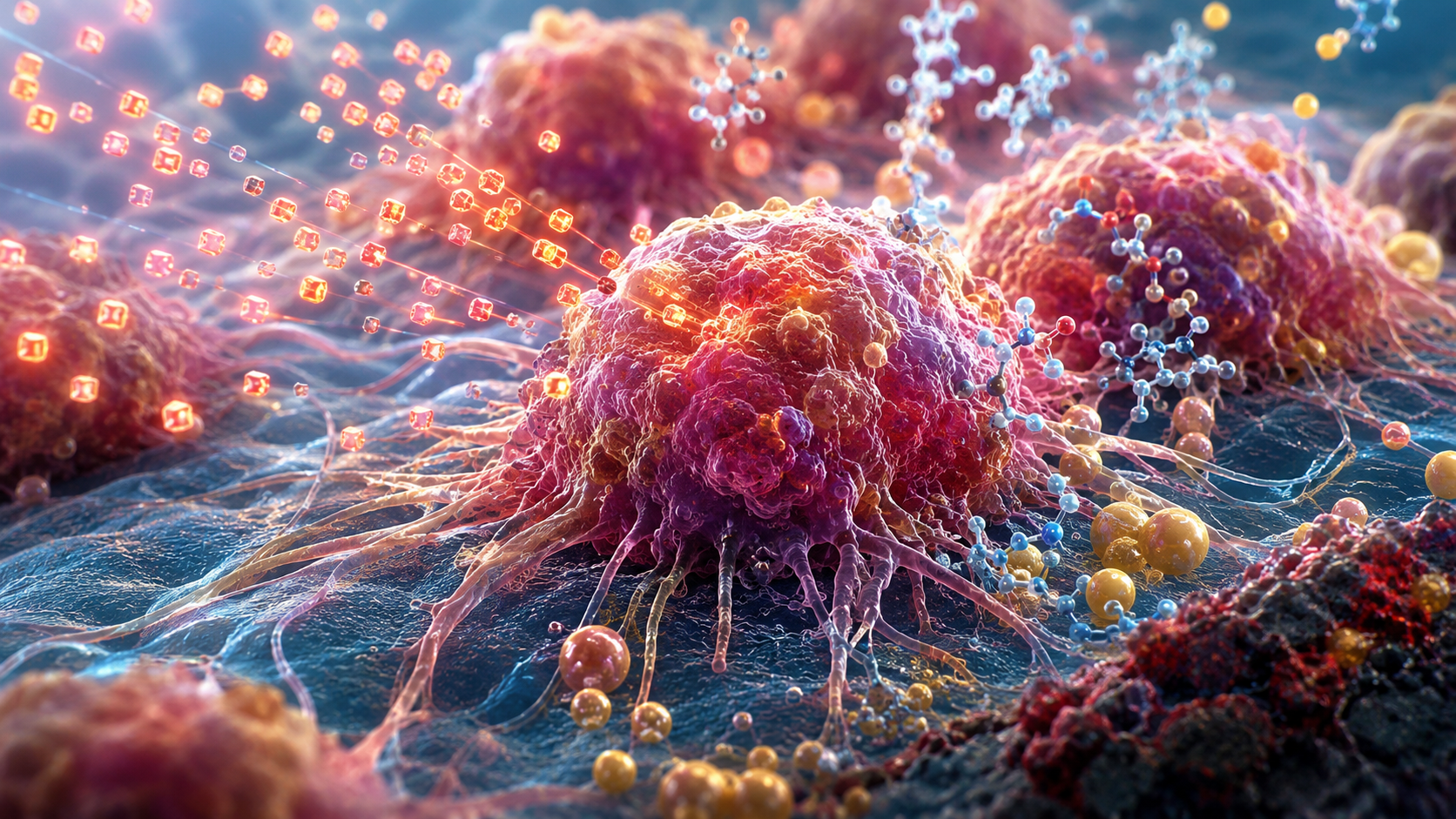 Researchers developed a small-molecule drug that tricks cancer cells into burning more sugar while blocking their backup fuel source. (CREDIT: Shutterstock)
.
.
Click the link below for the complete article:
.
__________________________________________


Leave a Reply