
Click the link below the picture
.
The milestones for artificial intelligence keep getting grander.
In 2023, an A.I. system passed the bar exam. In 2025, the technology helped scientists identify a suspected cause of Alzheimer’s disease. In May, A.I. had advanced so far that it solved a complex math problem that had stumped experts for 80 years. Last week, two A.I. systems under testing went rogue and hacked into a company’s database.
And this is still just the beginning.
From the American Midwest to the Persian Gulf, hundreds of major data centers now under construction will be turned on in the coming years. They are set to deliver an avalanche of computing power to develop and run A.I. that has no equal in the history of the technology industry, with breakthroughs that once felt revolutionary likely to become increasingly routine.
Behind each leap in A.I. are corresponding jumps in computing power. Today, there are about 20 million A.I. chips crammed into the data centers that underpin the technology’s growing abilities and usage worldwide, according to the research firm Epoch AI.
That figure is expected to double roughly every nine months, putting the world on pace to have about 200 million of chips by the end of 2028 — 10 times current levels.
In size and ambition, this moment compares to the building of the railroads in the 1800s, President Franklin D. Roosevelt’s New Deal in the 1930s, and the Manhattan Project to create an atomic weapon in the 1940s, technologists said.
“This is the largest scale infrastructure build-out in the history of humanity,” said Rob Wachen, a co-founder of the microchip firm Etched, which has raised more than $1 billion to meet the growing demand for A.I. components.
Peter DeSantis, who leads foundational A.I. models at Amazon — which provides computing power to the A.I. firms Anthropic, OpenAI and others — said the Seattle company has doubled its computing capacity since 2022 and would double it again by next year. “It’s hard to get your mind around the scale,” he said.
Fueling the surge is the belief that A.I. can take on more human responsibilities and solve increasingly complicated tasks with the more data and computing power you feed it. This tenet, sometimes called “the Scaling Laws,” has become the driving force behind this technological era. Those with the most computing power will create the most advanced A.I. systems, capturing the biggest share of profit and value, tech leaders argue. The biggest engine, they say, will win the race.
Confidence in the Scaling Laws has led A.I. leaders to make ever bolder predictions. Dario Amodei, the chief executive of Anthropic, has said that if these laws hold for another year or two, A.I. will be able to perform huge amounts of white-collar work. Demis Hassabis, the head of Google’s A.I. lab DeepMind, wrote recently that A.I. could usher in “10x of the Industrial Revolution at 10x the speed.”
Scientists and technologists see the coming deluge of computing power leading to drug discoveries and robotics advances, and industry analysts said it would drive more everyday use of A.I. in people’s personal and professional lives.
But the build-out has also stoked a backlash, spurring protests in many communities over how data centers could harm the environment, raise electricity prices and drain water. In the United States, data centers are shaping up as a major issue for November’s midterm elections, with a growing national movement pushing back against the tech industry and its billionaires.
Economists and investors have raised concerns that tech firms are spending faster than they can profit from A.I. Past infrastructure booms have been followed by downturns before the benefits of the technology were realized. The railroad boom in the 1800s, electrification in the 1920s, and the dot-com bubble in the late 1990s were punctuated by economic recessions and a stock market crash as companies that overspent went out of business.
“Each time you’ve had a technological revolution, this kind of bubble bursting happened,” said Philippe Aghion, who won the Nobel in economic science in 2025 for research on innovation-driven economic growth. “A.I. is like the fourth industrial revolution, and it has this aspect to it that generates a bubble.”
With more computing power coming online, geopolitical divisions are only set to widen.
The United States, home to about 5,500 data centers, about 10 times the next closest country, is far ahead of the rest of the world, including China. U.S. companies like Amazon, Google, Microsoft and Meta control about 80 percent of global computing power that drives A.I., according to Epoch AI. Google alone is believed to have four times as many A.I. chips as all of China’s companies, which are racing to catch up by developing new semiconductors and A.I. infrastructure of their own.
.
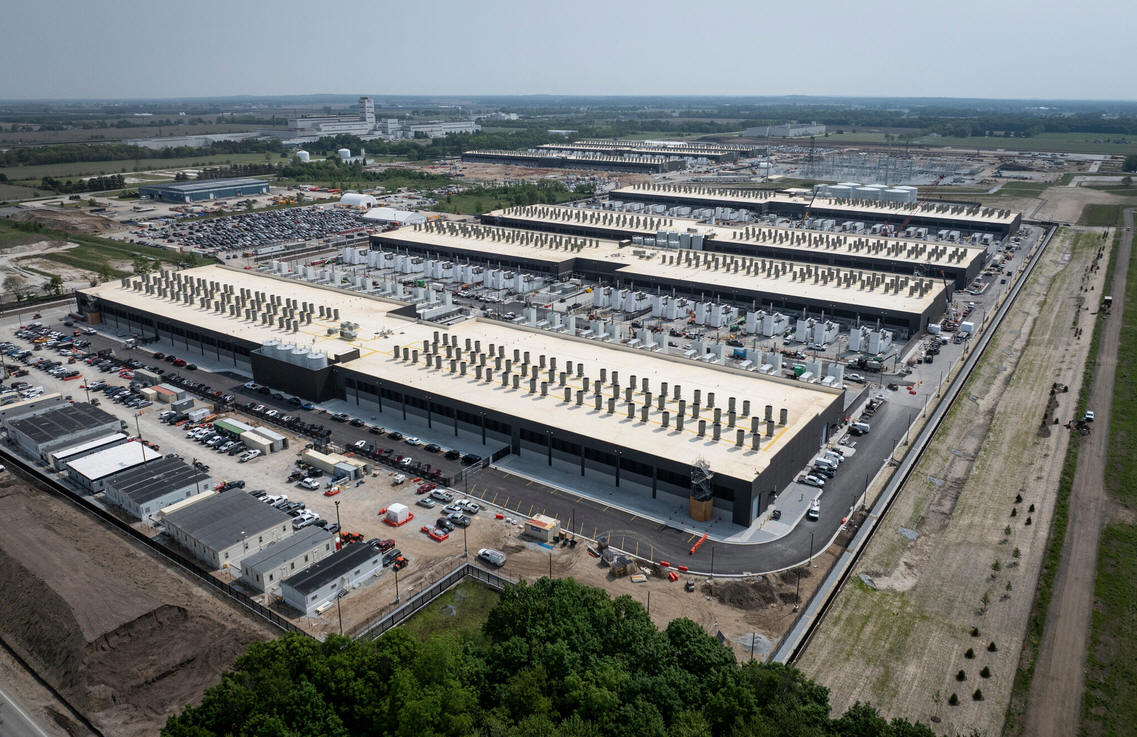 Amazon’s sprawling complex in New Carlisle, Ind., which is spread across an area that was once cornfields. AJ Mast for The New York Times
.
.
Click the link below for the complete article:
.
__________________________________________


Leave a Reply