
Click the link below the picture
.
To the casual observer, the look and feel of shipping containers suggests a world of smooth, lossless transportation, almost immaterial in its implementation of a logistical ideal. However, the system is far from lossless. In fact, during storms and shipwrecks, shipping containers regularly go overboard.
Nobody knows exactly how many of these vast, 20- or 40-foot-long steel capsules—stacked in the thousands in the cargo holds of each ship, carrying the stuff of the global economy—are lost each year. Shipping lines and insurance companies keep these figures under wraps. But estimates suggest that of the hundreds of millions in circulation annually, several thousand containers vanish—sometimes forever.
And what becomes of the containers that disappear?
If they reappear, then the matter is relatively simple. Each standard container carries, on each of its four sides, a code clearly identifying it. The codes for all containers worldwide are distributed by the Bureau International des Containers (BIC). In cargo shippers’ databases, the histories and current cargo of containers are recorded and accessible via their respective codes. Thus, it can be determined what was in each container and for whom it was intended. As long as the contents of a container have not been plundered outright, they can even be delivered to the recipient after an accident, albeit with some delay.
But it is, of course, more difficult when a container breaks open—particularly on the high seas, leaving its freight to the whims of the wind and the waves. In these cases, the contents are highly unlikely to ever reach their intended recipient. Yet these mishaps are not all for naught. In fact, while these lost shipping containers likely represent hundreds of millions of dollars in losses for the shipping industry, they have inadvertently been a boon to another community: oceanographers.
In May 1990, the Hansa Carrier, a German cargo ship traveling from Korea to the U.S., lost 21 containers in a Pacific storm north of Japan, and four of the containers broke open. The payload, more than 60,000 pairs of Nike sneakers, poured out into the sea. About nine months after the accident, known colloquially as “The Great Shoe Spill,” 1,600 sneakers washed up along the coast of Oregon, on the Queen Charlotte Islands in Canada, and on other beaches along the northern Pacific coast.
The fiasco resulted in something like 20–30 metric tons of footwear waste. However, for Curtis C. Ebbesmeyer, an oceanographer based in Seattle, the mishap presented a unique research opportunity. With the help of local beachcombers, Ebbesmeyer carefully documented the path of these sneakers, as he later wrote in his 2009 book “Flotsametrics and the Floating World.” Using the Ocean Surface Currents Simulation (or “OSCUR”), his colleague, James Ingraham, wrote a program to simulate surface flow. Together, they calculated the probable routes of the drifting shoes, which, though unintentionally released, were fed into the ocean system as data.
Of course, Nike sneakers are hardly the only accidental “probes” to have bobbed across the ocean: Over the years, researchers have tracked everything from toy cars and Lego figures to beer cans, hockey gloves, and hermetically sealed Riesen chocolates. By comparing their simulations with the real-world journeys of goods that washed ashore and were identified by serial number, oceanographers have helped produce increasingly precise maps of Pacific Ocean currents. These maps account for a range of variables, including cargo-shipping routes, surface currents, wind patterns, and the unpredictable drift of objects at sea.
In 1885, Prince Albert I of Monaco threw 1,675 buoys into the Atlantic along several lines between Europe and North America. As French author Érik Orsenna recounts in his 2010 sea tale “A Portrait of the Gulf Stream: In Praise of Currents,” the prince, sailor, explorer, and amateur oceanographer wanted to investigate the path and speed of the Gulf Stream as it crossed the Atlantic toward Europe.
Each of the prince’s buoys contained a message, drafted in seven languages within a sealed glass tube, requesting that those who found it should return the note “to the proper offices of their home country, so that it may be passed on to the French government, indicating the circumstances in which this document was found.” The buoys were eventually found along the coast of Europe to Gibraltar, on the coast of Africa to the Canary Islands and Cape Verde, in the Antilles, and along the coast of Central America.
Ever since then, an important branch of oceanography has developed from the practice of setting buoys, albeit more sophisticated ones than the bottles and floats used by Prince Albert I. Modern ocean surface drifters now transmit their locations by satellite. They allow scientists to track their whereabouts in real time and measure variables such as pressure, salinity, and wind.
Yet, sophisticated as these buoys might be, damaged containers have sometimes proven superior in recent decades. After all, a lost container can become a mass experiment that no research program would deliberately stage, sending thousands of objects into the ocean at once and allowing their eventual landfalls to chart the hidden pathways of currents across the globe. Of course, this growing mass constitutes a serious threat to the ocean ecosystem, not to mention the environmental catastrophes regularly caused by tanker accidents themselves. At the same time, the flotsam also contributes positively to the knowledge of the ocean system’s function, thereby presenting possibilities for its salvation.
If plastic objects spilled from shipping containers can help us understand the workings of the ocean, then nature and culture are no longer separate realms. They are deeply entangled: human actions, manufactured objects, trade routes, storms, currents, coastlines, and ecosystems all acting on one another. A lost shipment is therefore not only waste but a message: What does the sudden arrival of a container’s contents reveal? What can stranded shoes, toys, or fragments of plastic tell us that their counterparts still moving invisibly through global trade cannot?
.
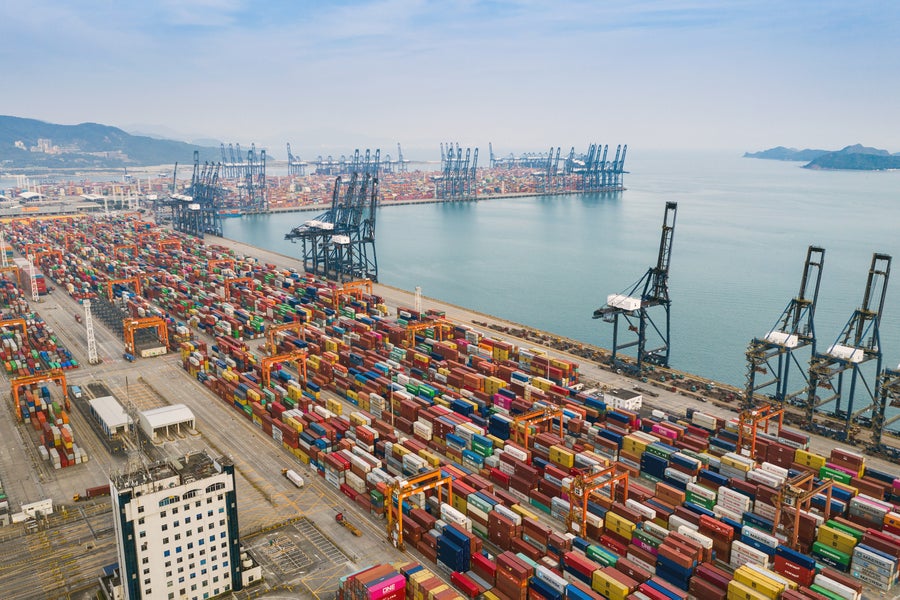
Container port, Shenzhen, China. Yinwei Liu/Getty Images
.
.
Click the link below for the complete article:
.
__________________________________________


Jul 27, 2026 @ 02:22:15
Nice write up.
LikeLike
Jul 27, 2026 @ 04:53:53
Thank you sir for your comment! In these cases you never know where your merchandise will go!
LikeLiked by 1 person
Jul 27, 2026 @ 08:07:34
You are most welcome.
Stay happy and keep sharing.
LikeLike