
Click the link below the picture
.
It’s a conversation that Marian Betz admits can feel awkward at first. Broaching it might even be viewed as questioning the adequacy of someone else’s parenting. But Betz, the mother of two teenage girls in Denver, Colo., says that because of the ubiquitous nature of firearms in American homes, she regularly asks other parents about securing guns. In fact, she has done so since her kids started having playdates and sleepovers a decade ago.
Many parents either don’t realize they should ask about guns or feel too embarrassed to do so. A study released last month in Pediatrics found that more than 60 percent of the Illinois parents that the researchers surveyed had never asked another parent whether there was an unlocked firearm in that person’s home before allowing their child to visit for a playdate. It’s a startling statistic when you consider that, among children aged 14 and under, almost 20 percent of unintentional firearm-related deaths occur at a friend’s home.
Betz, a professor of emergency medicine at the University of Colorado School of Medicine and an expert in the prevention of firearm injury and suicide, has seen firsthand the harm that guns can do when they’re left unlocked in the home. In all, 2,526 kids and teens died from gunshots wounds in the U.S. in 2022, according to a report released in September from the Johns Hopkins Center for Gun Violence Solutions.
A simple conversation can go a long way in preventing accidental deaths. Betz frames questions about guns as one of several safety topics parents should discuss with one another before playdates, including everything from food allergies to unsupervised pool access, marijuana, alcohol and adult supervision. But the most important discussion is about access to unlocked firearms. Betz taught herself to have these conversations because she contends that you can’t accurately predict who might be a gun owner. “Our stereotypes about gun owners can be wrong,” Betz says. “In a country where up to 40 percent of adults live in a house with a gun, you can’t just go by the political yard sign or their chosen TV news station.”
While non-gun owners might think that asking about guns feels overbearing, research, perhaps surprisingly, shows that gun owners welcome the conversation, says Nick Buttrick, a psychologist who studies the symbolism of gun ownership at the University of Wisconsin–Madison. People in focus groups who own guns say that talking about gun safety is actually really important to them. “The anticipated friction stops people from having the conversation,” Buttrick says, “but when they actually have it, they’re received with a lot more positivity than they might have imagined.”
Non-gun owners, he adds, may feel out of their depth when it comes to asking about safe gun storage because they might not know what it entails. The ideal practice is called triple-safe storage: a gun that is locked up and unloaded with ammunition stowed away separately. Knowing what you’re looking for before you ask can ease preconversation anxiety, Buttrick says.
Additionally, a study published in PNAS on April 8 found that within the gun-owning community, there is widespread discomfort with insecure firearm storage. In the study, even Republican gun owners didn’t want their neighbors
to have quick access to unlocked, loaded firearms. And that if a person knew someone living close by didn’t store their gun in a safe or at least with a chamber lock on a pistol, they were less likely to be willing to socialize with that neighbor, says Justin Sola, lead study author and an assistant professor of sociology at the University of North Carolina at Chapel Hill. This consensus held true for both “red” and “blue” voters, whether or not they were gun owners themselves. “There’s a penalty that people assess toward their neighbors if they don’t store their guns safely,” Sola says. He contends that there’s a universal aversion to unsafe storage that both gun owners and non-gun owners can agree on, all of which can make these conversations between parents easier.
Another good strategy is not to ask whether an individual has a gun but to assume they do and go straight to asking whether that gun is locked up, says Paul Nestadt, an associate professor of psychiatry at Johns Hopkins University, whose research focuses on gun death and suicide prevention. The question isn’t whether you should judge someone for owning guns; it’s whether those guns are locked up in a way that keeps kids from having any access to them. “Asking something more innocuous like ‘How do you store your gun?’ makes people feel less defensive, so they’re more likely to be honest,” Nestadt says. If they don’t have a gun, they can just say so—and if they do, the data show that they’re more likely than you might expect to want to talk about how they store it, he adds.
.
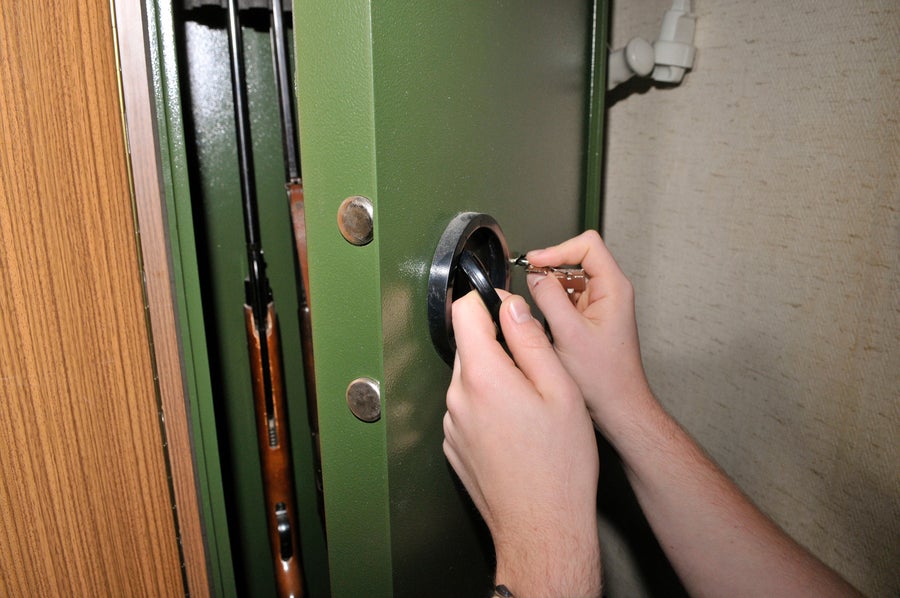
A child opens a gun safe. imageBROKER.com GmbH & Co. KG/Alamy Stock Photo
.
.
Click the link below for the complete article:
.
__________________________________________


Leave a comment