Q: I’ve heard conflicting stories about tofu. It’s either a great source of protein or loaded with estrogen and therefore unhealthy. Which is true?
If tofu and other soy foods were interviewing for a spot in your weekly meal rotation, they would offer an impressive résumé of nutrition credentials.
A three-ounce serving of tofu, for instance, can provide between four and 14 grams of protein (depending on the style), including all nine of the essential amino acids.
It also supplies B vitamins, healthy unsaturated fatty acids, and minerals like calcium, magnesium, zinc, and iron, said Amy Bragagnini, a dietitian and a spokeswoman for the Academy of Nutrition and Dietetics.
Yet soy foods are also burdened by an unsavory reputation. Ms. Bragagnini’s clients, for instance, routinely ask if soy foods are linked with cancer, a concern stemming from their relatively high levels of isoflavones, plant-based compounds that are structurally similar to the hormone estrogen.
The presence of isoflavones has also led to the worry that soy might negatively affect fertility or give men more feminine characteristics.
In 1886, The Statue of Liberty was a symbol of democratic government and Enlightenment ideals as well as a celebration of the Union’s victory in the American Civil War and the abolition of slavery. Edouard de Laboulaye, the French political thinker, U.S. Constitution expert, and abolitionist, who first proposed the idea of a great monument […]
Strong glutes aren’t just for show. Vital for optimal movement and athletic performance, the gluteus maximus is the largest, most powerful muscle in the human body. Together, the gluteal muscles help to stabilize the upper body and pelvis and assist in hip flexion and locomotion movements like walking, swimming, jumping, and my sport of choice, running.
For a few years, I was just a runner. I logged 35–40 miles each week and regularly participated in half-marathons. Although I’d previously lifted weights regularly for over a decade, I decided to drop my strength workouts altogether in favor of yoga a couple of times a week because being sore after weightlifting hurt my pace. All I cared about was running. But that was a mistake.
The lack of resistance training rendered my gluteal muscles almost nonexistent; the muscles were technically there, but not strong enough to support my heavy mileage. I developed chronic lower-back issues. Twice-a-week chiropractor visits and massage sessions kept me going, but it wasn’t sustainable. I was over being in pain.
When I finally saw a physical therapist, he suggested a strength-training routine with an emphasis on the glutes. So I hired a personal trainer. As part of a full-body weight training routine, my trainer introduced me to a new move: the hip thrust. Sitting on the ground with my back against a flat bench, I put a light barbell over my hips. Then, with my chin tucked and my feet flat on the floor (and in line with my knees), I squeezed my glutes, raising my hips to full extension. It wasn’t easy. At first, I could only do 40 pounds.
Five years later though, my personal record is 300 pounds. The best part? Those glute gains have eradicated my back pain.
A lot of people find it difficult to embrace the idea of regular exercise, even though they know it’s good for their physical and mental health. Yet committing to a workout routine doesn’t necessarily entail going to the gym or running around your neighborhood.
Gardening is a great example of a popular hobby that’s accessible and can also be used as a workout.
Working in your garden or yard is a source of moderate to vigorous physical activity in younger adults while providing low to moderate physical activity in older adults, research has shown. The pastime is also a muscle-strengthening activity, according to the US Physical Activity Guidelines for Americans, and one of the physical activities with the lowest injury rates.
More good news: Puttering in your garden just two hours a week could help boost your mood, while the communal gardening that’s proliferating in communities and schools provides social benefits that can alleviate stress and help combat isolation and even dementia, according to studies.
With all these benefits, gardening for fitness will be a trend this year, predicts Rishi Mandal, San Francisco-based co-founder, and CEO of the fitness coaching app Future. “Our clients at Future have already been asking their coaches to add gardening and landscaping activities into their routines,” Mandal said, “because it’s easy to access, fits into their lifestyle, and offers meditative benefits.”
This demand fits with the overall interest he’s seeing among clients for less intensive fitness routines that are accessible and mesh with an on-the-go lifestyle.
.
Gardening is a popular outdoor activity that can help build muscle strength and burn calories, according to the US Physical Activity Guidelines for Americans. Joshua Resnick/Adobe Stock
In-app purchases are inescapable. An app might be free to download, but more likely than not, a pop-up will immediately inform you the best features are locked behind a monthly fee or an annual subscription. Before you go ahead and subscribe to (or make a digital purchase in) the app, though, it’s worth your time to try to pay in a browser instead. The extra effort might save you some money.
In-app purchases can be more expensive
When you buy something from within an app on your iPhone or Android device, the developer isn’t getting the full amount of that purchase. Both Google and Apple take a hefty percentage of that payment for their own, as part of the agreement they have with developers for hosting apps on their digital marketplaces in the first place.
Apple charges developers 30% for any digital goods and services they sell inside iOS apps (or 15% if the developer earns less than $1 million, and qualifies for the small business program). That means if an app charges $10 per month for a subscription, Apple is actually getting $3 of that fee. If you buy a game for $5, Apple nets $1.50. If a user sticks with a subscription for more than a year, however, Apple drops its fee to 15%.
At a location he keeps secret, John Honovich was on his laptop, methodically scouring every link on a website for a conference half a world away. Hikvision, the world’s largest security camera manufacturer, was hosting the event—the 2018 AI Cloud World Summit—in its hometown of Hangzhou, a city of about 10 million people not far from Shanghai. Honovich, the founder of a small trade publication that covered video surveillance technology, wanted to find out what the latest Hikvision gear could do.
He zeroed in on one section of the conference agenda titled “Eco-Friendly, Peaceful, Relaxed” and found a description of an AI-powered system installed around Mount Tai, a historically sacred mountain in Shandong. A video showed Hikvision cameras pointed at tourists climbing the thousands of stone steps leading to the famous peak. Piano music played as a narrator explained, in Mandarin with English subtitles, that the cameras were there “to identify all visitors to ensure the safety of all.” The video cut to a shot of a computer screen, and Honovich hit pause. He saw a zoomed-in view of one visitor’s face. Below it was data that the camera’s AI had inferred. Honovich downloaded the video and took screenshots of the computer screen, for safekeeping.
Later, with the help of a translator, he scrutinized every bit of text on that screen. One set of characters, the translator explained, suggested each visitor was automatically sorted into categories: age, sex, wearing glasses, and smiling. When Honovich pointed at the fifth category and asked, “What’s this?” the translator replied, “minority.” Honovich pressed: “Are you sure?” The translator confirmed there was no other way to read it.
If you saw a Facebook ad recently for Jeremy’s Razors, which bills itself as a “woke-free” razor for men, you may well be a father of school-age children who likes ultimate fighting, Hershey’s chocolate, hunting, or Johnny Cash. This is according to Facebook’s ad library, which describes the audiences to which marketers target their advertisements.
I can see why Jeremy’s Razors is focusing its ad dollars on men who might appreciate its hypermasculine message. But the reverse is not as clear: Are these men better off for having been pitched an “anti-woke” razor?
In the traditional media world, ads are sold in context of the area in which publications are sold: Perhaps Jeremy’s Razors might favor advertising in Deer & Deer Hunting magazine, for example. But online, many ads are sold based on the many details that advertisers have gleaned about your behavior and interests from your online activity.
Tech firms track nearly every click from website to website, develop detailed profiles of your interests and desires, and make that data available to advertisers. That’s why you get those creepy ads in your Instagram feed or on websites that seem to know what you were just talking about.
With the fast-paced evolution of technology, it’s clear that the future of many industries is heavily intertwined with the integration of advanced technological solutions.
One of the most exciting and innovative developments in recent years has been the advent of Artificial Intelligence (AI). As a result, it has become an essential tool for both businesses and individuals who want to streamline their work processes and increase their efficiency.
Well, you all know about ChatGPT but there are more similar tools that will blow your mind.
In this article, we’ll explore some of the best AI tools available and examine how you can put them to work for you.
One of the stultifying but ultimately true maxims of the analytics movement in sports says that most narratives around player performance are lies. Each player has a “true talent level” based on their abilities, but the actual results are mostly up to variance and luck. If a player has, say, the true talent to hit thirty-one home runs in a season, the timing of those home runs is mostly random. If someone hits a third of those in April, that doesn’t really mean he’s a “hot starter” who is “building off a great spring”—it just means that if you take thirty-one home runs and toss them up in the air to land randomly on a timeline, sometimes ten of them float over to April. What does matter, the analytics guys say, are plate appearances: you have to clock in enough opportunities to realize your true talent level.
For much of my career, I was the type of journalist who only published a handful of magazine pieces a year. These required a great deal of time, much of which was spent on minor improvements to the reporting, structure, and sentences. I believed that long-form journalism, much like fiction or poetry, possessed a near-mystical rhythm that could be accessed through months of intensive labor. Once unlocked, some spirit would sing through the piece and touch the readers in a universal, truthful way.
Then, about two years ago, while working at the New York Times, I began writing and publishing thousands of words a week. My main motivation was health care: I had been a contract employee for years and had very little income stability. But also, from an authorial standpoint, I was curious to see what would happen if I just started churning. Would my sentences deteriorate? Would I lose my sense for what was good or bad?
In the world, human beings are facing various problems. People who are full of greed, anger, and ignorance are seen to be fighting with each other in words and deeds. As the fighting continues, various problems such as civil wars, wars of aggression, and wars of aggression are occurring. As world peace is being destroyed, humans are facing unbearable problems. Innocent children and women are not getting the rights they deserve and deserve. I can't think of one thing every time. What is it? The United Nations. If we look at the responsibilities and duties of the United Nations, I think it is not suitable for solving the problems that are happening in the world today. In fact, the United Nations and the World Security Council, such an organization must rule the world, must be able to give orders, and must have various ways to obey orders. There must be no organization that can influence more than that organization. There should be experts from each country. They can even dominate the superpowers like the US, China, and Britain. Only then will global peace be achieved quickly. Now, if a country with power develops more militarily, economically, or socially than its own country, then powerful countries will jealously seek out enemies and wage war. Or they will attack with fighter jets. In this, innocent people are losing their lives. No one understands the value of a life. You should think about how to achieve global peace by controlling these. If the US continues to be the permanent president of the UN, world peace will never be achieved. If you think carefully, no one sees that they are working for the common good, but for their own benefit, for the benefit of their own country. The permanent president of the UN and the Security Council has rejected this, As a young Rohingya, I have come to realize that only by electing the president and secretary from among the countries in the world through a secret ballot system and governing the world fairly can we achieve global peace. The United Nations and the Security Council are organizations in which any country must govern, give orders, and make them obey their orders. For example, only when a defendant is tried in court can we hold the leaders of the countries in check and control them, can we achieve global peace smoothly. Otherwise, it will not be easy for powerful countries to use various excuses to end this war every year, every year, for the benefit of themselves and their countries. No country's leaders pay any attention to the words of the United Nations and the Security Council. If we look at it in practice, look at the Rohingya issue. Myanmar is a small country. Even that country has been under siege for 8 years. What action can be taken? Why is the UN and the Security Council Powerless? Without such Power, how can the organization bring about global peace? Everyone should think about it. Whether there is a veto or a strong one, all countries in the world can only achieve global peace if they are subject to the UN and the Security Council. Seek peace in the quiet embrace of nature. Peace is an indispensable need of the human race. It is not as if one person can kill another person, and it is as if one country can attack another country, but instead of trying to build peace, we must try to destroy the peace now, and the world is getting hotter and is on the verge of collapse. I especially appeal to all the world experts to urgently try to bring about peace in all parts of the world. Mr, Noor Muhamed Arkhan Rohingya Youth Myanmar
Film and Writing Festival for Comedy. Showcasing best of comedy short films at the FEEDBACK Film Festival. Plus, showcasing best of comedy novels, short stories, poems, screenplays (TV, short, feature) at the festival performed by professional actors.

 Credit…Joyce Lee for The New York Times


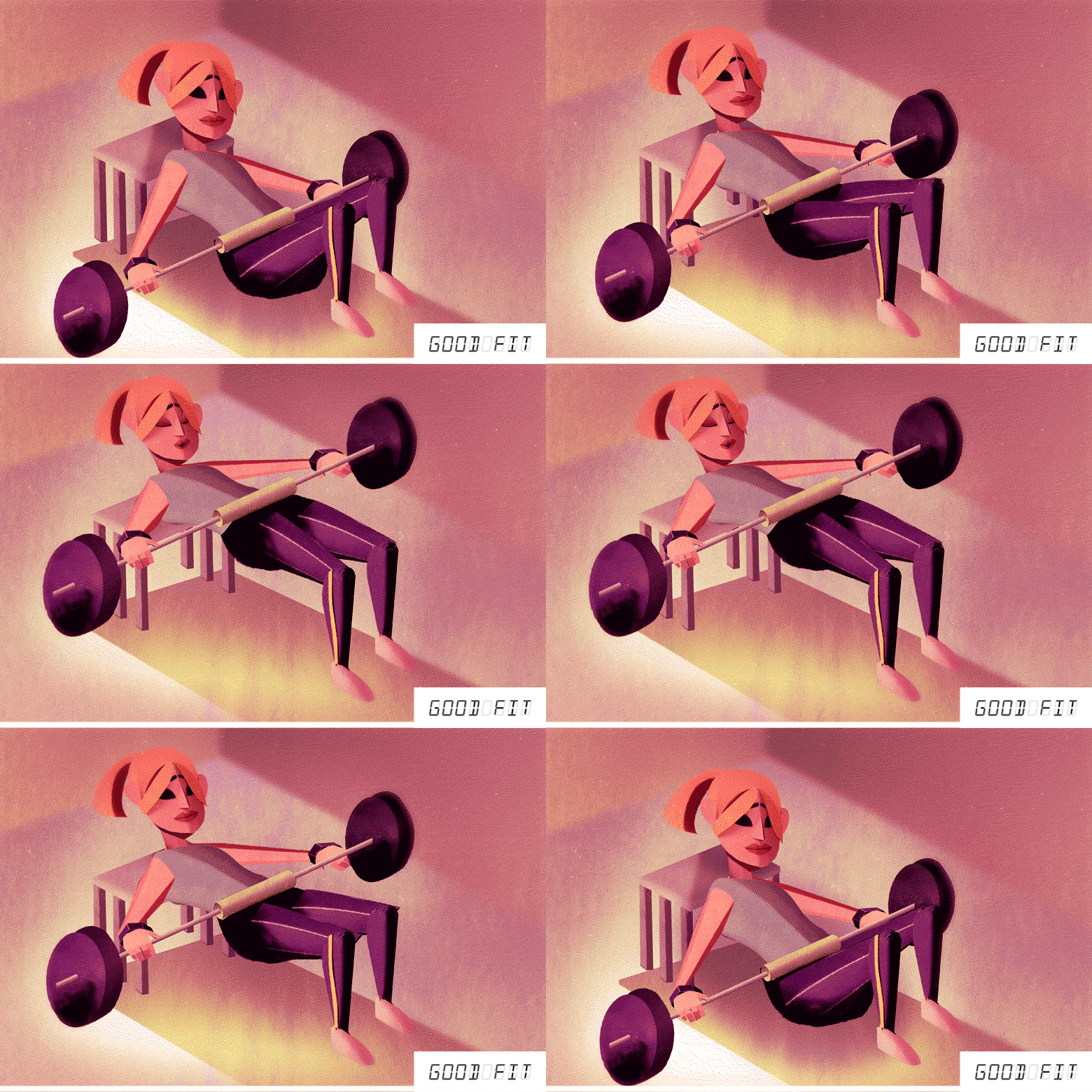



 Photo: platinumArt (Shutterstock)




 Photo by Tachina Lee on Unsplash