
Dr. Vanessa N. Gamble (1953-) First African American Woman of Many Achievements
Assorted human interest posts.
June 30, 2026

Everyone obsesses over flashy overnight wins, but the real magic happens in the shadows. Consistency is the unsung hero quietly building your empire while the crowd searches for cheap shortcuts. It is never about grand, exhausting bursts of motivation. It is about showing up for the heavy lifting when the gym is empty and your […]
True me.. Tap-2542..
June 29, 2026
Business, Food For Thought, Human Interest, Political, Science, Technical amazon, business, Business News, current-events, Future, Hotels, human-rights, medicine, mental-health, research, Science, Science News, technology, Technology News, travel, vacation Leave a comment

Click the link below the picture
.
In late May, in broad daylight, residents across Massachusetts and beyond saw a brilliant flash in the sky, followed by two sonic booms that rattled windows, shook houses, and prompted a flood of 911 calls. Some people thought they had just experienced an earthquake. Others thought it was thunder, an explosion, or a military flyover.
But the true source of all the commotion was out of this world—literally. A small meteoroid, about five feet wide and as heavy as an elephant, had entered the atmosphere at a blinding 42,000 miles per hour before disintegrating dozens of miles above the ground. The midair explosion released a pressure wave equivalent to 230–300 tons of TNT, and any surviving fragments likely fell into Cape Cod Bay.
The story quickly captivated an American public already more space-crazed than usual, thanks to the recent success of Artemis II. However, it has also served as a stark reminder that space is not as benign or empty as it may seem. Rather, our solar system is a celestial shooting gallery, chock-full of flying projectiles—not just meteoroids but larger bodies, such as comets, asteroids, and other cosmic detritus—and Earth is right in the firing line. Earlier in May, for instance, the newly discovered asteroid 2026 JH2, estimated at 50 to 115 feet wide, missed Earth by a “mere” 56,000 miles. Had it been on a collision course, it could have easily destroyed a big city.
But even that would not have been humanity’s worst nightmare scenario. After all, some celestial Goliaths can run a lot larger than JH2—large enough to decimate entire countries and even continents. British physicist Stephen Hawking believed that a cosmic impact poses one of the greatest threats to humanity, far greater than any global pandemic or terrestrial natural disaster. The question is not if we will suffer a direct hit but when.
Unfortunately, we humans would be powerless against a rare giant projectile many miles in diameter. Unlike the dinosaurs, we might well see the approach of a six-mile-wide killer asteroid, like the one that collided with Earth 66 million years ago. However, stopping it or deflecting its course is out of the question: It would be like trying to stop an oncoming truck by throwing ping-pong balls at it. And although we’ve discovered the vast majority of near-Earth objects (NEOs) larger than about two-thirds of a mile across, finding that none are on a collision course with Earth, astronomers could very well discover an enormous comet next week that will crash into the planet in a few years’ time. And again, there’s nothing we could do to stop it.
If we do want to protect ourselves from cosmic impacts, we need to focus on medium-sized objects, ranging from about 100 yards to about a half a mile. These are relatively numerous, and they can easily cause many tens of millions of casualties. Earth is hit by a 400-yard asteroid on average once every 100,000 years. If the collision occurs in Europe, a country like France will disappear completely from the map, and the entire continent will become an unimaginable disaster area. Such an impact is, in theory, preventable, so we would be crazy not to explore the possibilities of doing just that.
That’s what Dutch astrophysicist Piet Hut of the Institute for Advanced Study in Princeton, New Jersey, thought too. A few years after the 1998 Hollywood blockbusters Deep Impact and Armageddon brought the general public face-to-face with the possibility of an impact, Hut organized a workshop on how to avert such doomsday scenarios. A year later, in October 2002, together with a fellow astronomer and two former astronauts, he founded the B612 Foundation—a private nonprofit foundation that aimed to investigate how to deflect approaching celestial bodies.
Ten years ago, the foundation had ambitious plans to launch a satellite, called Sentinel, that would search for potentially dangerous asteroids. Although the project was canceled for lack of funds, the B612 Foundation remains one of the leading advocates of serious research into planetary defense techniques.
Meanwhile, government organizations such as NASA and the European Space Agency (ESA) are not sitting idly by.
NASA has its own Planetary Defense Coordination Office, while ESA has invested in NEOShield and NEOShield-2, European Union–funded research programs that studied the most plausible methods for asteroid deflection. The U.S. National Science and Technology Council has developed its own National Near-Earth Object Preparedness Strategy, and even within the United Nations Committee on the Peaceful Uses of Outer Space (COPUOS), there is an action team addressing the threat of cosmic impacts. In addition to its own International Asteroid Warning Network, the UN now has a Space Mission Planning Advisory Group.
Needless to say, many, many meetings are being held now on how to protect humanity from attacks by the cosmos.
How will we protect Earth?
When it comes to protecting Earth from a fatal collision, there are a number of ideas currently under consideration, ranging from good to bad to very bad.
For example, blowing an asteroid up with an atomic bomb, as happened in “Armageddon,” is not a smart idea. It is an option that Edward Teller, known as “the father of the hydrogen bomb,” proposed long ago, but it simply wouldn’t help. The numerous fragments created in such an explosion would still be moving through the solar system in more or less the same direction and at the original high speed. As a result, Earth would then have to endure not one big impact but a whole series of smaller ones, with all the attendant consequences.
A more practical solution would be to slightly deflect the approaching celestial body so that it passes close to Earth rather than colliding with it. Particularly if you can see the impact coming many years in advance, a small nudge can be enough to avert disaster. When astronomers discovered the 1,100-foot-wide near-Earth object Apophis, which for a while looked as if it would wreak havoc on Earth in 2029, they were already calculating that a minimal change in speed of just a few micrometers per second would be enough to prevent that anticipated catastrophe. Luckily, in the case of Apophis, there’s no need to intervene: The asteroid will safely fly by the Earth on April 13, 2029, at a distance of some 20,000 miles.
Still, for what it’s worth, NASA did manage to execute its first successful intentional asteroid deflection test rather recently: In September 2022, it deflected a small celestial body when the DART (Double Asteroid Redirection Test) spacecraft intentionally slammed into the 525-foot-wide asteroid Dimorphos, successfully changing its orbit around the larger parent body Didymos.
Meanwhile, at Lawrence Livermore National Laboratory, the HAMMER project is on the drawing board. HAMMER (Hypervelocity Asteroid Mitigation Mission for Emergency Response) is a celestial battering ram, 10 yards long and weighing almost 9 tons, that can be fired at high velocity at a small near-Earth object. With a 10-year warning period, it could deflect a 100-yard-wide object enough to prevent an impact. If something larger is speeding toward Earth, you just send out 10 or 20 HAMMERs. Or 50, or 100. Admittedly, that is a hugely expensive proposition, but if it means you can save 100 million lives, cost is obviously a secondary consideration.
Incidentally, there is a cheaper way to nudge a small asteroid out of its original orbit: just place a giant rocket motor on its surface. If a small rocket motor can transport a launcher into space, a big one should let you accelerate or decelerate an entire NEO at least a tiny bit. As for the raw material needed for the rocket fuel, you could use the composition of the asteroid itself: Hydrogen can be extracted from ice, and oxygen from rock. Or, rather than using a rocket motor, you simply catapult material from the NEO into space at high speed. That is, thanks to Newton’s third law—every action produces an equal and opposite reaction—which results in a kind of rocket effect in the opposite direction.
Thermodynamics could also be of use. For instance, we could heat a small area on one side of the asteroid until the surface material evaporates and jets off into space. The effect is the same as that of a rocket engine on the surface: Gas is blasted away in one direction, propelling the asteroid a tiny bit in the other direction. If you can set a piece of paper or a shoelace on fire using a magnifying glass, you can also focus sunlight on the surface of an asteroid using a large swarm of satellites equipped with gigantic lenses. Additionally, an entire fleet of laser cannons is an option, as is a nuclear explosion at a short distance from the celestial projectile. Another suggestion is to wrap an approaching NEO in thin, reflective foil, either strengthening or weakening the Yarkovsky effect (i.e., the tiny “push” that sunlight exerts on a rotating asteroid). Giving it a once-over with a can of spray paint is another way to achieve the same result.
Finally, perhaps the least invasive option would involve what’s known as a gravity tractor, developed by former astronaut Ed Lu (cofounder of the B612 Foundation) and his colleague Stan Love. The device, which might be a large, heavy space probe, would fly alongside the near-Earth object for an extended period (years to decades) and slowly drag it away from its collision course. The probe would need to keep its rocket engine on the whole time; otherwise, it would be pulled in by the celestial body’s gravity. With a bit of careful maneuvering and enough time, you could pull a killer asteroid into a safe orbit.
It’s not too late
It goes without saying that all of these planetary defense strategies sound rather fantastical. And that’s to say nothing of the complex political obstacles to the whole idea of planetary defense.
Suppose a relatively small near-Earth object is speeding toward our planet, threatening to wipe the city of Dallas (whose population is over a million) off the map. Will Russia and China be willing to help pay for a “rescue mission?” Do Americans have money to spare for the preservation of Chengdu? Do people in Europe care about Zimbabwe’s possible fate? American astronomer Carl Sagan foresaw yet another problem: If a country has the capability to deflect a small asteroid so that it passes close to Earth, the same technology can also be used to bring the asteroid down on an enemy. On this basis, the utopian concept of planetary defense could also turn into a celestial version of the Cold War—or worse.
These are exactly the kinds of issues that are on the agenda of the UN special committee dealing with the threat of cosmic impacts.
For the time being, any form of consensus is still a long way off. Nonetheless, something has to be done. If you are in the firing line, you have to protect and defend yourself as best you can. We must identify the danger, study all the conceivable countermeasures, and be ready to act when necessary. As with fighting the coronavirus pandemic and the climate crisis, the urgency of the problem will likely only sink in when the need arises. Hopefully, it won’t be too late by then.
.
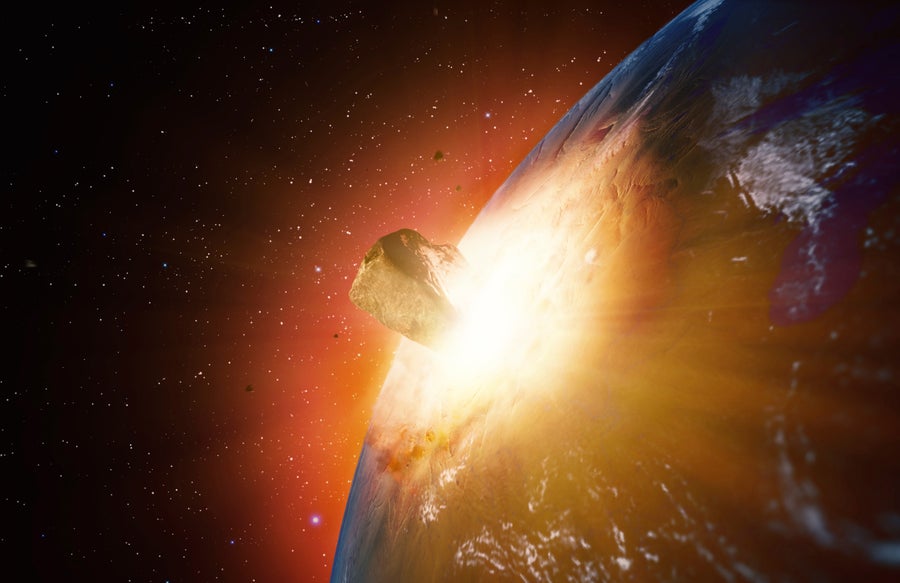
ANDRZEJ WOJCICKI/SCIENCE PHOTO LIBRARY via Getty Images
.
.
Click the link below for the complete article:
.
__________________________________________
June 29, 2026
Business, Food For Thought, Human Interest, Political, Science, Technical amazon, business, Business News, current-events, Future, Hotels, human-rights, medicine, mental-health, research, Science, Science News, technology, Technology News, travel, vacation Leave a comment

Click the link below the picture
.
The strawberry full moon in Capricorn rises on June 29 at 7:56 p.m. Eastern Time. Notably, the moon signifies when the fruit is in bloom, conveying virtue and the richness in life. It is a lunation of reflection and sympathy that gives us the opportunity to foster love and nurture our spirits.
As the first full moon of the summer, and the last full micromoon of the year, it marks a period when practicality clashes with passion, and impulsivity juxtaposes with caution. The strawberry moon aspects Neptune in Aries, a planet known to be extremely tender, but also deceptive. We will be challenging structures we’ve previously built, and trying to comprehend what is tangible and real versus what is based on our illusions.
In true Capricorn fashion, we must give our all to what speaks to our hearts. Fernando Salinas, author of The Joy of Tarot, says, “This full moon is all about recognizing that there is a magic to discipline, and that you have to be diligent if you’re going to get the gold medal in the end. I want for you to manifest something huge, something big—think of the mountain the goat of Capricorn has to climb—and then I want you to take one big step towards accomplishing it.”Approximately six and a half hours before the full moon occurs, Mercury also turns retrograde in Cancer. This cosmic back-and-forth is going to cause miscommunications and travel delays, ultimately testing our patience. Be cognizant of the shifts in the sky to avoid dramatic flare-ups with others. And most importantly, we should be gentle with ourselves.
To read the entire strawberry full moon horoscope in addition to Aries, click the link below the picture:
Aries
You’ve achieved so much on the professional front, but you never took a moment to honor and appreciate your accomplishments. The strawberry full moon urges you to celebrate yourself by recognizing how far you have come in a short amount of time—and also, what is possible in the foreseeable future. Cheers and toast to your lucrative career—past, present, and future!
.

.
.
Click the link below for the complete article:
.
__________________________________________
June 29, 2026
Business, Food For Thought, Human Interest, Political, Science, Technical amazon, business, Business News, current-events, Future, Hotels, human-rights, medicine, mental-health, research, Science, Science News, technology, Technology News, travel, vacation Leave a comment

Click the link below the picture
.
Shortly after the Supreme Court blocked President Trump from immediately ousting a sitting governor from the Federal Reserve, the president struck a defiant note, signaling he would not surrender his long-running fight to gain more sway over one of the most important stewards of the U.S. economy.
In the eyes of Mr. Trump, the 5-to-4 decision reached by the justices on Monday amounted only to a legal setback, not an insurmountable defeat. Even as the court acknowledged the century-old tradition of political independence at the nation’s central bank, it did not totally foreclose on the president’s ability to try to dismiss its officials in the future.
On one hand, the court concluded that Mr. Trump had erred when he first tried to oust Lisa D. Cook, a Fed governor, over unsubstantiated allegations of mortgage fraud last year. Siding with a lower court, which had allowed Ms. Cook to remain in her role while the case played out, a majority of the justices said the Trump administration should have afforded Ms. Cook the formal ability to contest the accusations against her.
But the Supreme Court left much unresolved. The justices did not clearly articulate the full legal criteria that would allow Mr. Trump to fire Ms. Cook, who denies any wrongdoing and has never been charged with a crime. Nor did they wager an opinion on the exact allegations against her. And the court majority did not even prescribe the exact venue in which Ms. Cook should be allowed to respond to the allegations.
The president did not hesitate to seize on that legal ambiguity. In a social media post, he described the decision as merely a “procedural” matter and vowed to “take appropriate action immediately to make sure that someone who has committed wrongdoing will not be making vital decisions concerning the Welfare of the United States of America!”
The outcome left many legal scholars on edge, particularly given Mr. Trump’s well-documented desire to install more of his supporters at the top ranks of the central bank as part of his pursuit for lower borrowing costs.
“It may look to be an attempt to quiet the temptation by presidents to meddle with the Fed, but I read it in the opposite direction,” said Peter Conti-Brown, an expert on Fed governance at the University of Pennsylvania. “It’s an invitation for more meddling.”
He added: “This saga is not over.”
Ms. Cook still found reason to celebrate on Monday, as she conveyed in a statement after the court’s decision.
“Today’s ruling affirms a principle that has underpinned sound economic stewardship for generations: that the Federal Reserve must make all its policy decisions guided by evidence and independent judgment, free from political interference,” Ms. Cook wrote. “I am grateful for this decision, not for my own sake, but for the sake of the American people, whose economic well-being depends on a central bank that answers to its mission, not political intimidation,” she added.
Those stakes loomed large over the Supreme Court as it wrestled with Mr. Trump’s power over the Fed, and they appeared to factor heavily into the opinion written by Chief Justice John G. Roberts Jr.
The liberal and conservative justices at one point cited the “ruinous financial panics” that had dotted the nation’s history, as they acknowledged the importance of a central bank that can operate free from political influence. And they channeled the country’s founders as they spoke to “the calamities that could arise from even the ‘suspicion’ of political manipulation of monetary policy.”
In addition to allowing Ms. Cook to keep her job for the time being, the split decision shot down the Trump administration’s argument that judges had no power to review its decision to fire a Fed official. It also undercut the premise that the president had nearly limitless ability to determine the conditions that would warrant such a removal.
Chief Justice Roberts said a decision accepting the view of Mr. Trump and his aides “would allow the president to remove a member of the Federal Reserve at any time, for any reason, without any notice before, and without any judicial check after.” That, the opinion said, “would turn for-cause protection into little more than at-will employment.”
For Scott Alvarez, the former general counsel for the Fed, the decision on Monday “helped to reinforce the court as a guardrail for Fed independence.” But it did not make the central bank impenetrable to further political encroachment.
For one, the Cook ruling was paired with a separate decision that vastly expanded the power of the executive branch by affirming Mr. Trump’s ability to fire all other independent regulators. In her dissent in Ms. Cook’s case, Justice Amy Coney Barrett said the decision to safeguard the Fed’s independence was “in serious tension” with the court’s ruling on the other agencies.
By invalidating the independence of those agencies, said Kathryn Judge, a Columbia Law School professor who was a Supreme Court law clerk for Justice Stephen G. Breyer, the central bank’s claim to that autonomy was more “precarious” given that for the last 90 years, “the Fed’s independence has really grown alongside the independence of other agencies.”
“There’s a path forward for the Fed to maintain meaningful independence, but it’s going to require more work to justify that independence in a way that really distinguishes it,” Ms. Judge added.
The saga around Ms. Cook began last year, after Bill Pulte, then the federal housing director, accused the Fed governor of misrepresenting her finances in order to obtain more favorable mortgage terms. His allegations soon prompted Mr. Trump to demand that Ms. Cook resign, before the president later moved to fire her.
Mr. Pulte, whom Mr. Trump has since tapped to serve as the director of national intelligence, previously said he referred the matter to the Justice Department. Shortly after the Supreme Court ruling, he asserted on social media that he believed Ms. Cook “will be indicted for mortgage fraud.”
The justices’ ruling in the case was narrow in a number of ways. The Supreme Court did not explain the conditions that would allow Mr. Trump to fire a Fed official for “cause,” the undefined criteria specified in the central bank’s chartering statute. It opposed Mr. Trump’s argument that presidents have uncontested authority to decide what qualifies as “cause,” but it also did not endorse Ms. Cook’s view that there was a high bar to meet.
Nor did the justices opine on the charges levied against Ms. Cook, citing the fact that she had not been afforded an opportunity to respond to the allegations, as required by law. That failure to give Ms. Cook the chance for rebuttal contributed heavily to the justices’ decision to allow her to continue serving at the Fed.
“To be clear, the ultimate question of whether the president can remove Cook for cause will depend in part on the underlying facts,” the majority wrote. “In this opinion, we have not addressed the facts, as they have yet to be found or analyzed under the relevant legal standards. Rather, we have simply addressed the parties’ arguments about the appropriate legal standards under which the facts must be evaluated.”
By leaving so many questions unanswered, the court gave Mr. Trump an opening to keep fighting, even if it is clear a majority does not want him to keep interfering with the Fed.
“This punt to the future is mostly a hope that the Trump administration and successive administrations will abandon this effort to meddle with the Federal Reserve,” Mr. Conti-Brown said.
Our Coverage of the Supreme Court
Weedkiller Lawsuit: The Supreme Court sided with the manufacturer of Roundup, overturning a jury award for a Missouri man who claimed the widely used herbicide caused cancer in a decision that could have sweeping impacts on thousands of other Americans who similarly claim the product sickened them.
Hawaii Gun Law: The justices struck down a Hawaii law that required gun owners to get permission before carrying a firearm onto private property like grocery stores, coffee shops and gas stations that are otherwise open to the public.
Religious Rights Case: The court said that a Rastafarian whose dreadlocks were forcibly shaved by prison guards could not sue state employees for money.
Assets Seized by Cuba: The justices cleared the way for Exxon Mobil to seek compensation from Cuban-owned entities over oil and gas assets the Communist country seized in 1960.
Securities and Exchange Commission: The court ruled that the S.E.C. can recover money that companies and individuals gained illegally, even if the agency is unable to prove that investors suffered a financial loss.
.

President Trump renewed his threat to fire Lisa D. Cook. Credit…Kenny Holston/The New York Times
.
.
Click the link below for the complete article:
.
__________________________________________
June 29, 2026
June 28, 2026
Business, Food For Thought, Human Interest, Political, Science, Technical amazon, business, Business News, current-events, Future, Hotels, human-rights, medicine, mental-health, research, Science, Science News, technology, Technology News, travel, vacation Leave a comment
Click the link below the picture
.
Part of soccer’s beauty lies in its unpredictability.
Already in World Cup 2026, we have seen Morocco tie with five-time champion Brazil and Australia overturn the odds by beating Turkey. But few surprises will top a Cabo Verde team ranked 67th at the start of the tournament holding Spain—many pundits’ pick for the title—to a 0-0 draw.
But what goes into deciding whether a team wins, draws, or loses? Of course, the quality of the players and coaching staff matters. And recent advances in sports analytics, including real-time player geolocation metrics, have led to the adoption of data-driven in-game decisions. Top football teams increasingly rely on big data and predictive algorithms to gain an advantage.
But sports psychology plays a big role, too. And that is where I come in. I have a passion for sports in general and soccer in particular—it is the game I grew up playing in Germany.
Now, as a sport psychologist and director of the Global Sport Leadership Solutions Lab at Drexel University, I study how players and coaches can manage chaos on the pitch to strategically improve performance and win.
Below, I outline several modern psychological principles that are essential to all 48 teams battling it out in Mexico, Canada and the U.S. during the 2026 FIFA World Cup.
5 steps for soccer success
Disruption — It is true across all sports, and certainly in modern soccer, that the winning team will benefit from disrupting its opponent. Disruptive tactics can include brute-force tactical fouls, high-speed counterattacks that catch the opposition off balance, deceptive set pieces that create organized chaos, high-pressure tactics that force opponents into errors, and getting under the skin of opposition players.
Disrupting the organization and rhythm of the opposing team is both a mindset and a tactic that can lead to goal-scoring opportunities. A team that can disrupt an opponent’s flow can often overturn a skill disadvantage or demoralize weaker teams.
Attentional fitness — Scoring goals in international soccer is difficult. A great striker is worth his or her weight in gold. They not only possess exceptional dribbling and spectacular one-on-one skills but also strong “attentional fitness,” which requires cognitive efficiency and a work ethic to get into positions to score.
Such players are celebrated for their “coolness” and on-the-ball craft, but it is their psychological intelligence that makes them special. One of the first skills to break under pressure is the ability to focus. The quintessential goal scorer does not freeze.
One could call it “nerves of steel,” but that is just a metaphor for managing multiple sources of attention simultaneously and efficiently. Strikers such as England’s Harry Kane, France’s Kylian Mbappé, and Norway’s Erling Haaland maintain attentional control under pressure. They lock into the moment when it matters most and seamlessly shift between tasks.
Controlled mind-wandering — Mind-wandering is a spontaneous zoning out of your immediate surroundings. In sports, mind-wandering is often seen as negative because inattention at a crucial moment can lead to disaster. But it is difficult to maintain focus for 90-plus minutes during a soccer game. And new neuroimaging evidence suggests that in moments of mind-wandering, the brain is not at rest at all. Rather, it is just processing information differently.
As such, controlled mind-wandering, which involves active mental exploration, can be highly beneficial in performance sports—even if only for a few seconds. The best players seem to know when to focus and when to pull back. They sometimes look away from the ball and absorb a broader perspective of the game. Then, when a crucial game-scoring opportunity arises, they lock in their focus and are 100 percent present.
When researchers examined where Argentine great Lionel Messi looks, they found that his eyes are often off the ball. Common sense in soccer has been to keep your eyes on the ball, but new research suggests that the winner will also mind-wander and look away from the action. Messi’s brain can seemingly do things many of his opponents’ cannot; he appears to have world-class cognitive skills.
Resilience (for referees) — Soccer is one of the most difficult sports to officiate. Not only must referees be in excellent physical condition, they must also be able to manage the game emotionally. This has become increasingly difficult, with professional players routinely simulating injuries and an offside rule that is interpreted to within fractions of an inch.
And then there is one of the most difficult and controversial cognitive decisions in all of sports: the penalty kick, awarded for committing a foul in one’s own penalty box.
With the stakes so high and everyone watching, the modern World Cup referee must have exceptional multitasking, communications and management skills. Referees are part of the fabric of the match, whether they want to be or not. Everybody is judging them—even more so in 2026, since referees are wearing cameras on their temples, so the viewing public can see the game from their point of view. The psychological toolbox of the 2026 World Cup referee is complex, but it has to start with a good dose of psychological resiliency.
Tactical creativity — Tactical creativity in soccer is related to finding solutions on the pitch to complex individual or team situations. It almost always relies on divergent thinking and is often surprising and original. Research has shown that creativity is within everyone’s reach, including soccer players, especially if tactical creativity has been part of the training plan. As a result, the evolution of playing styles in elite soccer over the past few decades has shifted away from a structured, defense-heavy, possession-based system toward a modern, data-driven way to play based on pressing the opposing team high up the pitch. This requires players to take on multiple roles on the pitch. It requires a balance of both inspiration—or open-mindedness—and perspiration, or discipline.
Of course, to be creative, one has to have the freedom to experiment; “play like children,” U.S. head coach Mauricio Pochettino suggested. Tactical creativityis a key driver of the cognitive skill set that allows players such as Croatia’s Luka Modrić and Belgium’s Kevin De Bruyne to see several moves ahead. These modern soccer stars not only play soccer on a different level, but they also think soccer on a different level.
With the World Cup now underway, sports psychologists like myself—along with fans the globe over—can observe how athletes put some of these principles to work. And with any luck, the tournament will have “wow” moments of creativity that will be remembered for a lifetime.
.

.
.
Click the link below for the complete article:
.
__________________________________________
June 28, 2026
Business, Food For Thought, Human Interest, Political, Science, Technical amazon, business, Business News, current-events, Future, Hotels, human-rights, medicine, mental-health, research, Science, Science News, technology, Technology News, travel, vacation Leave a comment

Click the link below the picture
.
On June 5, workers began refilling the newly renovated Lincoln Memorial Reflecting Pool. By June 15, the water had been taken over by algae. You know the story: The pool got greener and greener. President Donald Trump, who had made the clarity of the Reflecting Pool a cornerstone of his summer plans, got madder and madder.
As Euan Reavie followed the news, he found himself put out, too, for a different reason. “I was so frustrated that no one had actually analyzed a sample,” he says. Reavie is a senior research associate at the University of Minnesota whose work centers around “algae as indicators of environmental changes.” While the Department of the Interior has said that they are testing the water, they haven’t publicly shared the results. So Reavie deputized a friend of a friend in D.C. to dip a vial into the green water and ship it to him overnight. Then he put it under a microscope, he says, “just to see what was in there.” The answer, for that sample, was: mostly Desmodesmus, a green algae that gobbles up phosphorus and nitrogen.
In the weeks since the Reflecting Pool’s makeover went south, many have seized what is a rich and slimy opportunity for metaphor. Commentators draw parallels withBut one group is staying literal: the algae fans. They’re looking at the algae and seeing algae. And they’re hoping we can see it, too.
Although algae is rarely in the spotlight, it’s pretty much everywhere else. Worldwide, “there are probably over a million species,” says Reavie. The term is less taxonomically specific and more of a catchall, used to refer to any photosynthesizing organism that isn’t a plant. Where we might see unwelcome green goo, the Reavies of the world see “really interesting organisms” that are omnipresent, important, and full of information.
Algae can powerfully impact their surroundings, for good or ill. Reavie usually studies algae in the Great Lakes, where they make up the base of the freshwater food web, supporting an ecosystem that, in turn, supports a
But not all algae is like that. “People were making assumptions about it being toxic,” said Reavie about the Reflecting Pool algae. Desmodesmus is “not a dangerous thing,” he says, although in such large amounts, “it can be unsightly for sure,” as well as stinky.
He posted his microscope photos in a few places online, titling them “the people’s algae.” Algae-heads have flocked to the posts to share their own photos, hazard species-level identifications, and talk trash.
Some engaged in educated schadenfreude: “WAIT WAIT WAIT. It’s a [Desmodesmus] bloom??? Green algae is not … susceptible to hydrogen peroxide as a control method,” one redditor pointed out, referring to an attempt made to fight the algae. (In fact, according to the Atlantic, the hydrogen peroxide may have simply killed off blue-green algae, leaving room for Desmodesmus and related kinds of green algae to thrive.) Others were pulled back to their lab days: “Considering volunteering my services as I have unintentionally killed Desmodesmus cultures many times,” one scientist reminisced on Bluesky.
Others, it seems, wanted merch. When Annie Talley heard about the algae in the Reflecting Pool, she decided to honor it the best way she knew how: by creating a commemorative suncatcher that looks like a little Desmodesmus. She shared a photo in the Amateur Microscopy Facebook group she frequents, noting it’s “the most famous algae in the world right now!!”
Talley, an artist and retired college biology teacher, has—prior to the Reflecting Pool situation—made dozens of algae-themed suncatchers out of UV resin. While some of these creations have been commissioned by researchers, most hang in the window of her house. (Phycology, or the study of algae, is “really not that big of a field,” she says.) But her Desmodesmus photo has over 1,000 likes. “People are emailing me,” she says. “They want to buy them.”
Talley’s suncatchers dangle in the air and catch the light, an homage to algae’s most impactful contribution: producing over half of the world’s oxygen, which they do using energy from the sun.
“People think, ‘Oh, algae, it’s poison,’ ” she says. “But some algaes are good, and some are bad.” Plus, up close, “they’re just beautiful,” she says.
Alongside the curiosity and wholehearted appreciation, these fans see another benefit of focusing on the algae: It leads to the truth. Trump has asserted that the algae’s pool takeover must be an act of vandalism. But anyone who knows about algae will realize that it didn’t need any help, Talley says. The seeds of this algae bloom could have come from the air, the rain, or the piped-in replacement water. And “if they fertilize the lawn around the pool, all that water that’s running in there is adding nitrogen and phosphorus,” she says. “That’s what they love.”
Reavie was careful to say that without ongoing monitoring, he could only guess why the algae arrived, and what might happen to it next. But the coat of dark paint certainly doesn’t help, he says: “The pool is going to be much warmer now throughout the summer, which is going to promote, potentially, blooms of algae that you really don’t want.”
.
 Philip Yabut/Moment
.
.
Click the link below for the complete article:
.
__________________________________________
June 28, 2026
Business, Food For Thought, Human Interest, Political, Science, Technical amazon, business, Business News, current-events, Future, Hotels, human-rights, medicine, mental-health, research, Science, Science News, technology, Technology News, travel, vacation Leave a comment

Click the link below the picture
.
Old people cry a lot. I will see a sweet child in the street, watch a news story about a heroic rescue, or catch sight of a peony or of a full moon, and my eyes will be awash with tears. Whatever it is that I am feeling seems expressible only this way. People weep for joy or sorrow. I do neither, consciously.
Something comes over me, as it did the other day when I was sitting alone in an elegant room at the New York Society Library, waiting for an event at which I was to speak. It was one of those breathlessly hot days in mid-May, and the heat outside seemed to compound the still silence inside. For no apparent reason, I began to sing a song from “Carousel” called “If I Loved You.” I don’t mean that I muttered the song softly or mouthed the words or whispered. I mean that I sang clearly, nearly belting it out, as if I were onstage in the middle of the play: “If I loved you, / Words wouldn’t come in an easy way / Round in circles I’d go / Longin’ to tell you / But afraid and shy, / I’d let my golden chances pass me by.”
And sure enough, I started tearing up, as I tend to do often these days.
My singing at the Society Library lasted less than a minute. My event was about to begin, and I left the room thinking of what I was going to say. All the tentative beauty of the Rodgers and Hammerstein song had vanished along with my tears. But for a moment there, I was living in the world of the lyrics, a world of thwarted possibility and regret — not my own but rather that of everyone, the world I have arrived at after 85 years of living. And I was saying or singing to that world how I’d love you if I loved you.
Why do I tear up so often? I think it has to do with the past, how much past has built up inside me all these years. I first saw “Carousel” when I was 10 and was frightened by Billy Bigelow’s violent death. I saw it again when my granddaughter Jessica appeared in a school version of the play, and I heard “Soliloquy,” which includes the recurring phrase “my little girl,” not long after our daughter Amy died. Yet these days, I may tear up not for the play specifically but rather for all the years the play has rested with me, and whatever I’m feeling is both gone and remembered.
The past is a strange thing, both present and missing. In John Donne’s “Song: Go and Catch a Falling Star,” he creates a list of impossible things en route to his scoundrel’s lament that there’s no such thing as a woman who is faithful. “Tell me where all past years are,” he writes. It’s like the common phrase “Where did the time go?” to indicate that a stretch of time has passed too quickly to enjoy it fully. Here, Donne means the phrase literally. Where does time go? It is impossible to know.
And how suddenly the present becomes the past. Lifelong friends, here yesterday, gone today.
So many things lost in a life, my life, yours. So much left to articulate yearning. The proposition of “If I Loved You” is that, in fact, I do love you, but I cannot say it. I don’t have the words or the nerve. In Jane Austen’s “Emma,” the stoic Mr. Knightley says to the meddling heroine, “If I loved you less, I might be able to talk about it more.”
Is that why I tear up? Because I’m so overwhelmed with life as I approach the end of it that I’m at a loss for words, and all I can do is cry?
Overwhelmed. That seems to be the basis of weeping. Lord Byron contemplates losing his love, then regaining it. “How shall I greet thee? / With silence and tears.” In fact, tears are a form of silence. Voltaire called them “the silent language of grief.” They are for everything we cannot say, a tear for every word. A tear rolls down our face, glistens, then dries and disappears. Or we wipe it away, as if we are ashamed of it, as if we are getting rid of it. We never do, any more than we get rid of the pain that the endorphins were sent to cure.
In older age, the inexpressible may occur more frequently because one is approaching the ultimate inexpressibility of dying. We cannot know death until it is too late to report back on it. And we know the impossibility of knowing until all knowing has vanished into the past, the remembered, forgotten past.
Whatever happened to your life long ago, whatever carousel you were on, reminds you of yourself, who also happened long ago. So you’re tearing up for all that is gone, all that monumental past, vast and variegated. These days, I have so much past behind, and within me, it’s as if it bubbles over.
In my appearance that day, I said that one of the beauties of old age lies in appreciating what one has as opposed to ever wanting something new. This is true. But all that one has can gang up on you, too, and hit you when you least expect it. Such as the time I found myself all alone in an elegant room at the New York Society Library and sang my heart out.
.
 Lidewij Mulder
.
.
Click the link below for the complete article:
.
__________________________________________
Find the Best Forex Broker for Your Trading Success
AS HUMILDES OPINIÕES DE UMA MULHER DE CORAGEM QUE DIZ SIM À VIDA!
Să facem glume, nu război
In the world, human beings are facing various problems. People who are full of greed, anger, and ignorance are seen to be fighting with each other in words and deeds. As the fighting continues, various problems such as civil wars, wars of aggression, and wars of aggression are occurring. As world peace is being destroyed, humans are facing unbearable problems. Innocent children and women are not getting the rights they deserve and deserve. I can't think of one thing every time. What is it? The United Nations. If we look at the responsibilities and duties of the United Nations, I think it is not suitable for solving the problems that are happening in the world today. In fact, the United Nations and the World Security Council, such an organization must rule the world, must be able to give orders, and must have various ways to obey orders. There must be no organization that can influence more than that organization. There should be experts from each country. They can even dominate the superpowers like the US, China, and Britain. Only then will global peace be achieved quickly. Now, if a country with power develops more militarily, economically, or socially than its own country, then powerful countries will jealously seek out enemies and wage war. Or they will attack with fighter jets. In this, innocent people are losing their lives. No one understands the value of a life. You should think about how to achieve global peace by controlling these. If the US continues to be the permanent president of the UN, world peace will never be achieved. If you think carefully, no one sees that they are working for the common good, but for their own benefit, for the benefit of their own country. The permanent president of the UN and the Security Council has rejected this, As a young Rohingya, I have come to realize that only by electing the president and secretary from among the countries in the world through a secret ballot system and governing the world fairly can we achieve global peace. The United Nations and the Security Council are organizations in which any country must govern, give orders, and make them obey their orders. For example, only when a defendant is tried in court can we hold the leaders of the countries in check and control them, can we achieve global peace smoothly. Otherwise, it will not be easy for powerful countries to use various excuses to end this war every year, every year, for the benefit of themselves and their countries. No country's leaders pay any attention to the words of the United Nations and the Security Council. If we look at it in practice, look at the Rohingya issue. Myanmar is a small country. Even that country has been under siege for 8 years. What action can be taken? Why is the UN and the Security Council Powerless? Without such Power, how can the organization bring about global peace? Everyone should think about it. Whether there is a veto or a strong one, all countries in the world can only achieve global peace if they are subject to the UN and the Security Council. Seek peace in the quiet embrace of nature. Peace is an indispensable need of the human race. It is not as if one person can kill another person, and it is as if one country can attack another country, but instead of trying to build peace, we must try to destroy the peace now, and the world is getting hotter and is on the verge of collapse. I especially appeal to all the world experts to urgently try to bring about peace in all parts of the world. Mr, Noor Muhamed Arkhan Rohingya Youth Myanmar
Publicație umoristică dedicată glumeților de pretutindeni
Faith saved us from the savages that we were, losing faith makes us savages again
Where Trends Meet Truth
https://www.tangietwoods
Freelance poetry writing
Zalai Betti
INOVATION BLOG PEOPLE AND NEWS
Németh György
Konsultan Lingkungan Hidup di Lombok - NTB
Lea Krasznai (LeaArt21) – Idezetek (Idézetek) WordPress (Budapest, Hungary)
Appunti, spunti e passioni in liberta'
Gyorgy Nemeth
تعنى بتقديم نصائح للمعلمين المبتدئين، والطلبة الممتحنين، ومشاركة الاخرين تجربة الادخار في المال، بترشيد الاستهلاك المنزلي، وترتيب البيت، والحفاظ على البيئة، وتشجيع السيارات صديقةالبيئة، والسياحة والاسفار، ونماء رؤوس الاموال، والطب البديل وتشجيع التعليم الرقمي والذكاء الاصطناعي، والعناية بالنحل وتربية الاسماك، والاسثمار في رؤوس الاموال، الزراعة العضوية، والعناية باسنان الرضع، و صحة الحوامل، وتفسير القران
apprendre pour évoluer
Thoughts on books, language, meaning, and the culture around it.
Outdoor Recreation & Adventure in the Great Lakes Region
News, Info, Bio, Articles, Reviews, Lyrics, Technology, Science, Inspiration, Motivation, Philosphy and many more...
Christian Lifestyle Blogger
CEO and president of The Mullins Companies
Two Cultures. One Life. Endless Stories
Real Estate Development Specialist
¡Bienvenido de vuelta viajero!
so looking to the sky ¡ sing and from my heart to YOU ¡ bring...
CEO and Founder of Nsight Health
Catholic News, Prayers, HD Images, Rosary, Music, Videos, Holy Mass, Homily, Saints, Lyrics, Novenas, Retreats, Talks, Devotionals and Many More
Decoding Power. Defying Narratives.
A creative collaboration introducing the art of nature and nature's art.
The Home Of Entertainment News, Reviews and Reactions
•Whenever you are confronted with an opponent, conquer him with love.(Gandhi)
Algotrader at TRADING-CLUBS.COM
Film and Writing Festival for Comedy. Showcasing best of comedy short films at the FEEDBACK Film Festival. Plus, showcasing best of comedy novels, short stories, poems, screenplays (TV, short, feature) at the festival performed by professional actors.
Peace. Tranquility. Insanity.
Take a ride on the wild side
Découvre des musiques prometteuses (principalement) dans la sphère musicale française.
No tiene que Ser una Pesadilla.
Life in Kana-text (er... CONtext)
Where feelings meet metaphors and make questionable choices.
Finding hope and peace through writing, art, photography, and faith in Jesus.

