
Click the link below the picture
.
In late May, in broad daylight, residents across Massachusetts and beyond saw a brilliant flash in the sky, followed by two sonic booms that rattled windows, shook houses, and prompted a flood of 911 calls. Some people thought they had just experienced an earthquake. Others thought it was thunder, an explosion, or a military flyover.
But the true source of all the commotion was out of this world—literally. A small meteoroid, about five feet wide and as heavy as an elephant, had entered the atmosphere at a blinding 42,000 miles per hour before disintegrating dozens of miles above the ground. The midair explosion released a pressure wave equivalent to 230–300 tons of TNT, and any surviving fragments likely fell into Cape Cod Bay.
The story quickly captivated an American public already more space-crazed than usual, thanks to the recent success of Artemis II. However, it has also served as a stark reminder that space is not as benign or empty as it may seem. Rather, our solar system is a celestial shooting gallery, chock-full of flying projectiles—not just meteoroids but larger bodies, such as comets, asteroids, and other cosmic detritus—and Earth is right in the firing line. Earlier in May, for instance, the newly discovered asteroid 2026 JH2, estimated at 50 to 115 feet wide, missed Earth by a “mere” 56,000 miles. Had it been on a collision course, it could have easily destroyed a big city.
But even that would not have been humanity’s worst nightmare scenario. After all, some celestial Goliaths can run a lot larger than JH2—large enough to decimate entire countries and even continents. British physicist Stephen Hawking believed that a cosmic impact poses one of the greatest threats to humanity, far greater than any global pandemic or terrestrial natural disaster. The question is not if we will suffer a direct hit but when.
Unfortunately, we humans would be powerless against a rare giant projectile many miles in diameter. Unlike the dinosaurs, we might well see the approach of a six-mile-wide killer asteroid, like the one that collided with Earth 66 million years ago. However, stopping it or deflecting its course is out of the question: It would be like trying to stop an oncoming truck by throwing ping-pong balls at it. And although we’ve discovered the vast majority of near-Earth objects (NEOs) larger than about two-thirds of a mile across, finding that none are on a collision course with Earth, astronomers could very well discover an enormous comet next week that will crash into the planet in a few years’ time. And again, there’s nothing we could do to stop it.
If we do want to protect ourselves from cosmic impacts, we need to focus on medium-sized objects, ranging from about 100 yards to about a half a mile. These are relatively numerous, and they can easily cause many tens of millions of casualties. Earth is hit by a 400-yard asteroid on average once every 100,000 years. If the collision occurs in Europe, a country like France will disappear completely from the map, and the entire continent will become an unimaginable disaster area. Such an impact is, in theory, preventable, so we would be crazy not to explore the possibilities of doing just that.
That’s what Dutch astrophysicist Piet Hut of the Institute for Advanced Study in Princeton, New Jersey, thought too. A few years after the 1998 Hollywood blockbusters Deep Impact and Armageddon brought the general public face-to-face with the possibility of an impact, Hut organized a workshop on how to avert such doomsday scenarios. A year later, in October 2002, together with a fellow astronomer and two former astronauts, he founded the B612 Foundation—a private nonprofit foundation that aimed to investigate how to deflect approaching celestial bodies.
Ten years ago, the foundation had ambitious plans to launch a satellite, called Sentinel, that would search for potentially dangerous asteroids. Although the project was canceled for lack of funds, the B612 Foundation remains one of the leading advocates of serious research into planetary defense techniques.
Meanwhile, government organizations such as NASA and the European Space Agency (ESA) are not sitting idly by.
NASA has its own Planetary Defense Coordination Office, while ESA has invested in NEOShield and NEOShield-2, European Union–funded research programs that studied the most plausible methods for asteroid deflection. The U.S. National Science and Technology Council has developed its own National Near-Earth Object Preparedness Strategy, and even within the United Nations Committee on the Peaceful Uses of Outer Space (COPUOS), there is an action team addressing the threat of cosmic impacts. In addition to its own International Asteroid Warning Network, the UN now has a Space Mission Planning Advisory Group.
Needless to say, many, many meetings are being held now on how to protect humanity from attacks by the cosmos.
How will we protect Earth?
When it comes to protecting Earth from a fatal collision, there are a number of ideas currently under consideration, ranging from good to bad to very bad.
For example, blowing an asteroid up with an atomic bomb, as happened in “Armageddon,” is not a smart idea. It is an option that Edward Teller, known as “the father of the hydrogen bomb,” proposed long ago, but it simply wouldn’t help. The numerous fragments created in such an explosion would still be moving through the solar system in more or less the same direction and at the original high speed. As a result, Earth would then have to endure not one big impact but a whole series of smaller ones, with all the attendant consequences.
A more practical solution would be to slightly deflect the approaching celestial body so that it passes close to Earth rather than colliding with it. Particularly if you can see the impact coming many years in advance, a small nudge can be enough to avert disaster. When astronomers discovered the 1,100-foot-wide near-Earth object Apophis, which for a while looked as if it would wreak havoc on Earth in 2029, they were already calculating that a minimal change in speed of just a few micrometers per second would be enough to prevent that anticipated catastrophe. Luckily, in the case of Apophis, there’s no need to intervene: The asteroid will safely fly by the Earth on April 13, 2029, at a distance of some 20,000 miles.
Still, for what it’s worth, NASA did manage to execute its first successful intentional asteroid deflection test rather recently: In September 2022, it deflected a small celestial body when the DART (Double Asteroid Redirection Test) spacecraft intentionally slammed into the 525-foot-wide asteroid Dimorphos, successfully changing its orbit around the larger parent body Didymos.
Meanwhile, at Lawrence Livermore National Laboratory, the HAMMER project is on the drawing board. HAMMER (Hypervelocity Asteroid Mitigation Mission for Emergency Response) is a celestial battering ram, 10 yards long and weighing almost 9 tons, that can be fired at high velocity at a small near-Earth object. With a 10-year warning period, it could deflect a 100-yard-wide object enough to prevent an impact. If something larger is speeding toward Earth, you just send out 10 or 20 HAMMERs. Or 50, or 100. Admittedly, that is a hugely expensive proposition, but if it means you can save 100 million lives, cost is obviously a secondary consideration.
Incidentally, there is a cheaper way to nudge a small asteroid out of its original orbit: just place a giant rocket motor on its surface. If a small rocket motor can transport a launcher into space, a big one should let you accelerate or decelerate an entire NEO at least a tiny bit. As for the raw material needed for the rocket fuel, you could use the composition of the asteroid itself: Hydrogen can be extracted from ice, and oxygen from rock. Or, rather than using a rocket motor, you simply catapult material from the NEO into space at high speed. That is, thanks to Newton’s third law—every action produces an equal and opposite reaction—which results in a kind of rocket effect in the opposite direction.
Thermodynamics could also be of use. For instance, we could heat a small area on one side of the asteroid until the surface material evaporates and jets off into space. The effect is the same as that of a rocket engine on the surface: Gas is blasted away in one direction, propelling the asteroid a tiny bit in the other direction. If you can set a piece of paper or a shoelace on fire using a magnifying glass, you can also focus sunlight on the surface of an asteroid using a large swarm of satellites equipped with gigantic lenses. Additionally, an entire fleet of laser cannons is an option, as is a nuclear explosion at a short distance from the celestial projectile. Another suggestion is to wrap an approaching NEO in thin, reflective foil, either strengthening or weakening the Yarkovsky effect (i.e., the tiny “push” that sunlight exerts on a rotating asteroid). Giving it a once-over with a can of spray paint is another way to achieve the same result.
Finally, perhaps the least invasive option would involve what’s known as a gravity tractor, developed by former astronaut Ed Lu (cofounder of the B612 Foundation) and his colleague Stan Love. The device, which might be a large, heavy space probe, would fly alongside the near-Earth object for an extended period (years to decades) and slowly drag it away from its collision course. The probe would need to keep its rocket engine on the whole time; otherwise, it would be pulled in by the celestial body’s gravity. With a bit of careful maneuvering and enough time, you could pull a killer asteroid into a safe orbit.
It’s not too late
It goes without saying that all of these planetary defense strategies sound rather fantastical. And that’s to say nothing of the complex political obstacles to the whole idea of planetary defense.
Suppose a relatively small near-Earth object is speeding toward our planet, threatening to wipe the city of Dallas (whose population is over a million) off the map. Will Russia and China be willing to help pay for a “rescue mission?” Do Americans have money to spare for the preservation of Chengdu? Do people in Europe care about Zimbabwe’s possible fate? American astronomer Carl Sagan foresaw yet another problem: If a country has the capability to deflect a small asteroid so that it passes close to Earth, the same technology can also be used to bring the asteroid down on an enemy. On this basis, the utopian concept of planetary defense could also turn into a celestial version of the Cold War—or worse.
These are exactly the kinds of issues that are on the agenda of the UN special committee dealing with the threat of cosmic impacts.
For the time being, any form of consensus is still a long way off. Nonetheless, something has to be done. If you are in the firing line, you have to protect and defend yourself as best you can. We must identify the danger, study all the conceivable countermeasures, and be ready to act when necessary. As with fighting the coronavirus pandemic and the climate crisis, the urgency of the problem will likely only sink in when the need arises. Hopefully, it won’t be too late by then.
.
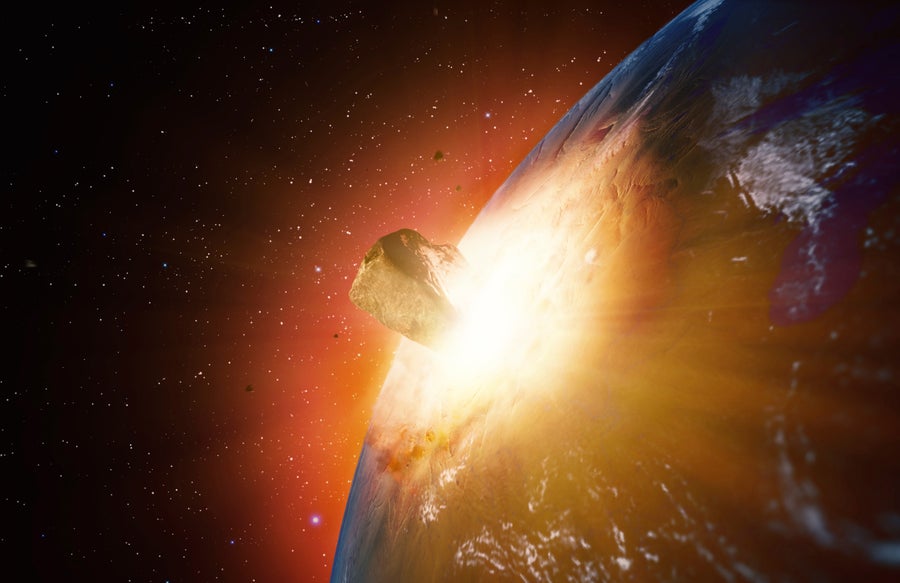
ANDRZEJ WOJCICKI/SCIENCE PHOTO LIBRARY via Getty Images
.
.
Click the link below for the complete article:
.
__________________________________________


Leave a Reply