Nikki Smith, an IT worker from Columbus, Ohio, was excited to find the r/ZeroWaste subreddit. Always a bit of an environmentalist, in recent years she became more serious about doing everything she could to reduce her carbon footprint. She dove head first into the online community, eagerly adopting tips like making reusable cotton rounds out of old or ill-fitting clothes.
Beyond those gems, though, a certain kind of post has irked her.
“I kept seeing post after post after post of people sharing photos and info on ‘look at these zero-waste things I just bought!’” Smith says over email. “It just boiled me long enough that I had to speak up.”
So, after a few weeks of seeing more posts like this than usual — maybe due to more new folks recently joining the subreddit — she made a post urging people to stop buying zero-waste things, arguing that these purchases are part of the problem.
“A lot of these items were ordered online with unrecyclable packaging, and then [there’s] fuel emissions from shipping,” she says. “And a lot of these items I kept thinking probably could have been found second-hand somewhere. Water bottles especially! They’re everywhere.”
She’s not the only one on the subreddit with that sentiment. On posts where users show hauls of glass jars from big-box stores like Walmart, commenters chime in to suggest that next time they should check their local thrift stores first. One Redditor shared that they sewed their own drawstring bag for travel utensils and received particular praise. “See, this is nice,” the top comment reads. “You didn’t miss the whole point and buy fancy new bamboo cutlery when you already had metal stuff at home that would work perfectly well.”
The market for earth-friendly products is ever-growing. In 2018, the reusable water bottle market was valued at more than $8 billion, up 3 percent from 2017, and it’s expected to reach $10.4 billion by 2025. The global eco fiber market, like bamboo fabric and organic cotton harvested without the use of pesticides or other chemicals, is anticipated to reach $93 billion by 2025. The green packaging market — think reusable food containers, along with packaging made of recycled materials or materials that break down naturally — will reportedly grow to $215 billion by 2021.
Companies are now marketing to the green consumer, and though there are clear environmental benefits to this, some zero wasters are concerned that this push to buy green products ignores those other two Rs of the environmentalist mantra: reduce and reuse.
.
Wooden cutlery, mason jars, and reusable cups are just a few of the zero-waste products on the market. Getty Images
Rustin is a biographical drama directed by George C. Wolfe, from a screenplay by Julian Breece and Dustin Lance Black, and a story by Breece about the life of civil rights activist Bayard Rustin. Produced by Barack and Michelle Obama’s production company Higher Ground. It is based on the true story of Rustin, who helped […]
Some content on this page was disabled on April 15, 2025 as a result of a DMCA takedown notice from Guardian Media Group. You can learn more about the DMCA here:
Welcome to Super Bowl LVIII week at The Ringer! In the days ahead, we’ll cover every aspect of the San Francisco 49ers–Kansas City Chiefs matchup in Las Vegas, Nevada. Let’s get started with a table setter: I’ve watched the film, crunched the numbers, and sorted through the noise to identify the 25 most important things you need to know about this game. Let’s get to it!
1. At the risk of jinxing it, I think we’re going to get a competitive Super Bowl for the third straight year. The 49ers finished the regular season second in total DVOA, and the Chiefs were fifth. Four teams finished in the top 10 of both offensive and defensive DVOA, and these are two of them (sorry, Cowboys and Ravens, hope you are enjoying Cancún).
The Chiefs are 88-25 with Patrick Mahomes as their starter. And among those 25 losses, just four have been by more than eight points. Let me say this a different way just to get the point across: In the 113 games that Mahomes has started, just four opponents—only 3.5 percent!—have managed to beat him by more than eight points. Now if you’re a hater, you can point to the fact that one of those losses came in the Super Bowl to the Tampa Bay Buccaneers. But you get the point. It doesn’t happen often.
2. Blowouts are rare for this iteration of the 49ers, too. They are 21-5 with Brock Purdy as their starter, and just three of those losses were by more than one possession. We saw it in the NFC championship game against the Lions. They can get down big (it was 24-7 in that game)—but because of how explosive the offense is, they can catch up in a hurry. Typically, when they’ve been in shoot-outs, they’ve won. Is there some randomness with the small sample? Sure. But the 49ers have not lost a game with Purdy (20-0) when they’ve scored at least 20 points.
If you drive north from Khartoum along a narrow desert road toward the ancient city of Meroe, a breathtaking view emerges from beyond the mirage: dozens of steep pyramids piercing the horizon. No matter how many times you may visit, there is an awed sense of discovery. In Meroe itself, once the capital of the Kingdom of Kush, the road divides the city. To the east is the royal cemetery, packed with close to 50 sandstone and red brick pyramids of varying heights; many have broken tops, the legacy of 19th-century European looters. To the west is the royal city, which includes the ruins of a palace, a temple, and a royal bath. Each structure has distinctive architecture that draws on local, Egyptian and Greco-Roman decorative tastes—evidence of Meroe’s global connections.
Off the highway, men wearing Sudanese jalabiyas and turbans ride camels across the desert sands. Although the area is largely free of the trappings of modern tourism, a few local merchants on straw mats in the sand sell small clay replicas of the pyramids. As you approach the royal cemetery on foot, climbing large, rippled dunes, Meroe’s pyramids, lined neatly in rows, rise as high as 100 feet toward the sky. “It’s like opening a fairytale book,” a friend once said to me.
I first learned of Sudan’s extraordinary pyramids as a boy, in the British historian Basil Davidson’s 1984 documentary series “Africa.” As a Sudanese-American who was born and raised in the United States and the Middle East, I studied the history of ancient Egypt and Mesopotamia, the Levant, Persia, Greece, and Rome—but never that of ancient Nubia, the region surrounding the Nile River between Aswan in southern Egypt and Khartoum in central Sudan. Seeing the documentary pushed me to read as many books as I could about my homeland’s history, and during annual vacations with my family, I spent much of my time at Khartoum’s museums, viewing ancient artifacts and temples rescued from the waters of Lake Nasser when Egypt’s Aswan High Dam was built during the 1960s and ’70s. Later, I worked as a journalist in Khartoum, Sudan’s capital, for close to eight years, reporting for the New York Times and other news outlets about Sudan’s fragile politics and wars. But every once in a while I got to write about Sudan’s rich and relatively little-known ancient history. It took me more than 25 years to see the pyramids in person, but when I finally visited Meroe, I was overwhelmed by a feeling of fulfilled longing for this place, which had given me a sense of dignity and a connection to global history. Like a long-lost relative, I wrapped my arms around a pyramid in a hug.
The land south of Egypt, beyond the first cataract of the Nile, was known to the ancient world by many names: Ta-Seti, or Land of the Bow, so named because the inhabitants were expert archers; Ta-Nehesi, or Land of Copper; Ethiopia, or Land of Burnt Faces, from the Greek; Nubia, possibly derived from an ancient Egyptian word for gold, which was plentiful; and Kush, the kingdom that dominated the region between roughly 2500 B.C. and A.D. 300. In some religious traditions, Kush was linked to the biblical Cush, son of Ham and grandson of Noah, whose descendants inhabited northeast Africa. tangie
.
Meroe, 150 miles north of Khartoum, served as a necropolis for the kings and queens of Kush for close to 600 years. Matt Stirn Text by Isma’il Kushkush; Photographs by Matt Stirn
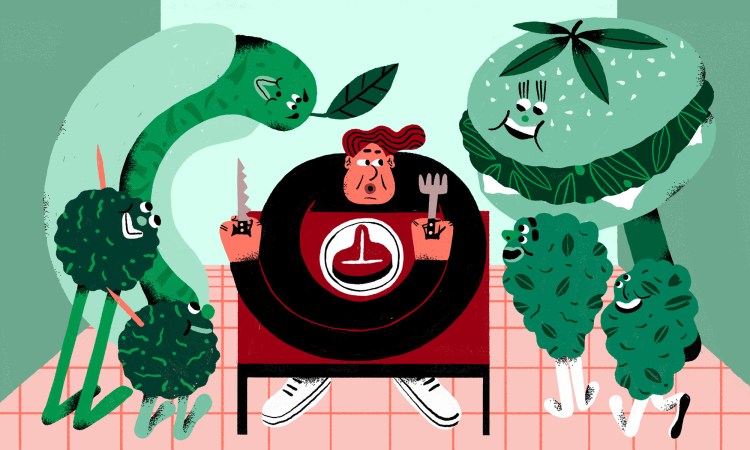
If we want the people in our lives to put down their steak knives and seriously consider changing their diets, we need to change the conversations we’re having with them, says food innovator Bruce Friedrich. Here’s what to say — and what not to say.
We can’t stop eating meat. Global consumption averages 94.8 pounds per person a year, and it’s expected to increase as much as 76 percent by 2050. In steak- and burger-loving countries such as Australia and the US, the average person eats between 220 and 240 pounds of meat and poultry a year.
Yet at the same time, researchers are increasingly aware of the serious consequences of our carnivorous diets. “In 2019 … 30 of the world’s leading scientists released the results of a massive three-year study into global agriculture and declared that meat production is destroying our planet and jeopardizing global health,” said Bruce Friedrich, cofounder and executive director of the Good Food Institute, an organization that supports the creation of plant-based and cell-based meat, in a TED Talk.
What’s more, eating meat has been shown to have a negative impact on personal health. A large-scale analysis found that a long-term diet of high amounts of red meat, particularly processed meat, is associated with an increased risk of mortality, cardiovascular disease, colorectal cancer, and type 2 diabetes. In fact, the World Health Organization’s International Agency for Research on Cancer (IARC) has classified processed meat as a human carcinogen due to its association with colorectal cancer, and WHO has classified red meat as “probably” carcinogenic because of its links to colorectal cancer.
Despite all the evidence, people aren’t putting down their double cheeseburgers, something that Friedrich, a TED Fellow, knows all too well. “Lots of people oppose the harms of industrial animal agriculture, but when they sit down to eat, they put their ethics to the side, and they eat what is delicious and orderable,” he says.
Here are 10 historical events that took place on February 7th, listed in chronological order: Thank you for reading my writings. If you’d like to, you can buy me a coffee for just £1 and I will think of you while writing my next post! Just hit the link below…. (thanks in advance)
In the world, human beings are facing various problems. People who are full of greed, anger, and ignorance are seen to be fighting with each other in words and deeds. As the fighting continues, various problems such as civil wars, wars of aggression, and wars of aggression are occurring. As world peace is being destroyed, humans are facing unbearable problems. Innocent children and women are not getting the rights they deserve and deserve. I can't think of one thing every time. What is it? The United Nations. If we look at the responsibilities and duties of the United Nations, I think it is not suitable for solving the problems that are happening in the world today. In fact, the United Nations and the World Security Council, such an organization must rule the world, must be able to give orders, and must have various ways to obey orders. There must be no organization that can influence more than that organization. There should be experts from each country. They can even dominate the superpowers like the US, China, and Britain. Only then will global peace be achieved quickly. Now, if a country with power develops more militarily, economically, or socially than its own country, then powerful countries will jealously seek out enemies and wage war. Or they will attack with fighter jets. In this, innocent people are losing their lives. No one understands the value of a life. You should think about how to achieve global peace by controlling these. If the US continues to be the permanent president of the UN, world peace will never be achieved. If you think carefully, no one sees that they are working for the common good, but for their own benefit, for the benefit of their own country. The permanent president of the UN and the Security Council has rejected this, As a young Rohingya, I have come to realize that only by electing the president and secretary from among the countries in the world through a secret ballot system and governing the world fairly can we achieve global peace. The United Nations and the Security Council are organizations in which any country must govern, give orders, and make them obey their orders. For example, only when a defendant is tried in court can we hold the leaders of the countries in check and control them, can we achieve global peace smoothly. Otherwise, it will not be easy for powerful countries to use various excuses to end this war every year, every year, for the benefit of themselves and their countries. No country's leaders pay any attention to the words of the United Nations and the Security Council. If we look at it in practice, look at the Rohingya issue. Myanmar is a small country. Even that country has been under siege for 8 years. What action can be taken? Why is the UN and the Security Council Powerless? Without such Power, how can the organization bring about global peace? Everyone should think about it. Whether there is a veto or a strong one, all countries in the world can only achieve global peace if they are subject to the UN and the Security Council. Seek peace in the quiet embrace of nature. Peace is an indispensable need of the human race. It is not as if one person can kill another person, and it is as if one country can attack another country, but instead of trying to build peace, we must try to destroy the peace now, and the world is getting hotter and is on the verge of collapse. I especially appeal to all the world experts to urgently try to bring about peace in all parts of the world. Mr, Noor Muhamed Arkhan Rohingya Youth Myanmar
Film and Writing Festival for Comedy. Showcasing best of comedy short films at the FEEDBACK Film Festival. Plus, showcasing best of comedy novels, short stories, poems, screenplays (TV, short, feature) at the festival performed by professional actors.

:format(webp)/cdn.vox-cdn.com/uploads/chorus_image/image/63781137/GettyImages_1135137418.0.jpg)

:format(webp)/cdn.vox-cdn.com/uploads/chorus_image/image/73112172/superbowlkickoff_getty_ringer.0.jpg)


/https://tf-cmsv2-smithsonianmag-media.s3.amazonaws.com/filer/1b/20/1b205e98-4c95-4d82-a053-5bc6e8d34c65/sudan_opener_socialmedia.jpg)

 Cari Vander Yacht


