NASA calls it the most colorful image ever captured by the Hubble Space Telescope–and the most comprehensive. It has to be one of the most spectacular.
But the image–the remarkable payoff of a new survey called the Ultraviolet Coverage of the Hubble Ultra Deep Field–is more than merely beautiful. It may also help fill in some gaps in our understanding of how stars form.
.
Image From NASA’s Hubble Telescope
.
.
Click link belowfor story, Amazing Shot, video and slideshow:
When a black hole swallows a star, things get violent. Very violent.
At least, that’s what scientists found in a new study when they used computer simulations to mimic the destruction of a star as it falls into a giant black hole. Just check it out in the video.
The simulations show that when the gravitational force of a supermassive black hole pulls in a star, the star is stretched into a long blob before it’s destroyed. About half of the star’s mass may get ejected as a stream of debris and the other half eventually may spiral into the black hole, forming what’s called an “accretion disk.”
.
Illustration of a star distorted by supermassive black hole.
Stargazers are thrilled over the surprise appearance of a star explosion, known as a nova, in the night sky last week, but there is more to this cosmic event than meets the eye.
The new Nova Delphinus 2013 was first spotted in the constellation Delphinus (The Dolphin) by Japanese amateur astronomer Koichi Itagaki on Aug. 14 and quickly confirmed by other skywatchers soon after. Novas are stars that are undergoing a powerful eruption, causing them to brighten significantly, so that they appear suddenly in the night sky where previously no star was visible.
Since its discovery, this nova has brightened rapidly to become an object visible to the naked eye, though stargazers will need to be away from city lights in order to see it clearly
Just how frequently does a nova become bright enough to be seen without the use of binoculars or a telescope?
On average, new novas are detected about once every four or five years. Over the last 112 years, there have been 47 novas that have flared into naked-eye view. The majority of these — 26 — were quite dim and could only be positively identified by using a star chart or sky atlas.
.
Photographer Justin Ng photographed Nova Delphinus 2013 on August 18, 2013. He is based in Singapore.
Forecasting when stars will die in giant explosions may one day be possible by looking for the warning outbursts they release beforehand, researchers say.
Supernovas are the most powerful stellar explosions in the universe, visible all the way to the edge of the cosmos. These stars detonate for two known reasons: either from gorging on too much mass stolen from a companion star or by running out of fuel and abruptly collapsing.
Astronomers have suggested that stars can give off smaller explosions just before they go supernova. To find out more about supernovas, researchers used three telescopes — the Palomar Observatory, the Very Large Array and NASA’s Swift mission — to investigate a star 500 million light-years away.
.
The image shows a simulation of a collision between two shells of matter ejected by a massive star in two subsequent pulsational pair-instability supernova eruptions, only years apart, just before the star dies. Image released Feb. 7, 2013.
.
.Click link below for story, slideshow, and video:
The Hubble Space Telescope launched on April 24, 1990, ushering in a new era in space exploration.
From its low-earth orbit, the telescope can take pictures without interference from the planet’s atmosphere, snapping photographs in visible light, ultraviolet and near-infrared wavelengths.
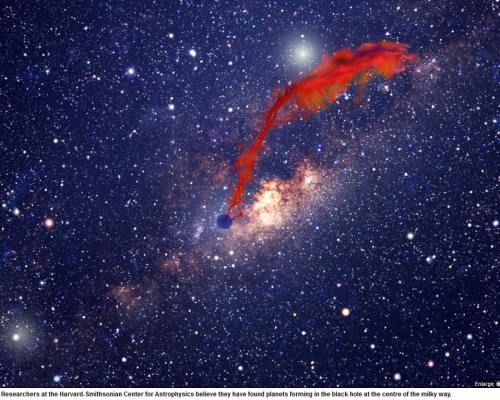
At first glance, the center of the Milky Way seems like a very inhospitable place to try to form a planet.
Stars crowd each other, supernova explosions blast out shock waves, and powerful gravitational forces from a supermassive black hole twist and warp the fabric of space itself.
Film and Writing Festival for Comedy. Showcasing best of comedy short films at the FEEDBACK Film Festival. Plus, showcasing best of comedy novels, short stories, poems, screenplays (TV, short, feature) at the festival performed by professional actors.
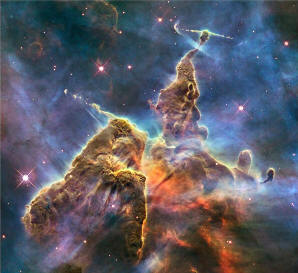 Image From NASA’s Hubble Telescope


 James' World 2