Woolly mammoths won’t be trouncing through the Arctic tundra anytime soon.
Contrary to recent headlines, which herald the extinct beast’s coming resurrection, scientists are still a long way from figuring out how to revive the elephant ancestor.
Woolly mammoths roamed the planet for hundreds of thousands of years before they vanished about 4,000 years ago. Paleontologists say the culprit for the die-off was possibly overhunting, or changes in mammoth’s food supply after the last Ice Age.
A camp of scientists — known as “revivalists” — are dedicated to bringing mammoths back in the modern era for environmental and biological reasons. Some researchers have made important early progress, although nothing is close to leaving the lab.
It happened in a geologic blink of an eye 252 million years ago. A vast volcanic vent in Siberia belched noxious gases and enough lava to build a new continent the size of Europe. The air grew warmer and drier, wildfires ravaged the landscape, and the oceans turned toxic. Over the course of a few tens of thousands of years 90 percent of all ocean species and three quarters of life on land was lost.
“It was devastating,” said paleontologist Peter Roopnarine. “The closest life on Earth has ever gotten to vanishing completely.”
.
An artist’s reconstruction of the Late Permian, showing a lucky Lystrosaurus and various Permian vegetation. The Lystrosaurus was one of the few species to survive the “Great Dying” extinction event, which wiped out nearly all life on Earth. (Marlene Hill Donnelly)
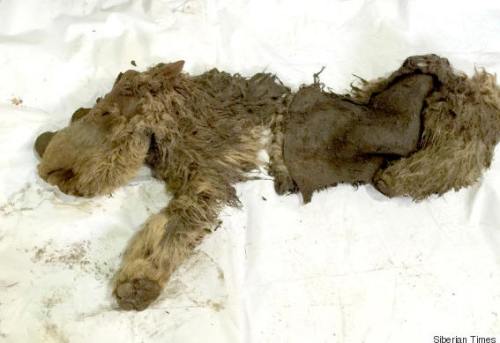
Scientists are going gaga over the recent discovery of a baby woolly rhino.
The pristine specimen of the tiny extinct rhino–the only one of its type ever found–was discovered in permafrost along the bank of a stream in Siberia’s Sakha Republic, The Siberian Times reported.
“At first we thought it was a reindeer’s carcass, but after it thawed and fell down we saw a horn on its upper jaw and realized it must be a rhino,” Alexander ‘Sasha’ Banderov, the hunter who made the discovery, told the Times. “The part of the carcass that stuck out of the ice was eaten by wild animals, but the rest of it was inside the permafrost and preserved well.”
.
(Academy of Sciences Republic of Sakha/Siberian Times)
The Internet Newspaper: News, Blogs, Video, Community
Click link below picture
.
A Siberian mummy with intricate tattoos decorating her body has been revealed in Russia.
Researchers estimate the mysterious woman, known as the Ukok princess, was probably 25 years old when she died nearly 2,500 years ago, ABC News reports. She was most likely a member of the Pazyryk tribe, nomads who lived in the Altai mountains of Siberia. Her mummy was discovered in 1993. It was kept preserved in the permafrost, which is why her tattoos are still visible.
Film and Writing Festival for Comedy. Showcasing best of comedy short films at the FEEDBACK Film Festival. Plus, showcasing best of comedy novels, short stories, poems, screenplays (TV, short, feature) at the festival performed by professional actors.



 (Academy of Sciences Republic of Sakha/Siberian Times)

 James' World 2