I have said it once, and I’ll say it again. 3D printing and robots will continue their inevitable convergence, leading to completely custom robots which can perform virtually any human-like task, and feature an appearance tailored to our individual preferences. We aren’t all the way there yet, but with 3D printing, we are getting ever so close.
One company, called RoboSavvy, is probably as close as any other company out there though, with their latest creation of a 3D printed humanoid robot. This robot is unlike any other robot you have seen before, and it is built mostly of 3D printed parts.
“The hands, fingers, forearms, head, chest shell, and several internal supports as well as the custom handle on the Segway are 3D printed,” Samantha Mehditash of RoboSavvy tells 3DPrint.com. “[The parts were printed on a] Makerbot Replicator 2X 3D Printer and our custom made large size 3D printer.”
A snowstorm can’t stop it. A blazing fire can’t stop it. And even getting run over by a car is no problem for this squishy little bot.
.
Researchers from Harvard University have developed a soft robot that not only can stand up and walk on its own, but also withstand tough elements all while carrying the equipment it needs on its back — from its microcompressors to control systems to batteries. Just check it out in the video above, which was recently posted to the university’s YouTube account.
.
Even a New England winter storm can’t stop this soft robot, which was recently developed by Harvard researchers.
RoboEarth. No, it’s not a lame SNES game from 1994, it’s a cloud network that lets robots learn from the actions of other bots. It started over three years ago, and now, a new, related project has sprung from that initiative at the Institute for Artificial Intelligence at the University of Bremen in Germany. Called RoboHow, it seeks to translate info on the web meant for human consumption into something our electromechanical helpers can understand. Imagine a future in which you ask your house robot to whip you up something new for dinner; RoboHow would ingest your chosen recipes from Epicurious and turn them into instructions said bot can execute.
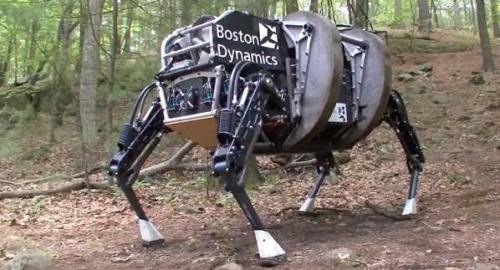
The New York Times reports tonight that Google has acquired Boston Dynamics, builder of terrifying walking robots DARPA-related projects like WildCat/Cheetah, Atlas, Petman and Big Dog. Andy Rubin has moved over from leading Android to directing Google’s robotics efforts and tweeted a link to the story, commenting that “The future is looking awesome!” While we’re sure it does — if you always thought the T-1000 was just misunderstood — reactions from meatbags are ranging from slightly uneasy to completely freaking out that a company with robots that go anywhere is teaming up with a company that seems to know everything about us.
There’s no word on how much Google spent to snap up the robotics company, but its founder Marc Raibert is quoted by the Times saying “I am excited by Andy and Google’s ability to think very, very big, with the resources to make it happen.” When we interviewed Raibert during Expand earlier this year (included after the break) he specifically highlighted his company’s recent growth and the possibility of building consumer-focused robots in the future.
Imagine being able to control a flying robot with your mind.
Sounds like a flight of fancy, but researchers at the University of Minnesota have fashioned an electrode-studded cap that records brain waves and uses them to control a “quadcopter” via wi-fi. Results of the copter’s test flights were published in the June issue of the Journal of Neural Engineering.
How does it work? “It’s completely noninvasive. Nobody has to have a chip implanted in their brain to pick up the neuronal activity,” biomedical engineering student and one of the paper’s authors, Karl LaFleur, said in a written statement.
Thinking about moving a body part makes cells in an area of the brain called the motor cortex produce tiny electrical currents. The cap sends this information to a computer, which translates it into directions for the copter.
.
.
.Click link below for story, video, and slideshow:
A robot as small as a housefly has managed the delicate task of flying and hovering the way the actual insects do.
“This is a major engineering breakthrough, 15 years in the making,” says electrical engineer Ronald Fearing, who works on robotic flies at the University of California, Berkeley. The device uses layers of ultrathin materials that can make its wings flap 120 times a second, which is on a par with a housefly’s flapping rate. This “required tremendous innovation in design and fabrication techniques”, he adds.
The robot’s wings are composed of thin polyester films reinforced with carbon fibre ribs and its ‘muscles’ are made from piezoelectric crystals, which shrink or stretch depending on the voltage applied to them.
.
.
.Click link below for story, videos, and slideshow:
If you’re planning a big party in the near future — a wedding reception, perhaps, or a Bar Mitzvah, or an inauguration gala — you’re probably spending a lot of money on staff to make sure everything runs smoothly. Between catering, waiters, and decoration, you’ve got a lot of dough riding on a lot of different people.
.
.
.Click link below for story and 11 videos of robots doing various tasks:
Engineers have created a robot that mimics a worm’s movements – crawling along surfaces by contracting segments of its body. The technique allows the machine to be made of soft materials so it can squeeze through tight spaces and mould its shape to rough terrain.
Film and Writing Festival for Comedy. Showcasing best of comedy short films at the FEEDBACK Film Festival. Plus, showcasing best of comedy novels, short stories, poems, screenplays (TV, short, feature) at the festival performed by professional actors.

 RoboSavvy’s Robot







 James' World 2