On Wednesday, the European Southern Observatory (ESO) unveiled a stunning new image of the Milky Way’s galactic plane taken by the APEX telescope in Chile’s Atacama Desert.
A composite of more than 700 observations captured by the telescope, it’s the most detailed image ever created of our galaxy from the Southern hemisphere, and the first time that the southern Milky Way has been shown at the submillimeter wavelengths between infrared light and radio waves:
Astronomers may be a step closer to solving the mystery of a strange object seen orbiting the massive black hole at the center of our Milky Way galaxy.
Dubbed G2, the object was first spotted in 2011 and was thought initially to be a gas cloud on the verge of being ripped apart by the black hole, which is known as Sagittarius A*. But when the object stayed intact, some scientists suggested G2 was something else: a pair of binary stars.
But now a team of scientists at the Max Planck Institute for Extraterrestrial Physics in Garching, Germany have sparked new debate, offering more evidence to support the gas cloud theory.
.
Simulation of gas cloud G2 after close approach to the black hole at the center of the Milky Way | ESO/MPE/Marc Schartmann
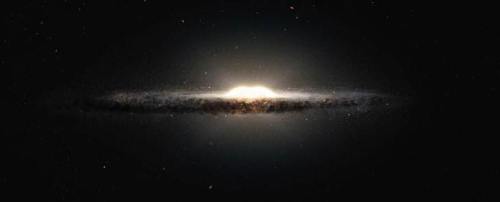
Two groups of astronomers have used data from ESO telescopes to make the best three-dimensional map yet of the central parts of the Milky Way. They have found that the inner regions take on a peanut-like, or X-shaped, appearance from some angles. This odd shape was mapped by using public data from ESO’s VISTA survey telescope along with measurements of the motions of hundreds of very faint stars in the central bulge.
One of the most important and massive parts of the galaxy is the galactic bulge. This huge central cloud of about 10 000 million stars spans thousands of light-years, but its structure and origin were not well understood.
Unfortunately, from our vantage point from within the galactic disc, the view of this central region — at about 27 000 light-years’ distance — is heavily obscured by dense clouds of gas and dust. Astronomers can only obtain a good view of the bulge by observing longer wavelength light, such as infrared radiation, which can penetrate the dust clouds.
Earlier observations from the 2MASS infrared sky survey had already hinted that the bulge had a mysterious X-shaped structure. Now two groups of scientists have used new observations from several of ESO’s telescopes to get a much clearer view of the bulge’s structure.
Astronomers witnessed a spectacular sight recently when they spotted an embryonic “monster” star in the Milky Way. Though the star is still forming, it’s expected to grow to become 100 times the mass of the sun, which would make it one of the galaxy’s most massive stars.
The photo of this monster star in the Milky Way was quite a feat for scientists at the Atacama Large Millimeter/sub-millimeter Array (ALMA) astronomy facility since the birth of such a large star is not often witnessed, let alone captured in a photo.
The star formation is located 11,000 light years from Earth in a stellar womb that is estimated to encompass 500 times the mass of the sun. In a photo of the formation, provided by the European Southern Observatory, the Milky Way’s monster star appears as a yellow blob in the center of the “womb.”
Photographer Tommy Eliassen captured this spectacular view of an Orionid meteor streaking through the dazzling northern lights and Milky Way from his camp in Korgfjellet, Hemnes, Norway, on Oct. 20, 2012, during the peak of the 2012 Orionid met.
.
.
.Click link below for slideshow (click on the picture above once in –Science Slideshows – to start this slideshow):
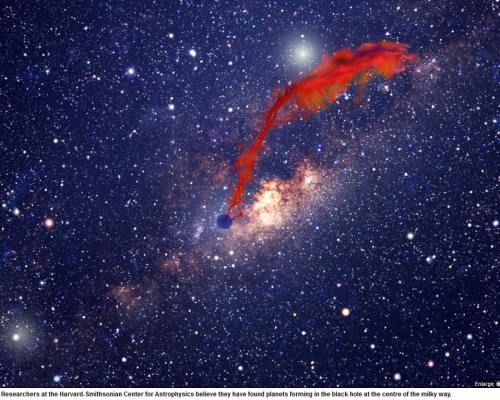
At first glance, the center of the Milky Way seems like a very inhospitable place to try to form a planet.
Stars crowd each other, supernova explosions blast out shock waves, and powerful gravitational forces from a supermassive black hole twist and warp the fabric of space itself.
Film and Writing Festival for Comedy. Showcasing best of comedy short films at the FEEDBACK Film Festival. Plus, showcasing best of comedy novels, short stories, poems, screenplays (TV, short, feature) at the festival performed by professional actors.



 .
.




 James' World 2