November 30, 2021
Mohenjo
Business, Food For Thought, Human Interest, Science, Technical
amazon, business, Business News, current-events, Future, Hotels, human-rights, medicine, mental-health, research, Science, Science News, technology, Technology News, travel, vacation

Click the link below the picture
.
La Niña will be joining us for the winter again, according to federal forecasters.
The National Oceanic and Atmospheric Administration’s (NOAA) Climate Prediction Center released its official winter outlook on Thursday and confirmed that La Niña conditions will be in place from December to February.
It’s not a total surprise: NOAA announced earlier this month that La Niña conditions had already developed, with an 87% chance they would remain in place during that three-month period. Now it’s forecasting wetter-than-average conditions across portions of the northern U.S., namely the Pacific Northwest, northern Rockies, Great Lakes, Ohio Valley, and western Alaska.
La Niña (translated from Spanish as “little girl”) is not a storm, but a climate pattern that occurs in the Pacific Ocean every few years and can impact weather around the world.
The U.S. is expected to feel its effects on temperature and precipitation, which could, in turn, have consequences for things such as hurricanes, tornadoes, and droughts.
.
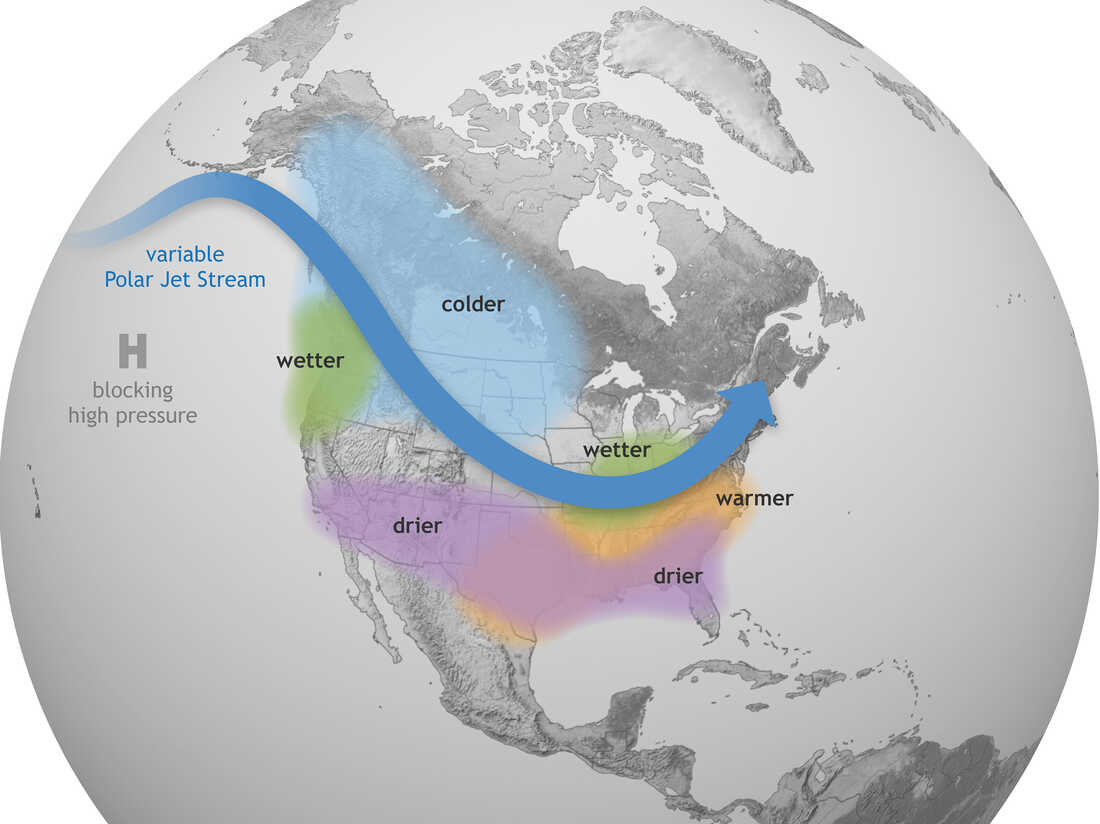
This Climate.gov graphic shows how La Niña generally affects weather conditions in the United States. Forecasters say there’s a nearly 90% chance that La Niña conditions will be in place from December 2021 to February 2022. National Oceanic and Atmospheric Administration
.
.
Click the link below for the article:
.
__________________________________________
November 30, 2021
Mohenjo
Food For Thought, Human Interest, Medical, missed News, Political, Science, Technical
amazon, business, Business News, current-events, Future, Hotels, human-rights, medicine, mental-health, research, Science, Science News, technology, Technology News, travel, vacation

.
News You might have missed!
Use your browser or smartphone back arrow (<-) to return to this table for your next selection.
.
__________________________________________
November 29, 2021
Mohenjo
Business, Enthralling, Human Interest, Photographs
amazon, business, Business News, current-events, Future, Hotels, human-rights, medicine, mental-health, research, Science, Science News, technology, Technology News, travel, vacation

Click the link below the picture
.
Lancaster is a city in Fairfield County, Ohio, in the south-central part of the state. As of the 2010 census, the city population was 38,780. The city is near the Hocking River, about 33 miles (53 km) southeast of Columbus and 38 miles (61 km) southwest of Zanesville. It is the county seat of Fairfield County.
The earliest known inhabitants of the southeastern and central Ohio region were the Hopewell, Adena, and Fort Ancient Native Americans, of whom little evidence survived, beyond the burial and ceremonial mounds built throughout the Ohio and Mississippi valleys. Many mounds and burial sites have also yielded archaeological artifacts. Serpent Mound and Hopewell Culture National Historical Park, though not in Fairfield County, are nearby.
Before and immediately after European settlement, the land today comprising Lancaster and Fairfield County was inhabited by the Shawnee, nations of the Iroquois, Wyandot, and other Native American tribes. It served as a natural crossroads for the inter-and intra-tribal wars fought at various times. Frontier explorer Christopher Gist reached Lancaster’s vicinity on January 19, 1751, when he visited the small Delaware town of Hockhocking nearby. Leaving the area the next day, Gist rode southwest to Maguck, another Delaware town near Circleville.
Having been ceded to the United States by Great Britain after the American Revolution in the Treaty of Paris, the lands north of the Ohio River and west of the Appalachian Mountains were incorporated into the Northwest Territory in 1787. White settlers began to encroach on Native American lands in the Northwest Territory. As the new United States government began to cast its eye westward, the stage was set for the series of campaigns that culminated in the Battle of Fallen Timbers in 1794 and the Treaty of Greenville in 1795. With pioneer settlement within Ohio made legal and safe from Indian raids, developers began to speculate in land sales in earnest. Wikipedia
.
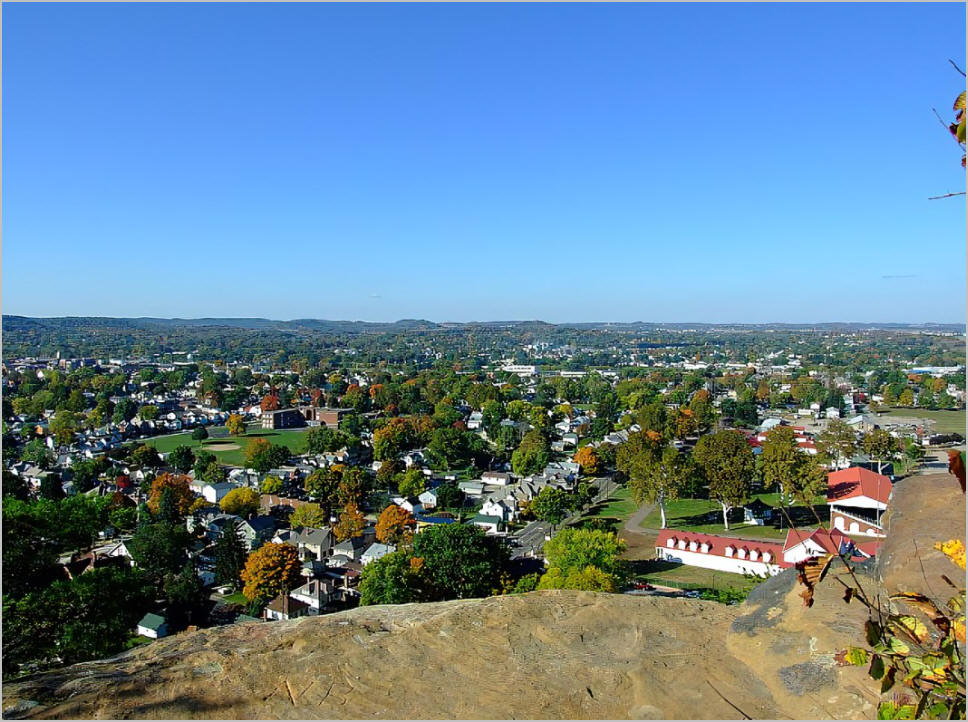 An image from Landcaster, OH, USA
.
.
Click the link below for images:
.
__________________________________________
November 29, 2021
Mohenjo
Business, Food For Thought, Human Interest, Science, Technical
amazon, business, Business News, current-events, Future, Hotels, human-rights, medicine, mental-health, research, Science, Science News, technology, Technology News, travel, vacation

Click the link below the picture
.
As human beings, we can’t really think of ourselves without time. We organize our days around its passing. We define ourselves through the events that have been encoded into our memories. Experiences unfold through a present that passes relentlessly from one moment to the next, and we make plans to achieve our goals with the knowledge that tomorrow will arrive on schedule, as it always does.
This is the phenomenology of time, or what neuroscientists call time consciousness. These aspects, or layers, of our experience of time, have played an important role in informing our intuitions about the nature of physical time. We assume that it has directionality, moving from an unchangeable past to an immersive present to unknown future— and that all of the above unfolds at a uniform rate throughout the cosmos.
But the more scientists have scrutinized the concept of time, the more they’ve come to understand that these common-sense assumptions may not reflect time’s true nature.
Einstein’s Big Idea
The first radical shift in our understanding of time came with the widespread scientific acceptance of Einstein’s theory of general relativity. Up until then, Newtonian time, or absolute time, existed independently of a perceiver, and progressed at a constant rate, everywhere. Relativity changed all of this. By perceiving space and time as an interwoven material, Einstein explained how mass warps this fabric to create gravity. The implications for merging space and time meant that mass not only distorted space; it distorted time, too.
Today, GPS satellites have to account for Earth’s varying distortion of space-time at different locations by adjusting the clocks in satellites and building mathematical corrections into their computer chips. Without this adjusting for relativity, Earth’s GPS systems would fail in about two minutes.
.
 (Credit: GoodIdeas/Shutterstock)
.
.
Click the link below for the article:
.
__________________________________________
November 29, 2021
Mohenjo
Business, Food For Thought, Human Interest, Science, Technical
amazon, business, Business News, current-events, Future, Hotels, human-rights, medicine, mental-health, research, Science, Science News, technology, Technology News, travel, vacation

Click the link below the picture
.
The ancient village of Culham, nestled in a bend of the River Thames west of London, seems an unlikely launching pad for the future. But next year, construction will start here on a gleaming building of glass and steel that could house what many people consider to be an essential technology to meet demand for clean energy in the twenty-first century and beyond.
Long derided as a prospect that is forever 30 years away, nuclear fusion seems finally to be approaching commercial viability. There are now more than 30 private fusion firms globally, according to an October survey by the Fusion Industry Association (FIA) in Washington DC, which represents companies in the sector; the 18 firms that have declared their funding say they have attracted more than US$2.4 billion in total, almost entirely from private investments (see ‘Fusion funding’). Key to these efforts are advances in materials research and computing that are enabling technologies other than the standard designs that national and international agencies have pursued for so long.
.
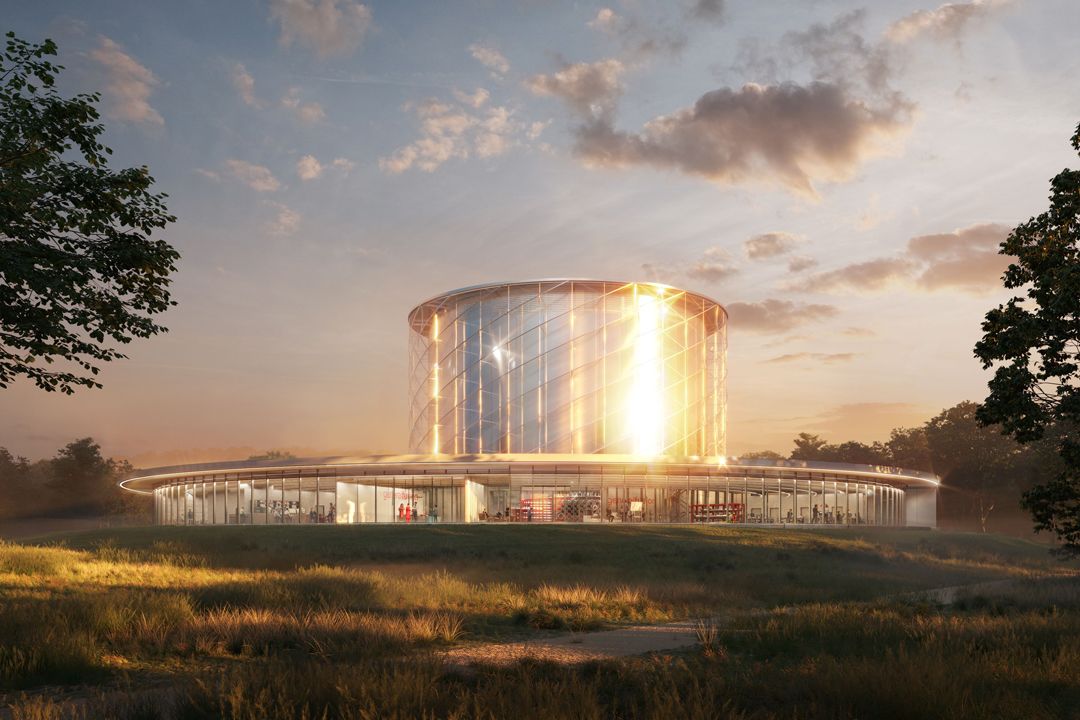 Artist’s impression of General Fusion’s planned plant at Culham, UK. Credit: AL_A for General Fusion. Lead image: The world’s strongest high-temperature superconducting magnet will be used in a 2025 fusion reactor in Massachusetts. Credit: Gretchen Ertl, CFS/MIT-PSFC, 2021
.
.
Click the link below for the article:
.
__________________________________________
November 29, 2021
Mohenjo
Crime, Food For Thought, Human Interest, Medical, missed News, Political, Science, sports, Technical
amazon, business, Business News, current-events, Future, Hotels, human-rights, medicine, mental-health, research, Science, Science News, technology, Technology News, travel, vacation
.
News You might have missed!
Use your browser or smartphone back arrow (<-) to return to this table for your next selection.
.
__________________________________________
November 28, 2021
Mohenjo
Business, Food For Thought, Human Interest, Science, Technical
amazon, business, Business News, current-events, Future, Hotels, human-rights, medicine, mental-health, research, Science, Science News, technology, Technology News, travel, vacation

Click the link below the picture
.
KISANFU, Democratic Republic of Congo — Just up a red dirt road, across an expanse of tall, dew-soaked weeds, bulldozers are hollowing out a yawning new canyon that is central to the world’s urgent race against global warming.
For more than a decade, the vast expanse of untouched land was controlled by an American company. Now a Chinese mining conglomerate has bought it and is racing to retrieve its buried treasure: millions of tons of cobalt.
At 73, Kyahile Mangi has lived here long enough to predict the path ahead. Once the blasting starts, the walls of mud-brick homes will crack. Chemicals will seep into the river where women do laundry and dishes while worrying about hippo attacks. Soon a manager from the mine will announce that everyone needs to be relocated.
“We know our ground is rich,” said Mr. Mangi, a village chief who also knows residents will share little of the mine’s wealth.
.
 Kisanfu is a new cobalt and copper mine being built by a Chinese conglomerate in the Democratic Republic of Congo.
.
.
Click the link below for the article:
.
__________________________________________
November 28, 2021
Mohenjo
Business, Food For Thought, Human Interest, Science, Technical
amazon, business, Business News, current-events, Future, Hotels, human-rights, medicine, mental-health, research, Science, Science News, technology, Technology News, travel, vacation

Click the link below the picture
.
In November 1915, Albert Einstein presented his general theory of relativity to a bewildered Prussian Academy of Sciences in Berlin, the theory that revolutionized our view of the universe.
Einstein’s theory reframed the idea of gravity in a completely novel way, profoundly different from the then accepted theory, created by Isaac Newton in 1686. Newton’s theory worked beautifully describing a host of gravitational phenomena, from the orbits of planets and comets around the sun to the tides and the oblateness of the Earth. (The Earth is an oblate spheroid — that is, slightly flattened at the poles.) Rocket engineers still use Newton’s theory to calculate their paths to reach other worlds in the solar system. The theory only begins to fail when gravitational forces are extremely strong, far from our everyday lives. But its premise, Einstein discovered, albeit an excellent approximation, is profoundly wrong.
.
 Credit: ezstudiophoto / Adobe Stock
.
.
Click the link below for the article:
.
__________________________________________
November 27, 2021
Mohenjo
Business, Enthralling, Human Interest, Photographs
amazon, business, Business News, current-events, Future, Hotels, human-rights, medicine, mental-health, research, Science, Science News, technology, Technology News, travel, vacation
Click the link below the picture
.
Karlsruhe is the third-largest city of the German federal state of Baden-Württemberg after its capital of Stuttgart, and Mannheim. Its 308,436 inhabitants make it the 21st largest city of Germany. On the right bank of the Rhine, the city lies near the French-German border, between the Mannheim/Ludwigshafen conurbation to the north, and the Strasbourg/Kehl conurbation to the south. It is the largest city of Baden, a historic region named after Hohenbaden Castle in the city of Baden-Baden. Karlsruhe is also the largest city in the South Franconian dialect area (transitional dialects between Central and Upper German), the only other larger city in that area being Heilbronn. The city is the seat of the Federal Constitutional Court (Bundesverfassungsgericht), as well as of the Federal Court of Justice (Bundesgerichtshof) and the Public Prosecutor General of the Federal Court of Justice (Generalbundesanwalt beim Bundesgerichtshof).
Karlsruhe was the capital of the Margraviate of Baden-Durlach (Durlach: 1565–1718; Karlsruhe: 1718–1771), the Margraviate of Baden (1771–1803), the Electorate of Baden (1803–1806), the Grand Duchy of Baden (1806–1918), and the Republic of Baden (1918–1945). Its most remarkable building is Karlsruhe Palace, which was built in 1715. There are nine institutions of higher education in the city, most notably the Karlsruhe Institute of Technology (Karlsruher Institut für Technologie). Karlsruhe/Baden-Baden Airport (Flughafen Karlsruhe/Baden-Baden) is the second-busiest airport of Baden-Württemberg after Stuttgart Airport, and the 17th-busiest airport of Germany.
In 2019 the UNESCO announced that Karlsruhe will join its network of “Creative Cities” as “City of Media Arts”.
Karlsruhe lies completely to the east of the Rhine, and almost completely on the Upper Rhine Plain. It contains the Turmberg in the east, and also lies on the borders of the Kraichgau leading to the Northern Black Forest. Wikipedia
.
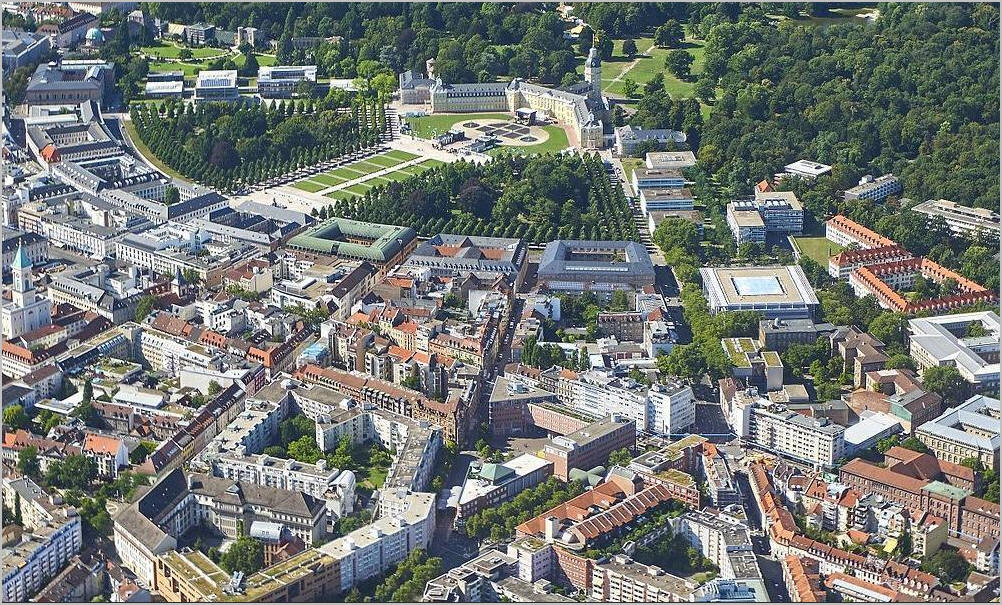 An image from Karlsruhe, Germany
.
.
Click the link below for images:
.
__________________________________________
November 27, 2021
Mohenjo
Business, Food For Thought, Human Interest, Science, Technical
amazon, business, Business News, current-events, Future, Hotels, human-rights, medicine, mental-health, research, Science, Science News, technology, Technology News, travel, vacation

Click the link below the picture
.
A research team at the University of Wisconsin-Madison has identified a new way to convert ammonia to nitrogen gas through a process that could be a step toward ammonia replacing carbon-based fuels.
The discovery of this technique, which uses a metal catalyst and releases—rather than requires—energy, was reported Nov. 8 in Nature Chemistry and has received a provisional patent from the Wisconsin Alumni Research Foundation.
“The world currently runs on a carbon fuel economy,” explains Christian Wallen, an author of the paper and a former postdoctoral researcher in the lab of UW-Madison chemist John Berry. “It’s not a great economy because we burn hydrocarbons, which release carbon dioxide into the atmosphere. We don’t have a way to close the loop for a true carbon cycle, where we could transform carbon dioxide back into a useful fuel.”
.

Credit: CC0 Public Domain
.
.
Click the link below for the article:
.
__________________________________________
Older Entries
Newer Entries

