Mars and the Earth may have more in common than we thought. NASA just revealed photos of Mars taken by its Mars Reconnaissance Orbiter. The images look strikingly similar to planet Earth.
The MRO, which has sent thousands of vibrant images back to scientists, has documented everything from dust storms to mineral hills since its launch nearly 12 years ago. The landscapes are somewhat like red deserts or canyons. “Earth has more in common with Mars than you might think,” NASA wrote in a recent video uploaded to YouTube.
MRO is used to better understand materials, subsurface water, dust and weather on Mars, according to NASA’s website. It’s also great at supplying us with gorgeous photos of the red planet.
If the idea of deep space travel conjures up mental images of a winged shuttle — or simply a dusted-off Apollo capsule — your imagination could use a little recalibration.
Not since the Moon landing have humans ventured beyond “Low Earth Orbit.” That means, to travel beyond the Moon, considered by NASA to be “deep space,” you’d need a spacecraft that builds on the best of previous space programs while developing new systems.
Instead, you’d need something like NASA’s Orion spacecraft designed and built by Lockheed Martin.
Through this partnership, Orion will transport the first crewed mission to deep space within a year or two, and one day, it will support the first human exploration mission at Mars.
.
The most-advanced-spacecraft
.
.
Click link below for article and photos (2 part article) :
After decades of space exploration and countless movies on the subject, why exactly does Mars continue to inspire such high levels of cultural and scientific fascination?
Both the red planet and NASA are coasting on a wave of newfound popularity, taking center stage in big-budget Hollywood productions. Whether by coincidence or design, the favorable treatment of NASA by Tinseltown comes at a time when the space agency recently discovered evidence for flowing water on Mars, and last week openly declared colonizing the planet within the next 20 years “an achievable goal.” And at least a few scientists think the survival of humanity may hinge on finding a new, hospitable planet to colonize.
Just a few years ago, NASA critics and even some supporters were openly questioning whether the Mars science laboratory was worth its $2.5 billion price tag.
Mars has water on its surface, and it’s in liquid form at least some of the time.
NASA on Monday announced the results of a new study showing that salty liquid water flows seasonally on Mars, giving the red planet one of the essential ingredients for life.
The study, published online by Nature Geoscience, focuses on the mysterious recurring slope lineae, or “RSL” — narrow, streaky features on the planet’s surface spotted by NASA’s Mars Reconnaissance Orbiter spacecraft.
.
NASA/JPL/University of Arizona
The dark streaks are known as recurring slope lineae and are believed to be evidence of flowing water. The blue color seen upslope of the dark streaks is thought not to be related to the streaks but to the presence of the mineral pyroxene.
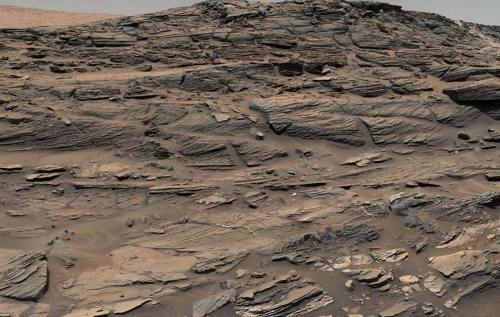
While petrified sand dunes can be found in the American Southwest, these ones were spotted a little farther from home — on the lower slopes of Mount Sharp on Mars.
.
Captured in late August by NASA’s Curiosity rover, this image shows a layer of sandstone that researchers are calling the “Stimson unit.” It sits over a layer of mudstone, which was deposited there long ago in a “lake environment.”
NASA believes they formed much like petrified sand dunes on Earth, created by blowing winds and then cemented into rock.
.
Large-scale crossbedding in the sandstone of this ridge on a lower slope of Mars’ Mount Sharp is common in petrified sand dunes. JPL / NASA
A NASA image of Mars being passed around on social media over the weekend has imaginations running wild.
The photo shows a stone formation in front of what may be a kind of cave. Some say it looks a bit like a crab monster straight out of a science fiction tale.
The discovery of strange, mineral veins on Mars has planetary scientists buzzing. And no wonder: the find may shed new light on the Red Planet’s watery past and could even help reveal whether Mars was once habitable.
NASA’s Curiosity rover spotted the prominent veins in “Garden City.” That’s the name scientists use for a geologically rich site on towering Mount Sharp (Aeolis Mons), a mountain that rises almost 3.5 miles off the Martian surface.
A composite image of the veins was made by combining 28 separate photos taken on March 18, 2015 by the right-eye camera of the rover’s Mastcam instrument.
.
This March 18, 2015, view from the Mast Camera on NASA’s Curiosity Mars rover shows a network of two-tone mineral veins at an area called “Garden City” on lower Mount Sharp.
Conspiracy theorists have gotten the green light to chatter about another strange object on the Red Planet. This time it’s not a Mars rat or a jelly doughnut that’s been spotted in a photo taken by NASA’s Curiosity Mars rover, but a “traffic signal.”
The extraterrestrial “signal” was spotted by a British UFO enthusiast named Joseph White. Curiosity snapped the photo at 1:08 a.m. EDT on sol 753 (Sept. 19). You can see the original here.
“I have been following the images from NASA since the start and I flick through them on the NASA website every day,” White said, according to the Western Daily Press. “I saw this one and I thought ‘Hang on, that looks a bit strange.'”
While White said he believes what he spotted is “clearly intelligently designed,” as he wrote on his latest video on the Youtube Channel ArtAlienTV-Mars Zoo, the formation is most likely just a rock.
Is a strange speck of light on Mars evidence of intelligent life on the Red Planet?
That’s what some are asking after what appears to be a bright white beam of light shining from behind the Martian dunes showed up in images taken by NASA’s Curiosity rover.
Scott Waring of the website UFO Sightings Daily noticed the mysterious spot in a photo taken by the rover on April 3, or sol 589 (a sol is a day on Mars).
Film and Writing Festival for Comedy. Showcasing best of comedy short films at the FEEDBACK Film Festival. Plus, showcasing best of comedy novels, short stories, poems, screenplays (TV, short, feature) at the festival performed by professional actors.





 .
.



 What is it?
  This March 18, 2015, view from the Mast Camera on NASA’s Curiosity Mars rover shows a network of two-tone mineral veins at an area called “Garden City” on lower Mount Sharp.
 .
.

 James' World 2