President Vladimir Putin probably approved a plan by Russia’s FSB security service to kill a former agent-turned-Kremlin critic who died after drinking tea laced with radioactive poison, a British judge said Thursday in a strongly worded report that led Moscow to accuse Britain of souring bilateral relations.
Judge Robert Owen, who led a public inquiry into the 2006 killing of Alexander Litvinenko, said he was certain that two Russian men had given Litvinenko tea containing a fatal dose of polonium-210 during a meeting at a London hotel.
He said there was a “strong probability” that Russia’s FSB, successor to the Soviet Union’s KGB spy agency, directed the killing and that the operation was “probably approved” by Putin, then as now the president of Russia.
.
Natasja Weitsz via Getty Images This 2006 file photo shows Alexander Litvinenko just days before his death by poisoning.
Millions of widows around the world are left destitute after being robbed of their inheritance, while others are enslaved by their in-laws, accused of witchcraft or forced to undergo abusive sexual rituals, research shows.
The crushing poverty and persecution faced by widows worldwide is outlined in a major report on widowhood which will be presented to U.N. Secretary General Ban Ki-moon on Friday.
“Widows have been suffering in silence for centuries, and yet nobody – no government, not even the U.N. – has ever attended to this problem,” said Lord Raj Loomba, a campaigner on widowhood, who will discuss the issue with Ban in New York.
.
Widows (in white), who have been abandoned by their families, hold earthen oil lamps as they offer prayers on the banks of the river Yamuna as part of Diwali celebrations organised by non-governmental organisation Sulabh International in Vrindavan, in Uttar Pradesh, India,…
The global “currency war” entered a new phase on Tuesday as China’s surprise devaluation threatened to unleash competitive devaluations and keep monetary policy around the world looser for longer, perhaps even forcing the U.S. Federal Reserve to delay its expected interest rate rise.
“Currency wars,” a phrase used by Brazil’s former finance minister Guido Mantega in 2010 to describe how competing countries explicitly or implicitly weaken their exchange rates to boost exports, have intensified in recent years.
As interest rates have fallen to zero in some developed economies and money printing has proliferated, exchange rate policy has become one of the few remaining levers to stimulate business activity and in some cases avoid deflation. So investors are now concerned that China may elect to keep pushing the yuan lower.
.
Image: Breaking News and Opinion on The Huffington Post
Serena Williams slugged her way to a sixth Wimbledon singles title Saturday morning, completing her second so-called “Serena Slam” and positioning herself for tennis history.
The 33-year-old American defeated Garbine Muguruza of Spain, 6-4, 6-4, to win her fourth consecutive Grand Slam tournament, beginning with last year’s U.S. Open and including this year’s Australian and French open titles. She accomplished a similar sweep in 2002-2003.
The Wimbledon win is also Williams’ 21st Grand Slam title.
.
Serena Williams celebrates after winning the women’s singles final at Wimbledon,in London on July 11. Kirsty Wigglesworth / AP
The Conservative Party swept to power Friday in Britain’s parliamentary elections, winning an unexpected majority that returns Prime Minister David Cameron to 10 Downing Street in a stronger position than before.
Cameron went to Buckingham Palace, where he was expected to tell Queen Elizabeth II that he has enough support to form a government.
That brings the election to a much-quicker-than-expected conclusion. Polls ahead of Election Day had shown Conservatives locked in a tight race with the opposition Labour Party, raising the possibility of days or weeks of negotiations to form a government.
.
Image: Breaking News and Opinion on The Huffington Post
Investigators believe that the “Jihadi John” masked fighter who fronted Islamic State beheading videos is a British man named Mohammed Emwazi, two U.S. government sources said on Thursday.
He was born in Kuwait and comes from a prosperous family in London, where he grew up and graduated with a computer programming degree, according to the Washington Post.
In videos released by Islamic State (IS), the black-clad militant brandishing a knife and speaking with an English accent appears to have decapitated hostages including Americans, Britons and Syrians.
The antidote to racism partly lies in empathy, or the willingness to “walk a mile in someone else’s shoes,” as the saying goes. But scientists from universities across Europe are taking the maxim one step further, providing people an opportunity to experience life in someone else’s skin by experimenting with virtual reality as a means of helping people shed racial stereotypes.
Researchers from London and Barcelona teamed up to discuss their recent experiments on virtual reality and race in an opinion piece for the journal Trends in Cognitive Sciences, published Dec. 15. The researchers found that if people got the chance to physically experience their own body with different skin colors (or ages and sexes), their unconscious biases against other racial groups could be diminished.
This isn’t merely a question of changing mentality or perception. The experience of “living” in different skin triggers sensory signals in the brain that allow it to expand its understanding of what a body can look like. This can “cause people to change their attitudes about others,” wrote the study’s co-researcher, Professor Mel Slater, a part-time professor of virtual environments at the University College London and research professor at the University of Barcelona.
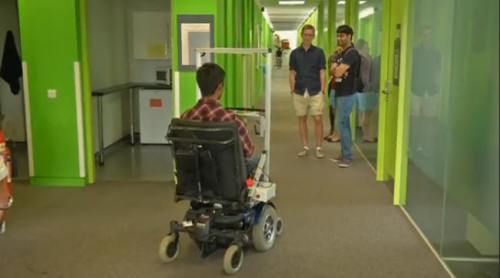
Scientists in London have developed an algorithm-based decoder system that enables wheelchair users to move around simply by looking to where they wish to travel. The researchers at Imperial College London say the system is inexpensive and easy to use and could transform the lives of people who are unable to use their limbs.
Algorithms working with inexpensive software could help quadriplegics steer wheelchairs simply by looking in their desired direction of travel. An Imperial College London team says their newly devised system can read eye movements to tell if a person is merely gazing or wants to move. Co-designer and student Kirubin Pillay says it’s simple to use.
The patient started feeling ill as he sat on a packed flight from Jeddah to London. Things didn’t get any better after he boarded another flight to Boston, or a third flight to Atlanta, or even as he took one last miserable leg to Orlando.
If he’d been watching the news, he should have known it was at least possible that he had MERS, the mysterious new Middle East respiratory virus. It’s been spreading in Saudi Arabia and has infected more than 570 people globally, killing 171 of them. The biggest risk factor is being a health care worker, like the patient.
Still, he boarded multiple flights and came into an Orlando hospital without warning he had respiratory symptoms and had come from Saudi Arabia. He spent hours in a public emergency room, potentially exposing other patients to his infection.
Film and Writing Festival for Comedy. Showcasing best of comedy short films at the FEEDBACK Film Festival. Plus, showcasing best of comedy novels, short stories, poems, screenplays (TV, short, feature) at the festival performed by professional actors.




 Image: Breaking News and Opinion on The Huffington Post

 Image: Breaking News and Opinion on The Huffington Post
 .
.




 James' World 2