Some content on this page was disabled on April 15, 2025 as a result of a DMCA takedown notice from Guardian Media Group. You can learn more about the DMCA here:
What I wish you knew about your child’s mental health: how aiming for high self-esteem is a mistake Dr Bill Garvey
July 18, 2024
Business, Food For Thought, Human Interest, Political, Science, Technical amazon, business, Business News, current-events, Future, Hotels, human-rights, medicine, mental-health, research, Science, Science News, technology, Technology News, travel, vacation Leave a comment
Facing Scorching Heat Waves, Cities Call on Scientists to Understand How People Respond
July 17, 2024
Business, Food For Thought, Human Interest, Political, Science, Technical amazon, business, Business News, current-events, Future, Hotels, human-rights, medicine, mental-health, research, Science, Science News, technology, Technology News, travel, vacation 6 Comments

Click the link below the picture
.
CLIMATEWIRE | U.S. cities want more research from scientists to help them handle extreme heat — especially the way high temperatures influence human behavior and health.
That was the message from a panel discussion Wednesday at Columbia University. Officials from Miami and New York City shared their heat research wishlists, and social studies — centered on high-risk populations — made the top of the list.
The use of cooling centers — specifically, who goes to them and why — was a big question for Isabelle Thomas, a policy adviser in the New York City mayor’s office.
“Why do people go to cooling centers? Why don’t people go to cooling centers?” she asked. “What is their perception of the urgency — or lack thereof — as it relates to extreme heat?”
She noted some communities face more risk from skyrocketing temperatures, such as outdoor workers and people experiencing homelessness. Better insight on the experiences of these vulnerable populations would help decision-makers craft more effective heat-related policies.
“We still in New York City are lacking some data on occupational heat exposure and health impacts, specifically as it relates to food vendors and delivery workers and other workers who are outside in the city,” Thomas said.
Cities also need better data on the number of people who die or fall sick during heat waves, said Jane Gilbert, the chief heat officer in Miami-Dade County. As of right now, these estimates are often vastly undercounted.
Extreme temperatures can directly lead to heat exhaustion, heat stroke or even death. These cases are easy to spot. But heat can have indirect effects on human health as well, such as exacerbating preexisting health conditions, increasing the risk of workplace injuries or affecting mental health. These indirect effects often go unrecorded on hospitalization records or death certificates.
“Really, direct heat deaths, illnesses, hospitalizations is the tip of the iceberg of health impacts,” Gilbert said.
Studies investigating how many people are actually hospitalized or dying from extreme heat — as well as where it’s happening and which populations are the most affected — can help policymakers design better protections for vulnerable communities.
“For us to design and prioritize interventions, having that situational understanding of where these illnesses and deaths are — where that exposure is happening — is very important for us,” Gilbert said.
.

Sprinklers help people to cool off in Long Island City, N.Y., as temperatures soared on June 21, 2024. Selcuk Acar/Anadolu via Getty Images
.
.
Click the link below for the article:
.
__________________________________________
5 Ways to Be Less Forgetful If You Feel Like Your Memory Is Already Shot
July 17, 2024
Business, Food For Thought, Human Interest, Political, Science, Technical amazon, business, Business News, current-events, Future, Hotels, human-rights, medicine, mental-health, research, Science, Science News, technology, Technology News, travel, vacation 3 Comments

Click the link below the picture
.
So you’re in your 30s or 40s, and you constantly feel forgetful and frazzled: Maybe it’s your first time balancing a high-powered role at work while juggling daycare drop-off and pickup times, or you’re really trying to maintain old and new friendships while also caring for an aging parent. Or perhaps you’re aiming to stick to a consistent workout schedule ever since your back started aching, and you’re also trying to cook every meal and go to therapy, and be a loving partner. Whatever your personal brand of scatterbrained adulthood looks like, it only makes sense that you’d feel like your memory is a little shot as a result.
Your brain is less capable of remembering things like that one person’s name or even why you walked into a room when you’re being pulled in a million directions. The competing demands of life in these decades can “tax the function of your prefrontal cortex,” Charan Ranganath, PhD, professor at the Center for Neuroscience in the Department of Psychology at the University of California Davis and author of Why We Remember, tells SELF. This is the part of your brain responsible for executive functions—things like planning, organizing, and, yes, remembering what’s needed to finish a task. To make matters worse, this section of the brain also naturally begins to shrink (albeit, very slowly) in your 30s, Dr. Ranganath adds, making it even tougher to access those little bits of memory.
Certain lifestyle habits, like getting solid sleep, exercising regularly, and cutting back on alcohol, can help slow that downward memory slide as you age. But according to experts, there are also simple tweaks to everyday behaviors—like how you snap pics on your phone and where you hang out with friends—that can help you feel sharper in the here and now. Here’s how to feel a little less forgetful and scatterbrained as you navigate your 30s and 40s.
1. Work on a single task at a time (and turn off push notifications).You can’t really do multiple things at once, brain-wise. When you’re “multitasking,” you’re actually just switching between tasks, which strains your brain, forcing it to focus on one thing and then on the other and back again.
The same thing happens with media multitasking, whether you’re popping between your email and Instagram, for instance, or you’re, say, scrolling on your phone while also watching a TV show. You’re putting conflicting priorities on your attention, threatening your memory of any one thing you’re doing.
When you’re task-switching, you’re essentially forming “these little blurry fragmented memories” of each action because you weren’t mentally focused on either, making them easier to forget, Dr. Ranganath says.
The key is to cut out as many distractions as possible when you’re doing something you want to remember (that means silencing any form of ping or ding), so you can lock in on it. The more attention you give to a task now—in brain talk, the more you’re engaging your prefrontal cortex—the better chance it’ll stick with you later, Dr. Ranganath says.
2. Take photos to capture the vibes, not just the facts of an event.Subscribing to a “pics, or it didn’t happen” mentality doesn’t just potentially jeopardize your enjoyment of, say, a concert or a cool trip. When you snap photos of entire scenarios or events, you’re actually less likely to remember key details about them because of the photo-taking impairment effect: Your brain knows it can rely on the camera to “remember” things, so it essentially opts out.
.

.
.
Click the link below for the article:
.
__________________________________________
How Did Jupiter Get Its Great Red Spot?
July 16, 2024
Business, Food For Thought, Human Interest, Political, Science, Technical amazon, business, Business News, current-events, Future, Hotels, human-rights, medicine, mental-health, research, Science, Science News, technology, Technology News, travel, vacation 2 Comments
Click the link below the picture
.
In a solar system full of wonders, Jupiter’s Great Red Spot still stands out.
This lushly red oval is obvious even through small telescopes, looking like a baleful eye staring out from the enormous gas giant planet. The Great Red Spot (or GRS) is so huge that you could drop the entire Earth into it and our planet would plunge through without touching the sides.
It’s been around for centuries and holds many mysteries, but we’re learning more about it all the time. Research recently published in the journal Geophysical Research Letters indicates that the GRS isn’t as old as once thought and implies that while it may yet last for many years to come, its days are numbered.
The GRS is Jupiter’s most iconic feature. I’d say “surface” feature, except Jupiter doesn’t really have a surface; what we see is actually clouds atop an atmosphere that’s thousands of kilometers deep. The GRS is in reality a spot of remarkably vast and persistent weather churning in the planet’s clouds; technically speaking, it’s an anticyclonic vortex—a counterclockwise-rotating high-pressure system—with gases spinning around the center at speeds of 450 kilometers per hour. That’s about as fast as the highest wind speeds ever recorded in a tornado on Earth!
This giant storm—the largest known in the solar system—is made up of two regions. One is an oval made up of reddish gases, and the other is a surrounding whiter, thinner band of gas (called the Hollow). The GRS lives in Jupiter’s South Equatorial Belt, one of the many bands across the planet’s face that give it a striped appearance. These bands are latitudinal wind patterns akin to the jet stream on Earth, but they are more complicated because of Jupiter’s lack of surface, the enormous convective currents of gases rising and falling through the atmosphere and immense air-bending forces from the giant planet’s rapid nine-hour-and-55-minute rotation.
Unlike Earth’s hurricanes that can wander across sizable swaths of our planet, storms on Jupiter tend to stay in their latitudinal lane, confined by powerful jet streams. That confinement also sustains the GRS, making the storm extremely long-lived, but its actual age has been an ongoing astronomical enigma.
In 1665 Italian astronomer Giovanni Cassini spotted—so to speak—a dark oval on Jupiter’s face. It was seen on and off again until 1713, and the recorded location of this “permanent spot” was the same as that of the current GRS. Cassini is credited with discovering it, though it may have been seen by another astronomer in 1632; if that is true, it lasted at least 80 years.
Despite astronomers’ ongoing monitoring of Jupiter, however, after 1713 this spot seems to have disappeared. The next known sighting of a storm at that latitude dates to 1831, well over a century later, when astronomers reported a dark spot there. (It wasn’t described as red until the 1870s!) This spot—our familiar, beloved GRS—has been continuously observed ever since, making it nearly 200 years old.
.
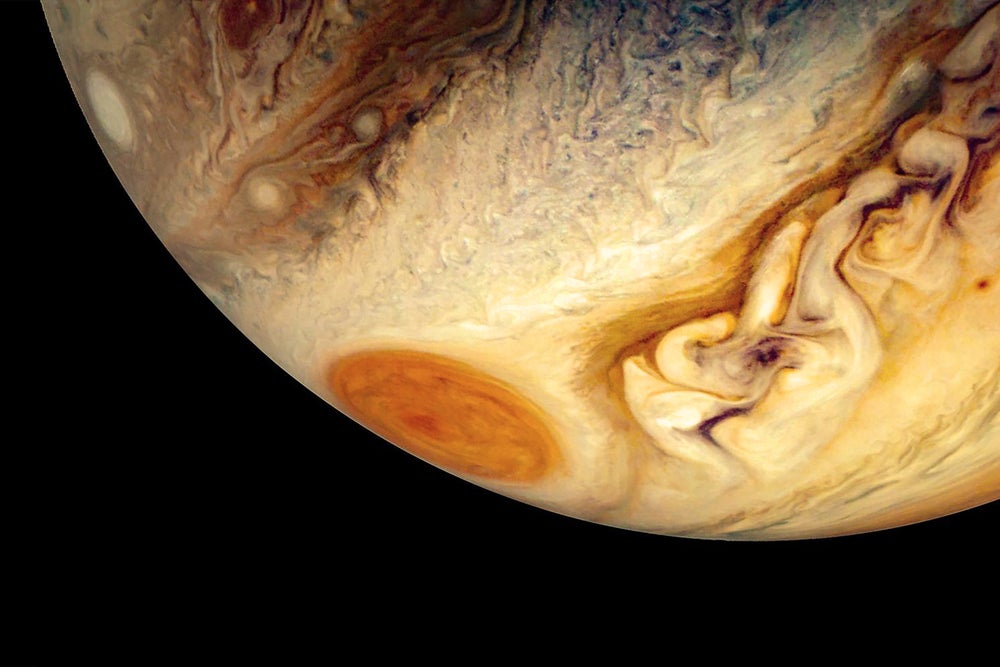
A view of Jupiter’s south temperate belt and Great Red Spot, as captured by NASA’s Juno spacecraft on December 30, 2020. NASA/JPL-Caltech/SwRI/MSSS/Navaneeth Krishnan (CC BY 4.0)
.
.
Click the link below for the article:
.
__________________________________________
The whole time? The Boys has been making fun of Trumpers the whole time?!
July 16, 2024
Business, Food For Thought, Human Interest, Political, Science, Technical amazon, business, Business News, current-events, Future, Hotels, human-rights, medicine, mental-health, research, Science, Science News, technology, Technology News, travel, vacation Leave a comment

Click the link below the picture
.
Television shows getting terrible reviews isn’t anything new. But there’s something fascinating happening with the fourth season of The Boys. It’s not just that people have suddenly turned on Amazon’s hit superhero satire, it’s who those people are and why they’ve changed their tune that’s so interesting.
Since premiering to critical praise on June 13, alleged fans have been review-bombing the show’s latest season on sites like Rotten Tomatoes and IMDB. The most vocal and eye-catching of these takedowns pronounce that the show has gone “woke” or is so obviously “anti-Donald Trump.”
They’re not wrong, but they’re excruciatingly late to this observation.
Since the show’s inception in 2019, The Boys has been a superhero allegory about Trump, dangerous authoritarianism, political fanaticism, Nazis, and America’s sway toward fascism. Its showrunner, Eric Kripke, has said as much interview after interview: This is a show explicitly about the allure of Trump and a critique of corporate America. The only thing that’s seemingly different in this fourth season is that it skates so close to what’s happening in the US now: Homelander (Antony Starr), a Superman-like sociopath who functions as the Trump stand-in, is facing a criminal trial and is fanning the flames of a January 6-like insurrection.
These angry public admissions from conservatives that they’ve spent the previous seasons cheering on this horrible character — only to now realize they’re the butt of the joke — have become bigger than the show itself. It’s a testament to our culture’s ever-diminishing media literacy.
This isn’t the first time in pop culture that a superhero satire has served as a warning about fascism, and its biggest fans have whiffed on the point. That it keeps happening is a testament to how difficult it may be for all of us to not be lost in the allure of powerful people.
What’s happening on this season of The Boys
At the heart of The Boys is a brash deconstruction of the superhero fantasy, taking apart the traditional comic book superhero arc where super-powered beings save the day and defend those who can’t defend themselves.
In The Boys, however, every character, every line, every shot, and every scene paints a larger portrait of how extremely screwed we would all be if superheroes existed in real life. The Boys’scynical counter to the fantasy is a worldview that humans — even super ones — are morally flawed beings and that power always compromises morality. No matter how good we could be or think we could be, our selfishness, biases, envy, and everything in between will always get the better of us.
People aren’t meant to be superheroes.
These human failings take the form of heroes like the terminally narcissistic Homelander or any of his coworkers, known as The Seven (a parallel to DC Comics’s Justice League or Marvel’s Avengers). Homelander and his pals rape and kill and lie, but their powers and, more importantly, their celebrity status keep them from facing any semblance of justice. The Seven are all propped up by Vought International, an ultra-powerful pharma-entertainment-military defense corporation originated by a Nazi who invented a serum that gave normal people superpowers.
.

Homelander (Antony Starr) in The Boys, season four.© Amazon Content Services LLC
.
.
Click the link below for the article:
.
__________________________________________
Ex-Secret Service special agents explain why counter-sniper who saved Trump’s life may have lost crucial seconds
July 15, 2024
Business, Food For Thought, Human Interest, Political, Science, Technical amazon, business, Business News, current-events, Future, Hotels, human-rights, medicine, mental-health, research, Science, Science News, technology, Technology News, travel, vacation Leave a comment

Click the link below the picture
.
13 American presidents who escaped attempts on their lives
- In American history, four out of 46 US presidents have been assassinated.
- Other presidents, including Ronald Reagan and George W. Bush, escaped attempts on their lives.
- Former President Donald Trump says he was shot in the ear at a Pennsylvania campaign rally on Saturday.
Four out of 45 US presidents have been assassinated over the course of American history.
Many more chief executives escaped assassination attempts thanks to heroic bystanders, diligent guards, misfiring pistols, and sheer luck.
Most recently, former President Donald Trump said he was struck in the ear during a campaign rally in Butler, Pennsylvania, on Saturday after a shooter opened fire from a nearby rooftop. A
spokesperson said Trump was “fine” following the incident. The FBI said they are investigating the shooting as an assassination attempt.
Two presidents who were assassinated escaped previous attempts on their lives.
On a hot August night in 1864, a sniper shot Lincoln’s hat off his head — missing his skull by inches — as he took a solo ride on his favorite horse “Old Abe,” according to “1864: Lincoln at the Gates of History.” Lincoln was later shot and killed by Confederate sympathizer John Wilkes Booth, just five days after the surrender of Robert E. Lee.
Almost a century later, in 1960, retired postal worker Richard Paul Pavlick crammed his car with dynamite and plotted to ram the vehicle into
Kennedy’s limo in Palm Beach, Florida, Smithsonian magazine reported. He was motivated by his intense hatred of Catholics and the Kennedy family, but backed off when he saw that the president was with his wife and young children. Pavlick was later arrested and institutionalized until 1966, three years after Kennedy was assassinated by Lee Harvey Oswald while visiting Dallas, Texas.
These 13 other presidents all experienced serious assassination threats and ultimately survived — and these are only the most dramatic, most-publicized instances. Undoubtedly, the Secret Service has thwarted many more over the years.
Here are 13 presidents who escaped attempts on their lives. (Click or tap the slides)
.

.
.
Click the link below for the article and slideshow:
.
__________________________________________
Young Adulthood Is No Longer One of Life’s Happiest Times
July 15, 2024
Business, Food For Thought, Human Interest, Political, Science, Technical amazon, business, Business News, current-events, Future, Hotels, human-rights, medicine, mental-health, research, Science, Science News, technology, Technology News, travel, vacation 1 Comment
Click the link below the picture
.
Is the midlife crisis a common rite of passage—or just a mythical concept that makes for grabby headlines? Research measuring well-being has typically provided solid evidence for such a period of soul searching. Over the course of a lifetime, happiness tends to start out high early in adulthood and decline in middle age, only to rise later in life. Unhappiness follows a mirror pattern—with the youngest and oldest tending to be the least unhappy and those in middle age being the most unhappy.
Plotting both qualities against age, the happiness curve is U-shaped (with the left and right peaks of the “U” corresponding to youth and old age), and the graph for unhappiness is depicted as a hump shape. Reduced to simpler terms, the midlife crisis seems to be real: happiness reaches its low point at around age 50, with peaks at age 30 and after age 70. This finding has been replicated in 146 countries and has held true for data reaching as far back as 1973—and does not just apply to Homo sapiens. Researchers have even identified similar patterns in nonhuman apes.
Is the midlife crisis a common rite of passage—or just a mythical concept that makes for grabby headlines? Research measuring well-being has typically provided solid evidence for such a period of soul searching. Over the course of a lifetime, happiness tends to start out high early in adulthood and decline in middle age, only to rise later in life. Unhappiness follows a mirror pattern—with the youngest and oldest tending to be the least unhappy and those in middle age being the most unhappy.
Plotting both qualities against age, the happiness curve is U-shaped (with the left and right peaks of the “U” corresponding to youth and old age), and the graph for unhappiness is depicted as a hump shape. Reduced to simpler terms, the midlife crisis seems to be real: happiness reaches its low point at around age 50, with peaks at age 30 and after age 70. This finding has been replicated in 146 countries and has held true for data reaching as far back as 1973—and does not just apply to Homo sapiens. Researchers have even identified similar patterns in nonhuman apes.
“We have to focus on the people at the extremes,” Blanchflower says. “Think about those who are most susceptible to commit suicide, to have deaths of despair. These are the people who say, ‘Every day of my life is a bad mental health day.’” Between 2020 and 2022, more than half of respondents reported no bad mental health days. But 7 percent acknowledged exactly 30. The proportion of those with this response nearly doubled from 1993 to 2023. That rate has grown most quickly among the young, especially women 18 to 25 years old. “This fact alone is the most striking and scary: my estimates are that 11 percent of … young women are in despair,” Blanchflower says.
Carol Graham, a senior fellow at the Brookings Institution whose work focuses on well-being, acknowledges the seriousness of this finding. “We never really thought about the lowest point being in youth,” she says. “That is when people are just starting their lives. It shouldn’t be when they are most anxious, are most depressed, and have no hope for the future. There is something profoundly wrong there.”
These trends have resulted in an altered relationship between age and ill-being. Between 2009 and 2018, despair remained hump-shaped, jibing with the preexisting research. A rapid rise in despair before age 45, especially before age 25, however, means that in 2019 unhappiness showed up more frequently at younger ages. “Danny Blanchflower has been hell-bent on showing the U-curve in so many countries…, and all of a sudden he’s writing a paper that’s showing the opposite,” Graham says.
.

Antonio Hugo Photo/Getty Images
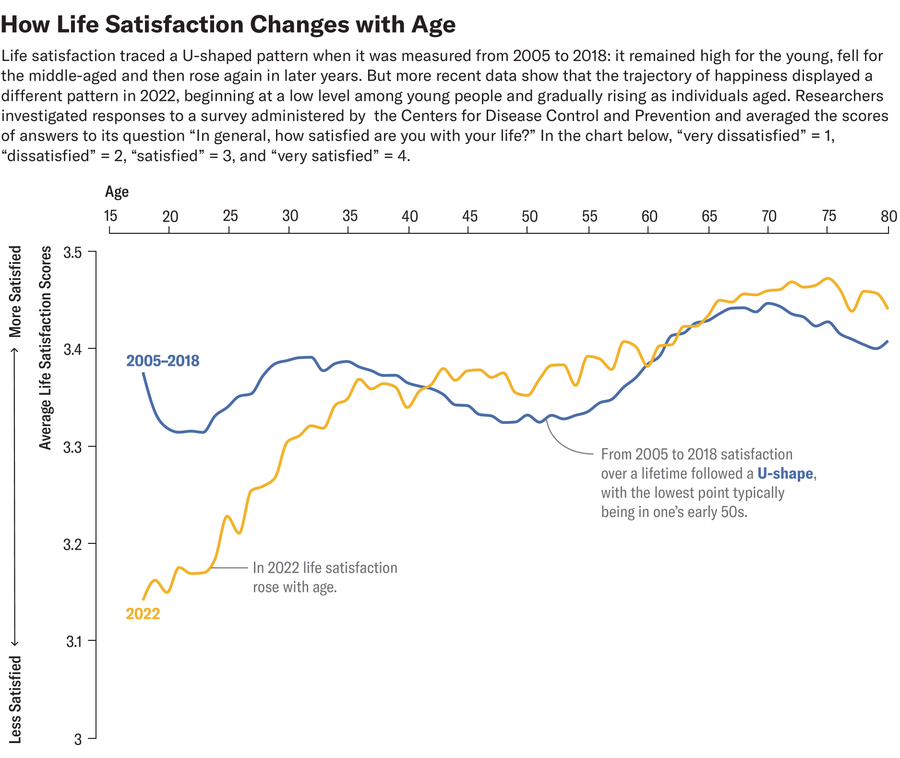
Shuyao Xiao; Source: “The Global Loss of the U-Shaped Curve of Happiness,” by David Blanchflower and Alex Bryson. Posted online June 6, 2024
.
.
Click the link below for the article:
https://www.scientificamerican.com/article/young-adulthood-is-no-longer-one-of-lifes-happiest-times/
.
__________________________________________
Fall after fall – care home accused of neglect
July 15, 2024
Business, Food For Thought, Human Interest, Political, Science, Technical amazon, business, Business News, current-events, Future, Hotels, human-rights, medicine, mental-health, research, Science, Science News, technology, Technology News, travel, vacation Leave a comment

Click the link below the picture
.
The daughter of an elderly care home resident who suffered 32 falls in only 11 months said she had sent social services “a begging email” to warn her mother “was going to die” unless urgent improvements were made.
“She suffered neglect in every way – it was devastating to see,” said Kylie Gobin, whose mother Winifred Tubb lived at St Luke’s in Runcorn, Cheshire.
Mrs. Gobin spoke to the BBC as part of an in-depth investigation which found nearly one in five care homes across England were rated as either “requiring improvement” or “inadequate”.
A spokesman for Halton Borough Council, which operates St Luke’s, said it had “fully investigated” the complaints and “some lessons have been learned”.
BBC England’s data journalism team analyzed Care Quality Commission (CQC) statistics and found the regulator now regards more than 2,500 care homes across England as “requiring improvement”.
The number of “inadequate” homes stands at 194 across England, but this figure is down on both 2022 and 2023.
This could either be due to services improving, care homes closing down, or both.
Common themes in struggling homes included:
- Gaps in staff training
- Mismanagement of medicines
- Accurate records not being kept
- Facilities not meeting safety and cleanliness standards
- Residents’ rights to privacy and dignity not being upheld
- Poor management oversight
Mrs Gobin said her mum – who had worked in the care sector before being diagnosed with dementia in 2010 – moved to St Luke’s in June 2021.
“From the August, she had repeated falls and broke her hip in October 2021,” she said.
“There was an internal inquiry, but no lessons were learned until I emailed in April 2022.”
A lower bed, sensory mats, and alarms – controlled by a key switch outside Mrs Tubb’s room – were installed so staff could be alerted if she attempted to get out of bed.
On at least two occasions, though, Mrs Gobin says she discovered the alarm had been disabled.
“In November 2022 I visited and found mum on the floor, with the alarms off,” she said.
“I was crying – every emotion you can imagine went through my body. I had to leave the room because I was so angry.
“It would have taken her two or three hours to get into that position because she wasn’t mobile.”
.
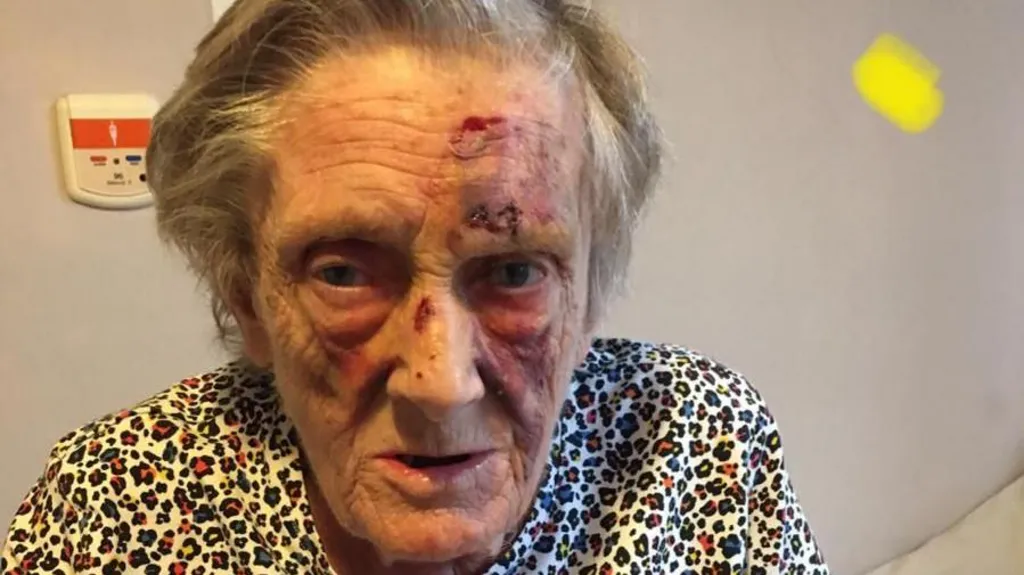 Winifred Tubb suffered 32 falls in less than a year
.
.
Click the link below for the article:
.
__________________________________________
Missed News 562A
July 14, 2024
Business, Crime, Finance, Food For Thought, Human Interest, Medical, missed News, Political, Science, Technical amazon, business, Business News, current-events, Future, Hotels, human-rights, medicine, mental-health, research, Science, Science News, technology, Technology News, travel, vacation Leave a comment

.
News You might have missed!
Use your browser or smartphone back arrow (<-) to return to this table for your next selection.
.
__________________________________________
The White House’s Kamala Harris Blunder
July 14, 2024
Business, Food For Thought, Human Interest, Political, Science, Technical amazon, business, Business News, current-events, Future, Hotels, human-rights, medicine, mental-health, research, Science, Science News, technology, Technology News, travel, vacation Leave a comment

Click the link below the picture
.
When Ron Klain admitted to me a year ago that the White House could have worked harder to elevate Kamala Harris’s profile, he didn’t know that the Democratic Party, and perhaps American democracy itself, would soon be riding on her readiness to be president. But perhaps he should have.
It was July 2023, and while interviewing President Joe Biden’s former chief of staff in his law office in downtown Washington, D.C., I’d asked if the administration had done enough to showcase Harris as a governing partner to the oldest president in history. Promoting one’s vice president is “always hard,” Klain, who was known to be an advocate of Harris’s, told me then. “Obviously, I wish, you know—you could always do more, and you should do more.”
Four months before the election, and one week after Biden’s disastrous debate performance against Donald Trump, Harris’s capacity to lead the Democratic Party and the free world has never been more relevant. And yet many Americans, after three years of the West Wing’s poor stewardship of Harris, are now looking at their vice president as if for the first time.
In another version of the Biden presidency, this would indeed be Kamala Harris’s moment. A growing list of prominent Democrats, including Representative James Clyburn of South Carolina and, in a conversation with me this week, Senator Laphonza Butler of California, are touting Harris as the candidate best positioned to take on Trump in the event that Biden decides to withdraw from the race. Tim Ryan, the former congressman from Ohio who challenged both Biden and Harris in the 2020 Democratic primary, has taken his support one step further, calling on the president to “rip the band aid off” and promote Harris immediately. A recent CNN poll shows the vice president now running closer to Trump than the president is.
.

.
.
Click the link below for the article:
.
__________________________________________

