January 8, 2014
Mohenjo
Science
Abell 2744, Abell 2744 Galaxies, amazon, American Astronomical Society, Ancient Galaxies, business, Business News, Distant Galaxies, Faraway Galaxies, Galaxies, Hotels, Hubble Galaxies, Hubble Space Telescope, huffingtonpost, human-rights, Jennifer Lotz, medicine, mental-health, NASA, research, Science, Science News, Slideshow, Space, space photos, Space Program, Spaceflight, technology, Technology News, travel, vacation, Youngest Galaxies
Click link below picture
.
The Hubble Space Telescope has peered back to a chaotic time 13. 2 billion years ago when never-before-seen galaxies were tiny, bright blue and full of stars bursting to life all over the place.
Thanks to some complex physics tricks, NASA’s aging telescope is just starting to see the universe at its infancy in living color and detail.
Images released by NASA on Tuesday show galaxies that are 20 times fainter than those pictured before. They are from a new campaign to have the 23-year-old Hubble gaze much earlier and farther away than it was designed to see.
“I like to call it cosmic dawn,” Hubble astronomer Jennifer Lotz said at the American Astronomical Society convention in Washington. “It’s when the lights are coming on.”
.

This long-exposure image from NASA’s Hubble Space Telescope of massive galaxy cluster Abell 2744 is the deepest ever made of any cluster of galaxies. It shows some of the faintest and youngest galaxies ever detected. | ASSOCIATED PRESS
.
.
Click link below for story and slideshow:
.
__________________________________________
December 7, 2012
Mohenjo
Science
American Museum of Natural History, Astronomers, Astronomy, Astrophysics, aviation, Benoit Borgue, Biggest Black Hole, Black Hole, Black Hole Quasar, black holes, Bronx Manhattan, business, climate, Computer models, distant galaxy, early universe, Galaxies, huffingtonpost, light computer, Most Powerful Galactic Eruption, Physics, Quasar, research, Science, Science News, SDSS J1106+1939, Space, technology, travel, vacation, Video, Virginia Tech
FROM

Click link below picture
.
Astronomers have seen a distant galaxy that blasts away material with two trillion times the energy the sun emits — the biggest such eruption ever seen. That ejection of matter could answer an important question about the universe: why are the black holes in the centers of galaxies so light?
Computer models of the early universe usually produce a virtual cosmos that looks like ours except for one thing. The ratio of the mass of black holes in galaxy centers to the rest of the matter in galaxies is larger in the simulations than in the real universe.
.
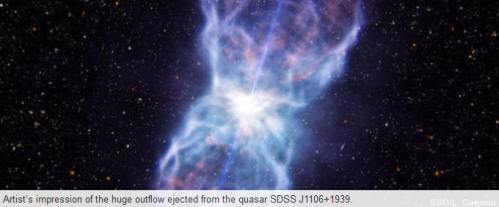
.
.Click link below for story, slideshow, and video:
http://www.huffingtonpost.com/2012/11/28/black-hole-quasar-eruption_n_2203663.html?utm_hp_ref=science
.
___________________________________________________
November 2, 2012
Mohenjo
Science
anniversary photos, business, climate, dark energy, Dr. Edwin Hubble, Environment, first-ever auroras above Uranus, Future, Galaxies, Hubble Anniversary, Hubble Space Telescope, huffingtonpost, infrared wavelengths, Jupiter, low earth orbit, myaol, near-infrared wavelengths, Nebula, photographs in visible light, research, Saturn, Science, Science News, Space, Space Telescope, Stars, Supernovas, Tarantula Nebula, technology, travel, ultraviolet, vacation
FROM
Click link below picture
.
The Hubble Space Telescope launched on April 24, 1990, ushering in a new era in space exploration.
From its low-earth orbit, the telescope can take pictures without interference from the planet’s atmosphere, snapping photographs in visible light, ultraviolet and near-infrared wavelengths.
.

.
.Click link below for story an slideshow:
http://www.huffingtonpost.com/2012/04/27/hubble-space-telescope-anniversary-photos_n_1460494.html?ref=science&icid=maing-grid7|myaol|dl8|sec1_lnk3%26pLid%3D156579
.
____________________________________________________
 James' World 2