September 20, 2026
Mohenjo
Business, Food For Thought, Human Interest, Political, Science, Technical
amazon, business, Business News, current-events, Future, Hotels, human-rights, medicine, mental-health, research, Science, Science News, technology, Technology News, travel, vacation

Click the link below the picture
.
The Parthenon is a stunning example of ancient Greek architecture—but it is also the site of an optical mystery. If you look closely, the platform on which the columns of the Parthenon stand, called the stylobate, is subtly curved, forming a parabola shape. A long-standing theory for this architectural quirk is that it creates an optical illusion that makes the Parthenon appear to stand straighter; it would look saggy otherwise.
But now a mathematician is making the case for why that theory just can’t be true.
In a new paper published in Royal Society Open Science, mathematician Alain Goriely shows that even though the stylobate really is curved, the illusion doesn’t hold up. According to existing research on how the eye perceives illusions, humans can detect about 1.5 to five centimeters of curve in a straight line from about 25 meters away. The stylobate’s curve reaches a maximum of six centimeters of change, so it would be perceptively curvy when viewed at that close of a distance. But when it is much farther than that, the average human eye is no longer capable of seeing it.
In fact, the ability to see the curve from 25 meters away may only hold in perfect theoretical conditions—such as a single high-contrast line on a two-dimensional surface. But in real life, when one is looking at the Parthenon, the noise in the image—the three-dimensional elements of the structure that exist in the background and foreground of the 2D lines—obscures our ability to notice the stylobate curve, even from 25 meters.
As a result, any illusory effects would likely be lost on a viewer. And even when looking up close, the stylobate would look curved, not straight.
“We’re not that easily fooled in the real three-dimensional world by visual illusion,” says Goriely, an applied mathematician at the University of Oxford.
“People sometimes are brought to the corner of the Parthenon, and that really amplifies the curvature,” he says. “And [they] say, ‘Aha, you see it’s curved. And why is it curved? Because the Greek made it so that it appears straight.’ But if it appears straight, why is it curved?”
Goriely also outlines how a straightening illusion might work—and why it doesn’t make sense for the Parthenon.
The Hering and Wundt illusions are examples of how straight lines can appear curved if intersecting lines cross them at a certain angle. The Parthenon’s columns famously have a slight inward tilt toward the roof and bulge at the center, which some people theorize balances out the curved stylobate. But the columns are much too perpendicular to the stylobate for that.
Goriely says other explanations, such as that this architectural style improved drainage or simply that the ancient Greeks liked it, hold more weight than any illusion.
Certainly, the ancient Greeks appreciated symmetry and precision in their architecture; it’s even been hypothesized that this symmetry was considered divine and thus represented religious dedication to the space. Mark Wilson Jones, an architectural historian and a visiting professor at the University of Cambridge, points out that there’s “a very satisfying proportion” in the Parthenon’s architecture: an exact 2:1 relationship between the width of the stylobate platform and the height of the structure, including both the columns and the entablature. That ratio’s “sweetness” depends on the curve of the stylobate, according to Wilson Jones.
Still, Wilson Jones doesn’t think the theory that the ancient Greeks were attempting an optical illusion should be ditched entirely. “In classical antiquity, as in most traditional cultures, partial explanations could operate at the same time, overlapping and reinforcing each other in ways that are not entirely logical to us,” he says. “The Greeks may have convinced themselves or suspended their disbelief… They didn’t have modern methods to prove or disprove theories such as this.”
.

The Parthenon. Elizabeth Beard / Getty Images
.
.
Click the link below for the complete article:
.
__________________________________________
September 20, 2026
Mohenjo
Business, Food For Thought, Human Interest, Political, Science, Technical
amazon, business, Business News, current-events, Future, Hotels, human-rights, medicine, mental-health, research, Science, Science News, technology, Technology News, travel, vacation

Click the link below the picture
.
Media outlets CNN, Politico and MS NOW filed a lawsuit Monday against the Trump administration after President Donald Trump banned them from covering the White House.
The president announced the ban Friday on Truth Social, citing what he said was “their constant ‘reporting’ FAKE NEWS!”
In a joint statement on social media, the three outlets said they notified the administration Monday that they were filing the suit “to protect our First Amendment rights and defend the principle that the government does not decide what the press reports or publishes.”
“Without notice or process, the White House revoked our journalists’ credentials because it objected to our reporting,” the statement continued. “Left unchallenged, this threatens press freedom and the public’s right to independent journalism free from government interference.”
Reached for comment on the lawsuit, the White House press office directed NBC News to Trump’s Truth Social post defending the move Monday morning. In the post, the president called the ban “an assault” on the news media, which he claimed is “a threat to our National Security, and must be stopped, NOW!”
Trump has targeted journalists and outlets he dislikes, but the ban is the most extreme instance so far of the president’s push to hinder press access.
Secret Service members turned away reporters from CNN, MS NOW and Politico from White House grounds and revoked their passes Saturday, prompting backlash from experts and the White House Correspondents’ Association, which called the move unconstitutional. CNN’s and MS NOW’s workspaces in the White House sat empty following their access being withdrawn.
The publications have long been part of the White House press pool, a group of media outlets that cover the president. The pool, which is managed by the White House Correspondents’ Association, assigns a small number of reporters each day to cover the president on behalf of the full press corps. The assigned outlet rotates. CNN, now banned, was assigned to pool duty Monday, providing broadcast coverage meant to be shared with all members of the press corps.
On Sunday night, the White House sent out its daily media guidance, which did not have any major broadcast outlet included for Monday’s pool duties.
Trump has attempted to ban outlets from government spaces before. He barred The Associated Press from the Oval Office, Air Force One and some events after it declined to call the Gulf of Mexico by Trump’s preferred name, the Gulf of America. The AP sued the administration, and the case is ongoing.
.
 CNN, Politico and MS NOW plan to sue the Trump administration over the president’s ban on them from covering the White House. Chip Somodevilla / Getty Images
.
.
Click the link below for the complete article:
.
__________________________________________
September 20, 2026
Mohenjo
Business, Food For Thought, Human Interest, Political, Science, Technical
amazon, business, Business News, current-events, Future, Hotels, human-rights, medicine, mental-health, research, Science, Science News, technology, Technology News, travel, vacation

Click the link below the picture
.
The frantic pace of the Trump presidency makes days seem like weeks and weeks like months — if not years. Finding rhyme or reason amid President Trump’s erratic conduct is impossible. Even so, while 2026 has not brought calm, it has brought more clarity.
Twenty months into his second term, Mr. Trump has remade the presidency and changed what Americans will tolerate from their government and from one another. Yet that transformation, sweeping as it is, may prove less important than what Mr. Trump and his allies could not do. They failed at the most ambitious project that they brought to his second term: using the state to remake American society. That failure is a central fact of the past 20 months, and it is why the country is in a less dangerous place than it was a year ago.
When Mr. Trump took office for the second time, he arrived with several overlapping but distinct agendas. The one he cared most about would convert the executive branch to a form of government that scholars call patrimonialism, in which the state is run as the leader’s personal property and family concern. In a patrimonialist system, expert bureaucracies and neutral rules are replaced by — or subordinated to — the head of state’s will. Where they can, patrimonialists personalize and weaponize law enforcement, pardons, programs and grants, appointments, promotions and all the other aspects of state power.
Patrimonialism is manifest in Mr. Trump’s enrichment of himself and his family, reportedly by several billion dollars — and in his effort to extract almost $1.8 billion from taxpayers by means of a sham legal settlement. It is manifest, too, in his systematic repurposing of the executive branch to serve his personal and political interests.
He uses his Justice Department to wage personal vendettas and his pardons to indemnify his cronies. He has staffed the department’s senior ranks with his own criminal defense attorneys, and the F.B.I. with a fierce political loyalist whose chief qualification was a career spent attacking the investigators who had scrutinized Mr. Trump. And he has purged the government’s internal checks on corruption, including by firing inspectors general, career prosecutors, and F.B.I. agents whose offense was to follow the rules.
Mr. Trump uses faits accomplis, such as the demolition of the United States Agency for International Development, to elbow aside Congress and impose his will without regard for constitutional boundaries. With some help from the Supreme Court, he has concentrated federal power in the office of the presidency; and with his patrimonialist agenda, he has remade that office to serve not the Constitution but himself and his desires.
The re-norming of political standards is another area in which Mr. Trump has made a lasting imprint. By “re-norming,” we mean the deliberate degradation of what is considered acceptable in American public life.
Examples are far too many to enumerate, but recall just a few: Mr. Trump described his political opponents as “vermin” and said immigrants were “poisoning the blood of our country.” When Robert Mueller died in March, Mr. Trump posted that he was “glad he’s dead.” When Rob Reiner and his wife were murdered in their home, he blamed the killings on Mr. Reiner’s criticism of him. He courted and excused political violence — winking at threats against officials who crossed him, joking about the near-fatal attack on Nancy Pelosi’s husband, and praising and then pardoning Jan. 6 rioters. He revels in bullying, cruelty, and hate as no president ever has. Beneath it all is the normalization of lying on an industrial scale: tens of thousands of documented false claims as president, including false accusations against Americans and false representations to courts.
Many Americans are sick of wading through the sludge and understandably want to look away. That is what Mr. Trump is counting on. He wins not by persuading us that the conduct is acceptable, but by wearing us out until we no longer object. Each violation makes the next easier; each unpunished transgression resets the baseline. What is being broken is not this standard or that one; it’s the idea that standards apply. Thanks largely to Mr. Trump and his allies, the country today accepts political speech and behavior that only a few years ago would have been disqualifying, if not unthinkable. It is no longer clear what a president could say — about a dead man, about a murdered family, about women he has abused, about incitements to violence — that would cost him anything.
.
 Cleon Peterson
.
.
Click the link below for the complete article:
.
__________________________________________
September 19, 2026
Mohenjo
Business, Food For Thought, Human Interest, Political, Science, Technical
amazon, business, Business News, current-events, Future, Hotels, human-rights, medicine, mental-health, research, Science, Science News, technology, Technology News, travel, vacation

Click the link below the picture
.
SpaceX’s reusable rocket, Starship – the tallest and most powerful ever launched – will orbit Earth for the first time within days. And because it will also release working Starlink V3 satellites, it will be the first commercially useful Starship mission.
The company has announced that a launch window will open at 7.15am CDT (1.15pm BST) on 22nd September, during which Starship will launch from the company’s Starbase site in Texas.
The flight – Starship’s 14th – will reach an altitude of 275 kilometres and complete six orbits of Earth over 10 hours, with re-entry and splashdown targeted in the Pacific Ocean, to the west of Chile.
This will make it by far the longest and most ambitious test flight of Starship to date. All 13 previous Starship test flights have been, at best, sub-orbital.
Starship is made up of two parts: an upper stage, confusingly also called Starship, and a lower stage, called Super Heavy. Currently, SpaceX is testing the latest third generation of each section using a fail-fast, learn-fast strategy more common to Silicon Valley than the conservative world of space exploration.
SpaceX is several years into its development programme for Starship, intended to be a rapidly reusable and extremely powerful launch vehicle that will take over the rollout of the company’s Starlink satellites and be a central part of NASA’s Artemis moon missions.
The 14th flight will also see 26 Starlink V3 satellites launched for the first time. Thousands of these new devices will join the existing constellation of satellites that provides internet connections around the world. Until now, Starship test flights have launched only dummy test satellites.
Davide Amato at Imperial College London says that an orbital test is indicative of confidence within the company that the rocket will at least survive the journey to orbit and the release of satellites. But he says that re-entry, where the company has faced problems during recent tests, may be another matter.
“In short, they’re making good progress towards introducing Starship as a successful commercial launcher,” says Amato. “Whether Starship will be ‘revolutionary’, as promised by their CEO, will depend on whether they will be able to achieve a high launch cadence and on whether their design is cost-effective.”
Leah-Nani Alconcel at the University of Birmingham, UK, says that the 14th test flight will be a key step for SpaceX. Not only will the release of V3 satellites help the company update its Starlink constellation – the new satellites fly in a lower orbit than existing Starlink satellites and have higher data capacity – but their larger size than previous models will go some way to showing whether Starship is up to the task of launching its proposed Starmind data centre spacecraft, which are substantially larger.
“I don’t think it’s a huge jump in operational complexity for the launch vehicle, but demonstrating the Starlink V3 delivery to orbit is a significant step,” says Alconcel. “It may not be as flashy as the ‘chopstick catch‘ for the vehicle stages, but it would be a big boost to their commercial capabilities to have both the already-established high-cadence Falcon 9 and a proven Starship in their repertoire.”
Three of the satellites due to be released on this flight have been modified to include cameras that can scan Starship’s heat shield whilst in orbit and transmit images to engineers on Earth.
During the 13th test flight, the booster stage made its ascent as planned, but during descent only eight of the 13 engines intended to slow its fall reignited, causing it to make a hard splashdown into the ocean rather than the planned gentle simulated landing on water. Neither the booster nor upper stage will attempt to make a controlled landing on the 14th flight.
Only two Starship flights have taken place so far in 2026, with flight 14 due to be the third. The upcoming flight will also be the second since SpaceX’s flotation on the stock market, which made controversial founder Elon Musk the world’s first trillionaire. The number of flights has fallen far beyond bold estimates made in previous years; SpaceX officials hoped to launch as many as 25 Starship test flights last year. In reality, only five test flights occurred that year.
SpaceX didn’t respond to a request for an interview, but the company says on its website that “there have been several modifications to hardware and software to address issues seen on the previous flight”.
.

SpaceX’s Starship atop the Super Heavy V3 booster during the 13th launch on 24 July 2026. SpaceX/UPI/Shutterstock
.
.
Click the link below for the complete article:
.
__________________________________________
September 19, 2026
Mohenjo
Business, Food For Thought, Human Interest, Political, Science, Technical
amazon, business, Business News, current-events, Future, Hotels, human-rights, medicine, mental-health, research, Science, Science News, technology, Technology News, travel, vacation

Click the link below the picture
.
Journalists from MS NOW, CNN and Politico were denied access to the White House grounds on Saturday, one day after President Donald Trump said he is banning the three outlets over their coverage of him.
White House reporter Akayla Gardner said MS NOW journalists were blocked from the grounds for the first time Saturday morning.
“Yesterday our journalists were able to stay here working on the White House grounds,” she said. “This was the first action we know of them actually denying us entry into the White House.”
“The White House belongs to the American people and the decisions made inside are funded by our tax dollars,” MS NOW said in a statement. “MS NOW intends to take any and all steps necessary to defend our First Amendment rights and the essential role of independent journalism in our democracy.“
MS NOW said it will “continue to report on the President, the administration, and the issues that impact the American people.”
CNN reported later Saturday that its journalists were denied access to the White House.
“CNN’s mission to report on the U.S. government will continue regardless of any attempts to restrict physical access to the White House and other government buildings, or any other attempts to impede our journalism,” CNN said in a statement. “We have a right under the U.S. Constitution to do our reporting without hindrance or interference from the government and this ban is an illegal assault under that right.”
The news organization reiterated it “stands fully behind our White House team.”
Politico’s editor-in-chief, Jonathan Greenberger, emailed the newsroom: ″A few minutes ago, our colleague Cheyenne Haslett attempted to enter the White House to do her job as a POLITICO reporter. Secret Service denied her entry to the complex and confiscated the pass that allows her access to the White House. We stand by her and all reporters here covering the White House. As we said yesterday, we will vigorously defend our First Amendment rights.”
When asked to respond, the White House referred CNBC to the president’s comments yesterday.
On Friday, Trump said in a Truth Social post that those outlets “shouldn’t be able to constantly write or report FICTION and LIES when they’re covering the President of the United States, the Trump Administration, or the United States of America.”
“Other Fake News Media Outlets to follow,” he added.
Later that day, in the Oval Office, the president said he was imposing the ban in response to “cumulative stories” by the three outlets.
“You get sick of it,” he said.
In 2018, Trump’s White House briefly tried to suspend a CNN reporter’s press pass, and it is currently being sued over an attempted ban of Associated Press journalists from certain spaces.
.

U.S. President Donald Trump speaks during a meeting with U.S. travel executives in the Oval Office of the White House on Sept. 2, 2026, in Washington, DC. Kevin Dietsch | Getty Images
.
.
Click the link below for the complete article:
.
__________________________________________
September 19, 2026
Mohenjo
Business, Food For Thought, Human Interest, Political, Science, Technical
amazon, business, Business News, current-events, Future, Hotels, human-rights, medicine, mental-health, research, Science, Science News, technology, Technology News, travel, vacation

Click the link below the picture
.
A Trump administration proposal to exclude some types of immigrants from the 2030 census might not expand the congressional map for Republicans, and could even result in fewer House seats in red states.
If congressional seats were redistributed based on recent census figures, excluding undocumented immigrants and other noncitizens without green cards could cause Texas to lose a congressional seat it would otherwise have gained, according to a New York Times analysis. Minnesota, a blue-leaning state, could gain a seat.
States are allotted congressional seats based on their populations during a process called reapportionment, which uses census data and occurs every 10 years. The next decennial census is slated to happen in 2030.
Though there are no official public statistics for the immigrants targeted by the proposal, two separate organizations estimated the group’s size in two recent years, 2023 and 2024. The Times used those estimates to explore the effect Mr. Trump’s proposal could have on the number of congressional seats each state would have received if reapportionment had happened in each of those years.
Both groups — FWD.us and Pew — produce detailed statistics on the types of foreign-born residents in order to estimate the undocumented population. Despite using different methods, they ended up with broadly similar results.
If reapportionment had happened in 2024 under the Trump administration proposal, it would have struck two seats from Republican strongholds in Texas and Florida, according to The Times’s analysis of the FWD.us estimates. Minnesota and Oregon would each have received one additional seat.
The map would look slightly different using Pew’s estimates, which are based on 2023 population figures. A hypothetical scenario for that year would result in a political wash. Texas would again have one fewer seat than it would have had under a full census count, and Minnesota one more, but Ohio would also gain a seat at the expense of Rhode Island.
“This isn’t exactly what I think the powers that be expected,” said Jeffrey Passel, a senior demographer at Pew who produced its breakdown of the immigrant population.
The variance between the scenarios can be attributed to differences both in the census counts for each year and in the two groups’ estimates.
For example, Florida’s growth between 2023 and 2024 would have been enough to give it another House seat. But excluding the immigrants targeted in the proposal would have canceled out that gain.
.
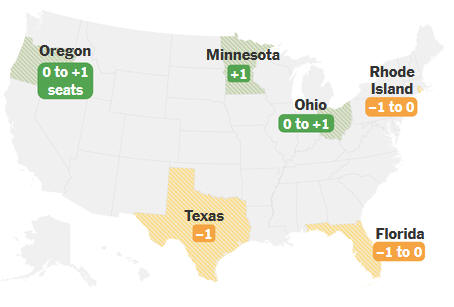
Result in fewer House seats in red states.
.
.
Click the link below for the complete article:
.
__________________________________________
September 18, 2026
Mohenjo
Business, Food For Thought, Human Interest, Political, Science, Technical
amazon, business, Business News, current-events, Future, Hotels, human-rights, medicine, mental-health, research, Science, Science News, technology, Technology News, travel, vacation
Click the link below the picture
.
Deep in the Bolivian Yungas cloud forests, there stalks an utterly adorable beast: smaller than a house cat and spotted like a leopard, the creature has long been known to local communities as a tilcayo. Scientists, however, have only just formally discovered it—marking the first new wildcat species to be identified in more than a century.
The new species, Leopardus tilcayo, is a type of tiger cat, a group of small felines in the genus Leopardus that are native to South America. In a paper published on Thursday in Current Biology, the researchers identify five distinct species of tiger cats in South America, including the tilcayo.
The discovery came by accident, said the study’s co-lead author Paola Nogales-Ascarrunz to NBC News. A man had brought one of the kitties into the sanctuary that she volunteered at, and she noticed that it didn’t quite match any existing tiger cat species. After a series of genetic tests, she and her team discovered the cat must be a new species that had likely diverged from its closest tiger cat relative some 1.4 million years ago.
The discovery of a new mammal, especially a cat, is rare. It’s even more rare to find an entirely new species rather than a variation of a known species. The study analyzed the genomes of 38 cats, including 26 Leopardus cats, comprising “the most complete genetic study yet,” said the study’s co-lead author Jonas Lescroart, an evolutionary ecologist at the University of Antwerp in Belgium, to Gizmodo.
It’s unclear how many tilcayos are out there, and the authors have said that the study should be a catalyst for intensified conservation efforts across tiger cat species.
“Describing a new cat species after more than 100 years shows how much we still have to learn about the biodiversity around us. But it also reminds us that we need to protect the Yungas forests, which are home to so many species—including some we are only beginning to understand,” Nogales-Ascarrunz said in a statement.
.

The tilcayo is the first new species of wildcat to be identified in more than a century. Fernando Faciole/National Geographic
.
.
Click the link below for the complete article:
.
__________________________________________
September 18, 2026
Mohenjo
Business, Food For Thought, Human Interest, Political, Science, Technical
amazon, business, Business News, current-events, Future, Hotels, human-rights, medicine, mental-health, research, Science, Science News, technology, Technology News, travel, vacation
From

Click the link below the picture
.
Actress Tisha Campbell is reminding us it’s never too late to get diagnosed. The former Martin star recently found out she’s on the autism spectrum, which she shared during a guest appearance on Way Up with Angela Yee.
After seeing specialists and undergoing intense testing, the 57-year-old received an AuDHD diagnosis, a term used for individuals with both autism and ADHD.
“I actually saw two specialists, and I took 12 tests each. They all vary from oral tests to written tests to just Q&As. And so I took all 12 twice, and I just got my diagnosis back,” she explained.
The My Wife and Kids actress also added that she’s level one on the spectrum. That means support is required for socializing and flexible thinking, but they can otherwise live life independently. Level one individuals can easily fly under the radar because they appear neurotypical.
“I have a lot of autistic tendencies, and I’m level one,” she explained to Yee. “So for me, I may not look like I need support, but I have earphones to block out sounds because I, too, have audio processing differences. Like, everything comes at me all at once.”
Some people don’t think a diagnosis later in life can be helpful because you’ve already learned to navigate the world without one. But Campbell shared that getting diagnosed has put puzzle pieces together, providing clarity for many of her life experiences. One being her hyperfixation on acting and music, which led to her undeniable success over the past few decades.
“A lot of autistic people have- they used to call them obsessions or fixations, but we call them special interests now. And my special interest was always acting and music,” she explained.
Campbell’s diagnosis couldn’t be more timely. She released her memoir The A Word: A Mother’s Journey Through Autism and Love on September 15. The book documents her experience raising her autistic son Xen, who was diagnosed at 18 months. However, the memoir doesn’t contain her personal experiences with autism since she was only recently diagnosed.
“I got the diagnosis after I wrote the book, so that part’s not even in the book. So I’m actually talking to you about this. My newer diagnosis, this just happened this year.”
If you follow Campbell, you know she’s been a staunch advocate of autism awareness over the years, shedding light on the disorder, which one in 31 children and one in 45 adults across the country have. Core messaging around autism awareness is that a diagnosis and services are there to support versus change, who autistic people are. The actress said getting diagnosed has helped her gain more self-awareness.
“I feel like I know myself so much better,” she said, adding that she’s been hiding her stimming—repetitive body movements, sounds, or object uses to help self-regulate over the years.
Campbell’s diagnosis is a full-circle moment as she’s gone from advocating for her son over the years to also advocating for herself. Other celebs like SZA and Chrisette Michele have also been diagnosed with autism as adults.
.
 NEW ORLEANS, LOUISIANA – JULY 04: Tisha Campbell speaks onstage during day 2 of the 2026 ESSENCE Festival of Culture® presented by Coca-Cola® at Ernest N. Morial Convention Center on July 04, 2026, in New Orleans, Louisiana. (Photo by Paras Griffin/Getty Images for ESSENCE)
.
.
Click the link below for the complete article:
.
__________________________________________
September 18, 2026
Mohenjo
Business, Food For Thought, Human Interest, Political, Science, Technical
amazon, business, Business News, current-events, Future, Hotels, human-rights, medicine, mental-health, research, Science, Science News, technology, Technology News, travel, vacation

Click the link below the picture
.
When President Trump’s envoys sat down with Vladimir V. Putin at the Kremlin this month, the Russian leader exuded confidence.
Within months, he said, Russian troops would finally capture Ukraine’s entire Donbas region. And Russia was poised to pummel Ukraine’s electricity grid, setting the stage for a miserable winter.
Then one of the envoys, Jared Kushner, tried to push back. With all due respect, you told us exactly that a year ago, Mr. Kushner said to the Russian president. What are the chances we come back here in another year and you are again saying the same thing? Maybe we don’t lose a year?
The exchange, described by a person familiar with the talks and by a U.S. official, captured the quandary of Mr. Trump’s more than 18 months of efforts to end the war in Ukraine.
Congress this week passed a landmark sanctions bill taking aim at Russia’s energy sector, a new attempt to make Russia “suffer” for its invasion and to pressure Mr. Putin to make compromises.
But even as that bill makes its way to Mr. Trump’s desk, the Trump administration is doubling down on a different approach: offering benefits for Russia that officials hope will get Mr. Putin to consider ending his war.
Among the new inducements: the White House is now considering signing business deals with Russia before it stops fighting in Ukraine, according to two people close to the talks. The U.S. official, speaking on condition of anonymity to be candid about the negotiations, said that deals with Russia before the end of the war were possible because they would show that the United States is serious about a reset relationship with Russia.
The approach represents a shift from Mr. Trump’s pledge last year that business deals with Russia would not come “until we get the war settled.” It indicates that Mr. Trump’s envoys for ending the war, Steve Witkoff and Mr. Kushner, are groping for new ways to entice Russia to stop fighting, now that it has become clear that Ukraine will not withdraw from the swath of its own territory that Mr. Putin insists he must control before the war ends.
And it contrasts with the approach advocated by both Republicans and Democrats in Congress — not to mention Kyiv’s European allies and Ukraine itself — that only heightened economic and military pressure on Mr. Putin can compel him to compromise.
“This bill will cripple Russia’s war machine and finally bring Putin to the negotiating table,” Representative Michael McCaul, Republican of Texas and one of the sanctions bill’s leading proponents, said on Wednesday after a bipartisan majority passed the legislation, 262 to 159.
Mr. Trump has indicated he will sign the bill, which was championed by Senator Lindsey Graham, Republican of South Carolina, until his death in July. It would allow the president to levy tariffs of as much as 100 percent on countries buying the most Russian oil or gas and would impose sanctions on Russian officials, businesspeople and financial institutions. Senator Darline Graham, Mr. Graham’s sister who replaced him in his seat, said it would “increase the president’s negotiating leverage.”
But insofar as the Trump administration is pursuing a carrot-and-stick approach with Mr. Putin, carrots seem the focus. The U.S. official said that the administration wanted to create more incentives for members of the Russian elite to push for peace. Executing some business deals before the end of the war could help convince anti-American hawks around Mr. Putin that Mr. Trump really does want to create a new relationship with Russia, the official added.
Balazs Jarabik, a former European Union diplomat in Kyiv who now works at R. Politik, a political analysis firm, said signs pointed to the United States “considering bigger concessions toward Russia.”
Washington “is now signaling that some deals could move forward if Moscow first demonstrates concrete restraint,” said Mr. Jarabik, who has been tracking the talks closely. “Washington had previously resisted signing such agreements before a cease-fire.”
It was not clear what deals in particular are on the table. The Kremlin’s foreign policy adviser, Yuri Ushakov, said after Mr. Putin’s meeting with Mr. Witkoff and Mr. Kushner on Sept. 5 that “economic issues and potential major mutually beneficial Russian-American projects were discussed in some detail.”
The Kremlin has been promoting business opportunities to the White House ever since Mr. Trump returned to office last year. Russian officials have floated deals for rare earths and aluminum, joint ventures in the Arctic and even getting U.S. companies involved in selling Russian natural gas to Europe.
Mr. Trump has hailed Russia’s economic potential as “tremendous,” but he has previously held out business deals as a reward for a Russia that makes peace.
“They want to do business,” Mr. Trump said ahead of his Alaska summit with Mr. Putin last year. “But they’re not doing business until we get the war settled.”
.
 President Donald Trump shaking hands with President Vladimir Putin of Russia during their meeting in Alaska last year. Credit…Doug Mills/The New York Times
.
.
Click the link below for the complete article:
.
__________________________________________
September 17, 2026
Mohenjo
Business, Food For Thought, Human Interest, Political, Science, Technical
amazon, business, Business News, current-events, Future, Hotels, human-rights, medicine, mental-health, research, Science, Science News, technology, Technology News, travel, vacation
Click the link below the picture
.
A nuclear fusion reaction has produced the brightest X-rays ever on Earth, rivalling those emitted by some stars. This could open the door for new extreme experiments, such as mimicking how the sun absorbs radiation and testing how materials that could improve future fusion reactions hold up to nuclear blasts.
The reaction itself was also hotter than the sun. “The truth of the matter is, when the fuel is burning, and ignition is occurring, and that [blast] wave is propagating out, we’re hotter than the sun,” says Ryan Lester at Los Alamos National Laboratory in New Mexico. “We are the hottest point in the local solar system.”
In 2021, researchers at the Lawrence Livermore National Laboratory’s National Ignition Facility in California achieved nuclear fusion ignition, a reaction that is energetic enough to be self-sustaining. This was a milestone on the path to developing nuclear fusion as a useful source of energy.
Now, Lester and his colleagues have added windows to the tiny cylinder within which ignition happens. This let out the brightest X-rays ever created in the lab and turned ignition into an unprecedentedly extreme physics experiment.
The researchers shot 192 very energetic laser beams into a gold cylinder about the size of a pencil eraser, which contained a carbon capsule filled with heavy versions of hydrogen atoms. The beams generated a bath of X-rays that compressed and heated the capsule so much that the hydrogen fuel started to undergo nuclear fusion, leading to ignition.
Once ignition happened, the windows evaporated and let the X-rays out, emitting tens of trillions of watts of power, on a par with the brightness of some red dwarf stars.
There are decades of computer simulations, prototyping and experimental tests behind every element of the apparatus that ultimately achieved ignition, says Lester. “This is a highly refined, highly optimised system to keep the radiation in, keep it warm [and] control capsule symmetry so that all the things line up in a perfect row and ignition can occur,” he says.
Laura Berzak Hopkins at the Princeton Plasma Physics Laboratory in New Jersey says that achieving ignition in the first place was a generational accomplishment, requiring details that researchers have worked on for decades. It is significant that ignition could not only be repeated, but repeated with a modified cylinder, she says.
To move from demonstrating ignition to using nuclear fusion as an efficient energy source, we have to learn something new about it every time it happens, says Berzak Hopkins. Lester and his colleagues have shown more ways to do so, she says.
Most studies of extremely energetic conditions, whether in nuclear fusion reactors or stars, rely on computer simulations, but the latest experiment could offer a more direct and exact alternative. One notable example would be studies of the sun’s opacity, or how some elements within it absorb radiation.
Lester says he hopes the experiment will also aid in designs for future ones, for example by providing a more detailed view of what happens when very low-density foams are added to the capsule. This is because it has been theorised that they could stabilise the reaction and make it more efficient. Such experiments could start as early as next year, he says.
.

An artist’s illustration of the X-rays produced during nuclear fusion
Lawrence Livermore National Laboratory
.
.
Click the link below for the complete article:
.
__________________________________________
Older Entries
Newer Entries

