September 30, 2015
Mohenjo
Science
amazon, Archaeology, business, Business News, Egypt, Hotels, huffingtonpost, human-rights, King Tut, king tut's tomb, medicine, mental-health, queen nefertiti, research, Science, Science News, Slideshow, technology, Technology News, travel, Tutankhamun, vacation, Video
FROM

Click link below picture
.
King Tut’s tomb may be hiding a huge secret.
Egyptian officials said on Monday there’s evidence of two hidden chambers behind the tomb’s famous painted walls — and one expert believes those secret rooms could be the long-lost final resting place of Queen Nefertiti.
Monday’s inspection of the walls of the 3,300-year-old tomb revealed scratches and other markings.
“This indicates that the western and northern walls of Tutankhamun’s tomb could hide two burial chambers,” Mamdouh Eldamaty, Egypt’s antiquities minister, told Ahram Online.
.
 ASSOCIATED PRESS
King Tut’s tomb seen in a 2007 file photo. Egyptian officials believe there may be two hidden burial chambers beyond the walls of the tomb.
.
.
Click link below for story and video:
http://www.huffingtonpost.com/entry/king-tuts-tomb-secret-chambers_560a0aece4b0af3706dda13b?cps=gravity_2692_-7347363654480353748
.
__________________________________________
March 15, 2015
Mohenjo
Science
amazon, Archaeology, Buddha, Buddha Mummy, Buddha Statue, Buddha Statue Mummy, Buddhist Mummies, Buddhist Mummy in a Statue, business, Business News, Hotels, huffingtonpost, Huffpost Science Click, human-rights, Meander Medical Center, medicine, Meditating Mummy, mental-health, Mummies, Mummy in a Statue, research, Science, Science News, Self Mummification, Slideshow, Statue Mummy, statue of Buddha, technology, Technology News, travel, Unearthed, vacation, Video
FROM
Huffpost Science
Click link below picture
.
Researchers examining a nearly 1,000-year-old statue of Buddha on display in Holland discovered something very unusual hidden inside: the mummy of a meditating monk.
Calling the mummy its “oldest patient ever,” the Meander Medical Center in the Dutch city of Amersfoort used a CT scanner to take images of the body inside the statue and an endoscope to examine the thoracic and abdominal cavities.
The mummy is believed to be that of Liuquan, a Buddhist monk who died in China around 1,100 A.D. During their examination, the researchers found that the mummy’s internal organs had apparently been removed and the space filled with “paper scraps that were printed with ancient Chinese characters,” the hospital said in a news release.
.
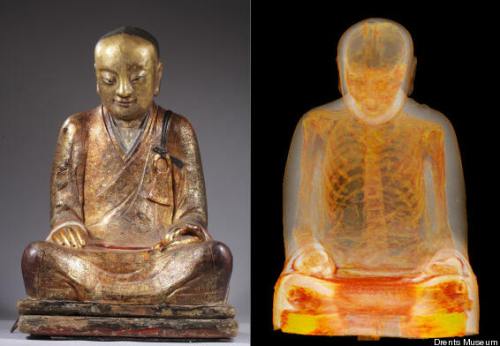 Buddha mummy statue (left) and CT scan image showing mummy inside (right).
.
.
Click link below for story, video and slideshow:
http://www.huffingtonpost.com/2015/02/23/buddha-statue-mummy_n_6734010.html?cps=gravity_2444_5140716466597086966
.
__________________________________________
February 14, 2015
Mohenjo
Science
amazon, ancient tragedy, archaeologists, Archaeology, business, Business News, Earliest Twins, Earliest Twins Siberia, Early Childbirth Death, Hotels, huffingtonpost, Huffpost Science Click, human-rights, Lokomotiv, Lokomotiv Cemetery, Lokomotiv Grave, Lokomotiv Hunter Gatherers, Lokomotiv Twins, medicine, mental-health, Neolithic Era, research, Science, Science News, Siberia Grave, Skeletons, technology, Technology News, travel, twins, Unearthed, vacation
FROM
Huffpost Science
Click link below picture
.
An ancient tragedy is shining new light on life in the Neolithic Era, as archaeologists have uncovered the remains of a woman who appears to have died with her twins during childbirth nearly 8,000 years ago.
It’s the oldest example of death by dystocia, or obstructed labor, and the earliest known example of twins on the archaeological record, researchers wrote in an article describing the discovery, published in the Feb. issue of the journal Antiquity.
.
 .
.
.
Click link below for story and slideshow:
http://www.huffingtonpost.com/2015/02/05/earliest-twins-siberia_n_6619340.html?cps=gravity_2440_8687709450297746126
.
__________________________________________
December 4, 2013
Mohenjo
Science
amazon, anthropology, Archaeology, business, Business News, Hotels, huffingtonpost, human-rights, May Help Reveal How Stones Were Moved, medicine, mental-health, mystery of Stonehenge, NATIONAL GEOGRAPHIC, Prehistory, research, Science, Science News, Slideshow, Stonehenge, Stonehenge Mystery, Stonehenge Rock, Stonehenge Rock Origin, Stonehenge Rock Origins Pinpointed In Wales, Stonehenge Rocks, Stonehenge Rocks Origin, stones, technology, Technology News, travel, Unearthed, vacation, Video
FROM

Click link below picture
.
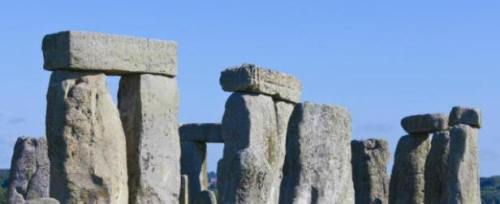
Are we one outcrop closer to unraveling the mystery of Stonehenge?
For years researchers have tried to pinpoint exactly where the enormous stones used in the English monument came from–and how they ended up on an otherwise grassy Salisbury Plain.
It’s long been thought that the iconic monument’s outer stones were hauled from a sandstone quarry situated 20 to 30 miles away, National Geographic reported. The inner stones, however, have presented a tougher question.
Currently, there are two prevailing theories about the inner stones’ origins. One is that an ancient glacier simply pushed them near to the site where the monument was erected, according to NatGeo. The other is that they were somehow hauled there by some exceedingly enterprising early humans.
Now a team of researchers say they’ve located the rocky Welsh hill where some of Stonehenge’s inner stones originated. The team — made up of archaeologists and geologists from several United Kingdom institutions — claim to have matched a type of stone found at Stonehenge, called a spotted dolerite bluestone, to the Carn Goedog outcrop in Wales, the BBC reported.
.
.
.
Click link below for story, video and slideshow:
.
__________________________________________
October 24, 2013
Mohenjo
Science
amazon, Ancient Human Skull, anthropology, Archaeology, biology, business, Business News, Daily Discovery, evolution, Health, Homo erectus, Homo ergaster, Homo habilis, Homo sapiens, Hotels, huffingtonpost, Human Ancestors, Human Evolution, human family tree, Human Skull Georgia, human species, human-rights, mental-health, Paleontology, Prehistoric Skull, Prehistory, research, Science, Science News, Skull 5, Skull 5 Humans, Slideshow, Smarter Ideas, technology, Technology News, travel, vacation, Video
FROM
Click link below picture
.
The earliest, now-extinct human lineages, once thought to be multiple species, may actually have been one species, researchers now controversially suggest.
Modern humans, Homo sapiens, are the only living member of the human lineage, Homo, which is thought to have arisen in Africa about 2 million years ago at the beginning of the ice age, also referred to as the Pleistocene Epoch. Many extinct human species were thought to once roam the Earth, such as Homo habilis, suspected to be among the first stone-tool makers; the relatively larger-brained Homo rudolfensis; the relatively slender Homo ergaster; and Homo erectus, the first to regularly keep tools it made.
To learn more about the roots of the human family tree, scientists investigated a completely intact, approximately 1.8-million-year-old skull excavated from the medieval hilltop town of Dmanisi in the Republic of Georgia. Archaeological excavations there about 30 years ago unexpectedly revealed that Dmanisi is one of the oldest-known sites for ancient human species out of Africa and the most complete collection of Homo erectus skulls and jaws found so far. The world’s largest, extinct cheetah species once lived in the area, and scientists cannot rule out whether it fed on these early humans.
.
 An artist’s conception revealing what “Skull 5” may have looked like some 1.8 million years ago when he (the scientists suspect the remains come from a male) lived.
.
.
Click link below for story, video and slideshow:
.
______________________________________________________________________________
October 18, 2013
Mohenjo
Science
amazon, anthropology, Archaeology, Balls Mesopotamia, business, Business News, Christopher Woods, clay balls, Clay Balls Mesopotamia, Hotels, huffingtonpost, human-rights, mental-health, Mesopotamia, Mesopotamia Clay Balls, Mesopotamia Code, Mesopotamian Code, Oriental Institute, Prehistoric Code, Prehistory, research, Science, Science News, Secret Code Mesopotamia, Slideshow, technology, Technology News, travel, Unearthed, vacation
FROM
Click link below picture
.
Researchers studying clay balls from Mesopotamia have discovered clues to a lost code that was used for record-keeping about 200 years before writing was invented.
The clay balls may represent the world’s “very first data storage system,” at least the first that scientists know of, said Christopher Woods, a professor at the University of Chicago’s Oriental Institute, in a lecture at Toronto’s Royal Ontario Museum, where he presented initial findings.
The balls, often called “envelopes” by researchers, were sealed and contain tokens in a variety of geometric shapes — the balls varying from golf ball-size to baseball-size. Only about 150 intact examples survive worldwide today.
The researchers used high-resolution CT scans and 3D modeling to look inside more than 20 examples that were excavated at the site of Choga Mish, in western Iran, in the late 1960s. They were created about 5,500 years ago at a time when early cities were flourishing in Mesopotamia.
.

Anna Ressman/Courtesy Oriental Institute of the Un
Archaeologists are using CT scanning and 3D modelling to crack a lost prehistoric code hidden inside clay balls, dating to some 5,500 years ago, found in Mesopotamia.
.
.
Click link below for story and slideshow:
.
______________________________________________________________________________
September 1, 2013
Mohenjo
Science
amazon, Ancient Nanotechnology, Ancient Romans, Ancient Romans Lycurgus Cup, Ancient Romans Nanotechnology, ancient technology, anthropology, Archaeology, biology, business, Business News, chemistry, color changes, Daily Discovery, Hotels, huffingtonpost, illinois assistant, Lycurgus Cup Nanotechnology, Nanotechnology, Nanotechnology History, Physics, research, Science, Science News, silver and gold, Slideshow, smithsonian magazine, technology, Technology News, tiny particles, travel, vacation, Video
FROM
Click link below picture
.54294
The ancient Romans were pretty advanced for their time — so advanced that they may even have been pioneers of what we now call nanotechnology.
In fact, an ornately decorated Roman artifact, known as the Lycurgus cup, is inspiring researchers to explore practical applications of the ancient technology.
Created sometime in the Fourth Century, the goblet exhibits a color-changing property that makes its glass take on different hues, depending on the light source — just watch the cup in the video above.
Scientists were long at a loss to explain the cup’s color changes. Then in the 1990s they discovered tiny particles of silver and gold in the cup’s glass. According to Smithsonian Magazine, “When hit with light, electrons belonging to the metal flecks vibrate in ways that alter the color depending on the observer’s position.”
Now, a research team is attempting to build upon the unique technology and apply it in the medical field.
Gang Logan Liu, an University of Illinois assistant professor who has studied the Lycurgus cup for several years, described it as an “icon for inspiration.”
.
.
.
Click link below for story, video and slideshow:
.
______________________________________________________________________________
July 30, 2013
Mohenjo
Science
amazon, anthropology, Archaeology, business, Business News, Coffin Inside Coffin Leicester, Coffin Inside Coffin Richard III, Coffin Within Coffin Leicester, Coffin Within Coffin Richard III, Double Coffin Richard III, Hotels, huffingtonpost, King Richard III, leicester archaeological services, moton, research, Richard III, Richard III Burial Site, Richard III Coffin, Science, Science News, Second Coffin Richard III, Slideshow, stone coffin, Stone Coffin Richard Iii, technology, Technology News, travel, Unearthed, vacation
FROM
Click link below picture
.
“None of us in the team have ever seen a lead coffin within a stone coffin before,” site director Mathew Morris of the University of Leicester Archaeological Services said in a written statement. “We will now need to work out how to open it safely, as we don’t want to damage the contents when we are opening the lid.”
The team announced their plans to pull the lid off the tomb — the only intact stone coffin uncovered at the site — earlier this month. At the time, Morris and his colleagues speculated that the coffin might contain the remains of a knight, such as Sir William de Moton of Peckleton, or one of two high-status friars.
The researchers decided to excavate the site after finding the remains of King Richard III in an unmarked grave beneath a parking lot last September. However, it wasn’t until earlier this year that tests confirmed the identity of the skeleton as the English king who ruled from from 1483 to 1485.
.

.
.Click link below for story and slideshow:
http://www.huffingtonpost.com/2013/07/29/coffin-richard-iii-burial-site-inside-tomb_n_3671397.html?ref=topbar
.
______________________________________________________________________________
July 6, 2013
Mohenjo
Science
amazon, Ancient Carving, Antenociticus, anthropology, Archaeology, british archaeologists, business, celtic deity, centimeters, County Durham, Daily Discovery, Durham University, fall of the roman empire, Hotels, huffingtonpost, northeastern england, research, Roman Carving, Roman Empire, Roman God, Roman Gods, Science, Science News, technology, Technology News, travel, vacation
FROM
Click link below picture
.
An 1,800-year-old stone carving of what may be the head of a Roman god was recently found in an ancient garbage dump, British archaeologists announced today (July 3).
An undergraduate student at Durham University discovered the largely intact head during an archaeological dig at the Binchester Roman Fort, a major Roman Empire fort built around A.D. 100 in northeastern England’s County Durham.
Archaeologists involved in the dig believe that somebody probably tossed the 8-inch-long (20 centimeters) statue in the garbage when the building was abandoned in the fourth century, during the fall of the Roman Empire.
The team is still not certain who the carved head is meant to represent, though they have noted its resemblance to a similar stone head discovered in 1862 inscribed with the name “Antenociticus” — a Celtic deity associated with military prayers in that particular region.
.

.
.Click link below for story and slideshow:
http://www.huffingtonpost.com/2013/07/05/ancient-carving-roman-gods-head-discovered-english-garbage_n_3546365.html?ref=topbar
.
________________________________________________
May 3, 2013
Mohenjo
Science
amazon, ancient civilization, ancient god, Archaeology, aviation, business, cars, god of rain, History, Hotels, huffingtonpost, Mesoamerica, Mexican Pyramids, Mexico, research, Robot Mexican Temple, Science, Science News, Slideshow, technology, Technology News, Temple Of Quetzalcoatl, temple of the feathered serpent, Teotihuacan, Tláloc II-TC, transportation, travel, vacation, Video
FROM
Click link below picture
.
A small robot has uncovered three 2,000-year-old chambers under an ancient temple in Mexico, archaeologists from the National Anthropology and History Institute announced this week.
The robot, named Tlaloc II-TC after Mexico’s ancient god of rain, found the chambers under the Temple of the Feathered Serpent (also called the Temple of Quetzalcoatl) in the Mesoamerican ruins of Teotihuacan, which is just 30 miles from Mexico City. The ancient city, thought to have been established around 100 BC, had more than 100,000 inhabitants at its peak, but had long been abandoned before the Aztecs arrived in the 1300s.
.

.
.Click link below for story, slideshow, and video:
http://www.huffingtonpost.com/2013/04/28/robot-teotihuacan-temple-archaeology_n_3155757.html
.
_____________________________________________________
Older Entries

 James' World 2