Editors’ note: This is the first installment in a new series, “Op-Eds From the Future,” in which science fiction authors, futurists, philosophers and scientists write op-eds that they imagine we might read 10, 20 or even 100 years in the future. The challenges they predict are imaginary — for now — but their arguments illuminate the urgent questions of today and prepare us for tomorrow. The opinion piece below is a work of fiction.
Last week, The Times published an article about the long-term results of the Gene Equality Project, the philanthropic effort to bring genetic cognitive enhancements to low-income communities. The results were largely disappointing: While most of the children born of the project have now graduated from a four-year college, few attended elite universities and even fewer have found jobs with good salaries or opportunities for advancement. With the results in hand, it is time for us to re-examine the efficacy and desirability of genetic engineering.
The tornado screeching across southern Ohio on Monday night triggered a cellphone alert that roused Rich Schlarman. He ignored it. Then came another. That was enough to persuade him to hurry his 83-year-old mother toward the basement.
“We only made it down about four steps when I heard a loud boom,” Mr. Schlarman said. “If we hadn’t made it down as far as we had, we would probably not have made it.”
On Tuesday, his home was a shambles: walls bent, doors tilted, the roof gone — another house crippled amid a stretch of severe weather that has tormented communities from the Rocky Mountains to the Mid-Atlantic in recent weeks.
.
The Brumley family moved belongings out of their home while a crew worked on the building’s damaged roof.CreditAndrew Spear for The New York Times
“One man’s food is another man’s poison.” – Lucretius (99-55 B.C.)
Most people have this basic understanding of genetics: You inherit genes from your parents, and their DNA combines to create your unique genetic makeup. This can include more obvious traits such as eye color and height but also more complex traits that may involve multiple genes, such as risk of diseases including diabetes, heart disease, obesity and cancer, as well as all aspects of metabolism.
.
The Human Genome Project — an international 13-year collaboration that mapped out all of the genes in humans — discovered approximately 50,000 variances (differences in the individual DNA code) in our genetic code that can make a difference in how your body functions.
.
What many people may not realize is that there is a significant interaction between your environment and your genes, and your diet is one of the most basic and potentially modifiable components of your environment.
.
Bacteria in our guts
Differences in the individual DNA code, in our genetic code that can make a difference in how your body functions.
Snakebites kill more than 200 people a day around the world, but Thai firefighter Pinyo Pookpinyo was one of the lucky ones.
When the tip of his thumb was bitten by a king cobra, he made it to a Bangkok hospital within 15 minutes. There, he was given a serum that stopped the venom, which can be fatal, from attacking his nervous system.
.
“The doctor didn’t believe at first that I was bitten by a king cobra. I had to tell him that I was an instructor teaching about snakes; I’m very good at identifying types.
.
“It affected me for about two months. I had to go back to the hospital to undergo surgery for another two times to remove dead tissues from my thumb.”
It had been more than two weeks that she had been lost in a thick Hawaiian forest, and Amanda Eller was at an end.
The 35-year-old doctor of physical therapy was at a place where she could no longer go forward because of the terrain. With a fractured leg and no shoes, she sure wasn’t going to go back.
.
The area she found herself in had little to no food. She stayed there for a day and a half and, as Eller’s mother and a friend told reporters Saturday as they detailed the rescued woman’s ordeal, she began to resign herself to the dire possibility that she might die there.
.
“It came down to life and death — and I had to choose. I chose life. I wasn’t going to take the easy way out. Even though that meant more suffering in me for myself,” Eller told CNN affiliate KHON.
.
Amanda Eller 17 days in Hawaii forest on berries, river water and smarts
In Japan, the secret to living a longer, happier and more fulfilled life can be summed up in one word: Ikigai.
In Japanese, iki means “to live” and gai means “reason” — in other words, your reason to live. This ideology dates to the Heian period (A.D. 794 to 1185), but only in the past decade has it gained attention from millions around the world.
The ikigai way of life is especially prominent Okinawa, in a group of islands south of mainland Japan. (It has also been nicknamed the “Land of Immortals” because it has among the longest lifespans and highest rates of centenarians in the world.)
If you were a wrestling fan on May 23rd, 1999, you were probably doing one of three things.One of those was watching WWE’s latest pay-per-view event, Over the Edge. Another was using “scramblevision” to listen to that event by tuning a TV or VCR without a cable box to the pay-per-view channel. Some fans were probably also watching The Jesse Ventura Story on NBC, which they doubtless regretted instantly. The low-budget Ventura biopic, made with cooperation for WWE’s rival promotion WCW, was an absolute catastrophe of a film and a rushed, obvious cash-in on Ventura’s upset win in the Minnesota gubernatorial election six months earlier. While bad and stupid in every possible way, the movie’s most enduring artistic legacy is the absurd amount of “creative license” it took, most famously through making Ventura a central figure of a scenario that was clearly based on Bret Hart’s last night in WWE.
.
Owen Hart with his beloved Slammy Award statue in a 1996 WWE promotional image.
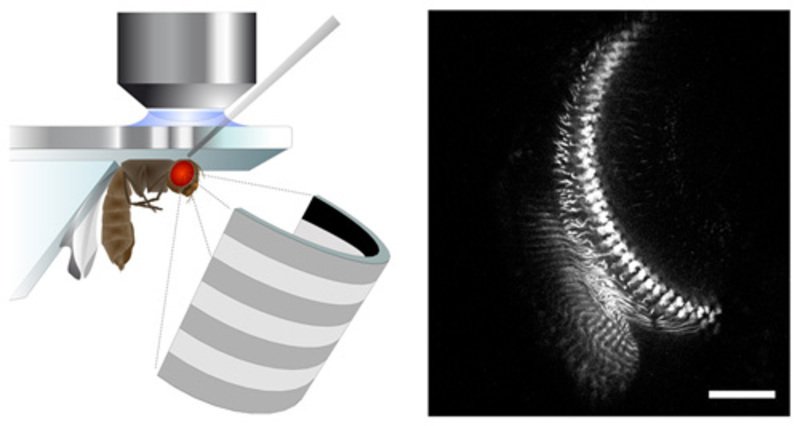
What would be the point of holding a soccer world championship if we couldn’t distinguish the ball from its background?Simply unthinkable! But then again, wouldn’t it be fantastic if your favourite team’s striker could see the movements of the ball in slow motion! Unfortunately, this advantage only belongs to flies. The minute brains of these aeronautic acrobats process visual movements in only fractions of a second. Just how the brain of the fly manages to perceive motion with such speed and precision is predicted quite accurately by a mathematical model. However, even after 50 years of research, it remains a mystery as to how nerve cells are actually interconnected in the brain of the fly. Scientists at the Max Planck Institute of Neurobiology are now the first to successfully establish the necessary technical conditions for decoding the underlying mechanisms of motion vision. The first analyses have already shown that a great deal more remains to be discovered.
.
Seeing into a fly’s brain: Neurobiologists use state-of-the-art methods to observe the activity of nerve cells
Film and Writing Festival for Comedy. Showcasing best of comedy short films at the FEEDBACK Film Festival. Plus, showcasing best of comedy novels, short stories, poems, screenplays (TV, short, feature) at the festival performed by professional actors.

 CreditCreditJohn Karborn


 Snakebites: The hidden health crisis
 Amanda Eller 17 days in Hawaii forest on berries, river water and smarts
 .
.
 Smiling Japanese elder