Science can explain a lot of things — why women need more sleep; why waist trainers are bullshit; why you should be sleeping naked; why certain foods can make you better in bed. But it can’t explain everything. There are a number of commonplace phenomena that continue to stump scientists.
It turns out that being brokenhearted after the death of a loved one isn’t just a euphemism — it’s possible that the loss of a partner may actually trigger an irregular heartbeat, according to a new study, especially when the loss is sudden.
“People are more likely to develop an irregular heartbeat following the death of their spouse or life partner, particularly if they’re younger or the loved one died unexpectedly,” reported HealthDay on Wednesday, citing a study conducted by Danish researchers and published Tuesday in the journal Open Heart.
The study found that the risk of atrial fibrillation, a kind of heart arrhythmia, was 41 percent higher among people whose partners had died compared to those who hadn’t experienced the death of a partner, HealthDay reported, and an unexpected death seems to play an even greater role in that risk.
Every year, around 17,000 kidney transplants and 6,000 liver transplants are performed in the U.S. But there was something special about two recent kidney and liver transplants performed at Johns Hopkins University Medical Center.
The kidney and liver came from a deceased donor with HIV, and they were transplanted into patients who also have HIV. They’re the first HIV-positive organ transplants since the 2013 repeal of an outdated law banning people with HIV from donating their organs.
“This is an unbelievably exciting day for our hospital and our team, but more importantly, for patients living with both HIV and end-stage organ disease,” Dr. Dorry L. Segev, professor of surgery at the Johns Hopkins University School of Medicine, said in a statement.
Middle Earth-dwelling hobbits may not be a total fantasy: It turns out that smallish, probably hairy humans lived many years ago, and new scientific evidence suggests that our Homo sapiens ancestors may be the reason they’re not around today.
Scientists first discovered Homo floresiensis, a small “primitive hominin species” in Indonesia during excavations that took place from 2001 to 2004, according to an article published in Nature this week. Standing at about 3 feet tall, their size earned the newly discovered species the nickname “hobbits,” after the race of small people in J.R.R. Tolkien’s fantasy novels, the Washington Postreported Wednesday.
A fossilized lizard found in Southeast Asia preserved in amber dates back some 99 million years, Florida scientists have determined, making it the oldest specimen of its kind and a “missing link” for reptile researchers.
The lizard is some 75 million years older than the previous record holder, according to researchers at the Florida Museum of Natural History, who announced the finding this week.
It was found decades ago in a mine along with other ancient, well-preserved reptile fossils, but the U.S. scientists were able to analyze the finds only recently.
“It was incredibly exciting to see these animals for the first time,” Edward Stanley, a member of the research team, said on Saturday. “It was exciting and startling, actually, how well they were preserved.”
.
Reuters
Various lizard specimens are shown preserved in ancient amber from present-day Myanmar in Southeast Asia.
This is the first USGS hazard report to factor in manmade earthquakes.
The oil and gas industry is considered the primary cause of such quakes.
Seven million Americans risk facing one in 2016.
Millions of Americans live in areas that could be affected by manmade earthquakes in the next year, according a new assessment from the U.S. Geological Survey.
The oil and gas industry’s wastewater disposal methods are putting about 7 million people at risk, the federal agency announced Monday in an earthquake hazard report. It’s common for companies to dispose of a drilling byproduct called wastewater by injecting it underground. This practice puts additional pressure on faults in the ground and drives them apart, scientists have observed.
.
The Washington Post via Getty Images Gary Landra stands on a crack across his basement floor that he says was caused by an earthquake in Prague…
I’ve always slept underwear free. PJ pants, sure — but nothing tighter than that. As a kid, I thought my friends who wore underwear and socks to bed at a sleepovers were absolutely nuts.
Then, at summer camp a few years later, a girl in my cabin took up my cause. When she announced she never wore underwear to sleep, the other kids ridiculed her. No one else believed her when she insisted it was “important to let your vagina breathe at night.”
What people wear — or don’t wear — to bed is the subject of lively debate. It isn’t just about underwear. People have strong opinions about whether it’s better to sleep naked or clothed — and if clothed, to what degree. Some folks insist you should wear a bra to sleep, while others balk at the prospect of keeping their boobs caged at night.
.
What people wear — or don’t wear — to bed is the subject of lively debate
As long as we make efforts to take care of ourselves and live healthy, there is a good chance that our bodies will serve us well for a long time. Our bodies truly are amazing. You might be surprised at what your body is capable of after reading these 50 weird facts about the human body.
The fact that Taylor Swift’s romantic dramedy of a song, “Wildest Dreams,” has been stuck in your head for damn days has nothing to do with whether or not it’s good. According to science, the reason why music gets stuck in our heads may have more to do with us — our brains, our personalities and the things we loathe — than it does with the imposing songs themselves.
A 2015 study found that earworms — scientifically speaking, involuntary musical imagery (INMI) — occur more frequently in people with tissue highly concentrated in the parts of the brain that are linked to memory and sound perception, as one would maybe guess if one were able to put the internal music on pause and really focus on the root of the problem.
“We did find a link between certain brain areas involved in music perception and music-evoked emotions and actually, emotions in general,” lead author of the study, Nicolas Farrugia, told CBS.
.
Even princes like William struggle with earworms (we imagine). Source: Max Mumby/Indigo/Getty Images
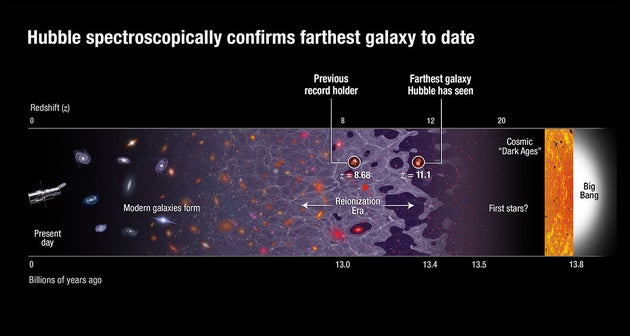
The Hubble Space Telescope has been “pushed to its limits,” and the result is a total shocker.
On Friday, NASA announced that the telescope had seen farther back in time than ever before, successfully observing the most distant (and oldest) galaxy in the universe to date.
The galaxy, dubbed GN-z11, is located a record 13.4 billion light years from Earth — that’s just 400 million years after the Big Bang — in the direction of the constellation Ursa Major. (In case you need an astronomy refresher, distance and age are linked here. The farther away an object is from Earth, the more time it takes for its light to reach us.)
Film and Writing Festival for Comedy. Showcasing best of comedy short films at the FEEDBACK Film Festival. Plus, showcasing best of comedy novels, short stories, poems, screenplays (TV, short, feature) at the festival performed by professional actors.










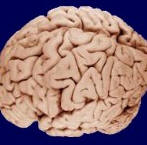 The Brain
 James' World 2