September 2, 2020
Mohenjo
Business, Crime, Human Interest, Science, Technical
amazon, business, Business News, current-events, Future, Hotels, human-rights, medicine, mental-health, research, Science, Science News, technology, Technology News, travel, vacation

Click the link below the picture
.
On Aug. 18, 2010, a police lieutenant in Gary, Ind., received an e-mail, the subject line of which would be right at home in the first few scenes of a David Fincher movie:
“Could there be a serial killer active in the Gary area?”
It isn’t clear what the lieutenant did with that e-mail; it would be understandable if he waved it off as a prank. But the author could not have been more serious. He’d attached source material—spreadsheets created from FBI files showing that over several years the city of Gary had recorded 14 unsolved murders of women between the ages of 20 and 50. The cause of each death was the same: strangulation. Compared with statistics from around the country, he wrote, the number of similar killings in Gary was far greater than the norm. So many people dying the same way in the same city—wouldn’t that suggest that at least a few of them, maybe more, might be connected? And that the killer might still be at large?
.
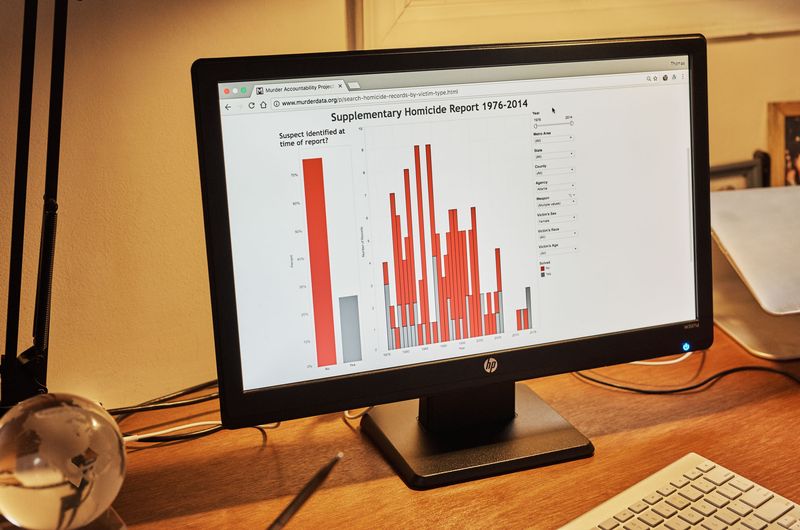
Data on the Murder Accountability Project’s website. Photos by Cait Oppermann for Bloomberg Businessweek.
.
.
Click the link below for the article:
.
__________________________________________
September 2, 2020
Mohenjo
Human Interest, Made Me Laugh, Medical, missed News, Political, Science, Technical
amazon, business, Business News, current-events, Future, Hotels, human-rights, medicine, mental-health, research, Science, Science News, technology, Technology News, travel, vacation

.
News You might have missed!
Use your browser or smartphone back arrow (<-) to return to this table for your next selection.
.
__________________________________________
September 1, 2020
Mohenjo
Business, Food For Thought, Human Interest, Science, Technical
amazon, business, Business News, current-events, Future, Hotels, human-rights, medicine, mental-health, research, Science, Science News, technology, Technology News, travel, vacation
Click the link below the picture
.
If you’ve ever failed at reaching any goal in life, the problem could all be in your mind. That’s how important your mindset is. Your mind is your most powerful force. The stories you tell yourself and the things you believe about yourself can either prevent change from happening or allow new ideas to blossom.
A mindset is a set of assumptions, methods, or notations that is so established that it creates a powerful incentive within you to continue to adopt or accept prior behaviours, choices, or tools.
It’s so powerful that it affects every decision making processes. It predetermines your responses and interpretations of situations.
You can’t outsmart your mindset!
.
 Photo bny Melinda Podor / Getty Images.
.
.
Click the link below for article:
https://getpocket.com/explore/item/if-you-are-serious-about-achieving-success-in-any-area-of-your-life-master-your-mindset
.
__________________________________________
September 1, 2020
Mohenjo
Crime, Food For Thought, Human Interest, Medical, missed News, Political, Science, Technical
amazon, business, Business News, current-events, Future, Hotels, human-rights, medicine, mental-health, research, Science, Science News, technology, Technology News, travel, vacation
.
News You might have missed!
Use your browser or smartphone back arrow (<-) to return to this table for your next selection.
.
__________________________________________
August 31, 2020
Mohenjo
Business, Human Interest, Medical, Science, Technical
amazon, business, Business News, current-events, Future, Hotels, human-rights, medicine, mental-health, research, Science, Science News, technology, Technology News, travel, vacation

Click the link below the picture
.
Aimee Hartley, like most people, thought she knew how to breathe – she had, after all, been doing it all her life. She had also given it plenty of thought, having trained as a yoga teacher. But then she took a lesson with a breathing coach, who told her where she was going wrong. He pointed out she wasn’t taking the air into her lower lungs but was, she says, an “upper chest breather. He then taught me this conscious breathing and I felt my lower belly open, and I felt myself breathing a lot better after just one session. So I then became fascinated by how we breathe.”
Watching her students in her yoga class, and observing people in everyday life, she started noticing that almost nobody breathes that well, by which she means in a way that makes your belly expand and your upper chest and back lift slightly, in a fluid motion. The exception, she says, is “babies, until they’re about three”. Then we forget how to breathe.
.
 We take in 23,000 breaths a day, but few of us know how to breathe well. Photo by Oscar Wong / Getty Images.
.
.
Click the link below for article:
.
__________________________________________
August 31, 2020
Mohenjo
Arts, Crime, Food For Thought, Human Interest, Medical, missed News, Political, Science, Technical
amazon, business, Business News, current-events, Future, Hotels, human-rights, medicine, mental-health, research, Science, Science News, technology, Technology News, travel, vacation

.
News You might have missed!
Use your browser or smartphone back arrow (<-) to return to this table for your next selection.
.
__________________________________________
August 30, 2020
Mohenjo
Business, Human Interest, Science, Technical
amazon, business, Business News, current-events, Future, Hotels, human-rights, medicine, mental-health, research, Science, Science News, technology, Technology News, travel, vacation

Click the link below the picture
.
California company NDB says its nano-diamond batteries will absolutely upend the energy equation, acting like tiny nuclear generators. They will blow any energy density comparison out of the water, lasting anywhere from a decade to 28,000 years without ever needing a charge. They will offer a higher power density than lithium-ion. They will be nigh-on indestructible and totally safe in an electric car crash. And in some applications, like electric cars, they stand to be considerably cheaper than current lithium-ion packs despite their huge advantages.
The heart of each cell is a small piece of recycled nuclear waste. NDB uses graphite nuclear reactor parts that have absorbed radiation from nuclear fuel rods and have themselves become radioactive. Untreated, it’s high-grade nuclear waste: dangerous, difficult, and expensive to store, with a very long half-life.
.

NDB makes remarkable claims about its self-charging nano-diamond battery, here seen mocked up as a circuit board component
.
.
Click the link below for article:
.
__________________________________________
August 30, 2020
Mohenjo
Crime, Human Interest, Medical, missed News, Political, Science, Technical
amazon, business, Business News, current-events, Future, Hotels, human-rights, medicine, mental-health, research, Science, Science News, technology, Technology News, travel, vacation
.
News You might have missed!
Use your browser or smartphone back arrow (<-) to return to this table for your next selection.
.
__________________________________________
August 27, 2020
Mohenjo
Business, Human Interest, Science, Technical
amazon, business, Business News, current-events, Future, Hotels, human-rights, medicine, mental-health, research, Science, Science News, technology, Technology News, travel, vacation

Click the link below the picture
.
There Jaron Lanier and I were, side by side on my computer screen, in a virtual space that looked a little like a conference room and a little like a movie theater. We could’ve been jurors, maybe. I was able to approximate rubbing his head. “As you have discovered,” Lanier said, noticing, “you can reach and interact with people a little bit. So there is this shared-space quality.” He was in Berkeley, California, in the hills above the city, in a house that looks out over the bay. I was in Los Angeles. Five minutes ago we were in our own separate video-chat windows, the ones many of us now see as we’re going to sleep, our dumb faces staring back at us. Then he had hit some buttons. Now we were together.
Lanier calls this technology Together mode; he helped design it this spring for Microsoft, where he has a post as an in-house seer of sorts. Initially, he’d conceived of Together mode as a way to help Stephen Colbert—in whose house band Lanier sometimes performs when he’s in New York—figure out how to host his show in front of a remote audience. (Lanier is sometimes credited as the father of virtual reality; he is also sometimes credited as the owner of the world’s largest flute, in addition to the many other exotic instruments he collects and expertly plays.) But mostly he was trying to solve, as he’s been doing since the early ’80s, a problem relating to technology and how humans might use it. In this case: How could we better, more naturally communicate with one another in the middle of a pandemic?
He explained a bit more about how Together mode worked, how it soothed what the medium had previously tended to aggravate. Being side by side, instead of separated—and being able to make eye contact, as we now could—worked on the psychology; it made you a little more playful, a little more relaxed. It might even help build, in the words of the NBA—which swiftly adopted Together mode as a way to project remote fans onto courtside monitors in otherwise empty Florida arenas—“a sense of community.”
.
 Jaron Lanier photographed at home with a decades-old lens from an augmented-reality headset.
.
.
Click the link below for article:
.
__________________________________________
August 26, 2020
Mohenjo
Business, Food For Thought, Human Interest, Science
amazon, business, Business News, current-events, Future, Hotels, human-rights, medicine, mental-health, research, Science, Science News, technology, Technology News, travel, vacation

Click the link below the picture
.
Recently, scientists discovered bacteria that had been buried beneath the ocean floor for more than a hundred million years and was still alive. What would change if we could live for even just a million years? Two thoughts immediately come to mind. First, tenure in academia would have to be capped. Universities would have to limit faculty appointments to a century at most in order to refresh their talent pool and mitigate old-fashioned education and research dogmas. Second, a birthday cake cannot hold a million candles. Instead, the number of birthday candles could reflect the logarithm of our age. For a thousand-year-old, that would mean three candles.
Past generations used to say that even though we cannot postpone natural death, we can control how we live. They also believed that there is “nothing new under the sun.” Both statements are inaccurate from our current perspective. With advances in bioscience and technology, one can imagine a post-COVID-19 future when most diseases are cured and our life span will increase substantially.
.
 Credit: Getty Images
.
.
Click the link below for article:
.
__________________________________________
Older Entries
Newer Entries
 James' World 2