Jeffrey Epstein’s apparent suicide inside the federally run Metropolitan Correctional Center in Manhattan shocked the country. How could officials allow one of the most high-profile prisoners in the U.S. to end his life, especially since he had just tried and failed less than a month ago? Conspiracy theories are everywhere: It must be murder at the hands of one of Epstein’s powerful and as-yet-unnamed co-conspirators in his allegedly widespread child sex trafficking operation.
But the truth is almost certainly more mundane. “When there’s more than one possible explanation for an occurrence, the simplest one is usually correct,” said Erik Heipt, an attorney who has litigated a number of jail death lawsuits. “People commit suicide in jails, in prisons, all the time.”
Jail suicides ― which are almost always preventable ― have been the No. 1 cause of jail deaths each year since at least the turn of the century.
In January, as the Senate debated whether to permit the Trump administration to lift sanctions on Russia’s largest aluminum producer, two men with millions of dollars riding on the outcome met for dinner at a restaurant in Zurich.
On one side of the table sat the head of sales for Rusal, the Russian aluminum producer that would benefit most immediately from a favorable Senate vote. The U.S. government had imposed sanctions on Rusal as part of a campaign to punish Russia for “malign activity around the globe,” including attempts to sway the 2016 presidential election.
On the other side sat Craig Bouchard, an American entrepreneur who had gained favor with officials in Kentucky, the home state of Senate Majority Leader Mitch McConnell. Bouchard was trying to build the first new aluminum-rolling mill in the United States in nearly four decades, in a corner of northeastern Kentucky ravaged by job losses and the opioid epidemic — a project that stood to benefit enormously if Rusal were able to get involved.
.
Senate Majority Leader Mitch McConnell (R-Ky.) heads toward his Capitol Hill office in January. (Salwan Georges/The Washington Post)
Eleanor Pelta has secured Polish passports for herself and her two sons. Stephanie Schwab is planning an escape route via Spain. Elie Jacobs has begun to keep enough cash on hand to buy last-minute plane tickets to Israel for his family. Alex and Aussa Lorens are applying for work visas in Australia, while Josh Lewin is aiming for New Zealand.
And Kami Lewis Levin already has her bags packed and tickets purchased. She leaves next week, with her husband, three children and a dog, for a new home in Costa Rica.
Americans are not flocking to the exits, but some of them are thinking about it, and some are talking about it, and at least a few are acting on the idea. Google searches for terms like “how to move out of America” spiked this past weekend to levels not seen since November 2016, right after the presidential election, and last seen a decade ago during the Great Recession. And in dozens of interviews after the massacres in El Paso, Texas, and Dayton, Ohio, people who were born here spoke of their crystallizing desire to leave.
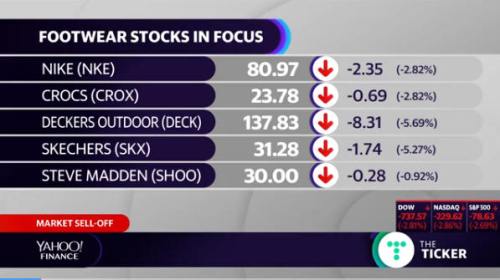
The Footwear Distributors and Retailers of America (FDRA) is breathing a small sigh of relief as President Trump delays the implementation of additional tariffs on $300 billion of Chinese Goods.
“The announcement today that the Trump Administration will be delaying the additional 10% tariff on some footwear until December 1 is an acknowledgment that tariffs are indeed paid by Americans,” the group’s president and CEO Matt Priest said in a statement. “It is no coincidence that the Administration is allowing certain shoes to come in without raising taxes in hopes that prices do not rise at retail during the holidays. Our industry’s loud unified voice left a clear impression that shoe tariffs are already extremely high, upwards of 67.5%, and any further tariffs would directly raise costs on consumers and cost footwear jobs.”
Priest, also says while the FDRA is pleased with the decision to delay new tariffs on certain shoes, they are not satisfied.
“We will continue to fight for any exclusions on new tariffs and we will fight to delay new tariffs on shoes until the entire tariff threat is lifted off the backs of American families,” he said.
President Trump’s explosive feud with two Democratic congresswomen moved to the international stage on Thursday as Israel denied the lawmakers entry into the country just hours after Trump publicly urged Israel to block them.
U.S. officials said the extraordinary intervention by the president was part of his strategy to sow divisions within the Democratic Party by shining a spotlight on its most liberal members.
Trump blasted the two lawmakers, Reps. Ilhan Omar (D-Minn.) and Rashida Tlaib (D-Mich.), tweeting that “they hate Israel & all Jewish people, & there is nothing that can be said or done to change their minds.”
But the actions by Trump and Israeli Prime Minister Benjamin Netanyahu, his close ally, appeared to unite Democratic Party leaders.
.
Reps. Ilhan Omar (D-Minn.) and Rashida Tlaib (D-Mich.) at President Trump’s State of the Union speech in January. (J. Scott Applewhite/AP)
It’s 7:20 p.m. when he rolls into Spicy Bite, one of the newest restaurants here in rural northwest New Mexico.
Locals in Milan, a town of 3,321, have barely heard of it.
The building is small, single-story, built of corrugated metal sheets. There are seats for 20. The only advertising is spray-painted on concrete roadblocks in English and Punjabi. Next door is a diner and gas station; the county jail is across the road.
Palwinder Singh orders creamy black lentils, chicken curry and roti, finishing it off with chai and cardamom rice pudding. After 13 hours on and off the road in his semi truck, he leans back in a booth as a Bollywood music video plays on TV.
“This is like home,” says Pal, the name he uses on the road (said like “Paul”).
.
Palwinder Singh hauls produce through New Mexico on Interstate 40 on the way to Indiana.
The marshmallow test is one of the most famous pieces of social-science research: Put a marshmallow in front of a child, tell her that she can have a second one if she can go 15 minutes without eating the first one, and then leave the room. Whether she’s patient enough to double her payout is supposedly indicative of a willpower that will pay dividends down the line, at school and eventually at work. Passing the test is, to many, a promising signal of future success.
But a new study has cast the whole concept into doubt. The researchers—NYU’s Tyler Watts and UC Irvine’s Greg Duncan and Hoanan Quan—restaged the classic marshmallow test, which was developed by the Stanford psychologist Walter Mischel in the 1960s. Mischel and his colleagues administered the test and then tracked how children went on to fare later in life. They described the results in a 1990 study, which suggested that delayed gratification had huge benefits, including on such measures as standardized test scores.
U.S. Immigration and Customs Enforcement on Tuesday blamed “political rhetoric” and “misinformation” about President Donald Trump’s detention policies after shots were fired into two buildings housing ICE offices in San Antonio overnight.
No one was injured, but “had the bullets gone two inches in another direction, we could be here today talking about the murder of a federal official,” Christopher Combs, the FBI’s special agent in charge in San Antonio, said.
Investigators said at a news conference that multiple shots were fired into the offices of ICE’s Immigration Enforcement and Removal division about 3 a.m.
.
Investigators say multiple shots were fired at two floors targeting ICE officials in San Antonio on Aug. 13, 2019.Google
National support for legalizing marijuana has been growing rapidly.
Now legalized in 23 states and the District of Columbia for medical use and four states — Colorado, Washington, Oregon, and Alaska — and DC for recreational use, cannabis is big business. Independent analysts have valued the legal industry at $3 billion and rising to $10 billion when including ancillary trades and services.
Cassandra Farrington, the co-founder and chief executive of Marijuana Business Media, puts the industry’s workforce at 60,000.
Others sates are expected to follow suit over the next couple of years, putting an end to cannabis prohibition. With the industry concentrating on making cannabis more of a mainstream and sellable product, a growing crop of businesses are expected to profit from the cultivation and distribution of marijuana.
Film and Writing Festival for Comedy. Showcasing best of comedy short films at the FEEDBACK Film Festival. Plus, showcasing best of comedy novels, short stories, poems, screenplays (TV, short, feature) at the festival performed by professional actors.

 .
.


 .
.

 .
.






 (Image: File)
 James' World 2