
Click the link below the picture
.
Tick season is in full swing, and unfortunately for us humans, these parasites are having a banner year. Across the U.S., weekly rates of emergency room visits for tick bites have been trending higher than in all years since 2019, according to the Centers for Disease Control and Prevention’s tick bite tracker. In the Midwest, the rates have consistently been at their highest since 2017, when the tracker was launched. That all adds up to a lot of bites. “Every year, an estimated 31 million people in the United States are bitten by a tick,” says CDC epidemiologist Alison Hinckley. These bites can cause serious, sometimes deadly diseases, including Lyme disease, Rocky Mountain spotted fever, and, increasingly, alpha-gal syndrome (also known as red meat allergy) and Powassan disease.
I recently had a tick bite and wasn’t sure what to do. I live in an area with a high incidence of Lyme disease, so that was on my mind. Should I go to a doctor to have the tick extracted or remove the offending creature myself? Monitor the bite and watch for a bull’s-eye rash and other symptoms of Lyme disease, or take a preventative dose of antibiotics? Some cursory Googling of tick bites suggested that I should remove the tick, flush it down the toilet, and watch for any symptoms in the following days and weeks. But a closer look at the literature hinted that I might be better off taking a different approach, given my circumstances. So I went down the rabbit hole. Here’s what I learned about what to do—and not to do—when you discover a tick on your body.
Remove the tick as soon as you discover it. Don’t wait to go to a health care provider, the CDC advises. The longer a tick is attached, the more time it has to transmit bacteria and other pathogens that cause disease. Infected ticks generally need to be attached for more than 24 hours to transmit Lyme disease, but they may transmit Powassan virus in as little as 15 minutes. The sooner you get the tick off your body, the better.
When I was a kid, the received wisdom was to get rid of ticks by burning them off with a match or cigarette (I remember my mom trying to do this with a tick she found on my head while washing my hair in the kitchen sink) or smothering them with petroleum jelly, among other tactics. Don’t do this. Interventions such as these could cause the tick to release infected fluids into the host, according to the Johns Hopkins Medicine Lyme Disease Research Center. All you need is a pair of fine-tipped tweezers. (Incidentally—and this is friendly advice, not official guidance—if you’re a little squeamish, take a moment to calm yourself first. The tick is gross. You might see its legs move when you lift it away from the skin. You can scream/shudder/sob later. Right now, your job is to stay cool and remove the tick safely. You’ve got this.)
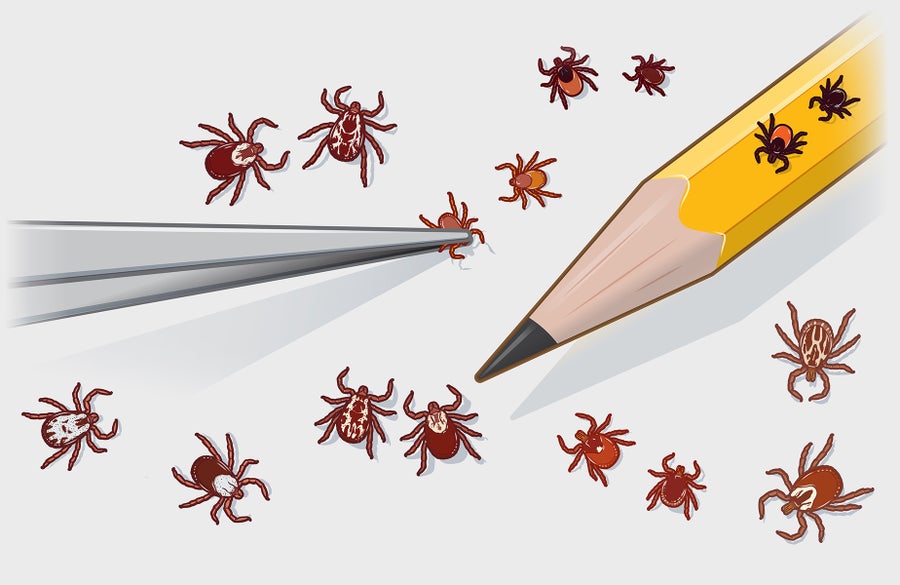
The tick is only attached to the host by its mouthparts, so grasp the tick with the tweezers at or near its head, as close to the skin as possible, and using steady, even pressure, pull it straight up and out, away from the skin. Do not squeeze its body, which could force infected fluids into the skin. Don’t crush the tick, which could complicate species identification. Put it in a clear, sealable plastic bag for identification and possible lab analysis. Clean the bite area and your hands with soap and warm water or alcohol. If you see that the tick’s head or mouthparts broke off and are stuck in the skin, don’t worry—the tick can’t transmit disease without its body. Your body will eventually expel the stuck parts as the wound heals.
Assess your risk for disease. Different species of ticks live in different parts of the country, and each species carries its own set of pathogens. “Knowing the type of tick, the likely tick infection rate in the region, and how long the tick was attached, and feeding are all critical details for making tick bite management decisions,” according to the University of Rhode Island’s TickEncounter resource center.
In New England, where I live, four tick species are well established: the brown dog tick, American dog tick, black-legged tick (also known as the deer tick), and the lone star tick; Gulf Coast ticks occur in smaller numbers in the southern part of the region. My tick was a few millimeters long and teardrop-shaped, with a brick-red abdomen surrounding the black shield on its back—hallmarks of an adult female deer tick.
Not all ticks are as easy to identify as mine. Not only do tick species differ in size, colors, and markings, but individuals of the same species can look different depending on what their life stage and sex are and how engorged they are from a blood meal (ugh). Some tick species are so similar that identification is best left to a pro. If you need help identifying your tick, your doctor may be able to assist you. And TickEncounter has a free tick identification program that allows users to submit a photograph of their tick and get an expert ID, usually within 24 hours. You can also contact your state or local health department for information about tick infection rates and disease case rates in your area.
The most common tick-borne disease in the U.S. is Lyme disease. The CDC estimates that 476,000 people a year are treated for Lyme. In North America, it is transmitted exclusively by the black-legged tick and the Western black-legged tick. In parts of the eastern U.S., the domain of the black-legged tick, more than half of these parasites carry the Borrelia bacteria that cause Lyme disease. Western black-legged ticks, which are found mostly on the Pacific coast, also carry Lyme bacteria, as well as several other pathogens, but typically less than 5 percent of them are infected, according to TickEncounter.
If you were bitten by a black-legged tick in an area where Lyme is common and your tick was attached for 36 hours or more, your doctor may recommend a single prophylactic dose of the antibiotic doxycycline to kill bacteria before they multiply. This preventative dose is most effective when given within 72 hours of tick removal, while the bacteria are incubating. Doxycycline is the same drug that is used to treat Lyme disease, but treatment requires a much longer course of the antibiotic than prevention—10 to 28 days or more.
Because my tick bite met all the criteria for high risk for transmitting Lyme, and because I was within the 72-hour window, my doctor and I decided to go ahead with the preventative dose of doxycycline.
.
 Diogo Guerra
.
.
Click the link below for the complete article:
.
__________________________________________


Jun 26, 2026 @ 10:09:17
Interesting read.
LikeLike
Jun 26, 2026 @ 16:24:09
Thank you sir!
It’s important to remove the tick ASAP. 👌 MAKE SURE YOU REMOVE THE HEAD AND NOT JUST THE BODY!
LikeLiked by 1 person