December 6, 2022
Mohenjo
Business, Food For Thought, Human Interest, Political, Science, Technical
amazon, business, Business News, current-events, Future, Hotels, human-rights, medicine, mental-health, research, Science, Science News, technology, Technology News, travel, vacation

Click the link below the picture
.
An intense jet of energy in space appears to be traveling seven times faster than the speed of light—a feat that is considered physically impossible in our universe. Though this rapid pace is only an optical illusion, according to a new study, it still represents a blast of energy shooting towards us at very nearly the speed of light.
The Hubble Space Telescope (HST) has captured incredible views of the jet—which was ignited by an unprecedented collision between two hyperdense objects, called neutron stars—that led to one of the most important breakthroughs in astronomical history at the time it was discovered in 2017.
While the jet did not actually break the cosmic speed limit, it raced right up to the edge of this impassable threshold, reaching at least 99.97 percent of the speed of light, which translates to about 670 million miles per hour. Scientists led by Kunal Mooley, an astrophysicist at the California Institute of Technology, used Hubble and other telescopes to clock the jet’s “superluminal motion,” meaning the trippy illusion of faster-than-light speed, in a study published on Wednesday in Nature.
.
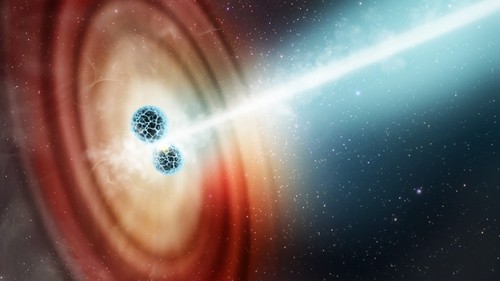 Image: Concept art of the neutron star merger and jet. Image: Elizabeth Wheatley (STScI)
.
.
Click the link below for the article:
.
__________________________________________
December 6, 2022
Mohenjo
Business, Food For Thought, Human Interest, Political, Science, Technical
amazon, business, Business News, current-events, Future, Hotels, human-rights, medicine, mental-health, research, Science, Science News, technology, Technology News, travel, vacation

Click the link below the picture
.
On a frigid March morning in 2022, a friend and I were visiting the Mojave National Preserve in California’s San Bernardino County. Joshua trees, normally crooked and whimsical with spiky green leaves, were instead blanched white and charred, limbs swinging in 25-mile-per-hour winds. Creosote bushes, blackbrush, and yucca — all of which were once shelter or food for jackrabbits, night lizards and ground squirrels — had also been scorched. In August 2020, the Dome Fire burned more than a million Joshua trees alone, leaving skeletal remains of what had been a dense woodland.
We were there to help replant Joshua trees. To the south rose Cima Dome, the gentle granite hill for which the fire was named. Gradually shifting landscapes are characteristic of the Mojave Desert, where hard-packed dirt gives way to low-lying springs and sandy washes. These shifts are difficult to see unless you look closely, but since living here, the desert has taught me the art of perception: how to slow down and actually see what’s in front of you.
I grew up in a suburb just outside San Diego County, 90 minutes from the Mojave Desert. But my parents preferred taking our family to the Pacific Coast and the redwoods up north — California’s canonical landscapes. If we entered the Mojave, it was usually just to pass through. As a result, I thought deserts were flat and barren. Official definitions confirmed my ideas. The United States Geological Survey defines American deserts as “areas of the country which receive less than 10 inches (250 millimeters) of annual precipitation.”
.
 John Francis Peters for The New York Times
.
.
Click the link below for the article:
.
__________________________________________
December 6, 2022
Mohenjo
Crime, Food For Thought, Human Interest, Medical, missed News, Political, Science, Technical
amazon, business, Business News, current-events, Future, Hotels, human-rights, medicine, mental-health, research, Science, Science News, technology, Technology News, travel, vacation

.
News You might have missed!
Use your browser or smartphone back arrow (<-) to return to this table for your next selection.
.
__________________________________________
December 5, 2022
Mohenjo
Business, Food For Thought, Human Interest, Political, Science, Technical
amazon, business, Business News, current-events, Future, Hotels, human-rights, medicine, mental-health, research, Science, Science News, technology, Technology News, travel, vacation

Click the link below the picture
.
A new kind of black hole analog could tell us a thing or two about an elusive radiation theoretically emitted by the real thing.
Using a chain of atoms in single file to simulate the event horizon of a black hole, a team of physicists has observed the equivalent of what we call Hawking radiation – particles born from disturbances in the quantum fluctuations caused by the black hole’s break in spacetime.
This, they say, could help resolve the tension between two currently irreconcilable frameworks for describing the Universe: the general theory of relativity, which describes the behavior of gravity as a continuous field known as spacetime; and quantum mechanics, which describes the behavior of discrete particles using the mathematics of probability.
For a unified theory of quantum gravity that can be applied universally, these two immiscible theories need to find a way to somehow get along.
This is where black holes come into the picture – possibly the weirdest, most extreme objects in the Universe. These massive objects are so incredibly dense that, within a certain distance of the black hole’s center of mass, no velocity in the Universe is sufficient for escape. Not even light speed.
That distance, varying depending on the mass of the black hole, is called the event horizon. Once an object crosses its boundary we can only imagine what happens, since nothing returns with vital information on its fate. But in 1974, Stephen Hawking proposed that interruptions to quantum fluctuations caused by the event horizon result in a type of radiation very similar to thermal radiation.
.
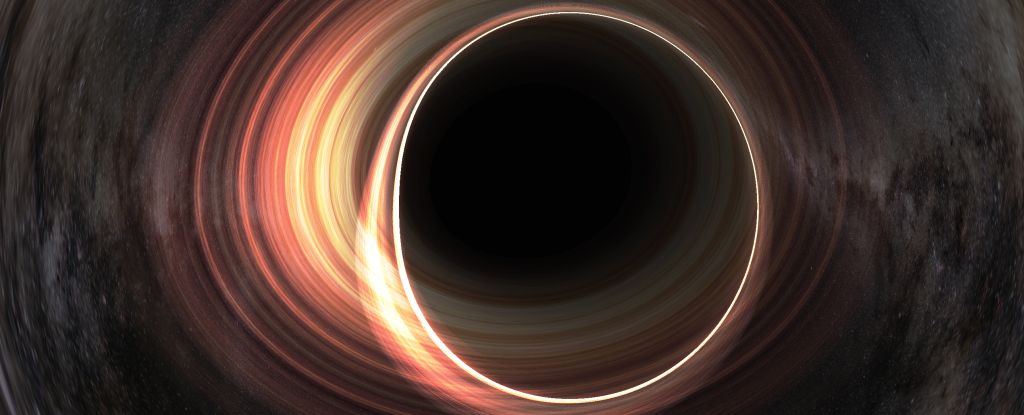 Simulation of a warped and spinning black hole. (Yukterez/Wikimedia Commons, CC BY-SA 4.0)
.
.
Click the link below for the article:
.
__________________________________________
December 5, 2022
Mohenjo
Business, Food For Thought, Human Interest, Political, Science, Technical
amazon, business, Business News, current-events, Future, Hotels, human-rights, medicine, mental-health, research, Science, Science News, technology, Technology News, travel, vacation

Click the link below the picture
.
This story, like many immigrants’ success stories, starts with a young man arriving in New York with a set of cooking knives and $50, which he would parlay into a nationwide empire of award-winning restaurants. Not content with personal success, he then founded the World Central Kitchen, a nonprofit that, since 2010, has served more than 200 million hot meals to people affected by natural disasters and other crises around the globe.
José Andrés, 53, is a burly man with a booming Spanish-accented voice, an ebullient personality, and a fondness for wearing utility vests, baggy cargo pants, and baseball caps. “Let’s go” is a favorite expression, seeming to reflect his boundless energy and drive. Yet, Andrés is a modest man who prefers talking about anything other than himself and dislikes being called a celebrity chef. “I am not a celebrity. I’m a cook,” he says simply. “I’ve been given the opportunity to feed the few, but that same know-how allows me to sometimes feed the many.”
Yes, he uses the simple word cook to describe himself, but he is also an internationally recognized culinary innovator, author of several cookbooks, a television personality (Iron Chef America), and the only chef in the world who has both a two-star Michelin restaurant (the reserved-months-in-advance Minibar by José Andrés) and four Bib Gourmands. Chef Éric Ripert, of New York’s acclaimed restaurant Le Bernardin, describes Andrés as “probably the most creative chef in the world today.”
.
 Flying into action: When catastrophe strikes, chef José Andrés and the World Central Kitchen move in to help. “We put our boots on the ground next to people in need.”(World Central Kitchen/WCK.org)
.
.
Click the link below for the article:
.
__________________________________________
December 5, 2022
Mohenjo
Crime, Food For Thought, Human Interest, Medical, missed News, Political, Science, Technical
amazon, business, Business News, current-events, Future, Hotels, human-rights, medicine, mental-health, research, Science, Science News, technology, Technology News, travel, vacation
.
News You might have missed!
Use your browser or smartphone back arrow (<-) to return to this table for your next selection.
.
__________________________________________
December 4, 2022
Mohenjo
Business, Food For Thought, Human Interest, Political, Science, Technical
amazon, business, Business News, current-events, Future, Hotels, human-rights, medicine, mental-health, research, Science, Science News, technology, Technology News, travel, vacation

Click the link below the picture
.
What was the hardest part about teaching during the pandemic?
Seeing students who already struggled not be able to get what they needed during that time. Before the pandemic, I could work with students one on one, have students work in pairs, or have students in more advanced classes come tutor students in entry-level classes. During the pandemic, all of this was taken away because we didn’t share the room with our students, and – at least in the initial stages of the pandemic – many of us didn’t have the skills to use comparable teaching strategies online.
How do you explain the recent drop in math scores?
Once schools shifted to remote learning during the pandemic, teachers didn’t have as many ways to keep students engaged. It was difficult to do hands-on activities and project-based learning, which are better for students who struggle in math.
Math teachers had to tell students what to do in mathematics, but this kind of direct instruction works for only about 20% of students. A lot of teaching math is visual. You need so much more space than just one screen. Teachers might use their words, hand gestures, whiteboards, graphs, diagrams, objects, physical movements, student work examples, and more. These actions and items build a comprehensive experience and build more of the skills that math students need since the students can look at several of these teaching aids at once. Online, the teacher is limited only to what can be seen on their screen or on one student’s screen at a time, which is vastly different.
.
 Math proficiency scores fell during the pandemic. fstop123 via Getty Images
.
.
Click the link below for the article:
.
__________________________________________
December 4, 2022
Mohenjo
Business, Food For Thought, Human Interest, Political, Science, Technical
amazon, business, Business News, current-events, Future, Hotels, human-rights, medicine, mental-health, research, Science, Science News, technology, Technology News, travel, vacation

Click the link below the picture
.
If there’s one thing most of us can be certain of it’s this: that our observed, physical reality actually exists. Although there are always some philosophical assumptions behind this conclusion, it’s an assumption that isn’t contradicted by anything we’ve ever measured under any conditions: not with human senses, not with laboratory equipment, not with telescopes or observatories, not under the influence of nature alone nor with specific human intervention. Reality exists, and our scientific description of that reality came about precisely because those measurements, conducted anywhere or at any time, is consistent with that very description of reality itself.
But there had previously been a set of assumptions that came along with our notion of reality that are no longer universally agreed upon, and chief among them is that reality itself exists in a fashion that’s independent of the observer or measurer. In fact, two of the greatest advances of 20th-century science — relativity and quantum mechanics — specifically challenge our notion of objective reality, and rather point to a reality that cannot be disentangled from the act of observing it. Here’s the bizarre science of what we know, today, about the notion of objective reality.
Objective reality
Put simply, the big idea is that reality exists, and it exists in a fashion that’s independent of anyone or anything that monitors or observes reality.
.
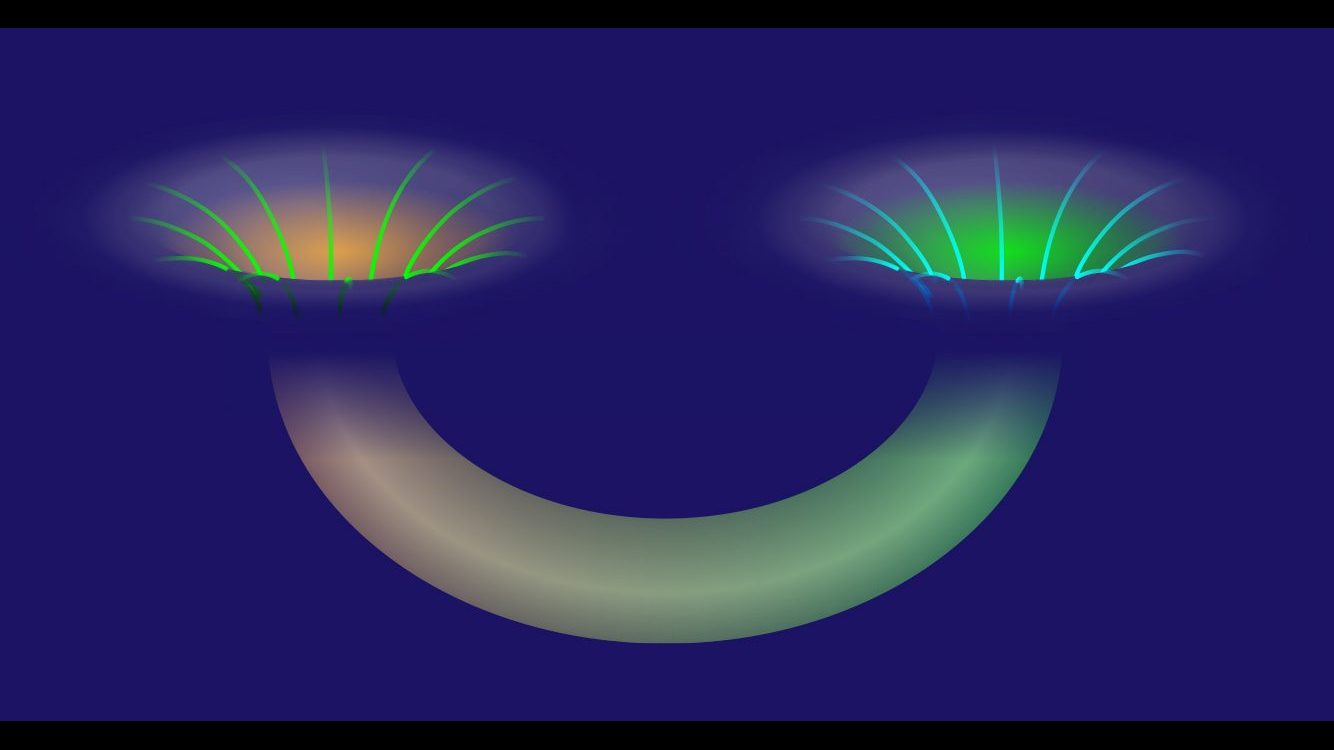
The idea that two quanta could be instantaneously entangled with one another, even across large distances, is often talked about as the spookiest part of quantum physics. If reality were fundamentally deterministic and were governed by hidden variables, this spookiness could be removed. Unfortunately, attempts to do away with this type of quantum weirdness have all failed, with conjectures like the AdS/CFT correspondence, which could involve an underlying objective reality, all requiring something exotic and unproven, such as the invocation of extra dimensions.
Credit: Alan Stonebraker/American Physical Society)
.
.
Click the link below for the article:
.
__________________________________________
December 3, 2022
Mohenjo
Business, Food For Thought, Human Interest, Political, Science, Technical
amazon, business, Business News, current-events, Future, Hotels, human-rights, medicine, mental-health, research, Science, Science News, technology, Technology News, travel, vacation

Click the link below the picture
.
On September 7, 1674, Antonie Van Leeuwenhoek, a fabric seller living just south of The Hague, Netherlands, burst forth from scientific obscurity with a letter to London’s Royal Society detailing an astonishing discovery. While he was examining algae from a nearby lake through his homemade microscope, a creature “with green and very glittering little scales,” which he estimated to be a thousand times smaller than a mite, had darted across his vision.
Two years later, on October 9, 1676, he followed up with another report so extraordinary that microbiologists today refer to it simply as “Letter 18”: Van Leeuwenhoek (lay-u-when-hoke) had looked everywhere and found what he called animalcules (Latin for “little animals”) in everything.
He found them in the bellies of other animals, his food, his own mouth, and other people’s mouths. When he noticed a set of remarkably rancid teeth, he asked the owner for a sample of his plaque, put it beneath his lens, and witnessed “an inconceivably great number of little animalcules” moving “so nimbly among one another, that the whole stuff seemed alive.” After a particularly uncomfortable evening, which he blamed on a fatty meal of hot smoked beef, he examined his own stool beneath his lens and saw animalcules that were “somewhat longer than broad, and their belly, which was flat-like, furnished with sundry little paws”—a clear description of what we now know as the parasite giardia.
With his observations of these fast, fat, and sundry-pawed creatures, Van Leeuwenhoek became the first person to ever see a microorganism—a discovery of almost incalculable significance to human health and our understanding of life on this planet.
.
 Illustration: Ariel Davis
.
.
Click the link below for article:
.
__________________________________________
December 3, 2022
Mohenjo
Business, Food For Thought, Human Interest, Political, Science, Technical
amazon, business, Business News, current-events, Future, Hotels, human-rights, medicine, mental-health, research, Science, Science News, technology, Technology News, travel, vacation

Click the link below the picture
.
Increasingly, college is an option only for those who can afford it or are willing to take on massive student debt. But not all schools see it that way.
To make higher education more accessible, a growing number of institutions are eliminating student loans altogether.
More than 20 schools now have “no-loan” policies, which means they will meet 100% of the undergraduate’s need for financial aid — without education debt.
.
 .
.
.
Click the link below for the article:
.
__________________________________________
Older Entries
Newer Entries

