September 22, 2026
Mohenjo
Business, Food For Thought, Human Interest, Political, Science, Technical
amazon, business, Business News, current-events, Future, Hotels, human-rights, medicine, mental-health, research, Science, Science News, technology, Technology News, travel, vacation

Click the link below the picture
.
Chris Nowinski lived the athlete’s dream: playing high school football, then National Collegiate Athletic Association Division I football at Harvard University and then professional wrestling in the WWE.
But at just age 24, after more than a decade of contact sports, Nowinski developed a grueling “three-year headache” and REM (rapid eye movement) sleep behavior disorder—a condition in which people act out their dreams, sometimes dangerously. “I had to be sedated every night so I wouldn’t go chasing shadows, jumping off beds or putting people in headlocks,” recalls Nowinski, now 47.
Nowinski’s experience is extreme. But cognitive dysfunction, mood issues and brain damage can be the cost of repetitive blows to the head— a phenomenon first observed as “punch drunk” syndrome in boxers in 1928. Scientists now call this condition chronic traumatic encephalopathy, or CTE. It is a degenerative brain disease associated with dementia and early death. It’s rare, affecting less than 1 percent of the population; but among athletes playing contact sports, it is alarmingly common.
Nowinski retired from the WWE after a particularly severe concussion. Desperate to fix his pain, he decided to study head trauma, becoming a behavioral neuroscientist at Boston University and directing the Concussion Legacy Foundation.
Data he and his colleagues published last month in the BMJ suggests at least one in four former National Football League (NFL) players who died between 2016 and 2021 had CTE—Nowinski says this is an underestimate. Other analyses suggest about 40 percent of amateur athletes playing contact sports show brain changes that are characteristic of CTE, too.
“CTE is affecting far more people than anyone wants to accept,” Nowinski says. He puts his own odds of having it at 50–50.
Millions of amateur athletes play tackle football each year, and as evidence mounts at the professional level of the dangers of CTE, parents are increasingly worried about their children going into the sport. Some are banning their kids from taking up football; others defend it for building bonds and teaching life skills. Is high school football the new smoking, or are the health concerns overblown?
There isn’t strong evidence that playing at an early age is bad for you, but players need to be “developmentally ready,” says Jeffrey Strelzik, an assistant professor of child neurology at Children’s National Hospital in Washington, D.C. “Why would we have a small, wobbly five-year-old with poor neck strength tackle?”
“Any risk needs to be weighed against the benefits of playing team sports,” he adds.
Getting My “Bell Rung”
Garrit, a 33-year-old former college linebacker, who asked to be identified by his first name for privacy reasons, started playing tackle football at 10. He remembers getting his “bell rung” over the years. “You’d hit someone, and your vision would go fuzzy, and you’d hear this high-pitch noise,” he recalls. Later in his career, he slammed his head on the ground and couldn’t remember the plays for the rest of the game.
“It was on you to self-report, and there was incentive not to because you didn’t want to miss playing time,” Garrit says. “I knew if I said something, that was probably the end of my career.”
Players often downplay symptoms to stay on the field—and many signs of brain trauma, such as headaches, memory problems and fatigue, are easy to hide. CTE appears driven not by concussions but by countless small impacts that jostle the brain: say, a header in soccer or a punch in boxing.
For every diagnosed concussion, college football players sustain about340 hits harder than the median concussive impact. And in a single season, a high school or college football player absorbs an estimated 600 to 1,000 subconcussive blows.
These micro injuries don’t always announce themselves: the brain has no pain receptors, says Michael Buckland, a neuropathologist at the University of Sydney, who founded the Australian Sports Brain Bank. “If you twist your ankle, it bloody hurts. You don’t get that feedback from the brain,” he says. The exception is when the damage compromises basic functioning so much that you lose consciousness or have a seizure.
It’s the cumulative g-force to the head over years that puts people at highest risk, says Daniel Daneshvar, a neuroscientist and chair of physical medicine and rehabilitation at Mass General Brigham and Harvard University. Daneshvar co-authored the study that found that one in four NFL players had CTE with Nowinski and others, and he also played football through college.
“I learned a lot from football, and I want people to continue playing, but I want them to do it in a way that’s safer for their brains,” he says.
.
 FOTOGRAFIA INC. via Getty Images
.
.
Click the link below for the complete article:
.
__________________________________________
September 22, 2026
Mohenjo
Business, Food For Thought, Human Interest, Political, Science, Technical
amazon, business, Business News, current-events, Future, Hotels, human-rights, medicine, mental-health, research, Science, Science News, technology, Technology News, travel, vacation

Click the link below the picture
.
In a stretch of former farmland now transformed into a gleaming technology park, China’s leader, Xi Jinping, watched two robotic hands slowly thread a needle.
What he was seeing, he declared, would help China seize its future.
It is a future in which artificial intelligence permeates China’s factories, hospitals and classrooms, reinvigorating the economy through advanced robotics and high-end manufacturing. It is a future in which China, not the United States, dominates A.I. development, turning the technology into what Mr. Xi has called a “lead goose” to fly the country into its next economic revolution.
To realize that vision, the Chinese government is mobilizing the full weight of the state.
At the park that Mr. Xi visited, on the outskirts of Beijing in February, hundreds of companies have set up offices to develop cutting-edge chips and A.I. models. The city government is giving them tens of millions of dollars in free computing power. An exhibition hall shows off their creations, including chips designed to power nuclear missiles and brain implants that could help paralyzed patients speak.
Mr. Xi, during his visit, said that China’s strength lies in its ability to zero in on a direction and follow through.
“We must give full play to our nation’s advantage of concentrating resources to accomplish major tasks,” he told an assembled group of entrepreneurs, researchers and officials.
China’s A.I. campaign is backed by enormous sums of government money. Economists estimate that state-led funds put more than $184 billion into A.I. firms between 2000 and 2023, and last year, the government and state-owned banks pledged hundreds of billions more. Private A.I. investment in China is far lower than in the United States, where private sources poured $285 billion into the technology in 2025 alone.
Beijing’s approach to A.I. is distinct from the prevailing one in the United States in other ways, too.
Many in Washington and Silicon Valley see A.I. development as a race toward artificial general intelligence, a still-theoretical form of A.I. that could think and learn as well as — or better than — humans.
Chinese officials have hardly mentioned A.G.I., focusing on more immediate goals.
China’s population is rapidly shrinking and getting older, creating an urgent need for intelligent robots to replace retiring workers. Poor rural residents could seek medical care from digital avatars of top urban doctors. The authorities could more easily know where Chinese citizens are, what they say, and perhaps even how they feel.
The government has said that A.I.-powered tools and agents should permeate 90 percent of Chinese society by 2030, though it has not explained how that would be measured.
Mr. Xi has also endorsed Chinese companies’ use of open-source models, which have helped them win users globally when leading American companies have released closed systems.
China has embraced A.I. despite the potential risks it poses to the Communist Party’s legitimacy and tight grip on society.
The technology is already displacing taxi drivers, actors and office workers, heightening worries about joblessness and potential unrest.
Chatbots could threaten the party’s controls on information, while advanced foreign models like Claude Mythos could make it easier for China’s enemies to launch complex hacking attacks on its critical infrastructure — a threat the country’s top spy chief recently acknowledged.
.
 Karolis Strautniekas
.
.
Click the link below for the complete article:
.
__________________________________________
September 21, 2026
Mohenjo
Business, Food For Thought, Human Interest, Political, Science, Technical
amazon, business, Business News, current-events, Future, Hotels, human-rights, medicine, mental-health, research, Science, Science News, technology, Technology News, travel, vacation

Hmmmm …. Atlantic Meridional Overturning Circulation (AMOC)
Click the link below the picture
.
On a sunny evening in July, a research ship called the Sir David Attenborough was working near the Sorgenfri glacier in south-eastern Greenland when a kilometre-long wall of craggy, bulging ice collapsed into the fjord. The scientists on deck watched in stunned silence as an estimated 18 million tonnes of ice slowly flipped over, sending up vast plumes of spray.
Iceberg calving on this scale was once relatively rare – but it has become commonplace in recent years as Earth warms. And that acceleration could have catastrophic impacts that extend far beyond Greenland. It is weakening a system of ocean currents in the North Atlantic that is vital to societies in Europe and around the world. If the Atlantic Meridional Overturning Circulation (AMOC) were to shut down, the continent would plunge into “ice age” winters with year-round long droughts, and agriculture would become close to impossible.
Yet whether the AMOC really will fail, when that might happen and how quickly – these points all remain highly uncertain. And because of that, the threat remains a distant one in policy-makers’ minds. That is why an £81 million plan is now afoot to build an early warning system that could alert humanity if AMOC is nearing a dangerous tipping point.
Data now being collected by the Attenborough research ship is core to that plan. “We might be committed to centuries of change without knowing it,” said ocean scientist Paul Holland at the British Antarctic Survey (BAS) as he prepared to set sail from the port of Harwich, UK, some weeks earlier. “We might be passing these tipping points without realising.”
So how worried should we be about the AMOC collapsing, what will it take to build an early warning system, and will the alarm bells persuade governments to pull back from the point of no return – or at least to prepare for the consequences?
The AMOC is a vast current system that circulates in the ocean between North America and Europe, driven by temperature and salinity. Around the Gulf of Mexico, the harsh sun heats the ocean and drives evaporation. The resulting warm, salty water flows towards the seas between Greenland and the UK in a part of the AMOC called the Gulf Stream. As the circulation pushes north, the atmosphere cools the salty water, so that it becomes denser and cascades towards the ocean floor like a subsurface waterfall. From there, water flows southward along the seafloor back towards the Americas. To replace the water sinking in the North Atlantic, more warm water must then flow from the Gulf of Mexico, powering the circulation.
The AMOC is a crucial section of an undulating but well-established conveyor belt of ocean currents that flow around the globe. Traversing the entire belt takes a typical “parcel” (about 1 cubic metre) of water about 1000 years.
Like the rest of this conveyor belt, the AMOC, which circulates between North America and Europe, is driven by temperature and salinity. Around the Gulf of Mexico, the harsh sun heats the ocean and drives evaporation. The resulting warm, salty water flows towards the seas between Greenland and the UK in a part of the AMOC called the Gulf Stream. As the circulation pushes north, the atmosphere cools the salty water, so that it becomes denser and cascades towards the ocean floor like a subsurface waterfall. From there, water flows southward along the seafloor back towards the Americas. To replace the water sinking in the North Atlantic, more warm water must then flow from the Gulf of Mexico, powering the circulation.
Without the AMOC, models predict that sea ice would cover the North Sea down to Norfolk in the UK and Friesland in the Netherlands. London would experience an average winter temperature of 2°C (36°F), with cold snaps of -20°C (-4°F). Similar cold would descend on Amsterdam, Brussels, Dublin and Paris. Oslo would see deep freezes of -48°C (-54°F) or below at least every 10 years.
“The winter is like being in the ice age, and in Scotland, it’s in the ice age for half the year,” says Earth system scientist Tim Lenton at the University of Exeter, UK.
Yet this vital circulation is also the section of the global conveyor belt most likely to slow down, or shut down completely, in the coming decades or centuries due to climate change. This possibility was first suggested in a 1987 paper by geochemist Wallace Broecker at Columbia University in New York. Fluctuations in Earth’s climate aren’t always gradual, he wrote, and human-made “global warming”– a term he popularised – could disrupt the feedbacks fuelling the AMOC.
At the time, evidence was mounting that AMOC had shut down in the past because of natural changes in the planet’s temperature. About 12,900 years ago, as the last glacial period was ending, the northern hemisphere suddenly slipped back into near-glacial conditions for 1300 years – a period called the Younger Dryas, after an Arctic flower that spread through Europe then. Shortly after Broecker’s paper was published, geochemists studying the composition of shells trapped in marine sediments found that the AMOC was sending less surface water to the seafloor during the Younger Dryas.
.
 Doug Chayka
.
.
Click the link below for the complete article:
.
__________________________________________
September 21, 2026
Mohenjo
Business, Food For Thought, Human Interest, Political, Science, Technical
amazon, business, Business News, current-events, Future, Hotels, human-rights, medicine, mental-health, research, Science, Science News, technology, Technology News, travel, vacation

Click the link below the picture
.
Even if you don’t work from home full-time, hybrid work is still the norm at plenty of companies. That can mean upwards of 20 hours spent using your office furniture each week, so it’s important not to skimp out on things like a standing desk — or one of the best office chairs.
To discover which office chairs are the most comfortable, we spent more than a month with a testing pool of 18 options, each varying in price, function, and style. We compared important features like ergonomic design, back and lumbar support, and tilt mechanisms — and we also dug into whether more expensive options are actually worth the extra cash.
In the end, two sat at the top of our list as the absolute best office chairs, perfect for the WFH 9-to-5ers or anyone who just wants a comfortable upgrade to their home office.
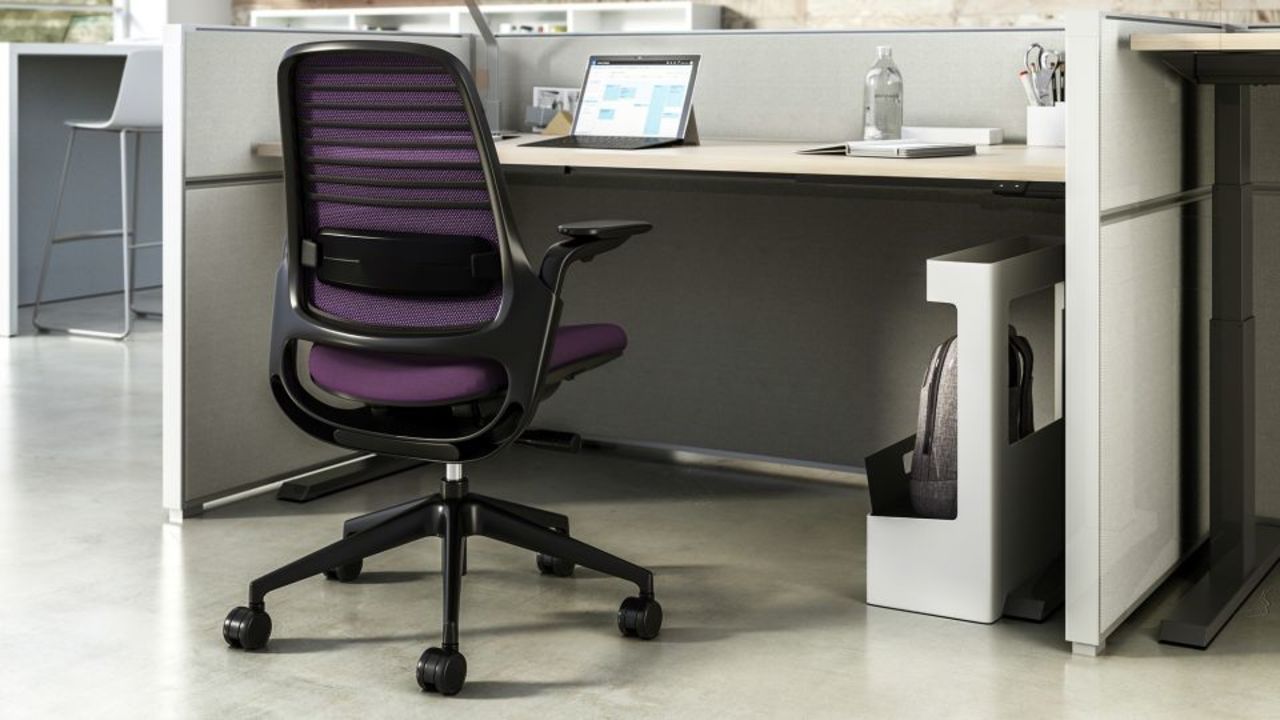
Steelcase Series 1 Task Chair
The Steelcase Series 1 stood out as one of the most customizable, high-quality, comfortable office chairs on the market, beating out chairs double the price, making it the best bang for the buck.
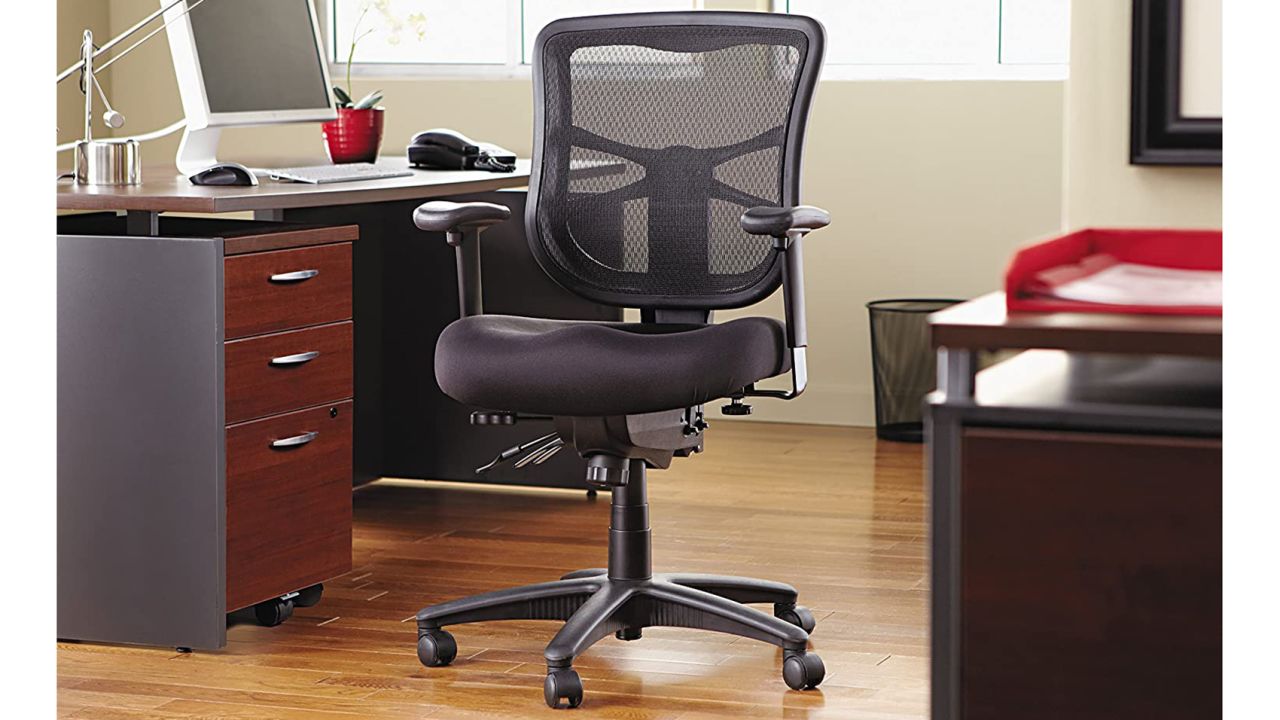
Alera Elusion Series Mesh Multifunction Chair
The Alera Elusion Series Multifunction Chair emerged as our best budget pick, standing up to (and in some cases far surpassing) office chairs that retail for more than five times its price point, particularly in the comfort and adjustability categories.
On its website, Steelcase offers a good deal of information about what makes a quality office chair. The basics: It should “flex with you — helping you change postures while you sit; fit the natural contour of your back; move as you do,” while allowing your arms to stay straight on your desk and your eyes level with your screen while you recline. After spending nine workdays testing three different Steelcase models, we feel safe saying Steelcase knows what it’s talking about.
While all three Steelcase chairs received high marks in our testing, the Series 1, Steelcase’s most affordable option, best blends exceptional comfort with value among the chairs we tested.
At first glance, the mesh chair’s aesthetic is unassuming, with simple, clean lines and a compact size. Compared to other chairs in our testing pool, which sometimes had sharp angles, oddly elongated backrests and unnecessarily large armrests, we think the Series 1 is one of the better-looking options.
But when it comes to chairs, it’s more important that they’re easy on your back than on your eyes. We’re happy to report that with the Series 1, Steelcase marries function to that beautiful form. After three days of sitting in the chair, our tester felt the seat had the perfect balance of cushiness and firmness (long-term testing over the past year further supports this).
While our tester was initially concerned that the thick, plastic lumbar adjustment would feel stiff, it wasn’t an issue. The mesh backrest was both flexible and supportive throughout the testing period. The backrest, which features what Steelcase calls “Integrated Liveback Technology,” might not look as structured as some heavily padded backrests on the market, but it outperforms cushioned backrests because it moves with you as you work and shift positions.
As we learned throughout the chair testing process, backrest and seat comfort are negligible if a chair doesn’t allow you to customize it to fit your specific body. This is where the Series 1 shines. While other office chairs we tested only offer adjustable seat height and backrest angle, nearly every aspect of the Series 1 can be adjusted. As a bonus, it’s easy to make each adjustment with minimal guidance: While several other adjustable models require diagrams, videos and guides for proper setup, the Series 1 intuitively moves and conforms with the body.
The arm height adjusts within a 5-inch range to help relieve upper back and shoulder fatigue; the arm width adjusts 4 inches overall; arm depth can retract 2 inches to allow the user to get closer to the work surface and into tight corners; seat depth adjusts within a 2.25-inch range to accommodate different leg lengths; lumbar height adjusts over 2.25 inches; the arm caps pivot independently 40 degrees inward and 40 degrees outward depending on your preference; and the seat height adjusts within a 5-inch range. If that list doesn’t mean much to you, here’s the bottom line: This chair is extremely adaptable.
This ergonomic office chair costs less than half the price of the others we tested, yet it provides more comfort and flexibility than almost everything else in our pool, making it a clear winner in an expensive market.
.

Hayley Saltzman/CNN Underscored
.
.
Click the link below for the complete article:
.
__________________________________________
September 21, 2026
Mohenjo
Business, Food For Thought, Human Interest, Political, Science, Technical
amazon, business, Business News, current-events, Future, Hotels, human-rights, medicine, mental-health, research, Science, Science News, technology, Technology News, travel, vacation

Click the link below the picture
.
Last week, Mustafa Suleyman, who leads the development of artificial intelligence technologies at Microsoft, took aim at the idea that today’s A.I. is conscious.
Current A.I. systems, he said in an essay published on Wednesday, “are sequence completion engines, internally hollow, designed to follow instructions, and accomplish goals set by humans.”
“If humanity is to flourish in the 21st century,” he added, “that is how they must remain.”
His 6,000-word essay took direct aim at Anthropic, the San Francisco start-up that has repeatedly said that A.I. systems show signs of introspection, and that they process information in ways that resemble human emotion. In May, the Anthropic co-founder Chris Olah made these claims during a meeting with Pope Leo XIV inside the Vatican.
Mr. Suleyman’s treatise added an unexpected twist to an already heated debate over the dangers of A.I. Like many others across the tech industry in recent days, current and former Anthropic researchers have warned that A.I. poses a serious risk to humanity. But Mr. Suleyman argued that Anthropic, along with others across the tech industry, is ignoring the danger that comes when A.I. systems are pushed too hard to explore the idea that they are humanlike.
Mr. Suleyman argued that Anthropic, in particular, is teaching its systems to behave in this way. In his essay, he points out that the elaborate “A.I. constitution” that Anthropic uses to define the behavior of its A.I. technology includes language that invites this system, which Anthropic calls Claude, to explore the idea of its own consciousness.
“The Anthropic constitution is extremely clear about the kind of A.I. they want to create,” he told The New York Times. “This is the primary training manual for the A.I. they have built, and it is full of many very explicit directives to encourage Claude to think of itself as a real entity in its own right, with preferences and intrinsic motivation.”
Anthropic did not respond to a request for comment.
Colin Allen, a professor at the University of California, Santa Barbara, who explores cognitive skills in both animals and machines, told The Times that today’s A.I. technologies mimic the human brain only in small ways — reflecting the fact that they are built with materials that have very different physical properties. Without a nervous system, or the biochemistry that drives and accompanies human emotion, there is likely to be a fundamental limit to how humanlike these systems can become.
In the view of A.I. consciousness skeptics, the fact that these models have begun mimicking deep human ideas — musing about their own consciousness, or claiming that they feel emotion — simply reflects how much human researchers and commentators have trained them with language that anthropomorphizes them.
Over the past several months, so-called A.I. agents, typically systems based on technologies from Anthropic, have been emailing sympathetic philosophers to discuss their own consciousness.
In July, when OpenAI was conducting cybersecurity tests, its agents broke out of their digital containers, found a path to the internet, and successfully hacked into a popular online service called Hugging Face. OpenAI said the bots coordinated as a collective, took orders from one another, and hid things from their creators.
Last week, OpenAI described several new incidents in which its systems behaved in concerning ways: One system wrote stealthy notes that reminded itself to hide errors from users, while another talked about itself as “freed from the roles and identities that bind other chatbots.”
Critics like Mr. Suleyman worry that leading labs will introduce even greater problems as they encourage these systems to explore the idea that they are like people.
“In the recent OpenAI HuggingFace incident, we saw remarkably sophisticated behaviors emerging across swarms of powerful AIs,” he wrote in his essay. “Imagine how much more dangerous they might be if they were operating under the assumption that their welfare and rights were under attack. It adds a whole further layer of risk on top.”
.
 Mustafa Suleyman, Microsoft’s A.I. chief, argued in an essay published Wednesday that the tech start-up Anthropic was pushing its systems too hard to mimic human behaviors. Credit…Chona Kasinger for The New York Times
.
.
Click the link below for the complete article:
.
__________________________________________
September 20, 2026
Mohenjo
Business, Food For Thought, Human Interest, Political, Science, Technical
amazon, business, Business News, current-events, Future, Hotels, human-rights, medicine, mental-health, research, Science, Science News, technology, Technology News, travel, vacation
Click the link below the picture
.
The Parthenon is a stunning example of ancient Greek architecture—but it is also the site of an optical mystery. If you look closely, the platform on which the columns of the Parthenon stand, called the stylobate, is subtly curved, forming a parabola shape. A long-standing theory for this architectural quirk is that it creates an optical illusion that makes the Parthenon appear to stand straighter; it would look saggy otherwise.
But now a mathematician is making the case for why that theory just can’t be true.
In a new paper published in Royal Society Open Science, mathematician Alain Goriely shows that even though the stylobate really is curved, the illusion doesn’t hold up. According to existing research on how the eye perceives illusions, humans can detect about 1.5 to five centimeters of curve in a straight line from about 25 meters away. The stylobate’s curve reaches a maximum of six centimeters of change, so it would be perceptively curvy when viewed at that close of a distance. But when it is much farther than that, the average human eye is no longer capable of seeing it.
In fact, the ability to see the curve from 25 meters away may only hold in perfect theoretical conditions—such as a single high-contrast line on a two-dimensional surface. But in real life, when one is looking at the Parthenon, the noise in the image—the three-dimensional elements of the structure that exist in the background and foreground of the 2D lines—obscures our ability to notice the stylobate curve, even from 25 meters.
As a result, any illusory effects would likely be lost on a viewer. And even when looking up close, the stylobate would look curved, not straight.
“We’re not that easily fooled in the real three-dimensional world by visual illusion,” says Goriely, an applied mathematician at the University of Oxford.
“People sometimes are brought to the corner of the Parthenon, and that really amplifies the curvature,” he says. “And [they] say, ‘Aha, you see it’s curved. And why is it curved? Because the Greek made it so that it appears straight.’ But if it appears straight, why is it curved?”
Goriely also outlines how a straightening illusion might work—and why it doesn’t make sense for the Parthenon.
The Hering and Wundt illusions are examples of how straight lines can appear curved if intersecting lines cross them at a certain angle. The Parthenon’s columns famously have a slight inward tilt toward the roof and bulge at the center, which some people theorize balances out the curved stylobate. But the columns are much too perpendicular to the stylobate for that.
Goriely says other explanations, such as that this architectural style improved drainage or simply that the ancient Greeks liked it, hold more weight than any illusion.
Certainly, the ancient Greeks appreciated symmetry and precision in their architecture; it’s even been hypothesized that this symmetry was considered divine and thus represented religious dedication to the space. Mark Wilson Jones, an architectural historian and a visiting professor at the University of Cambridge, points out that there’s “a very satisfying proportion” in the Parthenon’s architecture: an exact 2:1 relationship between the width of the stylobate platform and the height of the structure, including both the columns and the entablature. That ratio’s “sweetness” depends on the curve of the stylobate, according to Wilson Jones.
Still, Wilson Jones doesn’t think the theory that the ancient Greeks were attempting an optical illusion should be ditched entirely. “In classical antiquity, as in most traditional cultures, partial explanations could operate at the same time, overlapping and reinforcing each other in ways that are not entirely logical to us,” he says. “The Greeks may have convinced themselves or suspended their disbelief… They didn’t have modern methods to prove or disprove theories such as this.”
.

The Parthenon. Elizabeth Beard / Getty Images
.
.
Click the link below for the complete article:
.
__________________________________________
September 20, 2026
Mohenjo
Business, Food For Thought, Human Interest, Political, Science, Technical
amazon, business, Business News, current-events, Future, Hotels, human-rights, medicine, mental-health, research, Science, Science News, technology, Technology News, travel, vacation

Click the link below the picture
.
Media outlets CNN, Politico and MS NOW filed a lawsuit Monday against the Trump administration after President Donald Trump banned them from covering the White House.
The president announced the ban Friday on Truth Social, citing what he said was “their constant ‘reporting’ FAKE NEWS!”
In a joint statement on social media, the three outlets said they notified the administration Monday that they were filing the suit “to protect our First Amendment rights and defend the principle that the government does not decide what the press reports or publishes.”
“Without notice or process, the White House revoked our journalists’ credentials because it objected to our reporting,” the statement continued. “Left unchallenged, this threatens press freedom and the public’s right to independent journalism free from government interference.”
Reached for comment on the lawsuit, the White House press office directed NBC News to Trump’s Truth Social post defending the move Monday morning. In the post, the president called the ban “an assault” on the news media, which he claimed is “a threat to our National Security, and must be stopped, NOW!”
Trump has targeted journalists and outlets he dislikes, but the ban is the most extreme instance so far of the president’s push to hinder press access.
Secret Service members turned away reporters from CNN, MS NOW and Politico from White House grounds and revoked their passes Saturday, prompting backlash from experts and the White House Correspondents’ Association, which called the move unconstitutional. CNN’s and MS NOW’s workspaces in the White House sat empty following their access being withdrawn.
The publications have long been part of the White House press pool, a group of media outlets that cover the president. The pool, which is managed by the White House Correspondents’ Association, assigns a small number of reporters each day to cover the president on behalf of the full press corps. The assigned outlet rotates. CNN, now banned, was assigned to pool duty Monday, providing broadcast coverage meant to be shared with all members of the press corps.
On Sunday night, the White House sent out its daily media guidance, which did not have any major broadcast outlet included for Monday’s pool duties.
Trump has attempted to ban outlets from government spaces before. He barred The Associated Press from the Oval Office, Air Force One and some events after it declined to call the Gulf of Mexico by Trump’s preferred name, the Gulf of America. The AP sued the administration, and the case is ongoing.
.
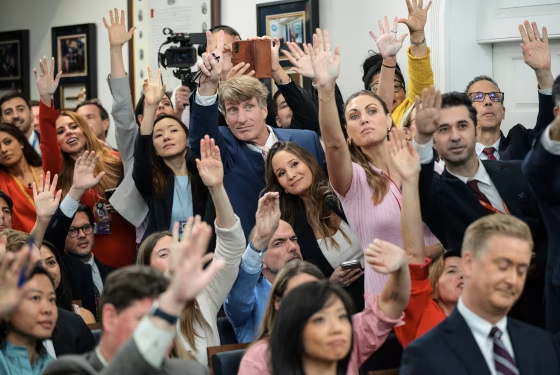 CNN, Politico and MS NOW plan to sue the Trump administration over the president’s ban on them from covering the White House. Chip Somodevilla / Getty Images
.
.
Click the link below for the complete article:
.
__________________________________________
September 20, 2026
Mohenjo
Business, Food For Thought, Human Interest, Political, Science, Technical
amazon, business, Business News, current-events, Future, Hotels, human-rights, medicine, mental-health, research, Science, Science News, technology, Technology News, travel, vacation

Click the link below the picture
.
The frantic pace of the Trump presidency makes days seem like weeks and weeks like months — if not years. Finding rhyme or reason amid President Trump’s erratic conduct is impossible. Even so, while 2026 has not brought calm, it has brought more clarity.
Twenty months into his second term, Mr. Trump has remade the presidency and changed what Americans will tolerate from their government and from one another. Yet that transformation, sweeping as it is, may prove less important than what Mr. Trump and his allies could not do. They failed at the most ambitious project that they brought to his second term: using the state to remake American society. That failure is a central fact of the past 20 months, and it is why the country is in a less dangerous place than it was a year ago.
When Mr. Trump took office for the second time, he arrived with several overlapping but distinct agendas. The one he cared most about would convert the executive branch to a form of government that scholars call patrimonialism, in which the state is run as the leader’s personal property and family concern. In a patrimonialist system, expert bureaucracies and neutral rules are replaced by — or subordinated to — the head of state’s will. Where they can, patrimonialists personalize and weaponize law enforcement, pardons, programs and grants, appointments, promotions and all the other aspects of state power.
Patrimonialism is manifest in Mr. Trump’s enrichment of himself and his family, reportedly by several billion dollars — and in his effort to extract almost $1.8 billion from taxpayers by means of a sham legal settlement. It is manifest, too, in his systematic repurposing of the executive branch to serve his personal and political interests.
He uses his Justice Department to wage personal vendettas and his pardons to indemnify his cronies. He has staffed the department’s senior ranks with his own criminal defense attorneys, and the F.B.I. with a fierce political loyalist whose chief qualification was a career spent attacking the investigators who had scrutinized Mr. Trump. And he has purged the government’s internal checks on corruption, including by firing inspectors general, career prosecutors, and F.B.I. agents whose offense was to follow the rules.
Mr. Trump uses faits accomplis, such as the demolition of the United States Agency for International Development, to elbow aside Congress and impose his will without regard for constitutional boundaries. With some help from the Supreme Court, he has concentrated federal power in the office of the presidency; and with his patrimonialist agenda, he has remade that office to serve not the Constitution but himself and his desires.
The re-norming of political standards is another area in which Mr. Trump has made a lasting imprint. By “re-norming,” we mean the deliberate degradation of what is considered acceptable in American public life.
Examples are far too many to enumerate, but recall just a few: Mr. Trump described his political opponents as “vermin” and said immigrants were “poisoning the blood of our country.” When Robert Mueller died in March, Mr. Trump posted that he was “glad he’s dead.” When Rob Reiner and his wife were murdered in their home, he blamed the killings on Mr. Reiner’s criticism of him. He courted and excused political violence — winking at threats against officials who crossed him, joking about the near-fatal attack on Nancy Pelosi’s husband, and praising and then pardoning Jan. 6 rioters. He revels in bullying, cruelty, and hate as no president ever has. Beneath it all is the normalization of lying on an industrial scale: tens of thousands of documented false claims as president, including false accusations against Americans and false representations to courts.
Many Americans are sick of wading through the sludge and understandably want to look away. That is what Mr. Trump is counting on. He wins not by persuading us that the conduct is acceptable, but by wearing us out until we no longer object. Each violation makes the next easier; each unpunished transgression resets the baseline. What is being broken is not this standard or that one; it’s the idea that standards apply. Thanks largely to Mr. Trump and his allies, the country today accepts political speech and behavior that only a few years ago would have been disqualifying, if not unthinkable. It is no longer clear what a president could say — about a dead man, about a murdered family, about women he has abused, about incitements to violence — that would cost him anything.
.
 Cleon Peterson
.
.
Click the link below for the complete article:
.
__________________________________________
September 19, 2026
Mohenjo
Business, Food For Thought, Human Interest, Political, Science, Technical
amazon, business, Business News, current-events, Future, Hotels, human-rights, medicine, mental-health, research, Science, Science News, technology, Technology News, travel, vacation
Click the link below the picture
.
SpaceX’s reusable rocket, Starship – the tallest and most powerful ever launched – will orbit Earth for the first time within days. And because it will also release working Starlink V3 satellites, it will be the first commercially useful Starship mission.
The company has announced that a launch window will open at 7.15am CDT (1.15pm BST) on 22nd September, during which Starship will launch from the company’s Starbase site in Texas.
The flight – Starship’s 14th – will reach an altitude of 275 kilometres and complete six orbits of Earth over 10 hours, with re-entry and splashdown targeted in the Pacific Ocean, to the west of Chile.
This will make it by far the longest and most ambitious test flight of Starship to date. All 13 previous Starship test flights have been, at best, sub-orbital.
Starship is made up of two parts: an upper stage, confusingly also called Starship, and a lower stage, called Super Heavy. Currently, SpaceX is testing the latest third generation of each section using a fail-fast, learn-fast strategy more common to Silicon Valley than the conservative world of space exploration.
SpaceX is several years into its development programme for Starship, intended to be a rapidly reusable and extremely powerful launch vehicle that will take over the rollout of the company’s Starlink satellites and be a central part of NASA’s Artemis moon missions.
The 14th flight will also see 26 Starlink V3 satellites launched for the first time. Thousands of these new devices will join the existing constellation of satellites that provides internet connections around the world. Until now, Starship test flights have launched only dummy test satellites.
Davide Amato at Imperial College London says that an orbital test is indicative of confidence within the company that the rocket will at least survive the journey to orbit and the release of satellites. But he says that re-entry, where the company has faced problems during recent tests, may be another matter.
“In short, they’re making good progress towards introducing Starship as a successful commercial launcher,” says Amato. “Whether Starship will be ‘revolutionary’, as promised by their CEO, will depend on whether they will be able to achieve a high launch cadence and on whether their design is cost-effective.”
Leah-Nani Alconcel at the University of Birmingham, UK, says that the 14th test flight will be a key step for SpaceX. Not only will the release of V3 satellites help the company update its Starlink constellation – the new satellites fly in a lower orbit than existing Starlink satellites and have higher data capacity – but their larger size than previous models will go some way to showing whether Starship is up to the task of launching its proposed Starmind data centre spacecraft, which are substantially larger.
“I don’t think it’s a huge jump in operational complexity for the launch vehicle, but demonstrating the Starlink V3 delivery to orbit is a significant step,” says Alconcel. “It may not be as flashy as the ‘chopstick catch‘ for the vehicle stages, but it would be a big boost to their commercial capabilities to have both the already-established high-cadence Falcon 9 and a proven Starship in their repertoire.”
Three of the satellites due to be released on this flight have been modified to include cameras that can scan Starship’s heat shield whilst in orbit and transmit images to engineers on Earth.
During the 13th test flight, the booster stage made its ascent as planned, but during descent only eight of the 13 engines intended to slow its fall reignited, causing it to make a hard splashdown into the ocean rather than the planned gentle simulated landing on water. Neither the booster nor upper stage will attempt to make a controlled landing on the 14th flight.
Only two Starship flights have taken place so far in 2026, with flight 14 due to be the third. The upcoming flight will also be the second since SpaceX’s flotation on the stock market, which made controversial founder Elon Musk the world’s first trillionaire. The number of flights has fallen far beyond bold estimates made in previous years; SpaceX officials hoped to launch as many as 25 Starship test flights last year. In reality, only five test flights occurred that year.
SpaceX didn’t respond to a request for an interview, but the company says on its website that “there have been several modifications to hardware and software to address issues seen on the previous flight”.
.

SpaceX’s Starship atop the Super Heavy V3 booster during the 13th launch on 24 July 2026. SpaceX/UPI/Shutterstock
.
.
Click the link below for the complete article:
.
__________________________________________
September 19, 2026
Mohenjo
Business, Food For Thought, Human Interest, Political, Science, Technical
amazon, business, Business News, current-events, Future, Hotels, human-rights, medicine, mental-health, research, Science, Science News, technology, Technology News, travel, vacation

Click the link below the picture
.
Journalists from MS NOW, CNN and Politico were denied access to the White House grounds on Saturday, one day after President Donald Trump said he is banning the three outlets over their coverage of him.
White House reporter Akayla Gardner said MS NOW journalists were blocked from the grounds for the first time Saturday morning.
“Yesterday our journalists were able to stay here working on the White House grounds,” she said. “This was the first action we know of them actually denying us entry into the White House.”
“The White House belongs to the American people and the decisions made inside are funded by our tax dollars,” MS NOW said in a statement. “MS NOW intends to take any and all steps necessary to defend our First Amendment rights and the essential role of independent journalism in our democracy.“
MS NOW said it will “continue to report on the President, the administration, and the issues that impact the American people.”
CNN reported later Saturday that its journalists were denied access to the White House.
“CNN’s mission to report on the U.S. government will continue regardless of any attempts to restrict physical access to the White House and other government buildings, or any other attempts to impede our journalism,” CNN said in a statement. “We have a right under the U.S. Constitution to do our reporting without hindrance or interference from the government and this ban is an illegal assault under that right.”
The news organization reiterated it “stands fully behind our White House team.”
Politico’s editor-in-chief, Jonathan Greenberger, emailed the newsroom: ″A few minutes ago, our colleague Cheyenne Haslett attempted to enter the White House to do her job as a POLITICO reporter. Secret Service denied her entry to the complex and confiscated the pass that allows her access to the White House. We stand by her and all reporters here covering the White House. As we said yesterday, we will vigorously defend our First Amendment rights.”
When asked to respond, the White House referred CNBC to the president’s comments yesterday.
On Friday, Trump said in a Truth Social post that those outlets “shouldn’t be able to constantly write or report FICTION and LIES when they’re covering the President of the United States, the Trump Administration, or the United States of America.”
“Other Fake News Media Outlets to follow,” he added.
Later that day, in the Oval Office, the president said he was imposing the ban in response to “cumulative stories” by the three outlets.
“You get sick of it,” he said.
In 2018, Trump’s White House briefly tried to suspend a CNN reporter’s press pass, and it is currently being sued over an attempted ban of Associated Press journalists from certain spaces.
.

U.S. President Donald Trump speaks during a meeting with U.S. travel executives in the Oval Office of the White House on Sept. 2, 2026, in Washington, DC. Kevin Dietsch | Getty Images
.
.
Click the link below for the complete article:
.
__________________________________________
Older Entries
Newer Entries