November 27, 2021
Mohenjo
Business, Food For Thought, Human Interest, Science, Technical
amazon, business, Business News, current-events, Future, Hotels, human-rights, medicine, mental-health, research, Science, Science News, technology, Technology News, travel, vacation

Click the link below the picture
.
A research team at the University of Wisconsin-Madison has identified a new way to convert ammonia to nitrogen gas through a process that could be a step toward ammonia replacing carbon-based fuels.
The discovery of this technique, which uses a metal catalyst and releases—rather than requires—energy, was reported Nov. 8 in Nature Chemistry and has received a provisional patent from the Wisconsin Alumni Research Foundation.
“The world currently runs on a carbon fuel economy,” explains Christian Wallen, an author of the paper and a former postdoctoral researcher in the lab of UW-Madison chemist John Berry. “It’s not a great economy because we burn hydrocarbons, which release carbon dioxide into the atmosphere. We don’t have a way to close the loop for a true carbon cycle, where we could transform carbon dioxide back into a useful fuel.”
.

Credit: CC0 Public Domain
.
.
Click the link below for the article:
.
__________________________________________
November 27, 2021
Mohenjo
Business, Food For Thought, Human Interest, Science, Technical
amazon, business, Business News, current-events, Future, Hotels, human-rights, medicine, mental-health, research, Science, Science News, technology, Technology News, travel, vacation

Click the link below the picture
.
In 2009, global health officials started tracking a new kind of flu. It appeared first in Mexico, in March, and quickly infected thousands. Influenza tends to kill the very young and the very old, but this flu was different. It seemed to be severely affecting otherwise healthy young adults.
American epidemiologists soon learned of cases in California, Texas, and Kansas. By the end of April, the virus had reached a high school in Queens, where a few kids, returning from a trip to Mexico, had infected a third of the student body. The Mexican government closed its schools and banned large gatherings, and the U.S. considered doing the same. “It was a very scary situation,” Richard Besser, who was then the acting director of the Centers for Disease Control and Prevention, told me. Early estimates suggested that the “swine flu,” as the new strain became known, killed as many as fourteen percent of those it infected—a case fatality rate more than two hundred times higher than typical seasonal flu. The virus soon spread to more than a hundred and fifty countries, and the Obama Administration considered delaying the start of school until after Thanksgiving when a second wave could be underway. Manufacturers worried about vaccine supplies. Like most flu vaccines, the one for the swine flu was grown in chicken eggs. “Even if you yell at them, they don’t grow faster,” Tom Frieden, who replaced Besser as the director of the C.D.C., said, at a press conference.
.
 Illustration by Nicholas Konrad / The New Yorker
.
.
Click the link below for the article:
.
__________________________________________
November 27, 2021
Mohenjo
Food For Thought, Human Interest, Medical, missed News, Political, Science, Technical
amazon, business, Business News, current-events, Future, Hotels, human-rights, medicine, mental-health, research, Science, Science News, technology, Technology News, travel, vacation

.
News You might have missed!
Use your browser or smartphone back arrow (<-) to return to this table for your next selection.
.
__________________________________________
November 26, 2021
Mohenjo
Business, Food For Thought, Human Interest, Science, Technical
amazon, business, Business News, current-events, Future, Hotels, human-rights, medicine, mental-health, research, Science, Science News, technology, Technology News, travel, vacation

Click the link below the picture
.
Dr. Gagneur is a neonatologist and a professor of pediatrics at the University of Sherbrooke. His research has led to programs that increase childhood vaccinations through motivational interviewing. Dr. Tamerius is a former psychiatrist and the founder of Smart Politics, an organization that teaches people to communicate more persuasively.
The difference between people who eagerly want the Covid-19 vaccine and people who are hesitant is not as great as it may seem. Most vaccine holdouts are not anti-vaxxers or conspiracy theorists.
Before you demand that your loved ones get a shot, know that not all conversations are created equal. Research shows that many common persuasive styles — commanding, advising, lecturing, and shaming — not only don’t work but also often backfire.
To help you learn the basics of a method that works, we’ve created a vaccination chatbot based on the principles of motivational interviewing, a research-backed approach for encouraging people to get vaccinated that’s used by health care professionals to harness people’s innate drive for change.
.
 Albert Tercero
.
.
Click the link below for the article:
.
__________________________________________
November 26, 2021
Mohenjo
Business, Food For Thought, Human Interest, Science, Technical
amazon, business, Business News, current-events, Future, Hotels, human-rights, medicine, mental-health, research, Science, Science News, technology, Technology News, travel, vacation

Click the link below the picture
.
This year, I turned 30, a development that came with a breathless sense of dread at time’s passing. It wakes me up in the early mornings: Nocturnal terror breaks through the surface of sleep like a whale breaching for air. My ambition and fear kick in together until I get up, pour myself some water, and look out the window at the squid-ink sky and the string of lights along my neighbors’ houses. I lie down again after finding firmer mental ground, dry land.
So when a guy that my friend was seeing evangelized about “time slips” — a genre of urban legend in which people claim that, while walking in particular places, they accidentally traveled back, and sometimes forward, in time — I was a ripe target. Curious and increasingly existential, I Googled these supposed time slips. I found a global community of believers building an archive of temporal dislocations from the present. These congregants gathered in corners of the internet to testify about how, in the right conditions, the dusting of alienation that settles over the world as we age can crystallize into collective fiction.
.
 Credit…Photo illustration by Ricardo Tomás
.
.
Click the link below for the article:
.
__________________________________________
November 26, 2021
Mohenjo
Crime, Food For Thought, Human Interest, Medical, missed News, Political, Science, Technical
amazon, business, Business News, current-events, Future, Hotels, human-rights, medicine, mental-health, research, Science, Science News, technology, Technology News, travel, vacation
.
News You might have missed!
Use your browser or smartphone back arrow (<-) to return to this table for your next selection.
.
__________________________________________
November 25, 2021
Mohenjo
Arts, Business, Food For Thought, Human Interest, Science, Technical
amazon, business, Business News, current-events, Future, Hotels, human-rights, medicine, mental-health, research, Science, Science News, technology, Technology News, travel, vacation

Click the link below the picture
.
Basran Burhan was born in Indonesia, on the centrally located island of Sulawesi. He studied archeology at Hasanuddin University, at first, he told me, mostly because he liked how it involved “a lot of outdoor activities.” After graduating, in 2010, he worked for a few different Indonesian research and cultural heritage institutions. He also became an independent archeologist, helping organize excavations for a researcher named Adam Brumm at Griffith University, in Australia. Burhan’s fieldwork struck Brumm as exceptional, and on the strength of it, Brumm tried to get Burhan into a Ph.D. program. But Burhan’s imperfect English delayed this project for a number of years. Instead, he kept working for Brumm and his team.
In 2017, Burhan was helping Brumm and other researchers plan their next season of fieldwork: searching for evidence of Paleolithic humans in Sulawesi. Earlier that year, Brumm had briefly explored a new area on the island that seemed promising. Burhan and a team of six Indonesian archeologists were sent there on a field exploration.
The survey lasted for several weeks. At some point, poring over a map of the island’s southern region, Burhan found his eyes drawn to an area he’d never noticed, let alone visited—a valley in a mountain region twenty miles or so northeast of the city of Makassar. There were no roads into the valley, and there was nothing on the map to suggest a way through the bush and mountain peaks. The map did indicate rice paddies and other signs of human habitation, but Burhan didn’t know if the area was currently populated. A good part of archeology is simply exploration. Burhan thought, Why not?
.
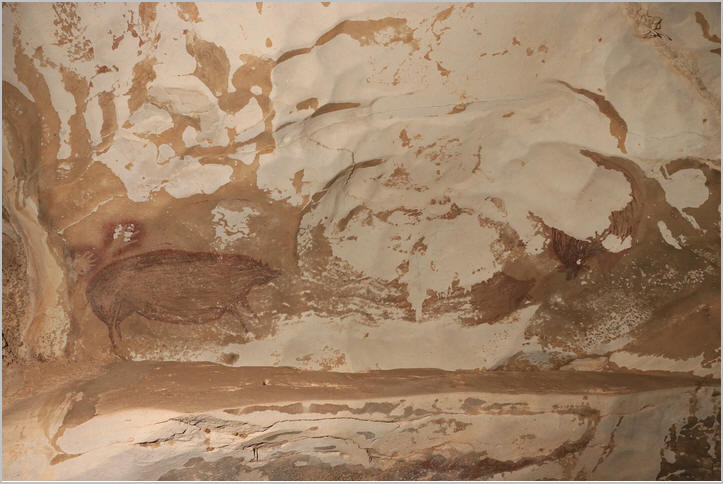 The discovery of the Sulawesi warty pig helps put to rest the idea that figurative cave art was unique to Europe.Photograph courtesy Basran Burhan
.
.
Click the link below for the article:
.
__________________________________________
November 25, 2021
Mohenjo
Business, Food For Thought, Human Interest
amazon, business, Business News, current-events, Future, Hotels, human-rights, medicine, mental-health, research, Science, Science News, technology, Technology News, travel, vacation
November 25, 2021
Mohenjo
Arts, Crime, Food For Thought, Human Interest, Medical, missed News, Political, Science, Technical
amazon, business, Business News, current-events, Future, Hotels, human-rights, medicine, mental-health, research, Science, Science News, technology, Technology News, travel, vacation
.
News You might have missed!
Use your browser or smartphone back arrow (<-) to return to this table for your next selection.
.
__________________________________________
November 24, 2021
Mohenjo
Business, Food For Thought, Human Interest, Science, Technical
amazon, business, Business News, current-events, Future, Hotels, human-rights, medicine, mental-health, research, Science, Science News, technology, Technology News, travel, vacation

Click the link below the picture
.
Advertisers have begun invading our sleep in an attempt to place their products in our dreams. This is neither metaphor nor fiction; it’s a fact. The night before Super Bowl LV, the beverage company Molson Coors ran what they called the ‘world’s largest dream study’. They explicitly aimed to place images of Coors beer, along with positive imagery (of refreshing alpine rivers, for instance), into dreamers’ minds. They hired a Harvard psychologist to design dream-incubation stimuli, incentivized participation with offers of free drinks, and, in a marketing coup, had the pop star Zayn Malik agree to sleep on Instagram Live while having an incubated Coors dream – though he did mention the whole project was ‘kinda messed up.
This isn’t an isolated case. Multiple marketing studies are openly testing new ways to alter and drive purchasing behavior through sleep and dream hacking. The American Marketing Association New York’s 2021 Future of Marketing study found that of more than 400 marketers from firms across the United States, 77 percent of them aim to deploy dream-tech for advertising in the next three years. The commercial, for-profit use of dream incubation – the presentation of stimuli before or during sleep to affect dream content – is rapidly becoming a reality.
Of course, advertisers are far from the first people to work on influencing and incubating dreams. Dream incubation stretches back more than 4,000 years to ancient Egypt, where sleepers lay in sacred beds in the Ṣaqqārah Serapeum to receive divine dreams; to ancient Greece, where ailing people went to dream in oracular temples; to today, where dream incubation plays a key role in healing, therapeutic and spiritual practices such as yoga nidra and Mohave shamanism. These traditions span time and place, providing tools for people to move from unpredictable dream content to sought-after dreams dealing with specific themes and issues. But technological advances and improved sleep science are expanding how such techniques can be reliably implemented.
.
 Dreamscape
.
.
Click the link below for the article:
.
__________________________________________
Older Entries
Newer Entries