Some content on this page was disabled on April 15, 2025 as a result of a DMCA takedown notice from Guardian Media Group. You can learn more about the DMCA here:
Are you anxious, introverted or just a ‘highly sensitive person’?
April 19, 2022
Business, Food For Thought, Human Interest, Science, Technical amazon, business, Business News, current-events, Future, Hotels, human-rights, medicine, mental-health, research, Science, Science News, technology, Technology News, travel, vacation Leave a comment
5 Languages That Could Change the Way You See the World
April 19, 2022
Business, Food For Thought, Human Interest, Political, Science, Technical amazon, business, Business News, current-events, Future, Hotels, human-rights, medicine, mental-health, research, Science, Science News, technology, Technology News, travel, vacation Leave a comment

Click the link below the picture
.
I went to my neighbor’s house for something to eat yesterday.
Think about this sentence. It’s pretty simple—English speakers would know precisely what it means. But what does it actually tell you—or, more to the point, what does it not tell you? It doesn’t specify facts like the subject’s gender or the neighbor’s, or what direction the speaker traveled, or the nature of the neighbors’ relationship, or whether the food was just a cookie or a complex curry. English doesn’t require speakers to give any of that information, but if the sentence were in French, say, the gender of every person involved would be specified.
The way that different languages convey information has fascinated linguists, anthropologists, and psychologists for decades. In the 1940s, a chemical engineer called Benjamin Lee Whorf published a wildly popular paper in the MIT Technology Review that claimed the way languages express different concepts—like gender, time, and space—influenced the way its speakers thought about the world. For example, if a language didn’t have terms to denote specific times, speakers wouldn’t understand the concept of time flowing.
The Matses people speak with what seems to be great care.
This argument was later discredited, as researchers concluded that it overstated language’s constraints on our minds. But researchers later found more nuanced ways that these habits of speech can affect our thinking. Linguist Roman Jakobson described this line of investigation thus: “Languages differ essentially in what they must convey and not in what they may convey.” In other words, the primary way language influences our minds is through what it forces us to think about—not what it prevents us from thinking about.
.
 “The Discussion,” by Harry Wilson Watrous.
.
.
Click the link below for the article:
.
__________________________________________
Slovakia Country
April 18, 2022
Business, Enthralling, Human Interest, Photographs amazon, business, Business News, current-events, Future, Hotels, human-rights, medicine, mental-health, research, Science, Science News, technology, Technology News, travel, vacation Leave a comment

Click the link below the picture
.
Slovakia, officially the Slovak Republic, is a landlocked country in Central Europe. It is bordered by Poland to the north, Ukraine to the east, Hungary to the south, Austria to the southwest, and the Czech Republic to the northwest. Slovakia’s mostly mountainous territory spans about 49,000 square kilometers (19,000 sq mi), with a population of over 5.4 million. The capital and largest city is Bratislava, while the second-largest city is Košice.
The Slavs arrived in the territory of present-day Slovakia in the fifth and sixth centuries. In the seventh century, they played a significant role in the creation of Samo’s Empire. In the ninth century, they established the Principality of Nitra, which was later conquered by the Principality of Moravia to establish Great Moravia. In the tenth century, after the dissolution of Great Moravia, the territory was integrated into the Principality of Hungary, which would then become the Kingdom of Hungary in 1000. In 1241 and 1242, after the Mongol invasion of Europe, much of the territory was destroyed. The area was recovered largely thanks to Béla IV of Hungary, who also settled Germans, leading them to become an important ethnic group in the area, especially in what are today parts of central and eastern Slovakia.
After World War, I and the dissolution of the Austro-Hungarian Empire, the state of Czechoslovakia was established. It was the only country in central and eastern Europe to remain a democracy during the interwar period. Nevertheless, local fascist parties gradually came to power in the Slovak lands, and the first Slovak Republic existed during World War II as a partially-recognized client state of Nazi Germany. At the end of World War II, Czechoslovakia was re-established as an independent country. After a coup in 1948, Czechoslovakia came under communist administration and became a part of the Soviet-led Eastern Bloc. Attempts to liberalize communism in Czechoslovakia culminated in the Prague Spring, which was crushed by the Warsaw Pact invasion of Czechoslovakia in August 1968. In 1989, the Velvet Revolution peacefully ended the Communist rule in Czechoslovakia. Slovakia became an independent state on 1 January 1993 after the peaceful dissolution of Czechoslovakia, sometimes known as the Velvet Divorce.
Slovakia is a developed country with an advanced high-income economy, ranking very high in the Human Development Index. It also performs favorably in measurements of civil liberties, press freedom, internet freedom, democratic governance, and peacefulness. The country maintains a combination of a market economy with a comprehensive social security system, providing citizens with a universal health care, free education, and one of the longest paid parental leaves in the OECD. Slovakia is a member of the European Union, the Eurozone, the Schengen Area, the United Nations, NATO, CERN, the OECD, the WTO, the Council of Europe, the Visegrád Group, and the OSCE. Slovakia is also home to eight UNESCO World Heritage Sites. It is the world’s largest per-capita car producer; it manufactured a total of 1.1 million cars in 2019, representing 43% of its total industrial output. Wikipedia
.
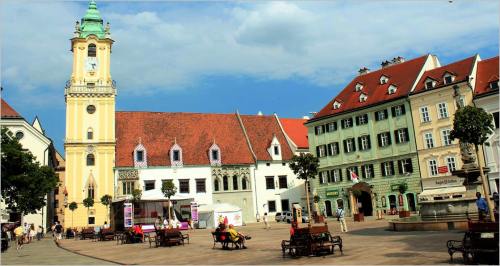 An image from Slovakia Country
.
.
Click the link below for images:
.
__________________________________________
Scientists Find Unexplained Waves Inside the Sun That Defy Known Physics
April 18, 2022
Business, Food For Thought, Human Interest, Science, Technical amazon, business, Business News, current-events, Future, Hotels, human-rights, medicine, mental-health, research, Science, Science News, technology, Technology News, travel, vacation Leave a comment

Click the link below the picture
.
Scientists have discovered a class of never-before-seen waves inside the Sun that move in the opposite direction of its rotation and travel so fast that they defy explanation. The “as-yet-undetermined nature of these waves promises novel physics and fresh insight into solar dynamics,” reports a new study.
The waves were serendipitously spotted by Chris Hanson, a research associate at New York University Abu Dhabi, and his colleagues, as the researchers scoured through decades of solar observations. The team was trying to answer a completely different question about the Sun when they noticed swirling patterns on its surface caused by these “high-frequency retrograde (HFR) waves,” according to a study published on Thursday in Nature Astronomy.
.
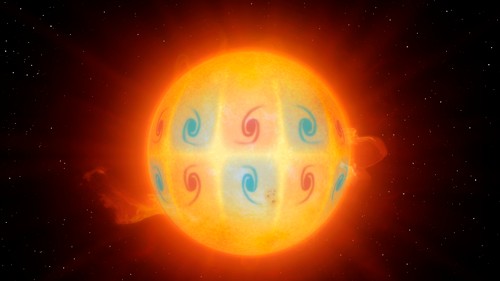 An artistic impression of the high-frequency retrograde (HFR) vorticity waves. Image: NYU Abu Dhabi
.
.
Click the link below for the article:
.
__________________________________________
1st image snapped by iconic Webb telescope pushes limits of the ‘laws of physics’
April 18, 2022
Business, Enthralling, Food For Thought, Human Interest, Political, Science, Technical amazon, business, Business News, current-events, Future, Hotels, human-rights, medicine, mental-health, research, Science, Science News, technology, Technology News, travel, vacation Leave a comment

Click the link below the picture
.
The James Webb Space Telescope (Webb) has released its first sharp image and it is a doozy — a spectacular view of a twinkling orange star that is focused with such sharpness that it pushes the limits of the laws of physics.
The image shows that the telescope’s 18 separate mirrors are now accurately aligned and acting as one, and the photo is even better than scientists hoped it would be, NASA officials said in a statement.
The Webb team released the photograph of the Milky Way star, designated 2MASS J17554042+6551277, and located roughly 2,000 light-years away, Wednesday (March 16). It was taken with a red filter to maximize the visual contrast between the star and the blackness of space, while dozens of other stars and distant galaxies can be seen in the background.
According to BBC News, the image shows that the optical systems of the new space telescope are now working better than the scientists and engineers had hoped.
“You not only see the star and the spikes from the diffraction of the star, but you see other stars in the field that are tightly focused, just like we expect, and all sorts of other interesting structure in the background,” Webb engineer Lee Feinberg told reporters at the NASA news conference Wednesday. “We’ve actually done very detailed analysis of the images we’re getting, and so far, what we’re finding is that the performance is as good [as], if not better than, our most optimistic prediction.”
The image is the result of the “fine phasing” stage of the mirror alignments, in which every optical parameter is checked to verify that the telescope can successfully gather light from distant objects, NASA said in the statement.
.
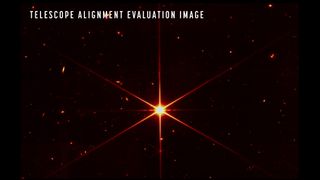 An image taken by the James Webb Space Telescope during its alignment process shows galaxies and stars in the background. (Image credit: NASA/STScI)
.
.
Click the link below for the article:
.
__________________________________________
“[Pioneer 10] was ahead of its time.”
April 17, 2022
Business, Food For Thought, Human Interest, Science, Technical amazon, business, Business News, current-events, Future, Hotels, human-rights, medicine, mental-health, research, Science, Science News, technology, Technology News, travel, vacation Leave a comment

Click the link below the picture
.
How to sum up the last fifty years of human space exploration? The International Space Station is an orbital beacon of collaborative research. The Hubble Telescope has transformed how we imagine the cosmos, and the James Webb Space Telescope will take our view to the next level.
It is easy to forget that a mere fifty years ago, a space probe launched and became the first unmanned mission to Jupiter — Pioneer 10. The probe not only provided a first close glimpse at the giant gas planet, but it also paved the way for two crafts that have altered our understanding of the Solar System, the Voyager missions.
The first of its kind, Pioneer 10 shows that, unlike landlines, the space-exploration technology of this bygone era can still go toe-to-toe with state-of-the-art inventions today. Pioneer 10 remains the spacecraft with the cleanest navigation ever used for exploring the outer Solar System, Slava Turyshev tells me. Turyshev is a research scientist at NASA’s Jet Propulsion Laboratory. From its initial build to the last signals it beamed back to Earth, Pioneer 10 is a lesson in how great a trail one craft can blaze through the cosmos.
.
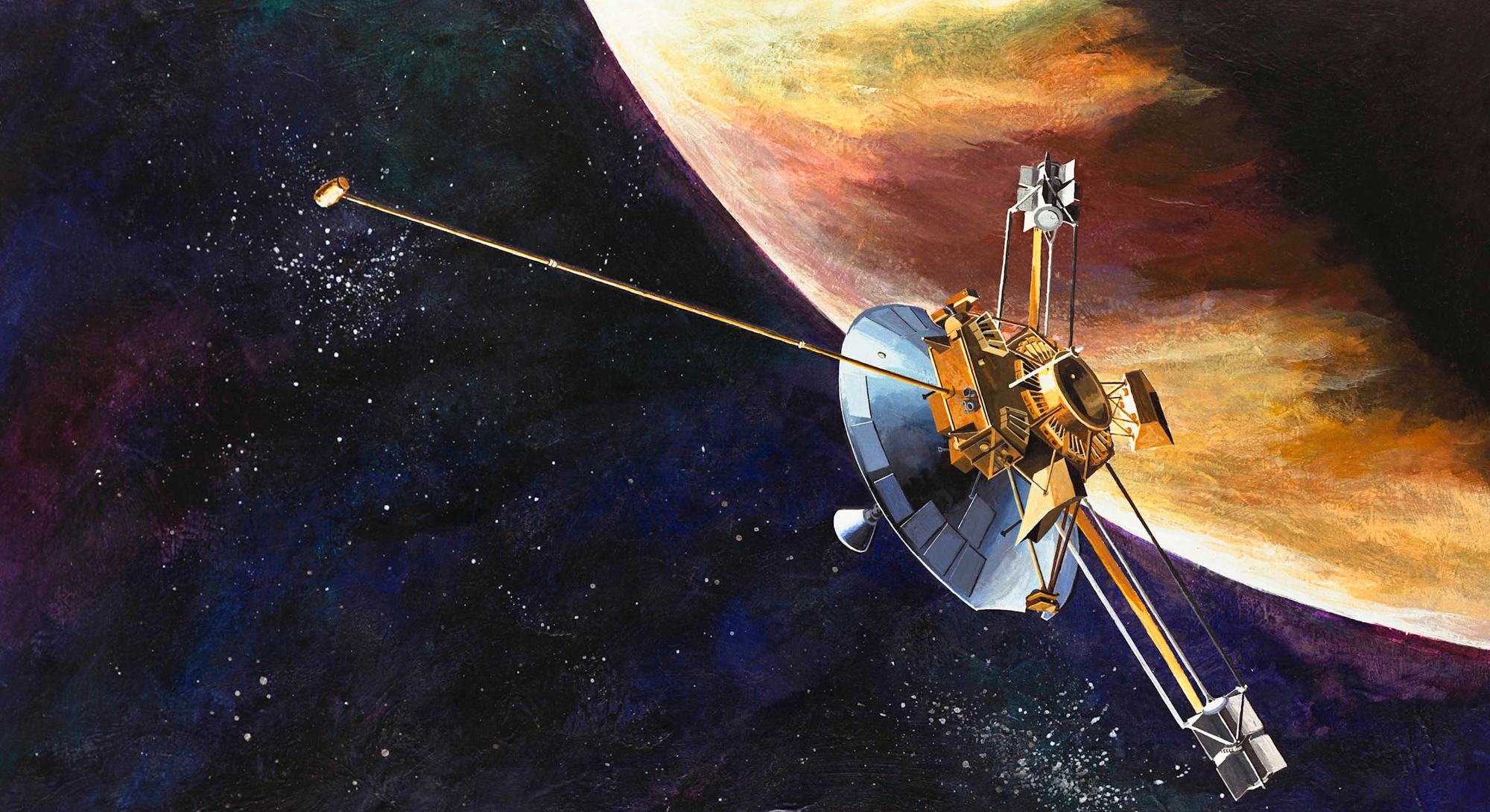
50 years ago, NASA sent a message to aliens — and sparked a Solar System mystery
.
.
Click the link below for the article:
.
__________________________________________
Four Years On, New Experiment Sees No Sign of ‘Cosmic Dawn’
April 17, 2022
Business, Food For Thought, Human Interest, Science, Technical amazon, business, Business News, current-events, Future, Hotels, human-rights, medicine, mental-health, research, Science, Science News, technology, Technology News, travel, vacation Leave a comment
Click the link below the picture
.
In 2018, astronomers operating an antenna called EDGES in the Australian outback reported that radio waves of a particular frequency were significantly dimmer than other waves coming from the night sky. The finding, published in Nature, was heralded as a groundbreaking signal from the birth of the first stars after the Big Bang — an event dubbed “cosmic dawn,” which should have stamped such a signature in the light.
What’s more, the dip in the radio spectrum observed by EDGES looked strikingly different than cosmologists had predicted. The data suggested that the early universe was surprisingly cold, triggering much theoretical activity and attempts to confirm the signal by other astronomers around the world.
Today, one such team, at the Raman Research Institute in Bangalore, India, has published the result of its search for the EDGES dip using a radio antenna called SARAS. The astronomers set the antenna afloat on a pair of remote lakes in India in early 2020, cutting their data collection short and returning to Bangalore hours before the first citywide COVID lockdown began. After spending the pandemic analyzing their data, the SARAS team now reports in Nature Astronomy that they found no trace of the dip observed by EDGES.
.
 Astronomers are looking for a telltale dip in the brightness of radio waves that would mark the universe’s transition from the cosmic dark ages to cosmic dawn.
.
.
Click the link below for the article:
.
__________________________________________
Punta Molentis Sardinia
April 16, 2022
Business, Enthralling, Human Interest, Photographs amazon, business, Business News, current-events, Future, Hotels, human-rights, medicine, mental-health, research, Science, Science News, technology, Technology News, travel, vacation Leave a comment
Click the link below the picture
.
Sardinia is the second-largest island in the Mediterranean Sea, after Sicily, and one of the 20 regions of Italy. It is located west of the Italian Peninsula, north of Tunisia, and immediately south of the French island of Corsica.
It is one of the five Italian regions with some degree of domestic autonomy being granted by a special statute. Its official name, Autonomous Region of Sardinia, is bilingual in Italian and Sardinian. It is divided into four provinces and a metropolitan city. The capital of the region of Sardinia — and its largest city — is Cagliari.
Sardinia’s indigenous language and Algherese Catalan are referred to by both the regional and national law as two of Italy’s twelve officially recognized linguistic minorities, albeit gravely endangered, while the regional law provides some measures to recognize and protect the aforementioned as well as the island’s other minority languages (the Corsican-influenced Sassarese and Gallurese, and finally Tabarchino Ligurian).
Owing to the variety of Sardinia’s ecosystems, which include mountains, woods, plains, stretches of largely uninhabited territory, streams, rocky coasts, and long sandy beaches, Sardinia has been metaphorically described as a micro-continent. In the modern era, many travelers and writers have extolled the beauty of its long-untouched landscapes, which retain vestiges of the Nuragic civilization.
The name Sardinia has pre-Latin roots. It comes from the pre-Roman ethnonym *s(a)rd-, later romanised as sardus (feminine sarda). It makes its first appearance on the Nora Stone, where the word ŠRDN, or *Šardana, testifies to the name’s existence when the Phoenician merchants first arrived.
According to Timaeus, one of Plato’s dialogues, Sardinia (referred to by most ancient Greek authors as Sardṓ, Σαρδώ) and its people as well might have been named after a legendary woman going by Sardṓ (Σαρδώ), born in Sardis (Σάρδεις), capital of the ancient Kingdom of Lydia. There has also been speculation that identifies the ancient Nuragic Sards with the Sherden, one of the Sea Peoples. It is suggested that the name had a religious connotation from its use also as the adjective for the ancient Sardinian mythological hero-god Sardus Pater (“Sardinian Father” or “Father of the Sardinians”), as well as being the stem of the adjective “sardonic”. Wikipedia
.
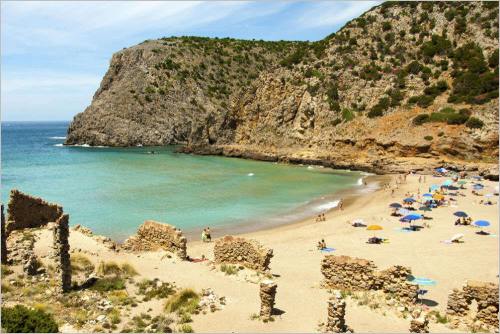 An image from Punta Molentis Sardinia
.
.
Click the link below for images:
.
__________________________________________
The story of climate change right now in 9 charts
April 16, 2022
Business, Food For Thought, Human Interest, Medical, Political, Science, Technical amazon, business, Business News, current-events, Future, Hotels, human-rights, medicine, mental-health, research, Science, Science News, technology, Technology News, travel, vacation 3 Comments

Click the link below the picture
.
Climate change has not been caused by one bad actor, and it won’t be solved by one silver bullet. Instead, climate change is being caused by a web of problems and is being addressed by another web of mitigation and adaptation strategies.
Globally, there has been significant progress to limit greenhouse gas emissions and slow global warming, but it hasn’t been enough.
It’s a complicated story and the charts, included as part of the latest Intergovernmental Panel on Climate Change report which was published Monday, tell the story visually, which can be helpful.
While the mix of factors and solutions are all incremental, the consequences of inaction are both dire and clear.
“We are on a fast track to climate disaster: Major cities under water. Unprecedented heatwaves. Terrifying storms. Widespread water shortages. The extinction of a million species of plants and animals. This is not fiction or exaggeration. It is what science tells us will result from our current energy policies,” United Nations Secretary General António Guterres said on Monday in response to the report.
.
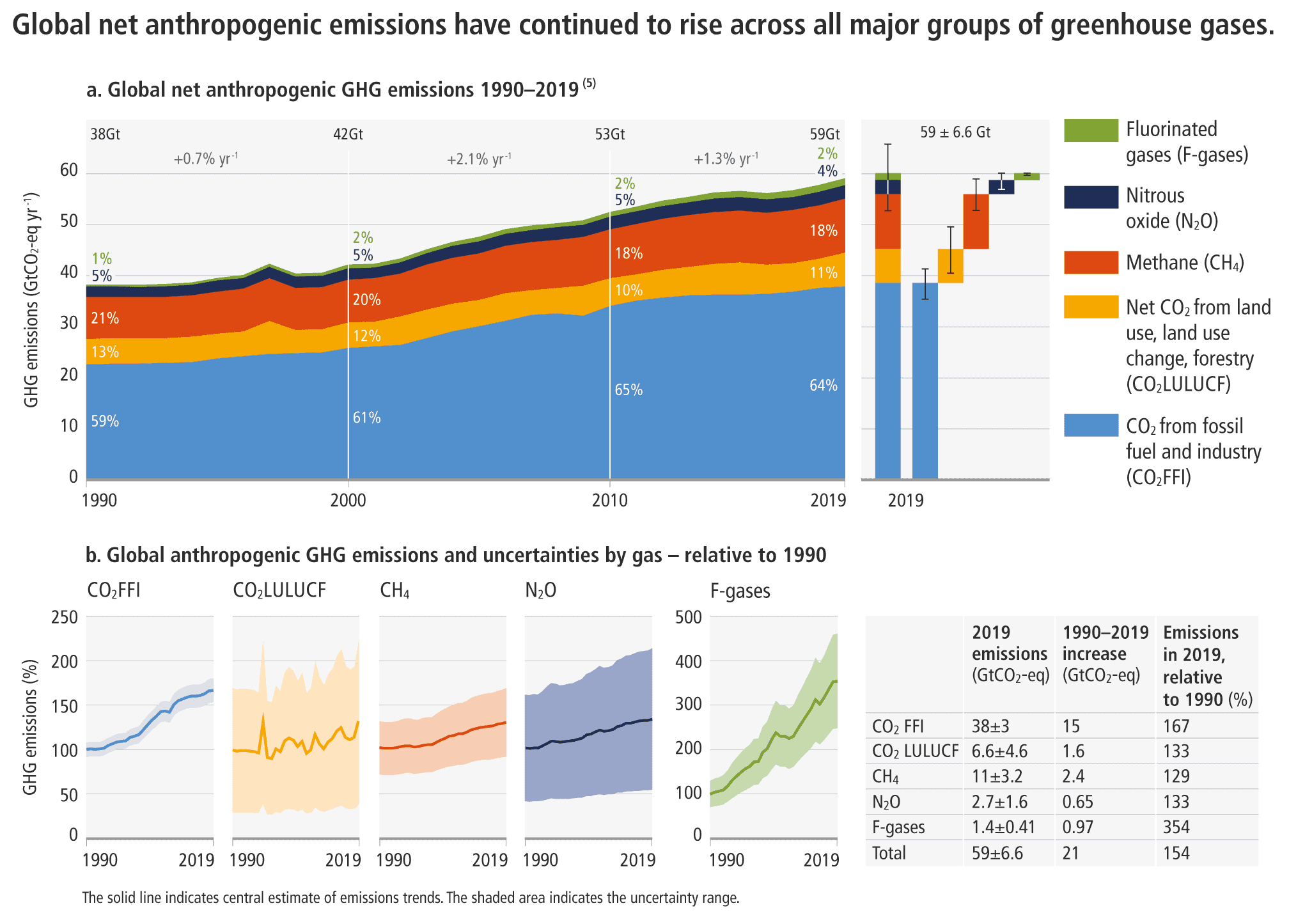
Anthropogenic (originating from human actions) emissions greenhouse gas emissions over the last few decades.
Courtesy Intergovernmental Panel on Climate Change (IPCC)
.
.
Click the link below for the article:
.
__________________________________________
Nuclear fusion hit a milestone thanks to better reactor walls – this engineering advance is building toward reactors of the future
April 16, 2022
Business, Food For Thought, Human Interest, Political, Science, Technical amazon, business, Business News, current-events, Future, Hotels, human-rights, medicine, mental-health, research, Science, Science News, technology, Technology News, travel, vacation 4 Comments

Click the link below the picture
.
Fusing particles together
Nuclear fusion is the merging of two atomic nuclei into one compound nucleus. This nucleus then breaks apart and releases energy in the form of new atoms and particles that speed away from the reaction. A fusion power plant would capture the escaping particles and use their energy to generate electricity.
There are a few different ways to safely control fusion on Earth. Our research focuses on the approach taken by JET – using powerful magnetic fields to confine atoms until they are heated to a high enough temperature for them to fuse.
The fuel for current and future reactors are two different isotopes of hydrogen – meaning they have the one proton, but different numbers of neutrons – called deuterium and tritium. Normal hydrogen has one proton and no neutrons in its nucleus. Deuterium has one proton and one neutron while tritium has one proton and two neutrons.
For a fusion reaction to be successful, the fuel atoms must first become so hot that the electrons break free from the nuclei. This creates plasma – a collection of positive ions and electrons. You then need to keep heating that plasma until it reaches a temperature over 200 million degrees Fahrenheit (100 million Celsius). This plasma must then be kept in a confined space at high densities for a long enough period of time for the fuel atoms to collide into each other and fuse together.
.
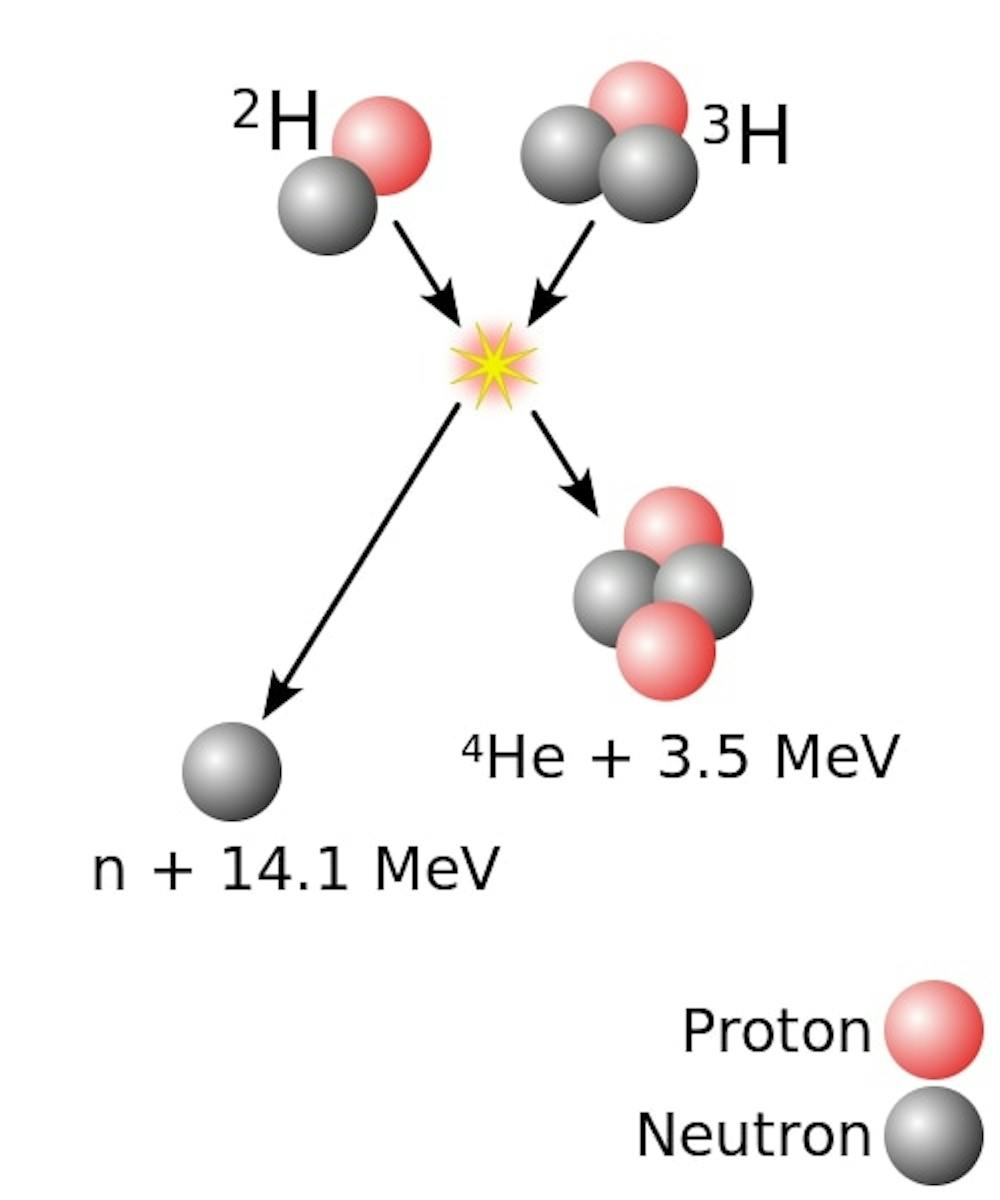 Fusion reactors smash two forms of hydrogen together (top) so that they fuse, producing helium and a high-energy neutron (bottom). Wykis/WikimediaCommons
.
.
Click the link below for the article:
.
__________________________________________

