August 22, 2023
Mohenjo
Business, Food For Thought, Human Interest, Political, Science, Technical
amazon, business, Business News, current-events, Future, Hotels, human-rights, medicine, mental-health, research, Science, Science News, technology, Technology News, travel, vacation

Click the link below the picture
.
Dear Prudence,
I (47 F) have been in a relationship with my boyfriend (50 M) for three years. I can make a long list of his good qualities, and my teenage children really enjoy spending time with him on occasion. I’m going to get straight to the “but.” Although we have been together for three years, I see him sparingly, as I am a single mom to three great kids. I mainly spend a night or two with him every other weekend while the kids are with their dad. Thus, I don’t really have the opportunity to know what he is like on a day-to-day basis. I probably see him on his best behavior. But I’ve had reason to question some things about him.
I think, but don’t know, that he drinks daily and probably too much. I expressed this concern to him, and he basically said he would take it into consideration, but I don’t see any change in his drinking. We have politically different views, which is fine with me, except his views are driven by anger and misinformation rather than logic and fact, such that I have had to tell him that we cannot discuss politics; we simply agree to disagree. Once, we were visiting some friends of his a few hours away, and he got drunk and told me that he thought I was flirting with another man and didn’t want me coming home with him. I ended up walking by myself at night through a city I didn’t know and taking an Uber two hours home. Last weekend, we drove a few hours to stay at the beach and once each on the way there and the way back, he had an instance of road rage so severe that he was driving alongside the other car screaming and gesturing. I felt so upset and unsafe. And I can’t stop thinking that he has jeopardized my safety on multiple occasions now.
But the instances are few and far between, and so out of line with everything else I know about him, so I end up letting them go. So, I am three years invested in this relationship. I feel like I would tell anyone else that this guy obviously has some issues and they should move on, but I have spent my whole life finding ways to justify and excuse others’ bad behavior—it’s my superpower and my kryptonite!—so I’m not confident about what to do here. I feel stuck and not sure which part of myself to trust.
—Determined to See the Best
Dear Determined,
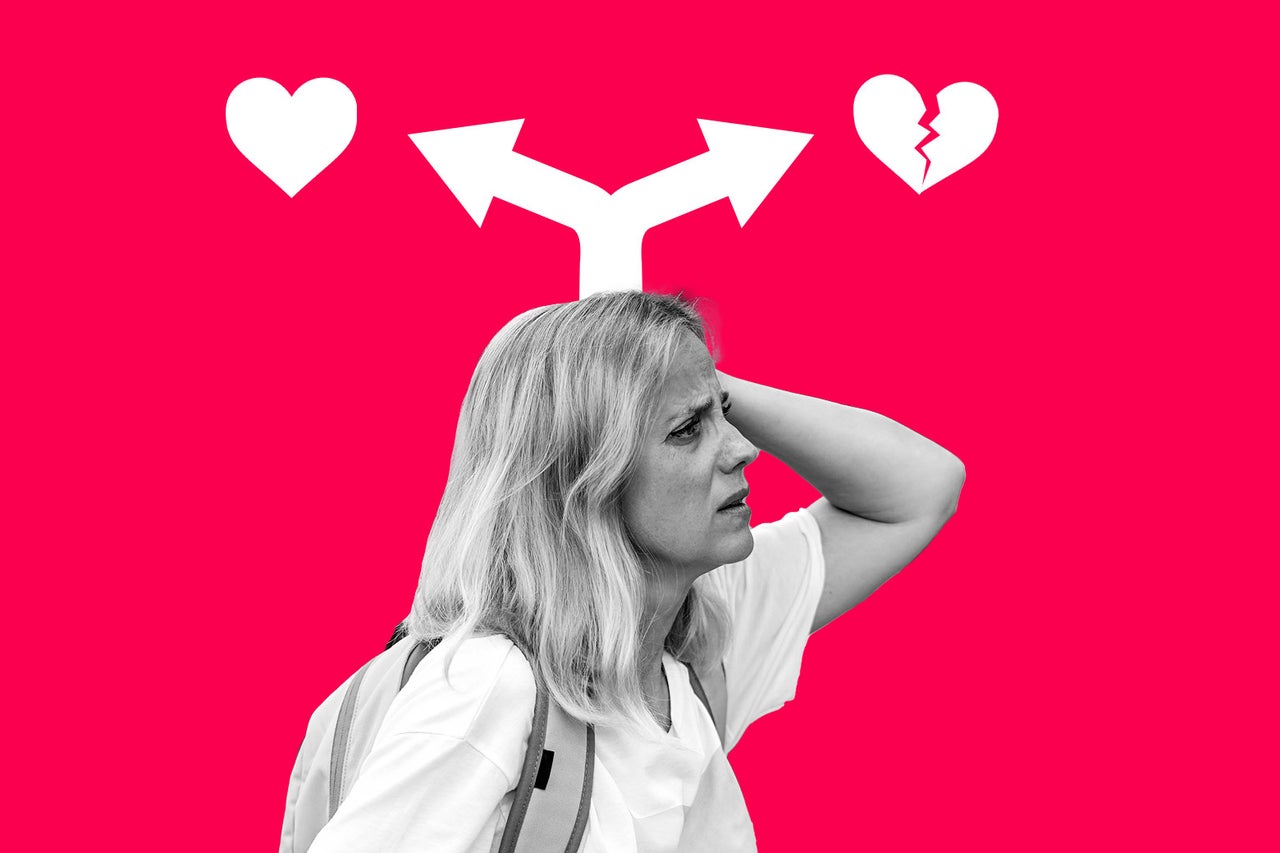 Photo illustration by Slate. Photo by Igor Vershinsky/iStock/Getty Images Plus.
.
.
Click the link below for the answer:
.
__________________________________________
August 22, 2023
Mohenjo
Business, Food For Thought, Human Interest, Political, Science, Technical
amazon, business, Business News, current-events, Future, Hotels, human-rights, medicine, mental-health, research, Science, Science News, technology, Technology News, travel, vacation

Click the link below the picture
.
There are plenty of fair criticisms of Christopher Nolan’s Oppenheimer. The film’s frenetic pace can make the viewer feel a bit like an Adderall-addled college student blitzing through the physicist’s biography before a midterm. The score veers toward the overwrought. Nolan finds a way to make a sex scene between Cillian Murphy and Florence Pugh into one of the least titillating things I’ve ever witnessed. At stake in the first two acts is whether Americans or Nazis will be the first to bring hellfire to planet Earth; at stake in the third is the outcome of an administrative hearing concerning the renewal of a national security clearance.
Despite these flaws, I think it’s a good flick. In an age when superhero sequels dominate box offices, the fact that Nolan managed to turn a three-hour history lesson about one of the 20th century’s most important nerds into a blockbuster is a real achievement and a boon to America’s cultural life.
Nevertheless, the aesthetic critiques of Oppenheimer have been largely reasonable. The political ones have been less so.
The film has taken fire from both left and right. Critics in the former camp have derided the film’s failure to center the experiences of those harmed by J. Robert Oppenheimer’s work, from Native Americans displaced by atomic weapons tests to Japanese civilians incinerated in Hiroshima and Nagasaki. They deem the film’s decision to withhold any images from the aftermath of those bombings to be cowardly at best and tantamount to a “glorification of mass murder” at worst.
.
 Photo: Melinda Sue Gordon/Universal Pic/Melinda Sue Gordon
.
.
Click the link below for the article:
.
__________________________________________
August 21, 2023
Mohenjo
Business, Food For Thought, Human Interest, Political, Science, Technical
amazon, business, Business News, current-events, Future, Hotels, human-rights, medicine, mental-health, research, Science, Science News, technology, Technology News, travel, vacation

Click the link below the picture
.
Everyone likes efficiency: If you can simplify a task, especially a task you need to do multiple times every day, your life becomes that much easier. NFC tags can help you turn these types of repetitive obligations into simple automations, and you don’t need many tech skills to start. In fact, all you actually need is a smartphone and a tag.
What are NFC tags?
NFC tags are stickers with “near field communication” technology built in. You know NFC from services like Apple Pay or Google Pay: It’s technology that lets two devices communicate with each other quickly and instantly. Your smartphone has NFC, as do these tags.
Unlike a POS (point of sale) at the store, however, NFC tags are a blank slate: You won’t be using one to purchase a product (although you could probably program it to do that), but you can use NFC tags to do just about anything you can think of using your iPhone or Android, specifically automated tasks that can save you time and energy.
For example, this Instagram creator uses an NFC tag as a way to communicate with her partner whenever one of them feeds the dog. It’s a great use case: Whenever one of them gives the dog breakfast on their way out for the day, they’ll scan the NFC tag. Doing so triggers an automation on their iPhone to send a text to the other that reads, “The dog has been fed.”
Another example is for simple wifi sharing, at least on Android: When someone new comes over your house, instead of pointing them to a sign with your wifi information on it, they can hover their smartphone over an NFC tag (maybe outfitted with a wifi theme for easy identification), which will trigger an automation to connect them to your home internet.
How to set up an NFC tag on your iPhone or Android
Because of the seemingly endless possibilities with NFC tags, there’s no single universal guide for setting up NFC tags. If you have a specific task you have in mind, you’ll need to do some research to figure out the exact steps to make it work. However, there are some universal aspects about using NFC tags in general, so we’ll get you started.
.
 Photo: Julia Albul (Shutterstock)
.
.
Click the link below for the article:
.
__________________________________________
August 21, 2023
Mohenjo
Business, Food For Thought, Human Interest, Political, Science, Technical
amazon, business, Business News, current-events, Future, Hotels, human-rights, medicine, mental-health, research, Science, Science News, technology, Technology News, travel, vacation

Click the link below the picture
.
The lecturer has you spellbound. Their topic is highly relevant, their slides compelling, and their presentation style mesmerizing. You’re hanging on their every word, closely following their line of reasoning, frantically scribbling down each salient point in your notebook, when suddenly . . . squirrel!
Your mind flits away, zigzagging near and far until you notice the other attendees gathering up their notebooks and tablets as they head for the door. The lecture is over, and you’ve missed out on much of the wisdom that held you momentarily entranced.
In our age of handheld devices and communicable ADHD, human beings are more distracted than ever. No matter how determined our efforts to keep focused, our eyes and our minds seem equally determined to ricochet hither and thither, drawn to any target that will eclipse what should be the object of our attention.
It may be comforting to learn that, by design, rapid eye movement extends beyond the realm of sleeping and dreaming. Even better news is that it’s not necessarily a symptom of inattention when we’re awake. In fact, just the opposite may be true. Which brings us to our most recent entry into the Ethical Lexicon:
Saccade (sac·cade/ sa-kahd) noun
Rapid shifts of gaze that place the line of sight on a desired target with a single smooth movement.
.
 [Source Photo: Andrea Piacquadio/Pexels]
.
.
Click the link below for the article:
.
__________________________________________
August 20, 2023
Mohenjo
Business, Food For Thought, Human Interest, Political, Science, Technical
amazon, business, Business News, current-events, Future, Hotels, human-rights, medicine, mental-health, research, Science, Science News, technology, Technology News, travel, vacation

Click the link below the picture
.
On a January evening in 1992, I was sitting in our kitchen, reading a comic book. My older sister Claudia went out to run an errand at a nearby minimart, just before it closed. Her keys jingled as she said goodbye and pulled the door shut. Her footsteps rushed down the stairs. A minute later, I heard her slam the garage door after she had pulled out her bicycle. Moments later, I heard a loud thud from down the street. I also thought I heard a muffled scream. I was 10. I couldn’t connect the dots.
A speeding car had hit Claudia while she was crossing the street. She didn’t die on the spot. Her boyfriend rushed my mom to the hospital. They spent the night at the ICU, while I spent the night in my best friend’s apartment. We set up camp on mattresses on his living room floor. He said: ‘I’m sure it’s just a broken leg.’ I said: ‘You’re right, she’ll be fine.’ We prayed. The next day, my mom stood in the doorframe, sobbing. ‘Claudia is dead,’ she said. I hugged her. I knew I had to be strong for her. What I did not know is that my sister’s death would, in some way, end my mom’s life as well.
We cried at the funeral. We cried at the cemetery. We cried at home. After a few months, I stopped crying. My mom never stopped crying. She became obsessed with Claudia’s grave. She would visit it every day, clean the white marble and bring fresh flowers. At the same time, she became frustrated and angry with the world. I spent my entire youth listening to her angry words, but her grief wouldn’t recede the tiniest bit.
Somewhere in my teens, I concluded that she must be suffering from depression. But I was wrong.
It’s no surprise I had it wrong. Back in the day, even professional psychologists lacked an official diagnosis for persisting grief. That changed in March 2022, when the condition my mom most likely suffered from was added as ‘prolonged grief disorder’ to the latest revision of the psychologists’ diagnostic manual, the DSM–5-TR. The diagnosis hinges on two factors. The first is denial: mourners cannot accept the death of the person they lost. This, in turn, causes symptoms like sadness, anger, or guilt that last for more than 12 months.
.
Self-Portrait (1924), lithograph by Käthe Kollwitz. Courtesy the British Museum
.
.
Click the link below for the article:
.
__________________________________________
August 20, 2023
Mohenjo
Business, Food For Thought, Human Interest, Political, Science, Technical
amazon, business, Business News, current-events, Future, Hotels, human-rights, medicine, mental-health, research, Science, Science News, technology, Technology News, travel, vacation

Click the link below the picture
.
Need to know
Do you feel blah? Not exactly suffering, but lacking interest and excitement? Do your days feel like a monotonous toil, akin to toothbrushing, but stretched over the entire day: same routines, same tiny annoyances? Are you unable to find motivation to do the activities that used to give you joy? If this describes your experience, then you may be going through a period of languishing.
People often think of mood as a battle between well-being and illbeing: either you feel good or bad. But if you don’t feel much of either, that’s the territory of languishing. It’s ‘the neglected middle child of mental health’, as Adam Grant put it in The New York Times in 2021. Whereas depression is active illbeing – feeling sad, powerless, and drained – and flourishing is active well-being – feeling engaged, excited, and empowered – languishing sits in between. It is a sense of stagnation where nothing is too wrong or painful but everything feels a bit boring and uninteresting. The world is grey.
A brief taxonomy of well-being states
To further understand languishing, it helps to recognize that an absence of illbeing does not mean the presence of well-being. Psychological research has shown that positive and negative feelings are partly independent processes – even neurologically and biologically. In moments of flourishing, you are high on excitement and joy, and low on negative feelings. In moments of suffering, there is not much joy but only sadness in our life. But there are also bittersweet moments where we feel strong positive and negative emotions simultaneously – such as feeling excited about one’s new job while feeling sad about leaving the old work community. Then there is languishing – moments when we don’t feel much of either. Languishing is thus about feeling low – but low on both positive and negative feelings.
.

Katharina Merian, attributed to the 16th-century painter Hans Brosamer. Courtesy the Met Museum, New York
.
.
Click the link below for the article:
.
__________________________________________
August 19, 2023
Mohenjo
Business, Food For Thought, Human Interest, Political, Science, Technical
amazon, business, Business News, current-events, Future, Hotels, human-rights, medicine, mental-health, research, Science, Science News, technology, Technology News, travel, vacation

Click the link below the picture
.
As a therapist who counsels couples, I have seen many people struggle with tough problems that are difficult to talk about. How do you tell a partner you do not want to move in together? Should you reveal an affair? In almost every relationship, there is an issue where someone is growing increasingly resentful.
It could be significant, like a waning sex life. Or it could be small, such as the partner never replacing the empty toilet paper roll. In each of these examples, one person can be stuck in a decision limbo. They are not happy but they are unsure what to do about it. A decisional impasse ranks high among the reasons people seek marital therapy.
Decision paralysis is not a relationship problem, it is a human one. Our brain favors the current state relative to an uncertain future state (known as status quo bias), research shows. Facing a painful or scary decision about our relationships is stressful, which can make it even harder to make a decision. “When we are stressed, we are operating in a state of high emotion. And based on how our brains work, when our emotions are high, our cognitive abilities are low,” says Abby Davisson, an author of “Money And Love.”
.
 (Celia Jacobs for The Washington Post)
.
.
Click the link below for the article:
.
__________________________________________
August 19, 2023
Mohenjo
Business, Food For Thought, Human Interest, Political, Science, Technical
amazon, business, Business News, current-events, Future, Hotels, human-rights, medicine, mental-health, research, Science, Science News, technology, Technology News, travel, vacation

Click the link below the picture
.
Outside St. Mary’s Church in Newport, Rhode Island, on a sunny September morning in 1953, a young woman then known as Jacqueline Bouvier emerged from her town car, ready to marry the recently elected junior senator for Massachusetts, John F. Kennedy. The next day, it wasn’t just the minting of a new political dynasty that made headlines, but the new Mrs. Kennedy’s exquisite white wedding dress. The fairy-tale gown captured the imagination of women the world over and sealed her nascent status as a fashion icon whose style would echo through generations. Missing from the day’s coverage, however, was the name of the designer.
In press clippings from the time, including in The New York Times, the maker was referred to only as a “colored designer.” For any bride seeking to emulate the delicate romance of Kennedy’s gown—its elegant portrait neckline, its billowing silk taffeta skirt, its diaphanous lace veil—the trail went cold. It would take years before Ann Lowe, the Black designer behind the dress, would be fully and nationally recognized for her work. Despite the breathless coverage of the wedding down to every last detail, according to author Rosemary E. Reed Miller, only a single Washington Post journalist at the time noted Lowe’s name. Lowe’s remarkable versatility as an artist and couturier would remain overlooked for decades.
.

.
.
Click the link below for the article:
.
__________________________________________
August 19, 2023
Mohenjo
Business, Food For Thought, Human Interest, Political, Science, Technical
amazon, business, Business News, current-events, Future, Hotels, human-rights, medicine, mental-health, research, Science, Science News, technology, Technology News, travel, vacation

Click the link below the picture
.
Ann Cole Lowe (December 14, 1898 – February 25, 1981) was the first African American to become a noted fashion designer. Lowe’s designs were popular among upper-class women for five decades from the 1920s through the 1960s. She was best known for designing the ivory silk taffeta wedding dress Jacqueline Bouvier wore when she married John F. Kennedy in 1953.
Early life
Lowe was born in rural Clayton, Alabama in 1898 to Jane and Jack Lowe. She was the great-granddaughter of an enslaved woman and an Alabama plantation owner. She had an older sister, Sallie. Ann attended school in Alabama until she dropped out at the age of 14. Lowe’s interest in fashion, sewing, and designing came from her mother Janey, and grandmother Georgia, both of whom were seamstresses. They ran a dressmaking business that was often frequented by the first families of Montgomery and other members of high society. Lowe’s mother died when Lowe was 16 years old. At this time, Lowe took over the family business.
.
 Ann Cole Lowe
.
.
Click the link below for the article:
.
__________________________________________
August 18, 2023
Mohenjo
Business, Food For Thought, Human Interest, Political, Science, Technical
amazon, business, Business News, current-events, Future, Hotels, human-rights, medicine, mental-health, research, Science, Science News, technology, Technology News, travel, vacation
Some content on this page was disabled on April 15, 2025 as a result of a DMCA takedown notice from Guardian Media Group. You can learn more about the DMCA here:
https://wordpress.com/support/copyright-and-the-dmca/
Older Entries
Newer Entries

